View question and answers regarding child maintenance posted on this website in the past. You may find some of the answers useful. My son is now 10 years old when he was much younger his father would pay here and there in all the years i have been supporting him… Continue Reading
Uncategorized
Parental Alienation in the situation of a divorce or separation – What can a parent do?
Family law becomes challenging when there are children in the equation. If a couple who were not married, broke up, there is not much to squabble about afterward if there were no kids. The same applies to a divorced couple. The only potential issues in such a divorce would be that of the matrimonial property regime and possible personal maintenance. If there are children involved, couples must deal with the issue of child maintenance, care, contact, and guardianship as well. The latter issues are usually the stumbling blocks in a divorce case or post-separation. At the end of the day, in all matters concerning children, the law says that their best interests should be upheld. Now let us look at the issue of parental alienation in the context of child custody disputes. 
What is parental alienation?
This article in no means provides a psychological analysis or definition of parental alienation. It deals with the legal relief a parent can seek should parental alienation be perpetrated. On the web, the following definition of parental alienation is provided: “The term parental alienation refers to psychological manipulation of a child, by saying and doing things that lead the child to look unfavorably on one parent or the other. In essence, parental alienation amounts to brainwashing the child, and it can be done both consciously and unconsciously. This is a significant problem in family law cases and something that the courts take very seriously…” We are certain there are many more similar definitions. However, what seems to be clear is that parental alienation deals with a situation where one parent tries to detrimentally affect the relationship a child has with the other parent.Parental Alienation Syndrome (PAS)
Then there is the issue of parental alienation syndrome (PAS). Whatever the definition or consequence of parental alienation is, it is an issue that needs to be addressed from a legal point of view. This article tackles that. This is so as parental alienation negatively affects the relationship between a child and his or her parent. Clearly, that would not be in the child’s best interests.What should one do if you suspect parental alienation taking place?
Looking at what constitutes parental alienation, a parent who experiences parental alienation would see a change in the child’s behaviour towards that parent. This change could be for various reasons. Some would be obvious and some less so. It would not mean that parental alienation is taking place due to every change in the child’s demeanour towards the affected parent. Maybe the child is being adversely affected by the separation or continual arguing by the parents and no parental alienation is actually taking place. Therefore, to verify that there is some form of parental alienation, an expert would need to be approached. In this case, we refer to a psychologist or social worker with the necessary experience and training in relation to parental alienation.How to stop parental alienation?
If a parent is practising parental alienation, by, for example, badmouthing the other parent, undermining the child’s relationship with the other parent, and so on, before approaching the courts, the parents must try to resolve this issue through less harsh means. Parents must try to go for family or parent counselling, or some type of mediation. This would all be based on the fact that an expert already advised that there is parental alienation taking place which adversely affects the minor child. If the latter suggestions and other potential avenues do not work, then, unfortunately, the court would need to be approached.What can the Court do regarding parental alienation?
If a parent believes that parental alienation is taking place, and the other parent does not want to work towards eradicating it, then, unfortunately, the court would need to be approached for relief. The court would be guided by what the experts have to say. It may happen that the court request the Family Advocate, or the private psychologist to advise on the issue of parental alienation and give the court some guidance on how it can be eradicated. Each case is different and therefore handled differently. A court may decide that in order to limit parental alienation, the child should have more contact with the affected parent. For example, the affected parent should be the one that takes and collects the child from school. In other cases, the court may decide to reverse the care and contact arrangements already in place. In other words, the child would not reside primarily by the parent who was the victim of parental alienation. The court would be guided by what is best for the minor child involved. As the presiding officer and lawyers involved are not child care experts, they would be greatly guided by those who are. However, the court would have the final say in the matter. We are certain that you found the above article useful and interesting. Please consider sharing it on the share buttons below. They include Facebook, Twitter, LinkedIn, WhatsApp, Gmail and more. Someone may find it useful as well. Should you require business advice or services, feel free to click on these links: Business SA | Private Legal | Envirolaws
Parental Alienation in the situation of a divorce or separation – What can a parent do? Family law becomes challenging when there are children in the equation. If a couple who were not married, broke up, there is not much to squabble about afterward if there were no kids. The Continue Reading
Various Matrimonial Property Regimes focusing on the Accrual System
Getting married is a legal act. With it comes certain responsibilities and rights. For example, you have a legal obligation to maintain your spouse. You cannot marry anyone else, and furthermore, your spouse can inherit from you interstate. Depending on the matrimonial property regime you entered into, certain legal consequences would apply regarding the proprietary (or money) aspects of your marriage. For example, to whom do money and assets belong to acquired during the marriage and before it. In South Africa, a person has three (3) choices when it comes to getting married in relation to your matrimonial property regime. They are explained briefly below.  In Community of Property (Default system) A marriage in community of property is the default matrimonial property regime. You do not need to enter into an antenuptial contract in order to be married like this. Basically, when getting married, both spouses’ assets, money, liabilities and so on becomes one single joint estate. You can compare it to placing it all in one pot. And from that pot would the spouse’s finances be dealt with. If either spouse gets themselves into financial trouble, it is the joint estate, or the pot that would have to be looked at in order to sort it out. This would apply to financial trouble which arose even before the marriage. Lastly, at death or divorce, the joint estate, or the pot would be divided and each party’s estate would leave with half. If you are worried about the financial implications of your marriage, you need to read further. Out of Community of Property and Profit or Loss (Without Accrual) Being married out of community of property and profit or loss is basically the exact opposite of being married in community of property. Here we are dealing with out of community of property with the exclusion of the accrual regime. Under this matrimonial property regime, there remain two separate estates just as there was before the spouses got married. Each spouse is responsible for their own wealth and debt. Creditors can therefore only claim from the estate of the relevant spouse. Not the other. At death or divorce, the situation remains exactly the same. Each estate leaves with whatever it has, being it money, assets or debt. In order for a couple to be married out of community of property and profit or loss, they need to stipulate it in an antenuptial contract and have it registered. The antenuptial contract would be executed before a Notary Public and registered at the Deeds Office. If this is not done, then the marriage would be In Community of Property as above. Next, we deal with a hybrid regime. You may find it more beneficial to you. Read more on antenuptial contracts by clicking here. Out of Community of Property and Profit or Loss (With Accrual) The third option a couple has is to get married out of community of property and profit or loss with the inclusion of the accrual regime. The accrual regime or system is outlined in the Matrimonial Property Act 88 of 1984. Basically, what it entails is that during the marriage you are married out of community of property and profit or loss as in the latter section, but at divorce or death, you share in the accrual or profits of the marriage. Each spouse still retains full control over their assets and estate during the marriage. Just as out of community of property and profit or loss without the accrual. If, however, the parties divorce or one dies, they will share in the accrual or profits. If you want the accrual regime to apply to your marriage, that would be stated in your antenuptial contract. It would then also be registered at the Deeds Office. In order to work out the accrual, one needs to know the net commencement value of each party’s estate. That would be stipulated in the antenuptial contract. The Accrual system is regulated in Chapter 1 of the Matrimonial Property Act 88 of 1984. In terms of the Act, certain items are excluded when calculating the accrual unless otherwise agreed upon. This is dealt with next.
Items or amounts excluded in the accrual calculation (unless otherwise agreed upon)
- Amounts which accrued to that estate by way of damages, other than damages for patrimonial loss. E.g. pain and suffering;
- An asset which has been excluded from the accrual system in terms of the antenuptial contract of the spouses, as well as any other asset which he or she acquired by virtue of his or her possession or former possession of the first-mentioned asset;
- An inheritance, a legacy or a donation which accrues to a spouse during the subsistence of his or her marriage, as well as any other asset which he acquired by virtue of his or her possession or former possession of such inheritance, legacy or donation (except in so far as the spouses may agree otherwise in their antenuptial contract or in so far as the testator or donor may stipulate otherwise);
- Donations between spouses, other than a donation mortis causa [anticipation of the death of the donor], is not taken into account either as part of the estate of the donor or as part of the estate of the donee.
Below find the relevant sections of the Matrimonial Property Act 88 of 1984 
Matrimonial Property Act 88 of 1984
Extracts of the Matrimonial Property Act: CHAPTER I ACCRUAL SYSTEM 2.Marriages subject to accrual system Every marriage out of community of property in terms of an antenuptial contract by which community of property and community of profit and loss are excluded, which is entered into after the commencement of this Act, is subject to the accrual system specified in this Chapter, except in so far as that system is expressly excluded by the antenuptial contract. 3.Accrual system (1) At the dissolution of a marriage subject to the accrual system, by divorce or by the death of one or both of the spouses, the spouse whose estate shows no accrual or a smaller accrual than the estate of the other spouse, or his estate if he is deceased, acquires a claim against the other spouse or his estate for an amount equal to half of the difference between the accrual of the respective estates of the spouses. (2) Subject to the provisions of section 8(1), a claim in terms of subsection (1) arises at the dissolution of the marriage and the right of a spouse to share in terms of this Act in the accrual of the estate of the other spouse is during the subsistence of the marriage not transferable or liable to attachment, and does not form part of the insolvent estate of a spouse. 4.Accrual of estate (1) (a) The accrual of the estate of a spouse is the amount by which the net value of his estate at the dissolution his marriage exceeds the net value of his estate at the commencement of that marriage. (b) In the determination of the accrual of the estate of a spouse— (i) any amount which accrued to that estate by way of damages, other than damages for patrimonial loss, is left out of account; (ii) an asset which has been excluded from the accrual system in terms of the antenuptial contract of the spouses, as well as any other asset which he acquired by virtue of his possession or former possession of the first-mentioned asset, is not taken into account as part of that estate at the commencement or the dissolution of his marriage; (iii) the net value of that estate at the commencement of his marriage is calculated with due allowance for any difference which may exist in the value of money at the commencement and dissolution of his marriage, and for that purpose the weighted average of the consumer price index as published from time to time in the Gazette serves as prima facie proof of any change in the value of money. (2) The accrual of the estate of a deceased spouse is determined before effect is given to any testamentary disposition, donation mortis causa or succession out of that estate in terms of the law of intestate succession. 5.Inheritances, legacies and donations excluded from accrual (1) An inheritance, a legacy or a donation which accrues to a spouse during the subsistence of his marriage, as well as any other asset which he acquired by virtue of his possession or former possession of such inheritance, legacy or donation, does not form part of the accrual of his estate, except in so far as the spouses may agree otherwise in their antenuptial contract or in so far as the testator or donor may stipulate otherwise. (2) In the determination of the accrual of the estate of a spouse a donation between spouses, other than a donation mortis causa, is not taken into account either as part of the estate of the donor or as part of the estate of the donee. 6.Proof of commencement value of estate (1) Where a party to an intended marriage does not for the purpose of proof of the net value of his estate at the commencement of his marriage declare that value in the antenuptial contract concerned, he may for such purpose declare that value before the marriage is entered into or within six months thereafter in a statement, which shall be signed by the other party, and cause the statement to be attested by a notary and filed with the copy of the antenuptial contract of the parties in the protocol of the notary before whom the antenuptial contract was executed. (2) A notary attesting such a statement shall furnish the parties with a certified copy thereof on which he shall certify that the original is kept in his protocol together with the copy of the antenuptial contract of the parties or, if he is not the notary before whom the antenuptial contract was executed, he shall send the original statement by registered post to the notary in whose protocol the antenuptial contract is kept, or to the custodian of his protocol, as the case may be, and the last-mentioned notary or that custodian, shall keep the original statement together with the copy of the antenuptial contract of the parties in his protocol. (3) An antenuptial contract contemplated in subsection (1) or a certified copy thereof, or a statement signed and attested in terms of subsection (1) or a certified copy thereof contemplated in subsection (2), serves as prima facie proof of the net value of the estate of the spouse concerned at the commencement of his marriage. (4) The net value of the estate of a spouse at the commencement of his marriage is deemed to be nil if— (a) the liabilities of that spouse exceed his assets at such commencement; (b) that value was not declared in his antenuptial contract or in a statement in terms of subsection (1) and the contrary is not proved. 7.Obligation to furnish particulars of value of estate When it is necessary to determine the accrual of the estate of a spouse or a deceased spouse that spouse or the executor of the estate of the deceased spouse, as the case may be, shall within a reasonable time at the request of the other spouse or the executor of the estate of the other spouse, as the case may be, furnish full particulars of the value of that estate. Power of court to order division of accrual (1) A court may on the application of a spouse whose marriage is subject to the accrual system and who satisfies the court that his right to share in the accrual of the estate of the other spouse at the dissolution of the marriage is being or will probably be seriously prejudiced by the conduct or proposed conduct of the other spouse, and that other persons will not be prejudiced thereby, order the immediate division of the accrual concerned in accordance with the provisions of this Chapter or on such other basis as the court may deem just. (2) A court making an order under subsection (1) may order that the accrual system applicable to the marriage be replaced by a matrimonial property system in terms of which accrual sharing as well as community of property and community of profit and loss are excluded. (3) When an order is made under subsection (2), the registrar shall send a copy thereof to the registrar of deeds concerned, who shall cause an appropriate reference to the new matrimonial property system to be made on the registry duplicate of the antenuptial contract concerned and on every copy thereof tendered to him for endorsement. (4) A registrar of deeds who receives notice of a new matrimonial property system in terms of subsection (3), shall notify all other registrars of deeds accordingly and furnish each of them with a copy of the court order, and every registrar of deeds so notified shall cause an appropriate reference to the new matrimonial property system to be endorsed on the copy, if any, of the antenuptial contract concerned filed in his registry and on every copy thereof tendered to him for endorsement. 8.Forfeiture of right to accrual sharing The right to share in the accrual of the estate of a spouse in terms of this Chapter is a patrimonial benefit which may on divorce be declared forfeit, either wholly or in part. Deferment of satisfaction of accrual claim A court may on the application of a person against whom an accrual claim lies, order that satisfaction of the claim be deferred on such conditions, including conditions relating to the furnishing of security, the payment of interest, the payment of instalments, and the delivery or transfer of specified, assets, as the court may deem just.
Various Matrimonial Property Regimes focusing on the Accrual System Getting married is a legal act. With it comes certain responsibilities and rights. For example, you have a legal obligation to maintain your spouse. You cannot marry anyone else, and furthermore, your spouse can inherit from you interstate. Depending on the Continue Reading
How to find the best advocate or attorney for legal services in South Africa?
Finding the best legal practitioners for you is not always straightforward. However, with some research and attention to detail, you will find the right person for the job sooner than later. Advocates and attorneys both assist their clients with legal matters. Legal issues vary, and not all advocates and attorneys do the same type of work. And then again, not all attorneys are the same, and not all advocates are the same. You should be familiar with this if you intend to use the top or best attorney or advocate for your matter.Type of Attorney in South Africa
When we speak about attorneys, we need to differentiate them from lawyers in general. A lawyer can be someone who works for the government or in a corporation and who only advises on legal issues. They would not represent their employee at work, nor would they ever set foot in a courtroom. However, attorneys, on the other hand, usually represent clients in legal matters. The matter can relate to employment issues, family law issues, or debt collection. Therefore, the distinct difference between an attorney, and a lawyer who is not an attorney, is that the attorney would represent members of the public in legal matters. You also find attorneys who are conveyancers and notaries. They are specialists. Therefore, to obtain the best attorney for you, make sure you know that not all lawyers are attorneys and that not all attorneys do the same work.Type of Advocates in South Africa
Advocates usually represent clients in legal matters. When you speak about and advocate, you usually refer to matters connected with the Court. You also have an advocate doing office work, but then that type of work can be done by an attorney or lawyer. In South Africa, we have two types of advocates. They are the referral advocate and then the Trust Account Advocate. The Trust Account Advocate can take work directly from members of the public. Basically, the same as an attorney can. The client would pay a deposit into the Trust Account Advocate’s Trust Banking Account. Advocate Muhammad Abduroaf is a Trust Account Advocate. He can therefore take instructions directly from members of the public. If you wish to instruct him on a legal matter, feel free to do so. If, however, he is unable to be of assistance, he will do his best to obtain a lawyer that suits your needs. [caption id="attachment_10671" align="alignnone" width="300"] Advocate Muhammad Abduroaf – Trust Account Lawyer- Best Legal Law Practitioners (Advocate Attorney) Child Custody Maintenance Contact Divorce Relocation Passport Consent High Court Cape Town[/caption] [caption id="attachment_10670" align="alignnone" width="300"]
 Advocate Muhammad Abduroaf – Trust Account Lawyer- Best Legal Law Practitioners (Advocate Attorney) Child Custody Maintenance Contact Divorce Relocation Passport Consent High Court Cape Town[/caption] [caption id="attachment_10669" align="alignnone" width="300"]
 Advocate Muhammad Abduroaf – Trust Account Lawyer- Best Legal Law Practitioners (Advocate Attorney) Child Custody Maintenance Contact Divorce Relocation Passport Consent High Court Cape Town[/caption] [caption id="attachment_10668" align="alignnone" width="300"]
 Advocate Muhammad Abduroaf – Trust Account Lawyer- Best Legal Law Practitioners (Advocate Attorney) Child Custody Maintenance Contact Divorce Relocation Passport Consent High Court Cape Town[/caption] [caption id="attachment_10667" align="alignnone" width="300"]
 Advocate Muhammad Abduroaf – Trust Account Lawyer- Best Legal Law Practitioners (Advocate Attorney) Child Custody Maintenance Contact Divorce Relocation Passport Consent High Court Cape Town[/caption] [caption id="attachment_10666" align="alignnone" width="300"]
 Advocate Muhammad Abduroaf – Trust Account Lawyer- Best Legal Law Practitioners (Advocate Attorney) Child Custody Maintenance Contact Divorce Relocation Passport Consent High Court Cape Town[/caption] [caption id="attachment_10665" align="alignnone" width="300"]
 Advocate Muhammad Abduroaf – Trust Account Lawyer- Best Legal Law Practitioners (Advocate Attorney) Child Custody Maintenance Contact Divorce Relocation Passport Consent High Court Cape Town[/caption] [caption id="attachment_10664" align="alignnone" width="300"]
 Advocate Muhammad Abduroaf – Trust Account Lawyer- Best Legal Law Practitioners (Advocate Attorney) Child Custody Maintenance Contact Divorce Relocation Passport Consent High Court Cape Town[/caption] [caption id="attachment_10663" align="alignnone" width="300"]
 Advocate Muhammad Abduroaf – Trust Account Lawyer- Best Legal Law Practitioners (Advocate Attorney) Child Custody Maintenance Contact Divorce Relocation Passport Consent High Court Cape Town[/caption] [caption id="attachment_10662" align="alignnone" width="300"]
 Advocate Muhammad Abduroaf – Trust Account Lawyer- Best Legal Law Practitioners (Advocate Attorney) Child Custody Maintenance Contact Divorce Relocation Passport Consent High Court Cape Town[/caption] [caption id="attachment_10661" align="alignnone" width="300"]
 Advocate Muhammad Abduroaf – Trust Account Lawyer- Best Legal Law Practitioners (Advocate Attorney) Child Custody Maintenance Contact Divorce Relocation Passport Consent High Court Cape Town[/caption] [caption id="attachment_10660" align="alignnone" width="300"]
 Advocate Muhammad Abduroaf – Trust Account Lawyer- Best Legal Law Practitioners (Advocate Attorney) Child Custody Maintenance Contact Divorce Relocation Passport Consent High Court Cape Town[/caption] [caption id="attachment_10659" align="alignnone" width="300"]
 Advocate Muhammad Abduroaf – Trust Account Lawyer- Best Legal Law Practitioners (Advocate Attorney) Child Custody Maintenance Contact Divorce Relocation Passport Consent High Court Cape Town[/caption] [caption id="attachment_10658" align="alignnone" width="300"]
 Advocate Muhammad Abduroaf – Trust Account Lawyer- Best Legal Law Practitioners (Advocate Attorney) Child Custody Maintenance Contact Divorce Relocation Passport Consent High Court Cape Town[/caption] [caption id="attachment_10657" align="alignnone" width="300"]
 Advocate Muhammad Abduroaf – Trust Account Lawyer- Best Legal Law Practitioners (Advocate Attorney) Child Custody Maintenance Contact Divorce Relocation Passport Consent High Court Cape Town[/caption] [caption id="attachment_10656" align="alignnone" width="300"]
 Advocate Muhammad Abduroaf – Trust Account Lawyer- Best Legal Law Practitioners (Advocate Attorney) Child Custody Maintenance Contact Divorce Relocation Passport Consent High Court Cape Town[/caption] [caption id="attachment_10655" align="alignnone" width="300"]
 Advocate Muhammad Abduroaf – Trust Account Lawyer- Best Legal Law Practitioners (Advocate Attorney) Child Custody Maintenance Contact Divorce Relocation Passport Consent High Court Cape Town[/caption] [caption id="attachment_10654" align="alignnone" width="300"]
 Advocate Muhammad Abduroaf – Trust Account Lawyer- Best Legal Law Practitioners (Advocate Attorney) Child Custody Maintenance Contact Divorce Relocation Passport Consent High Court Cape Town[/caption] [caption id="attachment_10653" align="alignnone" width="300"]
 Advocate Muhammad Abduroaf – Trust Account Lawyer- Best Legal Law Practitioners (Advocate Attorney) Child Custody Maintenance Contact Divorce Relocation Passport Consent High Court Cape Town[/caption] [caption id="attachment_10652" align="alignnone" width="300"]
 Advocate Muhammad Abduroaf – Trust Account Lawyer- Best Legal Law Practitioners (Advocate Attorney) Child Custody Maintenance Contact Divorce Relocation Passport Consent High Court Cape Town[/caption] [caption id="attachment_10651" align="alignnone" width="300"]
 Advocate Muhammad Abduroaf – Trust Account Lawyer- Best Legal Law Practitioners (Advocate Attorney) Child Custody Maintenance Contact Divorce Relocation Passport Consent High Court Cape Town[/caption] [caption id="attachment_10650" align="alignnone" width="300"]
 Advocate Muhammad Abduroaf – Trust Account Advocate – Best Legal Law Practitioners (Advocate Attorney) Child Custody Maintenance Contact Divorce Relocation Passport Consent[/caption] [caption id="attachment_10649" align="alignnone" width="300"]
 Advocate Muhammad Abduroaf – Trust Account Advocate – Best Legal Law Practitioners (Advocate Attorney) Child Custody Maintenance Contact Divorce Relocation Passport Consent[/caption] [caption id="attachment_10648" align="alignnone" width="300"]
 Advocate Muhammad Abduroaf – Trust Account Advocate – Best Legal Law Practitioners (Advocate Attorney) Child Custody Maintenance Contact Divorce Relocation Passport Consent[/caption] [caption id="attachment_10647" align="alignnone" width="300"]
 Advocate Muhammad Abduroaf – Trust Account Advocate – Best Legal Law Practitioners (Advocate Attorney) Child Custody Maintenance Contact Divorce Relocation Passport Consent[/caption] [caption id="attachment_10646" align="alignnone" width="300"]
 Advocate Muhammad Abduroaf – Trust Account Advocate – Best Legal Law Practitioners (Advocate Attorney) Child Custody Maintenance Contact Divorce Relocation Passport Consent[/caption] [caption id="attachment_10645" align="alignnone" width="300"]
 Advocate Muhammad Abduroaf – Trust Account Advocate – Best Legal Law Practitioners (Advocate Attorney) Child Custody Maintenance Contact Divorce Relocation Passport Consent[/caption] [caption id="attachment_10644" align="alignnone" width="300"]
 Advocate Muhammad Abduroaf – Trust Account Advocate – Best Legal Law Practitioners (Advocate Attorney) Child Custody Maintenance Contact Divorce Relocation Passport Consent[/caption] [caption id="attachment_10643" align="alignnone" width="300"]
 Advocate Muhammad Abduroaf – Trust Account Advocate – Best Legal Law Practitioners (Advocate Attorney) Child Custody Maintenance Contact Divorce Relocation Passport Consent[/caption] [caption id="attachment_10642" align="alignnone" width="300"]
 Advocate Muhammad Abduroaf – Trust Account Advocate – Best Legal Law Practitioners (Advocate Attorney) Child Custody Maintenance Contact Divorce Relocation Passport Consent[/caption] [caption id="attachment_10641" align="alignnone" width="300"]
 Advocate Muhammad Abduroaf – Trust Account Advocate – Best Legal Law Practitioners (Advocate Attorney) Child Custody Maintenance Contact Divorce Relocation Passport Consent[/caption] [caption id="attachment_10640" align="alignnone" width="300"]
 Advocate Muhammad Abduroaf – Trust Account Advocate – Best Legal Law Practitioners (Advocate Attorney) Child Custody Maintenance Contact Divorce Relocation Passport Consent[/caption] [caption id="attachment_10639" align="alignnone" width="300"]
 Advocate Muhammad Abduroaf – Trust Account Advocate – Best Legal Law Practitioners (Advocate Attorney) Child Custody Maintenance Contact Divorce Relocation Passport Consent[/caption] [caption id="attachment_10638" align="alignnone" width="300"]
 Advocate Muhammad Abduroaf – Trust Account Advocate – Best Legal Law Practitioners (Advocate Attorney) Child Custody Maintenance Contact Divorce Relocation Passport Consent[/caption] [caption id="attachment_10637" align="alignnone" width="300"]
 Advocate Muhammad Abduroaf – Trust Account Advocate – Best Legal Law Practitioners (Advocate Attorney) Child Custody Maintenance Contact Divorce Relocation Passport Consent[/caption] [caption id="attachment_10636" align="alignnone" width="300"]
 Advocate Muhammad Abduroaf – Trust Account Advocate – Best Legal Law Practitioners (Advocate Attorney) Child Custody Maintenance Contact Divorce Relocation Passport Consent[/caption] [caption id="attachment_10635" align="alignnone" width="300"]
 Advocate Muhammad Abduroaf – Trust Account Advocate – Best Legal Law Practitioners (Advocate Attorney) Child Custody Maintenance Contact Divorce Relocation Passport Consent[/caption] [caption id="attachment_10634" align="alignnone" width="300"]
 Advocate Muhammad Abduroaf – Trust Account Advocate – Best Legal Law Practitioners (Advocate Attorney) Child Custody Maintenance Contact Divorce Relocation Passport Consent[/caption] [caption id="attachment_10633" align="alignnone" width="300"]
 Advocate Muhammad Abduroaf – Trust Account Advocate – Best Legal Law Practitioners (Advocate Attorney) Child Custody Maintenance Contact Divorce Relocation Passport Consent[/caption] [caption id="attachment_10632" align="alignnone" width="300"]
 Advocate Muhammad Abduroaf – Trust Account Advocate – Best Legal Law Practitioners (Advocate Attorney) Child Custody Maintenance Contact Divorce Relocation Passport Consent[/caption] [caption id="attachment_10631" align="alignnone" width="300"]
 Advocate Muhammad Abduroaf – Trust Account Advocate – Best Legal Law Practitioners (Advocate Attorney) Child Custody Maintenance Contact Divorce Relocation Passport Consent[/caption] [caption id="attachment_10630" align="alignnone" width="300"]
 Advocate Muhammad Abduroaf – Trust Account Advocate – Best Legal Law Practitioners (Advocate Attorney) Child Custody Maintenance Contact Divorce Relocation Passport Consent[/caption]
How to find the best advocate or attorney for legal services in South Africa? Finding the best legal practitioners for you is not always straightforward. However, with some research and attention to detail, you will find the right person for the job sooner than later. Advocates and attorneys both assist Continue Reading
[caption id="attachment_10841" align="alignnone" width="687"]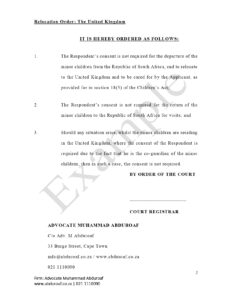 Relocation consent Court Order for minor child to the United Kingdom – UK – Advocate Muhammad Abduroaf[/caption]
I want to relocate from South Africa to the United Kingdom with my minor child. The other parent does not want my child to relocate to the United Kingdom. What can I do?
The United Kingdom is a popular destination to emigrate to. People emigrate from South Africa for many reasons. It ranges from better employment opportunities, family relations, or for a better standard of living. Whatever the reason a parent wants to relocate to the United Kingdom, if a minor child will be joining that parent and also relocating to the United Kingdom, then the parent remaining in South Africa’s consent would usually be required. Let us unpack the legal issues a parent may encounter when wanting to emigrate to the United Kingdom. Before we do so, let us list the various cities and towns in the United Kingdom to which you may want to relocate: England, Bath and North East Somerset (unitary authority), Bedford (unitary authority), Bedford (city), Blackburn with Darwen (unitary authority), Blackpool (town and unitary authority), Bournemouth (town and unitary authority), Bracknell Forest (unitary authority), Sandhurst (town), Brighton and Hove (unitary authority), Brighton (town and urban area), Hove (town and urban area), Bristol (city and unitary authority), Buckinghamshire (county), Aylesbury Vale (district), Aylesbury (town), Chiltern (district), Amersham (town), Chalfont St. Giles (town), South Bucks (district), Beaconsfield (town), Stoke Poges (town), Wycombe (district), High Wycombe (town and urban area), Marlow (town), Cambridgeshire (county), East Cambridgeshire (district), Ely (town), Fenland (district), Wisbech (town), Huntingdonshire (district), Huntingdon (town), Ramsey (town), St. Ives (town), South Cambridgeshire (district), Cambridge (city and district), Central Bedfordshire (unitary authority), Ampthill (town), Dunstable (town), Cheshire East (unitary authority), Congleton (town), Crewe (town), Knutsford (town), Macclesfield (town), Nantwich (town), Cheshire West and Chester (unitary authority), Chester (urban area), Northwich (town), Cornwall (unitary authority), Bodmin (town), Falmouth (town), Fowey (town), Helston (town), Launceston (town), Looe (town), Lostwithiel (town), Newquay (town), Penryn (town), Penzance (town), St. Austell (town), Saltash (town), Tintagel (village), Truro (city), Cumbria (county), Allerdale (district), Cockermouth (town), Keswick (town), Workington (town), Barrow-in-Furness (town and district), Carlisle (urban area, city and district), Copeland (district), Whitehaven (town), Eden (district), Penrith (town), South Lakeland (district), Grasmere (village), Kendal (town), Darlington (town and unitary authority), Derby (city and unitary authority), Derbyshire (county), Amber Valley (district), Belper (town), Bolsover (town and district), Chesterfield (town and district), Derbyshire Dales (district), Ashbourne (town), Matlock (town), Erewash (district), High Peak (district), Buxton, North East Derbyshire (district), South Derbyshire (district), Repton (village), Devon (county), East Devon (district), Axminster (town), Exmouth (town), Sidmouth (town), Exeter (city and district), Mid Devon (district), Crediton (town), North Devon (district), Barnstaple (town), Lynton and Lynmouth (town), South Hams (district), Dartmouth (town), Totnes (town), Teignbridge (district), Ashburton (town), Dawlish (town), Newton Abbot (town), Teignmouth (town), Torridge (district), Bideford (town), West Devon (district), Okehampton (town), Dorset (county), Christchurch (town and district), East Dorset (district), Wimborne Minster (town), North Dorset (district), Purbeck (district), Corfe Castle (village), West Dorset (district), Dorchester (town), Lyme Regis (town), Weymouth and Portland (district), Durham (unitary authority), Barnard Castle (town), Chester-le-Street (town), Durham (urban area), East Riding of Yorkshire (unitary authority), Beverley (town), Goole (town), East Sussex (county), Eastbourne (district), Hastings (district), Lewes (district), Lewes (town), Newhaven (town), Rother (district), Battle (town), Bexhill (town), Rye (town), Winchelsea (village), Wealden (district), Crowborough (town), Herstmonceux (village), Pevensey (village), Essex (county), Basildon (district), Braintree (town and district), Brentwood (town and district), Castle Point (district), Chelmsford (town and district), Colchester (town and district), Epping Forest (district), Chigwell (town), Harlow (town and district), Maldon (town and district), Burnham-on-Crouch (town), Rochford (district), Tendring (district), Harwich (town), Uttlesford (district), Saffron Walden (town), Gloucestershire (county), Cheltenham (town and district), Cotswold (district), Cirencester (town), Forest of Dean (district), Gloucester (city and district), Stroud (town and district), Tewkesbury (district), Tewkesbury (town), Winchcombe (village), Greater London (metropolitan county; See also London), Inner London, Camden (borough), Bloomsbury (neighbourhood), City of London (borough), Smithfield (area), City of Westminster (borough), Charing Cross (locality), St. Marylebone (neighbourhood), Soho (neighbourhood), Hackney (borough), Hammersmith and Fulham (borough), Haringey (borough), Islington (borough), Clerkenwell (neighbourhood), Kensington and Chelsea (borough), Lambeth (borough), Vauxhall (neighbourhood), Lewisham (borough), Newham (borough), Southwark (borough), Dulwich (neighbourhood), Tower Hamlets (borough), Limehouse (neighbourhood), Wandsworth (borough), Battersea (neighbourhood), Outer London, Barking and Dagenham (borough), Barnet (borough), Bexley (borough), Brent (borough), Bromley (borough), Croydon (borough), Ealing (borough), Enfield (borough), Greenwich (borough), Woolwich (town), Harrow (borough), Havering (borough), Hillingdon (borough), Hounslow (borough), Kingston upon Thames (borough), Merton (borough), Wimbledon (neighbourhood), Redbridge (borough), Richmond upon Thames (borough), Teddington (neighbourhood), Sutton (borough), Waltham Forest (borough), Greater Manchester (metropolitan county), Bolton (town and metropolitan borough), Bury (town and metropolitan borough), Manchester (city and metropolitan borough), Oldham (urban area and metropolitan borough), Rochdale (town and metropolitan borough), Salford (city and metropolitan borough), Stockport (urban area and metropolitan borough), Tameside (metropolitan borough), Trafford (metropolitan borough), Wigan (town and metropolitan borough), Atherton (town and urban area), Halton (unitary authority), Runcorn (town), Widnes (town), Hampshire (county), Basingstoke and Deane (district), Silchester (village), East Hampshire (district), Alton (town), Eastleigh (town and district), Fareham (town and district), Gosport (town and district), Hart (district), Havant (town and district), New Forest (district), Rushmoor (district), Test Valley (district), Andover (town), Romsey (town), Winchester (town and district), Hartlepool (town and unitary authority), Herefordshire (unitary authority), Hereford (city), Leominster (town), Ross-on-Wye (town), Hertfordshire (county), Broxbourne (district), Dacorum (district), Berkhamsted (town), Hemel Hempstead (town and urban area), East Hertfordshire (district), Bishop’s Stortford (town), Hertford (town), Ware (town), Hertsmere (district), North Hertfordshire (district), Letchworth (town), St. Albans (town and district), Stevenage (town and district), Three Rivers (district), Watford (town and district), Welwyn Hatfield (district), Hatfield (town), Welwyn Garden City (town and urban area), Isle of Wight (unitary authority), Carisbrooke (village), Cowes (town), Freshwater (town), Newport (town), Ryde (town), Ventnor (town), Isles of Scilly (independent administrative unit), Hugh Town (village), Kent (county), Ashford (town and district), Canterbury (town and district), Herne Bay (town), Whitstable (town), Dartford (town and district), Dover (district), Deal (town), Dover (town), Sandwich (town), Gravesham (district), Gravesend (town), Maidstone (town and district), Sevenoaks (district), Edenbridge (town), Shepway (district), Folkestone (town), Hythe (town), Lydd (town), New Romney (town), Swale (district), Faversham (town), Thanet (district), Broadstairs and St. Peter’s (town), Margate (town), Ramsgate (town), Tonbridge and Malling (district), Tunbridge Wells (town and district), Royal Tunbridge Wells (town), Kingston upon Hull (city and unitary authority), Lancashire (county), Burnley (town and district), Chorley (town and district), Fylde (district), Hyndburn (district), Lancaster (urban area and district), Pendle (district), Preston (city and district), Walton-le-Dale (neighbourhood), Ribble Valley (district), Rossendale (district), South Ribble (district), West Lancashire (district), Skelmersdale (town), Wyre (district), Leicester (city and unitary authority), Leicestershire (county), Blaby (district), Charnwood (district), Loughborough (town), Harborough (district), Market Harborough (town), Hinckley and Bosworth (district), Melton (district), North West Leicestershire (district), Oadby and Wigston (district), Lincolnshire (county), Boston (town and district), East Lindsey (district), Lincoln (district), North Kesteven (district), South Kesteven (district), Grantham (town), Stamford (town), South Holland (district), Crowland (village), West Lindsey (district), Gainsborough (town), Luton (town and unitary authority), Medway (unitary authority), Chatham (town), Gillingham (town), Rochester (town), Merseyside (metropolitan county), Knowsley (metropolitan borough), Huyton (former town), Liverpool (city and metropolitan borough), St. Helens (urban area and metropolitan borough), Sefton (metropolitan borough), Southport (town), Wirral (metropolitan borough), Birkenhead (town and urban area), Middlesbrough (town and unitary authority), Milton Keynes (town and unitary authority), Norfolk (county), Breckland (district), East Dereham (town), Thetford (town), Broadland (district), Great Yarmouth (town and district), King’s Lynn and West Norfolk (district), Castle Rising (village), King’s Lynn (town), Sandringham (village), North Norfolk (district), Norwich (city and district), South Norfolk (district), North East Lincolnshire (unitary authority), Cleethorpes (town and urban area), Grimsby (town), North Lincolnshire (unitary authority), Scunthorpe (town and urban area), North Somerset (unitary authority), Weston-super-Mare (town), North Yorkshire (county), Craven (district), Hambleton (district), Northallerton (town), Harrogate (town and district), Knaresborough (town), Ripon (city), Richmondshire (district), Richmond (town), Ryedale (district), Malton (town), Scarborough (town and district), Whitby (town), Selby (town and district), Northamptonshire (county), Corby (town and district), Daventry (town and district), East Northamptonshire (district), Oundle (town), Kettering (district), Northampton (town and district), South Northamptonshire (district), Wellingborough (town and district), Northumberland (unitary authority), Bamburgh (village), Bedlington (town), Cramlington (town), Hexham (town), Morpeth (town), Warkworth (village), Nottingham (city and unitary authority), Nottinghamshire (county), Ashfield (district), Bassetlaw (district), Worksop (town), Broxtowe (district), Beeston and Stapleford (urban area), Gedling (district), Mansfield (town and district), Newark and Sherwood (district), Newark-on-Trent (town), Rushcliffe (district), West Bridgford (town), Oxfordshire (county), Cherwell (district), Banbury (town), Bicester (town), Oxford (city and district), South Oxfordshire (district), Henley-on-Thames (town), Vale of White Horse (district), Wantage (town), West Oxfordshire (district), Burford (town), Peterborough (city and unitary authority), Plymouth (city and unitary authority), Poole (town and unitary authority), Portsmouth (city and unitary authority), Reading (town and unitary authority), Redcar and Cleveland (unitary authority), Rutland (unitary authority), Uppingham (town), Shropshire (unitary authority), Bridgnorth (town), Ludlow (town), Much Wenlock (town), Oswestry (town), Shrewsbury (town), Stokesay (village), Slough (town and unitary authority), Somerset (county), Mendip (district), Glastonbury (town), Wells (city), Sedgemoor (district), Bridgwater (town), Cheddar (village), South Somerset (district), Ilchester (town), Langport (town), Taunton Deane (district), Taunton (town), Wellington (town), West Somerset (district), Dunster (town), Minehead (town), South Gloucestershire (unitary authority), Badminton (village), Kingswood (urbanized area), South Yorkshire (metropolitan county), Barnsley (town and metropolitan borough), Doncaster (town and metropolitan borough), Adwick le Street (town), Rotherham (town and metropolitan borough), Sheffield (town, city, and metropolitan borough), Southampton (city and unitary authority), Southend-on-Sea (town and unitary authority), Staffordshire (county), Cannock Chase (district), East Staffordshire (district), Burton upon Trent (town and urban area), Lichfield (city and district), Newcastle-under-Lyme (town and district), South Staffordshire (district), Stafford (town and district), Staffordshire Moorlands (district), Tamworth (district), Stockton-on-Tees (town and unitary authority), Stoke-on-Trent (city and unitary authority), Suffolk (county), Babergh (district), Sudbury (town), Forest Heath (district), Mildenhall (town), Newmarket (town), Ipswich (town and district), Mid Suffolk (district), St. Edmundsbury (district), Bury St. Edmunds (town), Suffolk Coastal (district), Dunwich (village), Felixstowe (town), Woodbridge (town), Waveney (district), Beccles (town), Lowestoft (town), Surrey (county), Elmbridge (district), Epsom and Ewell (district), Guildford (town and district), Mole Valley (district), Dorking (town), Reigate and Banstead (district), Runnymede (district), Spelthorne (district), Staines (town and urban area), Surrey Heath (district), Tandridge (district), Waverley (district), Haslemere (town), Woking (district), Swindon (town and unitary authority), Telford and Wrekin (unitary authority), Telford (town and urban area), Thurrock (town and unitary authority), Tilbury (town), Torbay (unitary authority), Brixham (town), Tyne and Wear (metropolitan county), Gateshead (town and metropolitan borough), Felling (ward), Newcastle upon Tyne (city and metropolitan borough), Newburn (neighbourhood), North Tyneside (metropolitan borough), Wallsend (town), South Tyneside (metropolitan borough), Jarrow (town and urban area), South Shields (town), Sunderland (town and metropolitan borough), Washington (town), Warrington (city and unitary authority), Warwickshire (county), North Warwickshire (district), Nuneaton and Bedworth (district), Bedworth (town), Rugby (town and district), Stratford-on-Avon (district), Warwick (district), Royal Leamington Spa (town), Warwick (town), West Berkshire (unitary authority), Newbury (town), West Midlands (metropolitan county), Birmingham (city and metropolitan borough), Coventry (city and metropolitan borough), Dudley (metropolitan borough), Sandwell (metropolitan borough), West Bromwich (locality), Solihull (metropolitan borough), Walsall (metropolitan borough), Wolverhampton (metropolitan borough), West Sussex (county), Adur (district), Shoreham-by-Sea (town), Arun (district), Arundel (town), Bognor Regis (town), Chichester (district), Petworth (town), Crawley (town and district), Horsham (town and district), Mid Sussex (district), East Grinstead (town), Worthing (district), West Yorkshire (metropolitan county), Bradford (urban area, city, and metropolitan borough), Haworth (town), Keighley (town), Saltaire (village), Calderdale (metropolitan borough), Halifax (town and urban area), Todmorden (town), Kirklees (metropolitan borough), Dewsbury (town), Huddersfield (town and urban area), Leeds (urban area, city, and metropolitan borough), Wakefield (urban area, city, and metropolitan borough), Pontefract (town), Wiltshire (county), Amesbury (town), Bradford-on-Avon (town), Chippenham (town), Cricklade (town), Devizes (town), Malmesbury (town), Marlborough (town), Salisbury (city), Trowbridge (town), Westbury (town), Wilton (town), Windsor and Maidenhead (unitary authority), Ascot (locality), Bray (town), Eton (town), Maidenhead (town), Windsor (town and urban area), Wokingham (town and unitary authority), Worcestershire (county), Bromsgrove (district), Malvern Hills (town and district), Great Malvern (town), Redditch (town and district), Worcester (city and district), Wychavon (district), Broadway (village), Droitwich (town), Evesham (town), Wyre Forest (district), Kidderminster (town), York (city and unitary authority), Northern Ireland, Antrim and Newtownabbey (district), Antrim (town), Newtownabbey (district), Ards and North Down (district), Newtownards (town), Bangor (town), Armagh, Banbridge, and Craigavon (district), Armagh (city), Banbridge (town), Dromore (town), Craigavon (town), Lurgan (town), Belfast (city and district), Stormont (locality), Causeway Coast and Glens (district), Ballycastle (town), Ballymoney (town), Coleraine (town), Portrush (town), Limavady (town), Derry and Strabane (district), Londonderry (city), Strabane (town), Fermanagh and Omagh (district), Enniskillen (town), Omagh (town), Lisburn and Castlereagh (district), Lisburn (town), Mid and East Antrim (district), Ballymena (town), Carrickfergus (town), Larne (town), Mid Ulster (district), Cookstown (town), Dungannon (town), Magherafelt (town), Newry, Mourne, and Down (district), Downpatrick (town), Kilkeel (town), Newcastle (town), Newry (town), Scotland, Aberdeen (city and council area), Aberdeenshire (council area), Banff (town), Braemar (village), Cruden Bay (village), Peterhead (town), St. Fergus (village), Angus (council area), Arbroath (town), Brechin (town), Forfar (town), Glamis (village), Montrose (town), Argyll and Bute (council area), Campbeltown (town), Dunoon (town), Inveraray (town), Lochgilphead (town), Rothesay (town), Tarbert (village), Clackmannanshire (council area), Dumfries and Galloway (council area), Dumfries (town), Gretna Green (village), Kirkcudbright (town), Lochmaben (town), Whithorn (town), Dundee (city and council area), East Ayrshire (council area), Cumnock (town), Kilmarnock (town), Mauchline (village), East Dunbartonshire (council area), Kirkintilloch (town), Milngavie (town), East Lothian (council area), Dunbar (town), Haddington (town), East Renfrewshire (council area), Edinburgh (city and council area), Leith (port), Falkirk (council area), Falkirk (town), Grangemouth (town), Fife (council area), Buckhaven (town), Culross (town), Cupar (town), Dunfermline (city), Glenrothes (town), Kirkcaldy (town), Rosyth (town), St. Andrews (city), Glasgow (city and independent council area), Highland (council area), Alness (village), Cawdor (village), Cromarty (town), Fort William (town), Invergordon (town), Inverness (town), John o’Groats (village), Nigg (village), Thurso (town), Wick (town), Inverclyde (council area), Greenock (town), Midlothian (council area), Dalkeith (town), Moray (council area), Elgin (town), Forres (town), Lossiemouth (town), North Ayrshire (council area), Irvine (town), North Lanarkshire (council area), Coatbridge (town), Cumbernauld (town), Motherwell and Wishaw (urban area), Orkney Islands (council area), Kirkwall (town), Perth and Kinross (council area), Dunkeld (city), Kinross (town), Perth (city), Scone (village), Renfrewshire (council area), Paisley (town), Renfrew (town), Scottish Borders (council area), Coldstream (town), Duns (town), Galashiels (town), Hawick (town), Jedburgh (town), Kelso (town), Melrose (town), Newtown St. Boswells (village), Peebles (town), Selkirk (town), Shetland Islands (council area), Lerwick (town), Sullom Voe (locality), South Ayrshire (council area), Ayr (town), Alloway (suburb), Prestwick (town), South Lanarkshire (council area), East Kilbride (town), Hamilton (town), Lanark (town), Stirling (council area), Balquhidder (village), Bannockburn (town), Callander (town), Stirling (town), West Dunbartonshire (council area), Clydebank (town), Dumbarton (town), West Lothian (council area), Linlithgow (town), Livingston (town), Western Isles (council area), Stornoway (town), Wales, Blaenau Gwent (county borough), Abertillery (town), Ebbw Vale (town and urban area), Bridgend (county borough), Bridgend (town and urban area), Porthcawl (town), Caerphilly (county borough), Caerphilly (town and urban area), Gelligaer (town), Cardiff (city and county borough), Llandaff (former town, neighborhood), Carmarthenshire (county), Carmarthen (town), Llanelli (town and urban area), Ceredigion (county), Aberystwyth (town), Cardigan (town), Conwy (county borough), Colwyn Bay (town and urban area), Conwy (town), Llandudno (town), Denbighshire (county), Denbigh (town), Rhyl (town), St. Asaph (village), Flintshire (county), Hawarden (town), Holywell (town), Gwynedd (county), Bala (town), Bangor (city), Caernarfon (town), Harlech (village), Isle of Anglesey (county), Holyhead (town), Llangefni (town), Merthyr Tydfil (town and county borough), Monmouthshire (county), Abergavenny (town), Chepstow (town), Monmouth (town), Usk (town), Neath Port Talbot (county borough), Margam (locality), Neath (town and urban area), Pontardawe (town), Port Talbot (town and urban area), Newport (town and county borough), Caerleon (town), Pembrokeshire (county), Haverfordwest (town), Milford Haven (town), Pembroke (urbanized area), St. David’s (city), Tenby (town), Powys (county), Brecon (town), Builth Wells (town), Llandrindod Wells (town), Montgomery (town), Newtown (town), Welshpool (town), Rhondda Cynon Taf (county borough), Aberdare (town), Hirwaun (village), Llantrisant (town), Mountain Ash (town), Pontypridd (town), Swansea (county), Swansea (city), Torfaen (county borough), Cwmbrân (town and urban area), Pontypool (town and urban area), Vale of Glamorgan (county), Barry (town), Cowbridge (town), Llantwit Major (town), Wrexham (county borough). (https://www.britannica.com/topic/list-of-cities-and-towns-in-the-United-Kingdom-2034188) Why do I require the other parent’s Consent to relocate to the United Kingdom?
According to South African law, if you are a co-holder of parental responsibilities and rights over your minor child, you must consent to your child leaving South Africa. In this case, relocating to the United Kingdom. Here we refer to section 18 of the Children’s Act 38 of 2005. The entire provision is as follows: 18 Parental responsibilities and rights (1) A person may have either full or specific parental responsibilities and rights in respect of a child. (2) The parental responsibilities and rights that a person may have in respect of a child, include the responsibility and the right- (a) to care for the child; (b) to maintain contact with the child; (c) to act as guardian of the child; and (d) to contribute to the maintenance of the child. (3) Subject to subsections (4) and (5), a parent or other person who acts as guardian of a child must- (a) administer and safeguard the child’s property and property interests; (b) assist or represent the child in administrative, contractual and other legal matters; or (c) give or refuse any consent required by law in respect of the child, including- (i) consent to the child’s marriage; (ii) consent to the child’s adoption; (iii) consent to the child’s departure or removal from the Republic; (iv) consent to the child’s application for a passport; and (v) consent to the alienation or encumbrance of any immovable property of the child. (4) Whenever more than one person has guardianship of a child, each one of them is competent, subject to subsection (5), any other law or any order of a competent court to the contrary, to exercise independently and without the Consent of the other any right or responsibility arising from such guardianship. (5) Unless a competent court orders otherwise, the Consent of all the persons that have guardianship of a child is necessary in respect of matters set out in subsection (3)(c). Now let us explain what Parental Responsibilities and Rights are.What are Parental Responsibilities and Rights of a parent in relation to a child?
As can be seen from section 18(2) of the Children’s Act, when we refer to Parental Responsibilities and Rights, we refer to the following: (a) to care for the child; (b) to maintain contact with the child; (c) to act as guardian of the child; and (d) to contribute to the maintenance of the child. Therefore, if a parent has parental responsibilities and rights over a minor child, and accordingly, rights of guardianship, their Consent is required when it comes to issues of guardianship. As seen from section 18(3)(c) of the Children’s Act above, both parents’ Consent is required should a minor child depart from the Republic of South Africa. In this case, to emigrate to the United Kingdom. Even if the minor child only wants to go for a short holiday to the United Kingdom, both guardians’ Consent would be required.When would the other parent be seen as a guardian in the case of a relocation matter to the United Kingdom?
It must be noted that not all parents are legal guardians over their minor children. We should therefore distinguish between married or divorced parents and parents who were never married. As you would see below, usually married, or divorced parents’ Consent would be required for a minor child to relocate or emigrate to the United Kingdom. However, that does not automatically apply to parents who were never married. This could be because the child could have been born from a brief encounter and never met his or her father. It would not make sense that a parent who never met his or her 15-year-old child, should give Consent for relocation to the United Kingdom.Mother’s Consent for relocation of the minor child to the United Kingdom
Section 19 of the Children’s Act deals with the Parental responsibilities and rights of mothers. It states the following: 19 Parental responsibilities and rights of mothers (1) The biological mother of a child, whether married or unmarried, has full parental responsibilities and rights in respect of the child. (2) If- (a) the biological mother of a child is an unmarried child who does not have guardianship in respect of the child; and (b) the biological father of the child does not have guardianship in respect of the child, the guardian of the child’s biological mother is also the guardian of the child. (3) This section does not apply in respect of a child who is the subject of a surrogacy agreement. As seen from section 19(1) of the Children’s Act, in most cases involving the relocation of a minor child to the United Kingdom, the mother’s Consent is required as she has full parental responsibilities and rights over the minor child.Married father’s Consent for the relocation of the minor child to the United Kingdom
Section 20 of the Children’s Act deals with Parental responsibilities and rights of married fathers. It states the following: 20 Parental responsibilities and rights of married fathers The biological father of a child has full parental responsibilities and rights in respect of the child- (a) if he is married to the child’s mother; or (b) if he was married to the child’s mother at (i) the time of the child’s conception; (ii) the time of the child’s birth; or (iii) any time between the child’s conception and birth. As can be seen from sections 20 (a) and (b) of the Children’s Act, if the father and the mother were married, or are married, then his Consent is required for the minor child to relocate to the United Kingdom. Of course, an exception to this would be should a court of law order otherwise. This would be the case should the parents be divorced and the divorce court ordered that only the mother may act as guardian. Next, we deal with the issue of an unmarried father’s Consent to relocate a minor child to the United Kingdom.Consent of unmarried fathers for the relocation of their minor children to the United Kingdom.
Section 21 of the Children’s Act deals with parental responsibilities and rights of unmarried fathers. The section states the following: 21 Parental responsibilities and rights of unmarried fathers (1) The biological father of a child who does not have parental responsibilities and rights in respect of the child in terms of section 20, acquires full parental responsibilities and rights in respect of the child- (a) if at the time of the child’s birth he is living with the mother in a permanent life-partnership; or (b) if he, regardless of whether he has lived or is living with the mother- (i) consents to be identified or successfully applies in terms of section 26 to be identified as the child’s father or pays damages in terms of customary law; (ii) contributes or has attempted in good faith to contribute to the child’s upbringing for a reasonable period; and (iii) contributes or has attempted in good faith to contribute towards expenses in connection with the maintenance of the child for a reasonable period. (2) This section does not affect the duty of a father to contribute towards the maintenance of the child. (3) (a) If there is a dispute between the biological father referred to in subsection (1) and the biological mother of a child with regard to the fulfilment by that father of the conditions set out in subsection (1) (a) or (b), the matter must be referred for mediation to a family advocate, social worker, social service professional or other suitably qualified person. (b) Any party to the mediation may have the outcome of the mediation reviewed by a court. (4) This section applies regardless of whether the child was born before or after the commencement of this Act. As can be seen from the latter sections, a father of a child born out of wedlock does not automatically have parental responsibilities and rights over his minor child. He may however acquire those parental responsibilities and rights over his minor child if he is materially involved in the child’s life. That would be where the father and the mother were in a permanent life partnership when the child was born or he is meaningfully involved in the child’s life, as outlined above. We shall not go into much detail regarding that. However, in most cases, if the father had regular contact with the child and paid child support, he would have acquired parental responsibilities and rights over the minor child.What do you do if the other parent does not want to consent to the minor child relocating to the United Kingdom?
Suppose the other parent also has parental responsibilities and rights over the minor child, and he or she does not want to consent to the relocation of the minor child to the United Kingdom, then in such a case, the Court needs to be approached. Here I refer you back to section 18(5) of the Children’s Act referred to above where it states: (5) Unless a competent court orders otherwise, the Consent of all the persons that have guardianship of a child is necessary in respect of matters set out in subsection (3)(c). Therefore, after your Court Application has been launched an both sides have been heard, the Court would make the necessary Order. If you are successful in your application for the relocation of your minor children to the United Kingdom, then the Court will make an Order similar to that which is shown below. [caption id="attachment_10840" align="alignnone" width="658"]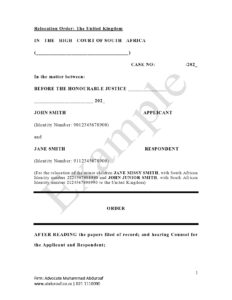 Relocation consent Court Order for minor child to the United Kingdom – UK – Advocate Muhammad Abduroaf[/caption] [caption id="attachment_10841" align="alignnone" width="678"] Relocation consent Court Order for minor child to the United Kingdom – UK – Advocate Muhammad Abduroaf[/caption]
I want to relocate from South Africa to the United Kingdom with my minor child. The other parent does not want my child to relocate to the United Kingdom. What can I do? The United Kingdom is a popular destination to emigrate to. People emigrate from South Africa for many Continue Reading
Top tips and tricks from a Senior Family Law Advocate on claiming maintenance for a five-year-old child in Cape Town.
Child Maintenance is the right of the child, and not that of the parent. It is also not a privilege granted to parents who must pay it. It is their duty to pay child maintenance and support their children. Once the child is self-supporting (being able to care for him or herself), the obligation falls away. This can happen when the child is 18, 20, or even 30. It all depends on the circumstances of the case.
Claiming child maintenance for your child in Cape Town
Whether you claim child maintenance in Cape Town, or any other city in South Africa, the procedures would be the same. There are however two (2) courts that can deal with child maintenance matters. That is a divorce court, in a divorce matter, and a Child Maintenance Court. For this article, we will focus on claiming maintenance in a Maintenance Court matter in Cape Town.
The maintenance scenario – Cape Town South Africa
In this article, we will deal with the following fictitious scenario, in a child maintenance matter:
- The Child is seven years old and attends school in Cape Town
- The child is cared for by the mother who works in Cape Town
- The mother works and earns a Salary of R 10 000
- The father sees the child every second weekend. He also lives and works in Cape Town
- The child’s monthly expenses are R 6000 – 00 which includes food, clothing, accommodation, education, travel etc.
- The father earns a reasonable salary and can afford the R 20 000 – 00 per month
- The mother claims R 4 000 – 00 maintenance as the father earns double her salary
What is the first step the mother must take in claiming child maintenance?
The first thing the mother must do is work out exactly what the child costs by item. She breaks down the minor child’s living expenses, starting from rent or accommodation to groceries to school fees etc. Once she has done that, she would need to determine what exactly does the minor child cost per month, seeing that she will be asking the father to contribute towards that. As best as possible, she needs to collect proof of expenses. This can be in the form of receipts.
How does she start the legal process?
The mother now needs to approach the maintenance court in the area where she lives or works to lodge a complaint for child maintenance. If she lives or works in Cape Town, it would be the maintenance court in Cape Town. She will complete a Form A wherein she will provide all the expenses for her and the minor child. She would also have to stipulate her income. Once she completed the form and submitted it to the maintenance court, she must then follow the next step.
What do you do while waiting for the maintenance court date?
While you wait to be informed of the court date by the Maintenance Court of Cape Town, and up until the actual first court date, you need to ensure that you keep a record of all income and expenses for you and the child. This is very important as the court allocates maintenance based on recent income and expenses.
What happens at the first court appearance at the Cape Town Maintenance Court?
Once you have been notified of the maintenance court date by the Cape Town Maintenance Court, you need to ensure that you attend it. On that day, both you and the father of the child would appear before a maintenance officer. The maintenance officer would go through both your income and expenses as well as that of the father. If all the relevant information is not before the maintenance court, then the matter may be postponed in order for the parties to submit it.
The maintenance officer will try to settle the matter and have the parents come to an agreement regarding the amount of child maintenance to be paid. If they cannot come to an agreement regarding the child maintenance to be paid, the matter would have to proceed to a formal hearing or trial before a Magistrate.
How does the Maintenance Court hearing or trial work in Cape Town?
Essentially, the maintenance court is called upon to make a fair ruling regarding what is a fair amount of child support that needs to be paid. For that to happen, the parents would have to give evidence in that regard. The mother would present to the court what the child costs, what she contributes and what she requires the other parent to pay. The Father would have a right to question the mother and to present evidence as to why he cannot afford the amount requested or why he feels it is an unfair amount. The mother can they also question him.
At the end of the day, the Cape Town Maintenance Court would be able to properly determine what is a fair and adequate amount of child maintenance to pay after being presented will all relevant information. The Cape Town Maintenance Court should play an active role in determining what is a fair amount of child maintenance the father should pay.
The above child maintenance application principles should apply to the following provinces and cities:
Eastern Cape:
Alice, Butterworth, East London, Graaff-Reinet, Grahamstown, King William’s Town, Mthatha
Port Elizabeth, Queenstown, Uitenhage, Zwelitsha
Free State:
Bethlehem. Bloemfontein, Jagersfontein, Kroonstad, Odendaalsrus, Parys, Phuthaditjhaba, Sasolburg, Virginia, Welkom
Gauteng:
Benoni, Boksburg, Brakpan, Carletonville, Germiston, Johannesburg, Krugersdorp, Pretoria, Randburg, Randfontein, Roodepoort, Soweto, Springs, Vanderbijlpark, Vereeniging
KwaZulu-Natal:
Durban, Empangeni, Ladysmith, Newcastle, Pietermaritzburg, Pinetown, Ulundi, Umlazi
Limpopo:
Giyani, Lebowakgomo, Musina, Phalaborwa, Polokwane, Seshego, Sibasa, Thabazimbi
Mpumalanga:
Emalahleni, Nelspruit, Secunda, North West, Klerksdorp, Mahikeng, Mmabatho, Potchefstroom, Rustenburg, Northern Cape, Kimberley, Kuruman, Port Nolloth
Western Cape:
Bellville, Cape Town, Constantia, George, Hopefield, Oudtshoorn, Paarl, Simon’s Town, Stellenbosch, Swellendam, Worcester
Top tips and tricks from a Senior Family Law Advocate on claiming maintenance for a five-year-old child in Cape Town. Child Maintenance is the right of the child, and not that of the parent. It is also not a privilege granted to parents who must pay it. It is their Continue Reading
Top tips and tricks from a Senior Family Law Advocate on claiming maintenance for a five-year-old child in Vanderbijlpark.
Child Maintenance is the right of the child, and not that of the parent. It is also not a privilege granted to parents who must pay it. It is their duty to pay child maintenance and support their children. Once the child is self-supporting (being able to care for him or herself), the obligation falls away. This can happen when the child is 18, 20, or even 30. It all depends on the circumstances of the case.
Claiming child maintenance for your child in Vanderbijlpark
Whether you claim child maintenance in Vanderbijlpark, or any other city in South Africa, the procedures would be the same. There are however two (2) courts that can deal with child maintenance matters. That is a divorce court, in a divorce matter, and a Child Maintenance Court. For this article, we will focus on claiming maintenance in a Maintenance Court matter in Vanderbijlpark.
The maintenance scenario – Vanderbijlpark South Africa
In this article, we will deal with the following fictitious scenario, in a child maintenance matter:
- The Child is seven years old and attends school in Vanderbijlpark
- The child is cared for by the mother who works in Vanderbijlpark
- The mother works and earns a Salary of R 10 000
- The father sees the child every second weekend. He also lives and works in Vanderbijlpark
- The child’s monthly expenses are R 6000 – 00 which includes food, clothing, accommodation, education, travel etc.
- The father earns a reasonable salary and can afford the R 20 000 – 00 per month
- The mother claims R 4 000 – 00 maintenance as the father earns double her salary
What is the first step the mother must take in claiming child maintenance?
The first thing the mother must do is work out exactly what the child costs by item. She breaks down the minor child’s living expenses, starting from rent or accommodation to groceries to school fees etc. Once she has done that, she would need to determine what exactly does the minor child cost per month, seeing that she will be asking the father to contribute towards that. As best as possible, she needs to collect proof of expenses. This can be in the form of receipts.
How does she start the legal process?
The mother now needs to approach the maintenance court in the area where she lives or works to lodge a complaint for child maintenance. If she lives or works in Vanderbijlpark, it would be the maintenance court in Vanderbijlpark. She will complete a Form A wherein she will provide all the expenses for her and the minor child. She would also have to stipulate her income. Once she completed the form and submitted it to the maintenance court, she must then follow the next step.
What do you do while waiting for the maintenance court date?
While you wait to be informed of the court date by the Maintenance Court of Vanderbijlpark, and up until the actual first court date, you need to ensure that you keep a record of all income and expenses for you and the child. This is very important as the court allocates maintenance based on recent income and expenses.
What happens at the first court appearance at the Vanderbijlpark Maintenance Court?
Once you have been notified of the maintenance court date by the Vanderbijlpark Maintenance Court, you need to ensure that you attend it. On that day, both you and the father of the child would appear before a maintenance officer. The maintenance officer would go through both your income and expenses as well as that of the father. If all the relevant information is not before the maintenance court, then the matter may be postponed in order for the parties to submit it.
The maintenance officer will try to settle the matter and have the parents come to an agreement regarding the amount of child maintenance to be paid. If they cannot come to an agreement regarding the child maintenance to be paid, the matter would have to proceed to a formal hearing or trial before a Magistrate.
How does the Maintenance Court hearing or trial work in Vanderbijlpark?
Essentially, the maintenance court is called upon to make a fair ruling regarding what is a fair amount of child support that needs to be paid. For that to happen, the parents would have to give evidence in that regard. The mother would present to the court what the child costs, what she contributes and what she requires the other parent to pay. The Father would have a right to question the mother and to present evidence as to why he cannot afford the amount requested or why he feels it is an unfair amount. The mother can they also question him.
At the end of the day, the Vanderbijlpark Maintenance Court would be able to properly determine what is a fair and adequate amount of child maintenance to pay after being presented will all relevant information. The Vanderbijlpark Maintenance Court should play an active role in determining what is a fair amount of child maintenance the father should pay.
The above child maintenance application principles should apply to the following provinces and cities:
Eastern Cape:
Alice, Butterworth, East London, Graaff-Reinet, Grahamstown, King William’s Town, Mthatha
Port Elizabeth, Queenstown, Uitenhage, Zwelitsha
Free State:
Bethlehem. Bloemfontein, Jagersfontein, Kroonstad, Odendaalsrus, Parys, Phuthaditjhaba, Sasolburg, Virginia, Welkom
Gauteng:
Benoni, Boksburg, Brakpan, Carletonville, Germiston, Johannesburg, Krugersdorp, Pretoria, Randburg, Randfontein, Roodepoort, Soweto, Springs, Vanderbijlpark, Vereeniging
KwaZulu-Natal:
Durban, Empangeni, Ladysmith, Newcastle, Pietermaritzburg, Pinetown, Ulundi, Umlazi
Limpopo:
Giyani, Lebowakgomo, Musina, Phalaborwa, Polokwane, Seshego, Sibasa, Thabazimbi
Mpumalanga:
Emalahleni, Nelspruit, Secunda, North West, Klerksdorp, Mahikeng, Mmabatho, Potchefstroom, Rustenburg, Northern Cape, Kimberley, Kuruman, Port Nolloth
Western Cape:
Bellville, Vanderbijlpark, Constantia, George, Hopefield, Oudtshoorn, Paarl, Simon’s Town, Stellenbosch, Swellendam, Worcester
Top tips and tricks from a Senior Family Law Advocate on claiming maintenance for a five-year-old child in Vanderbijlpark. Child Maintenance is the right of the child, and not that of the parent. It is also not a privilege granted to parents who must pay it. It is their duty Continue Reading
Top tips from a Senior Family Law Advocate on how to deal with your Child Custody matter in the Stellenbosch Children’s Court
Family law legal matters can be very stressful. This is so whether you live in Stellenbosch or any other city in South Africa. Especially so if you have no idea how the legal processes work. It is one thing to know that you are entitled to child support, but it is a totally different matter to know the law and procedure on how to claim child support. Luckily in child maintenance matters, the maintenance court is there to assist you in completing the application form. However, many times that is not enough. Especially so if the other parent has a lawyer and knows how to present the case for his or her client.
This article, however, deals with some top tips in care and contact or custody matters in the Children’s Court in Stellenbosch. It would explain the processes involved and advise on how to be best prepared for your matter. This advice is applicable whether you live in Stellenbosch or any other city in South Africa.
What to do before visiting the Stellenbosch Children’s Court
Before you approach the Children’s Court in Stellenbosch, first try to resolve the issues with the other parent. Therefore, if you want more contact with your child and the other parent is refusing, try to resolve the matter first with that parent. If that does not work, try mediation. The mediator can be anyone, from a trusted mutual friend, priest, or other religious leaders, or a professional like an attorney, psychologist, or the office of the Family Advocate. Stellenbosch has many professionals that can assist you in this regard. If resolving the matter by yourselves is not possible, or mediation fails, then we suggest you approach the Stellenbosch Children’s Court for assistance.
TIP: Focus on getting someone neutral to assist in mediating your matter. Organisations like FAMSA and FAMAC can be of assistance. Google them.
Approaching the Stellenbosch Children’s Court
The Stellenbosch Children’s Court should be approached if it is the closest Children’s Court to you. You need to verify with the Stellenbosch Children’s Court that you fall under their area of jurisdiction. If not, they would direct you to which Children’s Court is applicable to you.
Once you arrive at the Stellenbosch Children’s Court, they will provide you with a form headed “Bringing Matter to Court in Terms of Section 53 Children’s Act, 2005 (Act no. 38 of 2005) Regulation Relating to Children’s Court and International Child Abduction, 2008 [Regulation 6]. This form is also called Form 2.
In this form, you will provide all your particulars and that of the child or children and the other parent. The sections in the form are as follows:
- PART A: PARTICULARS OF CHILD(REN)
- PART B: PARTICULARS OF *CHILD WHO IS AFFECTED BY OR INVOLVED IN THE MATTER/PERSON *ACTING IN THE INTEREST OF THE CHILD/*ON BEHALF OF THE CHILD WHO CANNOT ACT IN HIS/HER OWN NAME/ *MEMBER OF A GROUP OF CLASS OF CHILDREN/*IN THE PUBLIC INTEREST (SECTION 53(2)
- PART C: PARTICULARS OF PERSONS HAVING AN INTEREST IN THE MATTER
- PART D: PARTICULARS OF MATTER
In part D, the following is stated which you need to provide in the form:
- Nature of matter brought to Court: (Please give full details of the matter e.g., registration/amendment of parenting plans, removal of child to safe care, children in need of care and protection, placement in youth care centers, adoption etc.
- Documents: Are there any documents relating to the matter? (If so please attach)
Once you have completed the form and attached the relevant documents to it, you must take it to a commissioner of Oaths to have it commissioned. It does not have to be in Stellenbosch.
TIP: Draft a separate affidavit explaining your case. Outline some background information and reasons why the Court should give you what you request. Attach it to Form 2.
Processing your Application at the Stellenbosch Children’s Court
Once you complete the Form A and submit it to the Clerk of the Stellenbosch Children’s Court, they will process it and allocate it a case number or reference number. The Clerk of the Court would then allocate a date to the matter and advise the parties accordingly when the court date is. Please note that some courts follow a different process for processing the application and informing the parties of the court date. Please enquire from the Court when making the application what process they follow.
TIP: Obtain the contact details of the Court for you to contact them to obtain the Court date or other information. Ask for their contact number and email address.
Appearing in the Stellenbosch Children’s Court
When notified of the Court date, both you and the other parent should attend. If you are making use of a lawyer (Advocate or Attorney), inform them timeously of the date. Depending on the Court, you may first see the Clerk or go directly to the Magistrate. The Children’s Court would do its best to try to resolve the matter. If the parents cannot come to an agreement, the Children’s Court may postpone the matter for either of the following:
- Get a social worker involved in the matter;
- Appoint a legal representative for the minor child;
- Implement interim care and contact arrangements;
- Having the parties attempt to agree on a parenting plan;
-
In serious matters, the Court may remove the minor child from both parents and place the child in foster care. The powers of the Children’s Court are extensive. It will, however, focus on what is in the child’s best interests.
TIP: Be as vocal as possible. Do not expect the Court to be understanding of your case or be on your side. It is your duty to explain your case and provide the Court with all the relevant information they require for them to make a fair decision.
Finalising the matter in the Stellenbosch Children’s Court
Once the Stellenbosch Children’s Court has enough information to make a final decision, it will do so. Depending on the facts of the matter, that could either be making a Parenting Plan, an Order of the Court or a final care and contact Order. The Court may even make further interim orders, where the parties are to return to Court after a few months, or a year later.
TIP: Do not agree to something just because the social worker, a lawyer, or the Court suggest it. You need to be happy with what is decided.
The above Stellenbosch Children’s Court Application tips should apply to the following provinces and cities:
Eastern Cape:
Alice, Butterworth, East London, Graaff-Reinet, Grahamstown, King William’s Town, Mthatha
Port Elizabeth, Queenstown, Uitenhage, Zwelitsha
Free State:
Bethlehem. Bloemfontein, Jagersfontein, Kroonstad, Odendaalsrus, Parys, Phuthaditjhaba, Sasolburg, Virginia, Welkom
Gauteng:
Benoni, Boksburg, Brakpan, Carletonville, Germiston, Johannesburg, Krugersdorp, Pretoria, Randburg, Randfontein, Roodepoort, Soweto, Springs, Vanderbijlpark, Vereeniging
KwaZulu-Natal:
Durban, Empangeni, Ladysmith, Newcastle, Pietermaritzburg, Pinetown, Ulundi, Umlazi
Limpopo:
Giyani, Lebowakgomo, Musina, Phalaborwa, Polokwane, Seshego, Sibasa, Thabazimbi
Mpumalanga:
Emalahleni, Nelspruit, Secunda, North West, Klerksdorp, Mahikeng, Mmabatho, Potchefstroom, Rustenburg, Northern Cape, Kimberley, Kuruman, Port Nolloth
Western Cape:
Bellville, Stellenbosch, Constantia, George, Hopefield, Oudtshoorn, Paarl, Simon’s Town, Stellenbosch, Swellendam, Worcester
Top tips from a Senior Family Law Advocate on how to deal with your Child Custody matter in the Stellenbosch Children’s Court Family law legal matters can be very stressful. This is so whether you live in Stellenbosch or any other city in South Africa. Especially so if you Continue Reading
Top tips from a Senior Family Law Advocate on how to deal with your Child Custody matter in the Boksburg Children’s Court
Family law legal matters can be very stressful. This is so whether you live in Boksburg or any other city in South Africa. Especially so if you have no idea how the legal processes work. It is one thing to know that you are entitled to child support, but it is a totally different matter to know the law and procedure on how to claim child support. Luckily in child maintenance matters, the maintenance court is there to assist you in completing the application form. However, many times that is not enough. Especially so if the other parent has a lawyer and knows how to present the case for his or her client.
This article, however, deals with some top tips in care and contact or custody matters in the Children’s Court in Boksburg. It would explain the processes involved and advise on how to be best prepared for your matter. This advice is applicable whether you live in Boksburg or any other city in South Africa.
What to do before visiting the Boksburg Children’s Court
Before you approach the Children’s Court in Boksburg, first try to resolve the issues with the other parent. Therefore, if you want more contact with your child and the other parent is refusing, try to resolve the matter first with that parent. If that does not work, try mediation. The mediator can be anyone, from a trusted mutual friend, priest, or other religious leaders, or a professional like an attorney, psychologist, or the office of the Family Advocate. Boksburg has many professionals that can assist you in this regard. If resolving the matter by yourselves is not possible, or mediation fails, then we suggest you approach the Boksburg Children’s Court for assistance.
TIP: Focus on getting someone neutral to assist in mediating your matter. Organisations like FAMSA and FAMAC can be of assistance. Google them.
Approaching the Boksburg Children’s Court
The Boksburg Children’s Court should be approached if it is the closest Children’s Court to you. You need to verify with the Boksburg Children’s Court that you fall under their area of jurisdiction. If not, they would direct you to which Children’s Court is applicable to you.
Once you arrive at the Boksburg Children’s Court, they will provide you with a form headed “Bringing Matter to Court in Terms of Section 53 Children’s Act, 2005 (Act no. 38 of 2005) Regulation Relating to Children’s Court and International Child Abduction, 2008 [Regulation 6]. This form is also called Form 2.
In this form, you will provide all your particulars and that of the child or children and the other parent. The sections in the form are as follows:
- PART A: PARTICULARS OF CHILD(REN)
- PART B: PARTICULARS OF *CHILD WHO IS AFFECTED BY OR INVOLVED IN THE MATTER/PERSON *ACTING IN THE INTEREST OF THE CHILD/*ON BEHALF OF THE CHILD WHO CANNOT ACT IN HIS/HER OWN NAME/ *MEMBER OF A GROUP OF CLASS OF CHILDREN/*IN THE PUBLIC INTEREST (SECTION 53(2)
- PART C: PARTICULARS OF PERSONS HAVING AN INTEREST IN THE MATTER
- PART D: PARTICULARS OF MATTER
In part D, the following is stated which you need to provide in the form:
- Nature of matter brought to Court: (Please give full details of the matter e.g., registration/amendment of parenting plans, removal of child to safe care, children in need of care and protection, placement in youth care centers, adoption etc.
- Documents: Are there any documents relating to the matter? (If so please attach)
Once you have completed the form and attached the relevant documents to it, you must take it to a commissioner of Oaths to have it commissioned. It does not have to be in Boksburg.
TIP: Draft a separate affidavit explaining your case. Outline some background information and reasons why the Court should give you what you request. Attach it to Form 2.
Processing your Application at the Boksburg Children’s Court
Once you complete the Form A and submit it to the Clerk of the Boksburg Children’s Court, they will process it and allocate it a case number or reference number. The Clerk of the Court would then allocate a date to the matter and advise the parties accordingly when the court date is. Please note that some courts follow a different process for processing the application and informing the parties of the court date. Please enquire from the Court when making the application what process they follow.
TIP: Obtain the contact details of the Court for you to contact them to obtain the Court date or other information. Ask for their contact number and email address.
Appearing in the Boksburg Children’s Court
When notified of the Court date, both you and the other parent should attend. If you are making use of a lawyer (Advocate or Attorney), inform them timeously of the date. Depending on the Court, you may first see the Clerk or go directly to the Magistrate. The Children’s Court would do its best to try to resolve the matter. If the parents cannot come to an agreement, the Children’s Court may postpone the matter for either of the following:
- Get a social worker involved in the matter;
- Appoint a legal representative for the minor child;
- Implement interim care and contact arrangements;
- Having the parties attempt to agree on a parenting plan;
-
In serious matters, the Court may remove the minor child from both parents and place the child in foster care. The powers of the Children’s Court are extensive. It will, however, focus on what is in the child’s best interests.
TIP: Be as vocal as possible. Do not expect the Court to be understanding of your case or be on your side. It is your duty to explain your case and provide the Court with all the relevant information they require for them to make a fair decision.
Finalising the matter in the Boksburg Children’s Court
Once the Boksburg Children’s Court has enough information to make a final decision, it will do so. Depending on the facts of the matter, that could either be making a Parenting Plan, an Order of the Court or a final care and contact Order. The Court may even make further interim orders, where the parties are to return to Court after a few months, or a year later.
TIP: Do not agree to something just because the social worker, a lawyer, or the Court suggest it. You need to be happy with what is decided.
The above Boksburg Children’s Court Application tips should apply to the following provinces and cities:
Eastern Cape:
Alice, Butterworth, East London, Graaff-Reinet, Grahamstown, King William’s Town, Mthatha
Port Elizabeth, Queenstown, Uitenhage, Zwelitsha
Free State:
Bethlehem. Bloemfontein, Jagersfontein, Kroonstad, Odendaalsrus, Parys, Phuthaditjhaba, Sasolburg, Virginia, Welkom
Gauteng:
Benoni, Boksburg, Brakpan, Carletonville, Germiston, Johannesburg, Krugersdorp, Pretoria, Randburg, Randfontein, Roodepoort, Soweto, Springs, Vanderbijlpark, Vereeniging
KwaZulu-Natal:
Durban, Empangeni, Ladysmith, Newcastle, Pietermaritzburg, Pinetown, Ulundi, Umlazi
Limpopo:
Giyani, Lebowakgomo, Musina, Phalaborwa, Polokwane, Seshego, Sibasa, Thabazimbi
Mpumalanga:
Emalahleni, Nelspruit, Secunda, North West, Klerksdorp, Mahikeng, Mmabatho, Potchefstroom, Rustenburg, Northern Cape, Kimberley, Kuruman, Port Nolloth
Western Cape:
Bellville, Boksburg, Constantia, George, Hopefield, Oudtshoorn, Paarl, Simon’s Town, Stellenbosch, Swellendam, Worcester
Top tips from a Senior Family Law Advocate on how to deal with your Child Custody matter in the Boksburg Children’s Court Family law legal matters can be very stressful. This is so whether you live in Boksburg or any other city in South Africa. Especially so if you Continue Reading
Top tips from a Senior Family Law Advocate on how to deal with your Child Custody matter in the Pinetown Children’s Court
Family law legal matters can be very stressful. This is so whether you live in Pinetown or any other city in South Africa. Especially so if you have no idea how the legal processes work. It is one thing to know that you are entitled to child support, but it is a totally different matter to know the law and procedure on how to claim child support. Luckily in child maintenance matters, the maintenance court is there to assist you in completing the application form. However, many times that is not enough. Especially so if the other parent has a lawyer and knows how to present the case for his or her client.
This article, however, deals with some top tips in care and contact or custody matters in the Children’s Court in Pinetown. It would explain the processes involved and advise on how to be best prepared for your matter. This advice is applicable whether you live in Pinetown or any other city in South Africa.
What to do before visiting the Pinetown Children’s Court
Before you approach the Children’s Court in Pinetown, first try to resolve the issues with the other parent. Therefore, if you want more contact with your child and the other parent is refusing, try to resolve the matter first with that parent. If that does not work, try mediation. The mediator can be anyone, from a trusted mutual friend, priest, or other religious leaders, or a professional like an attorney, psychologist, or the office of the Family Advocate. Pinetown has many professionals that can assist you in this regard. If resolving the matter by yourselves is not possible, or mediation fails, then we suggest you approach the Pinetown Children’s Court for assistance.
TIP: Focus on getting someone neutral to assist in mediating your matter. Organisations like FAMSA and FAMAC can be of assistance. Google them.
Approaching the Pinetown Children’s Court
The Pinetown Children’s Court should be approached if it is the closest Children’s Court to you. You need to verify with the Pinetown Children’s Court that you fall under their area of jurisdiction. If not, they would direct you to which Children’s Court is applicable to you.
Once you arrive at the Pinetown Children’s Court, they will provide you with a form headed “Bringing Matter to Court in Terms of Section 53 Children’s Act, 2005 (Act no. 38 of 2005) Regulation Relating to Children’s Court and International Child Abduction, 2008 [Regulation 6]. This form is also called Form 2.
In this form, you will provide all your particulars and that of the child or children and the other parent. The sections in the form are as follows:
- PART A: PARTICULARS OF CHILD(REN)
- PART B: PARTICULARS OF *CHILD WHO IS AFFECTED BY OR INVOLVED IN THE MATTER/PERSON *ACTING IN THE INTEREST OF THE CHILD/*ON BEHALF OF THE CHILD WHO CANNOT ACT IN HIS/HER OWN NAME/ *MEMBER OF A GROUP OF CLASS OF CHILDREN/*IN THE PUBLIC INTEREST (SECTION 53(2)
- PART C: PARTICULARS OF PERSONS HAVING AN INTEREST IN THE MATTER
- PART D: PARTICULARS OF MATTER
In part D, the following is stated which you need to provide in the form:
- Nature of matter brought to Court: (Please give full details of the matter e.g., registration/amendment of parenting plans, removal of child to safe care, children in need of care and protection, placement in youth care centers, adoption etc.
- Documents: Are there any documents relating to the matter? (If so please attach)
Once you have completed the form and attached the relevant documents to it, you must take it to a commissioner of Oaths to have it commissioned. It does not have to be in Pinetown.
TIP: Draft a separate affidavit explaining your case. Outline some background information and reasons why the Court should give you what you request. Attach it to Form 2.
Processing your Application at the Pinetown Children’s Court
Once you complete the Form A and submit it to the Clerk of the Pinetown Children’s Court, they will process it and allocate it a case number or reference number. The Clerk of the Court would then allocate a date to the matter and advise the parties accordingly when the court date is. Please note that some courts follow a different process for processing the application and informing the parties of the court date. Please enquire from the Court when making the application what process they follow.
TIP: Obtain the contact details of the Court for you to contact them to obtain the Court date or other information. Ask for their contact number and email address.
Appearing in the Pinetown Children’s Court
When notified of the Court date, both you and the other parent should attend. If you are making use of a lawyer (Advocate or Attorney), inform them timeously of the date. Depending on the Court, you may first see the Clerk or go directly to the Magistrate. The Children’s Court would do its best to try to resolve the matter. If the parents cannot come to an agreement, the Children’s Court may postpone the matter for either of the following:
- Get a social worker involved in the matter;
- Appoint a legal representative for the minor child;
- Implement interim care and contact arrangements;
- Having the parties attempt to agree on a parenting plan;
-
In serious matters, the Court may remove the minor child from both parents and place the child in foster care. The powers of the Children’s Court are extensive. It will, however, focus on what is in the child’s best interests.
TIP: Be as vocal as possible. Do not expect the Court to be understanding of your case or be on your side. It is your duty to explain your case and provide the Court with all the relevant information they require for them to make a fair decision.
Finalising the matter in the Pinetown Children’s Court
Once the Pinetown Children’s Court has enough information to make a final decision, it will do so. Depending on the facts of the matter, that could either be making a Parenting Plan, an Order of the Court or a final care and contact Order. The Court may even make further interim orders, where the parties are to return to Court after a few months, or a year later.
TIP: Do not agree to something just because the social worker, a lawyer, or the Court suggest it. You need to be happy with what is decided.
The above Pinetown Children’s Court Application tips should apply to the following provinces and cities:
Eastern Cape:
Alice, Butterworth, East London, Graaff-Reinet, Grahamstown, King William’s Town, Mthatha
Port Elizabeth, Queenstown, Uitenhage, Zwelitsha
Free State:
Bethlehem. Bloemfontein, Jagersfontein, Kroonstad, Odendaalsrus, Parys, Phuthaditjhaba, Sasolburg, Virginia, Welkom
Gauteng:
Benoni, Boksburg, Brakpan, Carletonville, Germiston, Johannesburg, Krugersdorp, Pretoria, Randburg, Randfontein, Roodepoort, Soweto, Springs, Vanderbijlpark, Vereeniging
KwaZulu-Natal:
Durban, Empangeni, Ladysmith, Newcastle, Pietermaritzburg, Pinetown, Ulundi, Umlazi
Limpopo:
Giyani, Lebowakgomo, Musina, Phalaborwa, Polokwane, Seshego, Sibasa, Thabazimbi
Mpumalanga:
Emalahleni, Nelspruit, Secunda, North West, Klerksdorp, Mahikeng, Mmabatho, Potchefstroom, Rustenburg, Northern Cape, Kimberley, Kuruman, Port Nolloth
Western Cape:
Bellville, Pinetown, Constantia, George, Hopefield, Oudtshoorn, Paarl, Simon’s Town, Stellenbosch, Swellendam, Worcester
Top tips from a Senior Family Law Advocate on how to deal with your Child Custody matter in the Pinetown Children’s Court Family law legal matters can be very stressful. This is so whether you live in Pinetown or any other city in South Africa. Especially so if you Continue Reading