[caption id="attachment_10835" align="alignnone" width="656"]Relocation consent Court Order for minor child to Qatar - Advocate Muhammad Abduroaf Relocation consent Court Order for minor child to Qatar – Advocate Muhammad Abduroaf[/caption]

I want to relocate from South Africa to Qatar with my minor child. The other parent does not want my child to relocate to Qatar. What can I do?

Qatar is a popular destination to emigrate to. People emigrate from South Africa for many reasons. It ranges from better employment opportunities, family relations, or for a better standard of living. Whatever the reason a parent wants to relocate to Qatar, if a minor child will be joining that parent and also relocating to Qatar, then the parent remaining in South Africa’s consent would usually be required. Let us unpack the legal issues a parent may encounter when wanting to emigrate to Qatar. Before we do so, let us list the various cities and towns in Qatar to which you may want to relocate: Doha, Abu az Zuluf, Abu Thaylah, Ad Dawhah al Jadidah, Al `Arish, Al Bida` ash Sharqiyah, Al Ghanim, Al Ghuwariyah, Al Hilal al Gharbiyah, Al Hilal ash Sharqiyah, Al Hitmi, Al Jasrah, Al Jumaliyah, Al Ka`biyah, Al Khalifat, Al Khor, Al Khawr, Al Khuwayr, Al Mafjar, Al Qa`abiyah, Al Wakrah, second city, Al `Adhbah, An Najmah, Ar Rakiyat, Al Rayyan, Ar Ru’ays, As Salatah, As Salatah al Jadidah, As Sani`, As Sawq, Ath Thaqab, Blaré, Dukhan, Ras Laffan Industrial City, Umm Bab, Umm Sa’id, Umm Salal Ali, Umm Salal Mohammed. (https://www.wikiwand.com/simple/List_of_cities_in_Qatar)  

Why do I require the other parent’s Consent to relocate to Qatar?

According to South African law, if you are a co-holder of parental responsibilities and rights over your minor child, you must consent to your child leaving South Africa. In this case, relocating to Qatar. Here we refer to section 18 of the Children’s Act 38 of 2005. The entire provision is as follows: 18 Parental responsibilities and rights  (1) A person may have either full or specific parental responsibilities and rights in respect of a child.  (2) The parental responsibilities and rights that a person may have in respect of a child, include the responsibility and the right-  (a) to care for the child;  (b) to maintain contact with the child;  (c) to act as guardian of the child; and  (d) to contribute to the maintenance of the child.  (3) Subject to subsections (4) and (5), a parent or other person who acts as guardian of a child must-  (a) administer and safeguard the child’s property and property interests;  (b) assist or represent the child in administrative, contractual and other legal matters; or  (c) give or refuse any consent required by law in respect of the child, including-  (i) consent to the child’s marriage;  (ii) consent to the child’s adoption;  (iii) consent to the child’s departure or removal from the Republic;  (iv) consent to the child’s application for a passport; and  (v) consent to the alienation or encumbrance of any immovable property of the child.  (4) Whenever more than one person has guardianship of a child, each one of them is competent, subject to subsection (5), any other law or any order of a competent court to the contrary, to exercise independently and without the Consent of the other any right or responsibility arising from such guardianship. (5) Unless a competent court orders otherwise, the Consent of all the persons that have guardianship of a child is necessary in respect of matters set out in subsection (3)(c). Now let us explain what Parental Responsibilities and Rights are.

What are Parental Responsibilities and Rights of a parent in relation to a child?

As can be seen from section 18(2) of the Children’s Act, when we refer to Parental Responsibilities and Rights, we refer to the following: (a) to care for the child;  (b) to maintain contact with the child;  (c) to act as guardian of the child; and  (d) to contribute to the maintenance of the child. Therefore, if a parent has parental responsibilities and rights over a minor child, and accordingly, rights of guardianship, their Consent is required when it comes to issues of guardianship. As seen from section 18(3)(c) of the Children’s Act above, both parents’ Consent is required should a minor child depart from the Republic of South Africa. In this case, to emigrate to Qatar. Even if the minor child only wants to go for a short holiday to Qatar, both guardians’ Consent would be required.

When would the other parent be seen as a guardian in the case of a relocation matter to Qatar?

It must be noted that not all parents are legal guardians over their minor children. We should therefore distinguish between married or divorced parents and parents who were never married. As you would see below, usually married, or divorced parents’ Consent would be required for a minor child to relocate or emigrate to Qatar. However, that does not automatically apply to parents who were never married. This could be because the child could have been born from a brief encounter and never met his or her father. It would not make sense that a parent who never met his or her 15-year-old child, should give Consent for relocation to Qatar.

Mother’s Consent for relocation of the minor child to Qatar

Section 19 of the Children’s Act deals with the Parental responsibilities and rights of mothers. It states the following: 19 Parental responsibilities and rights of mothers  (1) The biological mother of a child, whether married or unmarried, has full parental responsibilities and rights in respect of the child.  (2) If-  (a) the biological mother of a child is an unmarried child who does not have guardianship in respect of the child; and  (b) the biological father of the child does not have guardianship in respect of the child, the guardian of the child’s biological mother is also the guardian of the child.  (3) This section does not apply in respect of a child who is the subject of a surrogacy agreement. As seen from section 19(1) of the Children’s Act, in most cases involving the relocation of a minor child to Qatar, the mother’s Consent is required as she has full parental responsibilities and rights over the minor child.

Married father’s Consent for the relocation of the minor child to Qatar

Section 20 of the Children’s Act deals with Parental responsibilities and rights of married fathers. It states the following: 20 Parental responsibilities and rights of married fathers The biological father of a child has full parental responsibilities and rights in respect of the child- (a) if he is married to the child’s mother; or (b) if he was married to the child’s mother at (i) the time of the child’s conception; (ii) the time of the child’s birth; or (iii) any time between the child’s conception and birth. As can be seen from sections 20 (a) and (b) of the Children’s Act, if the father and the mother were married, or are married, then his Consent is required for the minor child to relocate to Qatar. Of course, an exception to this would be should a court of law order otherwise. This would be the case should the parents be divorced and the divorce court ordered that only the mother may act as guardian. Next, we deal with the issue of an unmarried father’s Consent to relocate a minor child to Qatar.

Consent of unmarried fathers for the relocation of their minor children to Qatar.

Section 21 of the Children’s Act deals with parental responsibilities and rights of unmarried fathers. The section states the following: 21 Parental responsibilities and rights of unmarried fathers  (1) The biological father of a child who does not have parental responsibilities and rights in respect of the child in terms of section 20, acquires full parental responsibilities and rights in respect of the child-  (a) if at the time of the child’s birth he is living with the mother in a permanent life-partnership; or  (b) if he, regardless of whether he has lived or is living with the mother-  (i) consents to be identified or successfully applies in terms of section 26 to be identified as the child’s father or pays damages in terms of customary law;  (ii) contributes or has attempted in good faith to contribute to the child’s upbringing for a reasonable period; and  (iii) contributes or has attempted in good faith to contribute towards expenses in connection with the maintenance of the child for a reasonable period.  (2) This section does not affect the duty of a father to contribute towards the maintenance of the child.  (3) (a) If there is a dispute between the biological father referred to in subsection (1) and the biological mother of a child with regard to the fulfilment by that father of the conditions set out in subsection (1) (a) or (b), the matter must be referred for mediation to a family advocate, social worker, social service professional or other suitably qualified person.  (b) Any party to the mediation may have the outcome  of the mediation reviewed by a court.  (4) This section applies regardless of whether the child was born before or after the commencement of this Act. As can be seen from the latter sections, a father of a child born out of wedlock does not automatically have parental responsibilities and rights over his minor child. He may however acquire those parental responsibilities and rights over his minor child if he is materially involved in the child’s life. That would be where the father and the mother were in a permanent life partnership when the child was born or he is meaningfully involved in the child’s life, as outlined above. We shall not go into much detail regarding that. However, in most cases, if the father had regular contact with the child and paid child support, he would have acquired parental responsibilities and rights over the minor child.

What do you do if the other parent does not want to consent to the minor child relocating to Qatar?

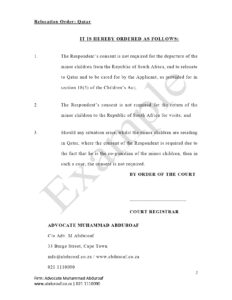
Suppose the other parent also has parental responsibilities and rights over the minor child, and he or she does not want to consent to the relocation of the minor child to Qatar, then in such a case, the Court needs to be approached. Here I refer you back to section 18(5) of the Children’s Act referred to above where it states: (5) Unless a competent court orders otherwise, the Consent of all the persons that have guardianship of a child is necessary in respect of matters set out in subsection (3)(c). Therefore, after your Court Application has been launched an both sides have been heard, the Court would make the necessary Order. If you are successful in your application for the relocation of your minor children to Qatar, then the Court will make an Order similar to that which is shown below. [caption id="attachment_10834" align="alignnone" width="667"]Relocation consent Court Order for minor child to Qatar - Advocate Muhammad Abduroaf Relocation consent Court Order for minor child to Qatar – Advocate Muhammad Abduroaf[/caption] [caption id="attachment_10835" align="alignnone" width="656"]Relocation consent Court Order for minor child to Qatar - Advocate Muhammad Abduroaf Relocation consent Court Order for minor child to Qatar – Advocate Muhammad Abduroaf[/caption]
Relocation consent Court Order for minor child to Qatar - Advocate Muhammad Abduroaf
Relocation consent Court Order for minor child to Qatar – Advocate Muhammad Abduroaf

I want to relocate from South Africa to Qatar with my minor child. The other parent does not want my child to relocate to Qatar. What can I do?

Qatar is a popular destination to emigrate to. People emigrate from South Africa for many reasons. It ranges from better employment opportunities, family relations, or for a better standard of living. Whatever the reason a parent wants to relocate to Qatar, if a minor child will be joining that parent and also relocating to Qatar, then the parent remaining in South Africa’s consent would usually be required. Let us unpack the legal issues a parent may encounter when wanting to emigrate to Qatar. Before we do so, let us list the various cities and towns in Qatar to which you may want to relocate:

Doha, Abu az Zuluf, Abu Thaylah, Ad Dawhah al Jadidah, Al `Arish, Al Bida` ash Sharqiyah, Al Ghanim, Al Ghuwariyah, Al Hilal al Gharbiyah, Al Hilal ash Sharqiyah, Al Hitmi, Al Jasrah, Al Jumaliyah, Al Ka`biyah, Al Khalifat, Al Khor, Al Khawr, Al Khuwayr, Al Mafjar, Al Qa`abiyah, Al Wakrah, second city, Al `Adhbah, An Najmah, Ar Rakiyat, Al Rayyan, Ar Ru’ays, As Salatah, As Salatah al Jadidah, As Sani`, As Sawq, Ath Thaqab, Blaré, Dukhan, Ras Laffan Industrial City, Umm Bab, Umm Sa’id, Umm Salal Ali, Umm Salal Mohammed. (https://www.wikiwand.com/simple/List_of_cities_in_Qatar)


Why do I require the other parent’s Consent to relocate to Qatar?

According to South African law, if you are a co-holder of parental responsibilities and rights over your minor child, you must consent to your child leaving South Africa. In this case, relocating to Qatar.

Here we refer to section 18 of the Children’s Act 38 of 2005. The entire provision is as follows:

18 Parental responsibilities and rights

 (1) A person may have either full or specific parental responsibilities and rights in respect of a child.

 (2) The parental responsibilities and rights that a person may have in respect of a child, include the responsibility and the right-

 (a) to care for the child;

 (b) to maintain contact with the child;

 (c) to act as guardian of the child; and

 (d) to contribute to the maintenance of the child.

 (3) Subject to subsections (4) and (5), a parent or other person who acts as guardian of a child must-

 (a) administer and safeguard the child’s property and property interests;

 (b) assist or represent the child in administrative, contractual and other legal matters; or

 (c) give or refuse any consent required by law in respect of the child, including-

 (i) consent to the child’s marriage;

 (ii) consent to the child’s adoption;

 (iii) consent to the child’s departure or removal from the Republic;

 (iv) consent to the child’s application for a passport; and

 (v) consent to the alienation or encumbrance of any immovable property of the child.

 (4) Whenever more than one person has guardianship of a child, each one of them is competent, subject to subsection (5), any other law or any order of a competent court to the contrary, to exercise independently and without the Consent of the other any right or responsibility arising from such guardianship.

(5) Unless a competent court orders otherwise, the Consent of all the persons that have guardianship of a child is necessary in respect of matters set out in subsection (3)(c).

Now let us explain what Parental Responsibilities and Rights are.

What are Parental Responsibilities and Rights of a parent in relation to a child?

As can be seen from section 18(2) of the Children’s Act, when we refer to Parental Responsibilities and Rights, we refer to the following:

(a) to care for the child;

 (b) to maintain contact with the child;

 (c) to act as guardian of the child; and

 (d) to contribute to the maintenance of the child.

Therefore, if a parent has parental responsibilities and rights over a minor child, and accordingly, rights of guardianship, their Consent is required when it comes to issues of guardianship. As seen from section 18(3)(c) of the Children’s Act above, both parents’ Consent is required should a minor child depart from the Republic of South Africa. In this case, to emigrate to Qatar. Even if the minor child only wants to go for a short holiday to Qatar, both guardians’ Consent would be required.

When would the other parent be seen as a guardian in the case of a relocation matter to Qatar?

It must be noted that not all parents are legal guardians over their minor children. We should therefore distinguish between married or divorced parents and parents who were never married. As you would see below, usually married, or divorced parents’ Consent would be required for a minor child to relocate or emigrate to Qatar. However, that does not automatically apply to parents who were never married. This could be because the child could have been born from a brief encounter and never met his or her father. It would not make sense that a parent who never met his or her 15-year-old child, should give Consent for relocation to Qatar.

Mother’s Consent for relocation of the minor child to Qatar

Section 19 of the Children’s Act deals with the Parental responsibilities and rights of mothers. It states the following:

19 Parental responsibilities and rights of mothers

 (1) The biological mother of a child, whether married or unmarried, has full parental responsibilities and rights in respect of the child.

 (2) If-

 (a) the biological mother of a child is an unmarried child who does not have guardianship in respect of the child; and

 (b) the biological father of the child does not have guardianship in respect of the child, the guardian of the child’s biological mother is also the guardian of the child.

 (3) This section does not apply in respect of a child who is the subject of a surrogacy agreement.

As seen from section 19(1) of the Children’s Act, in most cases involving the relocation of a minor child to Qatar, the mother’s Consent is required as she has full parental responsibilities and rights over the minor child.

Married father’s Consent for the relocation of the minor child to Qatar

Section 20 of the Children’s Act deals with Parental responsibilities and rights of married fathers. It states the following:

20 Parental responsibilities and rights of married fathers

The biological father of a child has full parental responsibilities and rights in respect of the child-

(a) if he is married to the child’s mother; or

(b) if he was married to the child’s mother at (i) the time of the child’s conception; (ii) the time of the child’s birth; or (iii) any time between the child’s conception and birth.

As can be seen from sections 20 (a) and (b) of the Children’s Act, if the father and the mother were married, or are married, then his Consent is required for the minor child to relocate to Qatar. Of course, an exception to this would be should a court of law order otherwise. This would be the case should the parents be divorced and the divorce court ordered that only the mother may act as guardian. Next, we deal with the issue of an unmarried father’s Consent to relocate a minor child to Qatar.

Consent of unmarried fathers for the relocation of their minor children to Qatar.

Section 21 of the Children’s Act deals with parental responsibilities and rights of unmarried fathers. The section states the following:

21 Parental responsibilities and rights of unmarried fathers

 (1) The biological father of a child who does not have parental responsibilities and rights in respect of the child in terms of section 20, acquires full parental responsibilities and rights in respect of the child-

 (a) if at the time of the child’s birth he is living with the mother in a permanent life-partnership; or

 (b) if he, regardless of whether he has lived or is living with the mother-

 (i) consents to be identified or successfully applies in terms of section 26 to be identified as the child’s father or pays damages in terms of customary law;

 (ii) contributes or has attempted in good faith to contribute to the child’s upbringing for a reasonable period; and

 (iii) contributes or has attempted in good faith to contribute towards expenses in connection with the maintenance of the child for a reasonable period.

 (2) This section does not affect the duty of a father to contribute towards the maintenance of the child.

 (3) (a) If there is a dispute between the biological father referred to in subsection (1) and the biological mother of a child with regard to the fulfilment by that father of the conditions set out in subsection (1) (a) or (b), the matter must be referred for mediation to a family advocate, social worker, social service professional or other suitably qualified person.

 (b) Any party to the mediation may have the outcome  of the mediation reviewed by a

court.

 (4) This section applies regardless of whether the child was born before or after the commencement of this Act.

As can be seen from the latter sections, a father of a child born out of wedlock does not automatically have parental responsibilities and rights over his minor child. He may however acquire those parental responsibilities and rights over his minor child if he is materially involved in the child’s life. That would be where the father and the mother were in a permanent life partnership when the child was born or he is meaningfully involved in the child’s life, as outlined above. We shall not go into much detail regarding that. However, in most cases, if the father had regular contact with the child and paid child support, he would have acquired parental responsibilities and rights over the minor child.

What do you do if the other parent does not want to consent to the minor child relocating to Qatar?

Suppose the other parent also has parental responsibilities and rights over the minor child, and he or she does not want to consent to the relocation of the minor child to Qatar, then in such a case, the Court needs to be approached. Here I refer you back to section 18(5) of the Children’s Act referred to above where it states:

(5) Unless a competent court orders otherwise, the Consent of all the persons that have guardianship of a child is necessary in respect of matters set out in subsection (3)(c).

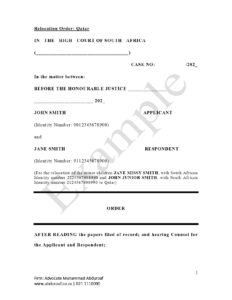
Therefore, after your Court Application has been launched an both sides have been heard, the Court would make the necessary Order. If you are successful in your application for the relocation of your minor children to Qatar, then the Court will make an Order similar to that which is shown below.
Relocation consent Court Order for minor child to Qatar - Advocate Muhammad Abduroaf
Relocation consent Court Order for minor child to Qatar – Advocate Muhammad Abduroaf
Relocation consent Court Order for minor child to Qatar - Advocate Muhammad Abduroaf
Relocation consent Court Order for minor child to Qatar – Advocate Muhammad Abduroaf

Related Post

Uncontested divorce in South Africa

First of all, what is an uncontested divorce? An uncontested divorce occurs when both parties agree to the divorce. This type of divorce is quicker, less expensive, and simpler. A formal trial is not necessary, but legal guidance may still be necessary. Other factors, such as child custody, child support, and asset division, may be relevant to the divorce but do not necessarily slow down the process. The legal expert must assist the parties in reaching a legal agreement. [caption id="attachment_4561" align="alignleft" width="300"] Call our law offices on: 0211110090
Email us at: [email protected][/caption] For professional legal consultation,
contact our law offices on 021 111 0090 and have our friendly receptionist make an online appointment for you. Secure your one-on-one legal consultation today! Simply click on the link below and download our free divorce product toolkit below: Free Divorce Tool Kit How long does a divorce take in South Africa? This a common question we’re often faced with when dealing with divorce matters. Unfortunately, some divorces are more complex in which the other party is not co-operating and refuse to agree to a divorce. Under such circumstances, the divorce can unfold over years depending on the nature and circumstance of the matter. [caption id="attachment_4562" align="alignleft" width="300"] Call our law offices on: 0211110090
Email us at: [email protected][/caption] Contested or opposed divorces on the other hand, are when both parties are not in agreement with the divorce – this can cause a dreadful, costly legal drag.  The contested divorce will unfold in the following ways:  
  • pleadings
  • application for and set down of trial date
  • discovery of documents
  • further discovery and particulars
  • pre-trial conference
  • trial
  • judgment
Feel free to click on the links below and find out more about our legal expertise: Feel free to call our law offices on 021 424 3487 for a professional legal consultation today and have our friendly receptionist make an online appointment for you. Secure your one on one legal consultation today! Online divorce South Africa Technology is of a dynamic nature which is why we have moved with the times. We have recently introduced our modern, online operation. Efficiency and convenience is our main objective for the layperson. [caption id="attachment_4563" align="alignleft" width="300"] Call our law offices on: 0211110090
Email us at: [email protected][/caption] Should you be residing out of the South Africa, consulting with us will not be a problem. We are able to conduct legal consultations online, face to face or Skype / video call. We have now recently introduced our national contact number which caters for those residing out of Cape Town. Our online appointment system is efficient and gets you in the swing of an easy step to having your legal consultation with the legal expert. Simply call our offices today and have your online appointment made for you!

I am dissatisfied with the decision of the High Court of South Africa. How do I appeal to the Supreme Court of Appeal? And what are their contact details?

Many legal disputes are adjudicated in the High Courts of South Africa. Each province in South Africa has at least one High Court. If you are not happy with the decision of the High Court, you can appeal to the Supreme Court of Appeal. In South Africa, the Supreme Court of Appeal (SCA) is the second-highest court in the judicial hierarchy, and it primarily hears appeals from the High Court. The SCA generally does not hear cases directly but serves as a court of appeal for matters that have already been heard in the lower courts. Here are common circumstances under which you can appeal to the Supreme Court of Appeal:

Appeals from High Court Decisions:

The SCA hears appeals from decisions of the various divisions of the High Court. If you are dissatisfied with a judgment or order of the High Court, you can appeal to the Supreme Court of Appeal.

Civil Appeals:

Civil matters, including disputes related to contracts, property, family law, and other civil issues, can be appealed to the SCA.

Criminal Appeals:

Appeals in criminal cases, including appeals against convictions, sentences, or both, can be brought before the Supreme Court of Appeal.

Constitutional Matters:

While the Constitutional Court is the highest court for constitutional matters, the SCA may still deal with constitutional issues arising in the context of appeals from the High Court.

Administrative Law Appeals:

Appeals involving administrative law matters, such as decisions made by government bodies, may be heard by the SCA.

Interpretation of Legislation:

Matters involving the interpretation and application of statutes or other legislation can be subject to appeal to the SCA.

Land and Property Disputes:

Appeals related to land and property disputes, including matters involving land ownership, expropriation, and related issues.

Family Law Appeals:

Appeals from family law matters, including divorces, custody disputes, and maintenance orders, can be heard by the SCA. It’s important to note that, in most cases, before appealing to the Supreme Court of Appeal, you would typically need to have received a judgment or order from a lower court (usually the High Court). The appeal process usually involves filing a notice of appeal, obtaining the record of proceedings from the lower court, and presenting arguments to the SCA.

Do you wish to appeal to the Supreme Court of Appeal?

If you are unhappy with a Court decision and require legal assistance regarding a possible appeal to the Supreme Court of Appeal, feel free to contact us for assistance. The contact details of the Supreme Court of Appeal are as follows as found on https://www.concourt.org.za/index.php/contact-us/superior-courts-contacts: Tel: +27 51 412 7400 Fax: +27 51 412 7449 PO Box 258, Bloemfontein, Free State, 9300 Cnr President Brand & Elizabeth Streets, Bloemfontein, 9300 GPS: E 26.21675; S -29.11563 Registrar: Ms Elizabeth Vermeulen E-mail: 
[email protected] Tel: +27 51 492 4674 Website:www.justice.gov.za/

Do you require a video legal advice consultation?

Click here and schedule one today!