Top tips from a Senior Family Law Advocate on how to deal with your Child Custody matter in the Graaff-Reinet Children’s Court Family law legal matters can be very stressful. This is so whether you live in Graaff-Reinet or any other city in South Africa. Especially so if you Continue Reading
Telelaw
Top tips from a Senior Family Law Advocate on how to deal with your Child Custody matter in the Benoni Children’s Court
Family law legal matters can be very stressful. This is so whether you live in Benoni or any other city in South Africa. Especially so if you have no idea how the legal processes work. It is one thing to know that you are entitled to child support, but it is a totally different matter to know the law and procedure on how to claim child support. Luckily in child maintenance matters, the maintenance court is there to assist you in completing the application form. However, many times that is not enough. Especially so if the other parent has a lawyer and knows how to present the case for his or her client.
This article, however, deals with some top tips in care and contact or custody matters in the Children’s Court in Benoni. It would explain the processes involved and advise on how to be best prepared for your matter. This advice is applicable whether you live in Benoni or any other city in South Africa.
What to do before visiting the Benoni Children’s Court
Before you approach the Children’s Court in Benoni, first try to resolve the issues with the other parent. Therefore, if you want more contact with your child and the other parent is refusing, try to resolve the matter first with that parent. If that does not work, try mediation. The mediator can be anyone, from a trusted mutual friend, priest, or other religious leaders, or a professional like an attorney, psychologist, or the office of the Family Advocate. Benoni has many professionals that can assist you in this regard. If resolving the matter by yourselves is not possible, or mediation fails, then we suggest you approach the Benoni Children’s Court for assistance.
TIP: Focus on getting someone neutral to assist in mediating your matter. Organisations like FAMSA and FAMAC can be of assistance. Google them.
Approaching the Benoni Children’s Court
The Benoni Children’s Court should be approached if it is the closest Children’s Court to you. You need to verify with the Benoni Children’s Court that you fall under their area of jurisdiction. If not, they would direct you to which Children’s Court is applicable to you.
Once you arrive at the Benoni Children’s Court, they will provide you with a form headed “Bringing Matter to Court in Terms of Section 53 Children’s Act, 2005 (Act no. 38 of 2005) Regulation Relating to Children’s Court and International Child Abduction, 2008 [Regulation 6]. This form is also called Form 2.
In this form, you will provide all your particulars and that of the child or children and the other parent. The sections in the form are as follows:
- PART A: PARTICULARS OF CHILD(REN)
- PART B: PARTICULARS OF *CHILD WHO IS AFFECTED BY OR INVOLVED IN THE MATTER/PERSON *ACTING IN THE INTEREST OF THE CHILD/*ON BEHALF OF THE CHILD WHO CANNOT ACT IN HIS/HER OWN NAME/ *MEMBER OF A GROUP OF CLASS OF CHILDREN/*IN THE PUBLIC INTEREST (SECTION 53(2)
- PART C: PARTICULARS OF PERSONS HAVING AN INTEREST IN THE MATTER
- PART D: PARTICULARS OF MATTER
In part D, the following is stated which you need to provide in the form:
- Nature of matter brought to Court: (Please give full details of the matter e.g., registration/amendment of parenting plans, removal of child to safe care, children in need of care and protection, placement in youth care centers, adoption etc.
- Documents: Are there any documents relating to the matter? (If so please attach)
Once you have completed the form and attached the relevant documents to it, you must take it to a commissioner of Oaths to have it commissioned. It does not have to be in Benoni.
TIP: Draft a separate affidavit explaining your case. Outline some background information and reasons why the Court should give you what you request. Attach it to Form 2.
Processing your Application at the Benoni Children’s Court
Once you complete the Form A and submit it to the Clerk of the Benoni Children’s Court, they will process it and allocate it a case number or reference number. The Clerk of the Court would then allocate a date to the matter and advise the parties accordingly when the court date is. Please note that some courts follow a different process for processing the application and informing the parties of the court date. Please enquire from the Court when making the application what process they follow.
TIP: Obtain the contact details of the Court for you to contact them to obtain the Court date or other information. Ask for their contact number and email address.
Appearing in the Benoni Children’s Court
When notified of the Court date, both you and the other parent should attend. If you are making use of a lawyer (Advocate or Attorney), inform them timeously of the date. Depending on the Court, you may first see the Clerk or go directly to the Magistrate. The Children’s Court would do its best to try to resolve the matter. If the parents cannot come to an agreement, the Children’s Court may postpone the matter for either of the following:
- Get a social worker involved in the matter;
- Appoint a legal representative for the minor child;
- Implement interim care and contact arrangements;
- Having the parties attempt to agree on a parenting plan;
-
In serious matters, the Court may remove the minor child from both parents and place the child in foster care. The powers of the Children’s Court are extensive. It will, however, focus on what is in the child’s best interests.
TIP: Be as vocal as possible. Do not expect the Court to be understanding of your case or be on your side. It is your duty to explain your case and provide the Court with all the relevant information they require for them to make a fair decision.
Finalising the matter in the Benoni Children’s Court
Once the Benoni Children’s Court has enough information to make a final decision, it will do so. Depending on the facts of the matter, that could either be making a Parenting Plan, an Order of the Court or a final care and contact Order. The Court may even make further interim orders, where the parties are to return to Court after a few months, or a year later.
TIP: Do not agree to something just because the social worker, a lawyer, or the Court suggest it. You need to be happy with what is decided.
The above Benoni Children’s Court Application tips should apply to the following provinces and cities:
Eastern Cape:
Alice, Butterworth, East London, Graaff-Reinet, Grahamstown, King William’s Town, Mthatha
Port Elizabeth, Queenstown, Uitenhage, Zwelitsha
Free State:
Bethlehem. Bloemfontein, Jagersfontein, Kroonstad, Odendaalsrus, Parys, Phuthaditjhaba, Sasolburg, Virginia, Welkom
Gauteng:
Benoni, Boksburg, Brakpan, Carletonville, Germiston, Johannesburg, Krugersdorp, Pretoria, Randburg, Randfontein, Roodepoort, Soweto, Springs, Vanderbijlpark, Vereeniging
KwaZulu-Natal:
Durban, Empangeni, Ladysmith, Newcastle, Pietermaritzburg, Pinetown, Ulundi, Umlazi
Limpopo:
Giyani, Lebowakgomo, Musina, Phalaborwa, Polokwane, Seshego, Sibasa, Thabazimbi
Mpumalanga:
Emalahleni, Nelspruit, Secunda, North West, Klerksdorp, Mahikeng, Mmabatho, Potchefstroom, Rustenburg, Northern Cape, Kimberley, Kuruman, Port Nolloth
Western Cape:
Bellville, Benoni, Constantia, George, Hopefield, Oudtshoorn, Paarl, Simon’s Town, Stellenbosch, Swellendam, Worcester
Top tips from a Senior Family Law Advocate on how to deal with your Child Custody matter in the Benoni Children’s Court Family law legal matters can be very stressful. This is so whether you live in Benoni or any other city in South Africa. Especially so if you Continue Reading
Top tips from a Senior Family Law Advocate on how to deal with your Child Custody matter in the Kuruman Children’s Court
Family law legal matters can be very stressful. This is so whether you live in Kuruman or any other city in South Africa. Especially so if you have no idea how the legal processes work. It is one thing to know that you are entitled to child support, but it is a totally different matter to know the law and procedure on how to claim child support. Luckily in child maintenance matters, the maintenance court is there to assist you in completing the application form. However, many times that is not enough. Especially so if the other parent has a lawyer and knows how to present the case for his or her client.
This article, however, deals with some top tips in care and contact or custody matters in the Children’s Court in Kuruman. It would explain the processes involved and advise on how to be best prepared for your matter. This advice is applicable whether you live in Kuruman or any other city in South Africa.
What to do before visiting the Kuruman Children’s Court
Before you approach the Children’s Court in Kuruman, first try to resolve the issues with the other parent. Therefore, if you want more contact with your child and the other parent is refusing, try to resolve the matter first with that parent. If that does not work, try mediation. The mediator can be anyone, from a trusted mutual friend, priest, or other religious leaders, or a professional like an attorney, psychologist, or the office of the Family Advocate. Kuruman has many professionals that can assist you in this regard. If resolving the matter by yourselves is not possible, or mediation fails, then we suggest you approach the Kuruman Children’s Court for assistance.
TIP: Focus on getting someone neutral to assist in mediating your matter. Organisations like FAMSA and FAMAC can be of assistance. Google them.
Approaching the Kuruman Children’s Court
The Kuruman Children’s Court should be approached if it is the closest Children’s Court to you. You need to verify with the Kuruman Children’s Court that you fall under their area of jurisdiction. If not, they would direct you to which Children’s Court is applicable to you.
Once you arrive at the Kuruman Children’s Court, they will provide you with a form headed “Bringing Matter to Court in Terms of Section 53 Children’s Act, 2005 (Act no. 38 of 2005) Regulation Relating to Children’s Court and International Child Abduction, 2008 [Regulation 6]. This form is also called Form 2.
In this form, you will provide all your particulars and that of the child or children and the other parent. The sections in the form are as follows:
- PART A: PARTICULARS OF CHILD(REN)
- PART B: PARTICULARS OF *CHILD WHO IS AFFECTED BY OR INVOLVED IN THE MATTER/PERSON *ACTING IN THE INTEREST OF THE CHILD/*ON BEHALF OF THE CHILD WHO CANNOT ACT IN HIS/HER OWN NAME/ *MEMBER OF A GROUP OF CLASS OF CHILDREN/*IN THE PUBLIC INTEREST (SECTION 53(2)
- PART C: PARTICULARS OF PERSONS HAVING AN INTEREST IN THE MATTER
- PART D: PARTICULARS OF MATTER
In part D, the following is stated which you need to provide in the form:
- Nature of matter brought to Court: (Please give full details of the matter e.g., registration/amendment of parenting plans, removal of child to safe care, children in need of care and protection, placement in youth care centers, adoption etc.
- Documents: Are there any documents relating to the matter? (If so please attach)
Once you have completed the form and attached the relevant documents to it, you must take it to a commissioner of Oaths to have it commissioned. It does not have to be in Kuruman.
TIP: Draft a separate affidavit explaining your case. Outline some background information and reasons why the Court should give you what you request. Attach it to Form 2.
Processing your Application at the Kuruman Children’s Court
Once you complete the Form A and submit it to the Clerk of the Kuruman Children’s Court, they will process it and allocate it a case number or reference number. The Clerk of the Court would then allocate a date to the matter and advise the parties accordingly when the court date is. Please note that some courts follow a different process for processing the application and informing the parties of the court date. Please enquire from the Court when making the application what process they follow.
TIP: Obtain the contact details of the Court for you to contact them to obtain the Court date or other information. Ask for their contact number and email address.
Appearing in the Kuruman Children’s Court
When notified of the Court date, both you and the other parent should attend. If you are making use of a lawyer (Advocate or Attorney), inform them timeously of the date. Depending on the Court, you may first see the Clerk or go directly to the Magistrate. The Children’s Court would do its best to try to resolve the matter. If the parents cannot come to an agreement, the Children’s Court may postpone the matter for either of the following:
- Get a social worker involved in the matter;
- Appoint a legal representative for the minor child;
- Implement interim care and contact arrangements;
- Having the parties attempt to agree on a parenting plan;
-
In serious matters, the Court may remove the minor child from both parents and place the child in foster care. The powers of the Children’s Court are extensive. It will, however, focus on what is in the child’s best interests.
TIP: Be as vocal as possible. Do not expect the Court to be understanding of your case or be on your side. It is your duty to explain your case and provide the Court with all the relevant information they require for them to make a fair decision.
Finalising the matter in the Kuruman Children’s Court
Once the Kuruman Children’s Court has enough information to make a final decision, it will do so. Depending on the facts of the matter, that could either be making a Parenting Plan, an Order of the Court or a final care and contact Order. The Court may even make further interim orders, where the parties are to return to Court after a few months, or a year later.
TIP: Do not agree to something just because the social worker, a lawyer, or the Court suggest it. You need to be happy with what is decided.
The above Kuruman Children’s Court Application tips should apply to the following provinces and cities:
Eastern Cape:
Alice, Butterworth, East London, Graaff-Reinet, Grahamstown, King William’s Town, Mthatha
Port Elizabeth, Queenstown, Uitenhage, Zwelitsha
Free State:
Bethlehem. Bloemfontein, Jagersfontein, Kroonstad, Odendaalsrus, Parys, Phuthaditjhaba, Sasolburg, Virginia, Welkom
Gauteng:
Benoni, Boksburg, Brakpan, Carletonville, Germiston, Johannesburg, Krugersdorp, Pretoria, Randburg, Randfontein, Roodepoort, Soweto, Springs, Vanderbijlpark, Vereeniging
KwaZulu-Natal:
Durban, Empangeni, Ladysmith, Newcastle, Pietermaritzburg, Pinetown, Ulundi, Umlazi
Limpopo:
Giyani, Lebowakgomo, Musina, Phalaborwa, Polokwane, Seshego, Sibasa, Thabazimbi
Mpumalanga:
Emalahleni, Nelspruit, Secunda, North West, Klerksdorp, Mahikeng, Mmabatho, Potchefstroom, Rustenburg, Northern Cape, Kimberley, Kuruman, Port Nolloth
Western Cape:
Bellville, Kuruman, Constantia, George, Hopefield, Oudtshoorn, Paarl, Simon’s Town, Stellenbosch, Swellendam, Worcester
Top tips from a Senior Family Law Advocate on how to deal with your Child Custody matter in the Kuruman Children’s Court Family law legal matters can be very stressful. This is so whether you live in Kuruman or any other city in South Africa. Especially so if you Continue Reading
Top tips from a Senior Family Law Advocate on how to deal with your Child Custody matter in the Hopefield Children’s Court
Family law legal matters can be very stressful. This is so whether you live in Hopefield or any other city in South Africa. Especially so if you have no idea how the legal processes work. It is one thing to know that you are entitled to child support, but it is a totally different matter to know the law and procedure on how to claim child support. Luckily in child maintenance matters, the maintenance court is there to assist you in completing the application form. However, many times that is not enough. Especially so if the other parent has a lawyer and knows how to present the case for his or her client.
This article, however, deals with some top tips in care and contact or custody matters in the Children’s Court in Hopefield. It would explain the processes involved and advise on how to be best prepared for your matter. This advice is applicable whether you live in Hopefield or any other city in South Africa.
What to do before visiting the Hopefield Children’s Court
Before you approach the Children’s Court in Hopefield, first try to resolve the issues with the other parent. Therefore, if you want more contact with your child and the other parent is refusing, try to resolve the matter first with that parent. If that does not work, try mediation. The mediator can be anyone, from a trusted mutual friend, priest, or other religious leaders, or a professional like an attorney, psychologist, or the office of the Family Advocate. Hopefield has many professionals that can assist you in this regard. If resolving the matter by yourselves is not possible, or mediation fails, then we suggest you approach the Hopefield Children’s Court for assistance.
TIP: Focus on getting someone neutral to assist in mediating your matter. Organisations like FAMSA and FAMAC can be of assistance. Google them.
Approaching the Hopefield Children’s Court
The Hopefield Children’s Court should be approached if it is the closest Children’s Court to you. You need to verify with the Hopefield Children’s Court that you fall under their area of jurisdiction. If not, they would direct you to which Children’s Court is applicable to you.
Once you arrive at the Hopefield Children’s Court, they will provide you with a form headed “Bringing Matter to Court in Terms of Section 53 Children’s Act, 2005 (Act no. 38 of 2005) Regulation Relating to Children’s Court and International Child Abduction, 2008 [Regulation 6]. This form is also called Form 2.
In this form, you will provide all your particulars and that of the child or children and the other parent. The sections in the form are as follows:
- PART A: PARTICULARS OF CHILD(REN)
- PART B: PARTICULARS OF *CHILD WHO IS AFFECTED BY OR INVOLVED IN THE MATTER/PERSON *ACTING IN THE INTEREST OF THE CHILD/*ON BEHALF OF THE CHILD WHO CANNOT ACT IN HIS/HER OWN NAME/ *MEMBER OF A GROUP OF CLASS OF CHILDREN/*IN THE PUBLIC INTEREST (SECTION 53(2)
- PART C: PARTICULARS OF PERSONS HAVING AN INTEREST IN THE MATTER
- PART D: PARTICULARS OF MATTER
In part D, the following is stated which you need to provide in the form:
- Nature of matter brought to Court: (Please give full details of the matter e.g., registration/amendment of parenting plans, removal of child to safe care, children in need of care and protection, placement in youth care centers, adoption etc.
- Documents: Are there any documents relating to the matter? (If so please attach)
Once you have completed the form and attached the relevant documents to it, you must take it to a commissioner of Oaths to have it commissioned. It does not have to be in Hopefield.
TIP: Draft a separate affidavit explaining your case. Outline some background information and reasons why the Court should give you what you request. Attach it to Form 2.
Processing your Application at the Hopefield Children’s Court
Once you complete the Form A and submit it to the Clerk of the Hopefield Children’s Court, they will process it and allocate it a case number or reference number. The Clerk of the Court would then allocate a date to the matter and advise the parties accordingly when the court date is. Please note that some courts follow a different process for processing the application and informing the parties of the court date. Please enquire from the Court when making the application what process they follow.
TIP: Obtain the contact details of the Court for you to contact them to obtain the Court date or other information. Ask for their contact number and email address.
Appearing in the Hopefield Children’s Court
When notified of the Court date, both you and the other parent should attend. If you are making use of a lawyer (Advocate or Attorney), inform them timeously of the date. Depending on the Court, you may first see the Clerk or go directly to the Magistrate. The Children’s Court would do its best to try to resolve the matter. If the parents cannot come to an agreement, the Children’s Court may postpone the matter for either of the following:
- Get a social worker involved in the matter;
- Appoint a legal representative for the minor child;
- Implement interim care and contact arrangements;
- Having the parties attempt to agree on a parenting plan;
-
In serious matters, the Court may remove the minor child from both parents and place the child in foster care. The powers of the Children’s Court are extensive. It will, however, focus on what is in the child’s best interests.
TIP: Be as vocal as possible. Do not expect the Court to be understanding of your case or be on your side. It is your duty to explain your case and provide the Court with all the relevant information they require for them to make a fair decision.
Finalising the matter in the Hopefield Children’s Court
Once the Hopefield Children’s Court has enough information to make a final decision, it will do so. Depending on the facts of the matter, that could either be making a Parenting Plan, an Order of the Court or a final care and contact Order. The Court may even make further interim orders, where the parties are to return to Court after a few months, or a year later.
TIP: Do not agree to something just because the social worker, a lawyer, or the Court suggest it. You need to be happy with what is decided.
The above Hopefield Children’s Court Application tips should apply to the following provinces and cities:
Eastern Cape:
Alice, Butterworth, East London, Graaff-Reinet, Grahamstown, King William’s Town, Mthatha
Port Elizabeth, Queenstown, Uitenhage, Zwelitsha
Free State:
Bethlehem. Bloemfontein, Jagersfontein, Kroonstad, Odendaalsrus, Parys, Phuthaditjhaba, Sasolburg, Virginia, Welkom
Gauteng:
Benoni, Boksburg, Brakpan, Carletonville, Germiston, Johannesburg, Krugersdorp, Pretoria, Randburg, Randfontein, Roodepoort, Soweto, Springs, Vanderbijlpark, Vereeniging
KwaZulu-Natal:
Durban, Empangeni, Ladysmith, Newcastle, Pietermaritzburg, Pinetown, Ulundi, Umlazi
Limpopo:
Giyani, Lebowakgomo, Musina, Phalaborwa, Polokwane, Seshego, Sibasa, Thabazimbi
Mpumalanga:
Emalahleni, Nelspruit, Secunda, North West, Klerksdorp, Mahikeng, Mmabatho, Potchefstroom, Rustenburg, Northern Cape, Kimberley, Kuruman, Port Nolloth
Western Cape:
Bellville, Hopefield, Constantia, George, Hopefield, Oudtshoorn, Paarl, Simon’s Town, Stellenbosch, Swellendam, Worcester
Top tips from a Senior Family Law Advocate on how to deal with your Child Custody matter in the Hopefield Children’s Court Family law legal matters can be very stressful. This is so whether you live in Hopefield or any other city in South Africa. Especially so if you Continue Reading
Top tips and tricks from a Senior Family Law Advocate on claiming maintenance for a five-year-old child in Rustenburg.
Child Maintenance is the right of the child, and not that of the parent. It is also not a privilege granted to parents who must pay it. It is their duty to pay child maintenance and support their children. Once the child is self-supporting (being able to care for him or herself), the obligation falls away. This can happen when the child is 18, 20, or even 30. It all depends on the circumstances of the case.
Claiming child maintenance for your child in Rustenburg
Whether you claim child maintenance in Rustenburg, or any other city in South Africa, the procedures would be the same. There are however two (2) courts that can deal with child maintenance matters. That is a divorce court, in a divorce matter, and a Child Maintenance Court. For this article, we will focus on claiming maintenance in a Maintenance Court matter in Rustenburg.
The maintenance scenario – Rustenburg South Africa
In this article, we will deal with the following fictitious scenario, in a child maintenance matter:
- The Child is seven years old and attends school in Rustenburg
- The child is cared for by the mother who works in Rustenburg
- The mother works and earns a Salary of R 10 000
- The father sees the child every second weekend. He also lives and works in Rustenburg
- The child’s monthly expenses are R 6000 – 00 which includes food, clothing, accommodation, education, travel etc.
- The father earns a reasonable salary and can afford the R 20 000 – 00 per month
- The mother claims R 4 000 – 00 maintenance as the father earns double her salary
What is the first step the mother must take in claiming child maintenance?
The first thing the mother must do is work out exactly what the child costs by item. She breaks down the minor child’s living expenses, starting from rent or accommodation to groceries to school fees etc. Once she has done that, she would need to determine what exactly does the minor child cost per month, seeing that she will be asking the father to contribute towards that. As best as possible, she needs to collect proof of expenses. This can be in the form of receipts.
How does she start the legal process?
The mother now needs to approach the maintenance court in the area where she lives or works to lodge a complaint for child maintenance. If she lives or works in Rustenburg, it would be the maintenance court in Rustenburg. She will complete a Form A wherein she will provide all the expenses for her and the minor child. She would also have to stipulate her income. Once she completed the form and submitted it to the maintenance court, she must then follow the next step.
What do you do while waiting for the maintenance court date?
While you wait to be informed of the court date by the Maintenance Court of Rustenburg, and up until the actual first court date, you need to ensure that you keep a record of all income and expenses for you and the child. This is very important as the court allocates maintenance based on recent income and expenses.
What happens at the first court appearance at the Rustenburg Maintenance Court?
Once you have been notified of the maintenance court date by the Rustenburg Maintenance Court, you need to ensure that you attend it. On that day, both you and the father of the child would appear before a maintenance officer. The maintenance officer would go through both your income and expenses as well as that of the father. If all the relevant information is not before the maintenance court, then the matter may be postponed in order for the parties to submit it.
The maintenance officer will try to settle the matter and have the parents come to an agreement regarding the amount of child maintenance to be paid. If they cannot come to an agreement regarding the child maintenance to be paid, the matter would have to proceed to a formal hearing or trial before a Magistrate.
How does the Maintenance Court hearing or trial work in Rustenburg?
Essentially, the maintenance court is called upon to make a fair ruling regarding what is a fair amount of child support that needs to be paid. For that to happen, the parents would have to give evidence in that regard. The mother would present to the court what the child costs, what she contributes and what she requires the other parent to pay. The Father would have a right to question the mother and to present evidence as to why he cannot afford the amount requested or why he feels it is an unfair amount. The mother can they also question him.
At the end of the day, the Rustenburg Maintenance Court would be able to properly determine what is a fair and adequate amount of child maintenance to pay after being presented will all relevant information. The Rustenburg Maintenance Court should play an active role in determining what is a fair amount of child maintenance the father should pay.
The above child maintenance application principles should apply to the following provinces and cities:
Eastern Cape:
Alice, Butterworth, East London, Graaff-Reinet, Grahamstown, King William’s Town, Mthatha
Port Elizabeth, Queenstown, Uitenhage, Zwelitsha
Free State:
Bethlehem. Bloemfontein, Jagersfontein, Kroonstad, Odendaalsrus, Parys, Phuthaditjhaba, Sasolburg, Virginia, Welkom
Gauteng:
Benoni, Boksburg, Brakpan, Carletonville, Germiston, Johannesburg, Krugersdorp, Pretoria, Randburg, Randfontein, Roodepoort, Soweto, Springs, Vanderbijlpark, Vereeniging
KwaZulu-Natal:
Durban, Empangeni, Ladysmith, Newcastle, Pietermaritzburg, Pinetown, Ulundi, Umlazi
Limpopo:
Giyani, Lebowakgomo, Musina, Phalaborwa, Polokwane, Seshego, Sibasa, Thabazimbi
Mpumalanga:
Emalahleni, Nelspruit, Secunda, North West, Klerksdorp, Mahikeng, Mmabatho, Potchefstroom, Rustenburg, Northern Cape, Kimberley, Kuruman, Port Nolloth
Western Cape:
Bellville, Rustenburg, Constantia, George, Hopefield, Oudtshoorn, Paarl, Simon’s Town, Stellenbosch, Swellendam, Worcester
Top tips and tricks from a Senior Family Law Advocate on claiming maintenance for a five-year-old child in Rustenburg. Child Maintenance is the right of the child, and not that of the parent. It is also not a privilege granted to parents who must pay it. It is their duty Continue Reading
[caption id="attachment_10835" align="alignnone" width="656"]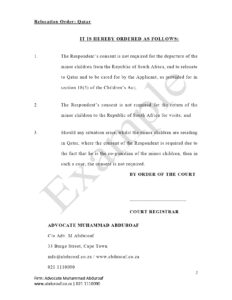 Relocation consent Court Order for minor child to Qatar – Advocate Muhammad Abduroaf[/caption]
I want to relocate from South Africa to Qatar with my minor child. The other parent does not want my child to relocate to Qatar. What can I do?
Qatar is a popular destination to emigrate to. People emigrate from South Africa for many reasons. It ranges from better employment opportunities, family relations, or for a better standard of living. Whatever the reason a parent wants to relocate to Qatar, if a minor child will be joining that parent and also relocating to Qatar, then the parent remaining in South Africa’s consent would usually be required. Let us unpack the legal issues a parent may encounter when wanting to emigrate to Qatar. Before we do so, let us list the various cities and towns in Qatar to which you may want to relocate: Doha, Abu az Zuluf, Abu Thaylah, Ad Dawhah al Jadidah, Al `Arish, Al Bida` ash Sharqiyah, Al Ghanim, Al Ghuwariyah, Al Hilal al Gharbiyah, Al Hilal ash Sharqiyah, Al Hitmi, Al Jasrah, Al Jumaliyah, Al Ka`biyah, Al Khalifat, Al Khor, Al Khawr, Al Khuwayr, Al Mafjar, Al Qa`abiyah, Al Wakrah, second city, Al `Adhbah, An Najmah, Ar Rakiyat, Al Rayyan, Ar Ru’ays, As Salatah, As Salatah al Jadidah, As Sani`, As Sawq, Ath Thaqab, Blaré, Dukhan, Ras Laffan Industrial City, Umm Bab, Umm Sa’id, Umm Salal Ali, Umm Salal Mohammed. (https://www.wikiwand.com/simple/List_of_cities_in_Qatar) Why do I require the other parent’s Consent to relocate to Qatar?
According to South African law, if you are a co-holder of parental responsibilities and rights over your minor child, you must consent to your child leaving South Africa. In this case, relocating to Qatar. Here we refer to section 18 of the Children’s Act 38 of 2005. The entire provision is as follows: 18 Parental responsibilities and rights (1) A person may have either full or specific parental responsibilities and rights in respect of a child. (2) The parental responsibilities and rights that a person may have in respect of a child, include the responsibility and the right- (a) to care for the child; (b) to maintain contact with the child; (c) to act as guardian of the child; and (d) to contribute to the maintenance of the child. (3) Subject to subsections (4) and (5), a parent or other person who acts as guardian of a child must- (a) administer and safeguard the child’s property and property interests; (b) assist or represent the child in administrative, contractual and other legal matters; or (c) give or refuse any consent required by law in respect of the child, including- (i) consent to the child’s marriage; (ii) consent to the child’s adoption; (iii) consent to the child’s departure or removal from the Republic; (iv) consent to the child’s application for a passport; and (v) consent to the alienation or encumbrance of any immovable property of the child. (4) Whenever more than one person has guardianship of a child, each one of them is competent, subject to subsection (5), any other law or any order of a competent court to the contrary, to exercise independently and without the Consent of the other any right or responsibility arising from such guardianship. (5) Unless a competent court orders otherwise, the Consent of all the persons that have guardianship of a child is necessary in respect of matters set out in subsection (3)(c). Now let us explain what Parental Responsibilities and Rights are.What are Parental Responsibilities and Rights of a parent in relation to a child?
As can be seen from section 18(2) of the Children’s Act, when we refer to Parental Responsibilities and Rights, we refer to the following: (a) to care for the child; (b) to maintain contact with the child; (c) to act as guardian of the child; and (d) to contribute to the maintenance of the child. Therefore, if a parent has parental responsibilities and rights over a minor child, and accordingly, rights of guardianship, their Consent is required when it comes to issues of guardianship. As seen from section 18(3)(c) of the Children’s Act above, both parents’ Consent is required should a minor child depart from the Republic of South Africa. In this case, to emigrate to Qatar. Even if the minor child only wants to go for a short holiday to Qatar, both guardians’ Consent would be required.When would the other parent be seen as a guardian in the case of a relocation matter to Qatar?
It must be noted that not all parents are legal guardians over their minor children. We should therefore distinguish between married or divorced parents and parents who were never married. As you would see below, usually married, or divorced parents’ Consent would be required for a minor child to relocate or emigrate to Qatar. However, that does not automatically apply to parents who were never married. This could be because the child could have been born from a brief encounter and never met his or her father. It would not make sense that a parent who never met his or her 15-year-old child, should give Consent for relocation to Qatar.Mother’s Consent for relocation of the minor child to Qatar
Section 19 of the Children’s Act deals with the Parental responsibilities and rights of mothers. It states the following: 19 Parental responsibilities and rights of mothers (1) The biological mother of a child, whether married or unmarried, has full parental responsibilities and rights in respect of the child. (2) If- (a) the biological mother of a child is an unmarried child who does not have guardianship in respect of the child; and (b) the biological father of the child does not have guardianship in respect of the child, the guardian of the child’s biological mother is also the guardian of the child. (3) This section does not apply in respect of a child who is the subject of a surrogacy agreement. As seen from section 19(1) of the Children’s Act, in most cases involving the relocation of a minor child to Qatar, the mother’s Consent is required as she has full parental responsibilities and rights over the minor child.Married father’s Consent for the relocation of the minor child to Qatar
Section 20 of the Children’s Act deals with Parental responsibilities and rights of married fathers. It states the following: 20 Parental responsibilities and rights of married fathers The biological father of a child has full parental responsibilities and rights in respect of the child- (a) if he is married to the child’s mother; or (b) if he was married to the child’s mother at (i) the time of the child’s conception; (ii) the time of the child’s birth; or (iii) any time between the child’s conception and birth. As can be seen from sections 20 (a) and (b) of the Children’s Act, if the father and the mother were married, or are married, then his Consent is required for the minor child to relocate to Qatar. Of course, an exception to this would be should a court of law order otherwise. This would be the case should the parents be divorced and the divorce court ordered that only the mother may act as guardian. Next, we deal with the issue of an unmarried father’s Consent to relocate a minor child to Qatar.Consent of unmarried fathers for the relocation of their minor children to Qatar.
Section 21 of the Children’s Act deals with parental responsibilities and rights of unmarried fathers. The section states the following: 21 Parental responsibilities and rights of unmarried fathers (1) The biological father of a child who does not have parental responsibilities and rights in respect of the child in terms of section 20, acquires full parental responsibilities and rights in respect of the child- (a) if at the time of the child’s birth he is living with the mother in a permanent life-partnership; or (b) if he, regardless of whether he has lived or is living with the mother- (i) consents to be identified or successfully applies in terms of section 26 to be identified as the child’s father or pays damages in terms of customary law; (ii) contributes or has attempted in good faith to contribute to the child’s upbringing for a reasonable period; and (iii) contributes or has attempted in good faith to contribute towards expenses in connection with the maintenance of the child for a reasonable period. (2) This section does not affect the duty of a father to contribute towards the maintenance of the child. (3) (a) If there is a dispute between the biological father referred to in subsection (1) and the biological mother of a child with regard to the fulfilment by that father of the conditions set out in subsection (1) (a) or (b), the matter must be referred for mediation to a family advocate, social worker, social service professional or other suitably qualified person. (b) Any party to the mediation may have the outcome of the mediation reviewed by a court. (4) This section applies regardless of whether the child was born before or after the commencement of this Act. As can be seen from the latter sections, a father of a child born out of wedlock does not automatically have parental responsibilities and rights over his minor child. He may however acquire those parental responsibilities and rights over his minor child if he is materially involved in the child’s life. That would be where the father and the mother were in a permanent life partnership when the child was born or he is meaningfully involved in the child’s life, as outlined above. We shall not go into much detail regarding that. However, in most cases, if the father had regular contact with the child and paid child support, he would have acquired parental responsibilities and rights over the minor child.What do you do if the other parent does not want to consent to the minor child relocating to Qatar?
Suppose the other parent also has parental responsibilities and rights over the minor child, and he or she does not want to consent to the relocation of the minor child to Qatar, then in such a case, the Court needs to be approached. Here I refer you back to section 18(5) of the Children’s Act referred to above where it states: (5) Unless a competent court orders otherwise, the Consent of all the persons that have guardianship of a child is necessary in respect of matters set out in subsection (3)(c). Therefore, after your Court Application has been launched an both sides have been heard, the Court would make the necessary Order. If you are successful in your application for the relocation of your minor children to Qatar, then the Court will make an Order similar to that which is shown below. [caption id="attachment_10834" align="alignnone" width="667"] Relocation consent Court Order for minor child to Qatar – Advocate Muhammad Abduroaf[/caption] [caption id="attachment_10835" align="alignnone" width="656"] Relocation consent Court Order for minor child to Qatar – Advocate Muhammad Abduroaf[/caption]
I want to relocate from South Africa to Qatar with my minor child. The other parent does not want my child to relocate to Qatar. What can I do? Qatar is a popular destination to emigrate to. People emigrate from South Africa for many reasons. It ranges from better employment Continue Reading
Frequently asked Child Custody and Guardianship Questions, answered by Adv. Muhammad Abduroaf, Advocate of the High Court of South Africa
Parents who are separated or having difficulties in their marriage or relationship often have questions regarding issues regarding child custody, care, visitation, and guardianship. Below are a few questions that Adv. Muhammad Abduroaf attempt to answer.What is the most common child custody agreement?
The most common child custody agreement is for one parent to have primary care and for the other to have reasonable contact. That basically means the child would be cared for by one parent during the school week, and the other parent would have visitation rights every other weekend. Sometimes visitation would be during the week as well. Regarding school holidays, each parent would care for the child equally if possible. That would mean that the school holidays would be split in half. There are many variations to the above. However, the idea is that one parent would care for the child’s day-to-day needs and would be the first point of call for the child. For example, should the child fall ill at school, then the primary caregiver would be first contacted. That parent would also ensure that the child does their homework, attend sport, etc. The other parent may assist with schoolwork and assignments while caring for the child.At what age can a child refuse visitation in South Africa?
Children need to listen to their parents. The opposite also applies. However, the difference is that parents know what is best for their children. Once the child turns 18 and is an adult, they can decide when and with whom they want to have contact. If, however, a child is afraid to have contact with a parent, then in such a case, the matter needs to be looked into. It may be best that the child sees a social worker or psychologist to determine the root of the problem and work from there.How does guardianship work in South Africa?
Guardianship refers to legal matters concerning a child’s life. For example, a child’s legal guardian would consent to a child obtaining a passport or buying a house. Consent is also required for a child to undergo specific medical procedures and international travel. As you can see, guardianship has nothing to do with the visitation of a child. Therefore, a parent can have visitation rights but no guardianship rights.What do judges look for in child custody cases in South Africa?
In all matters concerning children, the court or the judge is only concerned with what is in the child’s best interest, and not what is in the parent’s best interest. Therefore, whenever a judge has to decide regarding care, contact or anything related to the well-being of the minor child, it needs to make it based on what it believes is in the child’s best interests.Are fathers entitled to 50/50 custody?
Fathers and mothers are entitled to 50/50 custody if the facts allow it. 50/50 is also sometimes referred to as shared care. If 50/50 is in the child’s best interests, the court will make such an order. If, for example, a parent lives far away from the child’s school, and that parent also needs to be at work very early, it would not make sense for that parent to have shared care over the minor child.What is a realistic custody agreement?
A realistic custody agreement is one that would work for your specific family. Each family is different; therefore, what would work for one family would not necessarily work for another. Some parents work from home, and others work abroad. Furthermore, some parents are unable to assist children with schoolwork. Therefore, whatever custody agreement would work and be in the child’s best interests is best.At what age will a judge listen to a child in South Africa?
If the child is mature enough, and there is a need for it, the court would listen to the child. However, usually, it depends on other experts’ interactions with the child—for example, the Office of the Family Advocate or a social worker who would provide a report.How can a mother lose custody in South Africa?
If the mother has custody or primary care over the minor child, she can lose custody if she cannot be the primary caregiver. She may also lose custody if the other parent is better equipped to care for the minor child. For example, the mother now must work long hours and is away at work more often. The court may decide that it is best for the father to care for the minor child if he can do so.Is South Africa a 50/50 custody State?
South Africa does not follow the 50/50 custody principle, and it makes a custody order based on all the information before it and on what is in the child’s best interests.What is considered an unfit parent in South Africa?
An unfit parent neglects a child. Not everyone has the same income or wealth, so a parent who cannot purchase everything the child wants is not seen as unfit. However, if that parent puts the child in harm’s way or neglects the child, that parent would be seen as an unfit parent.How do you win a custody battle with a narcissist?
Whether or not the other parent is a narcissist, the principles applicable to winning a child custody case would remain the same. It would help if you focused on the child’s best interests and nothing else. The court would pick up that the other parent is a narcissist. However, that does not mean you will win your case. A narcissist that can care well for the child should care for the child. Therefore, focus on aspects showing that you can care better for the child.What access do fathers usually get?
Historically, the father usually received reasonable contact, which usually entailed contact every second weekend, on special days and half the holidays. The law and society have evolved so that many fathers are primary caregivers, and the mothers are the ones who receive reasonable contact. No matter what the gender of the parent is, the law looks at what is best for the child concerned.How do you calculate child custody?
You would calculate child custody by the amount of time a parent would spend with a child during the month. For example, if a parent has contact with a child every second weekend, that would mean that the parent cares for the child 4 to 5 days a month.How can I gain full custody of my child?
Any parent can gain full custody of their child if they can prove it would be in their best interests. No court would give full custody to a parent who cannot care well for the child. The law does not look at the amount of money you have as the court can always order the other parent to pay more child support. [caption id="attachment_10745" align="alignnone" width="300"] Adv. Muhammad Abduroaf[/caption]
Frequently asked Child Custody and Guardianship Questions, answered by Adv. Muhammad Abduroaf, Advocate of the High Court of South Africa Parents who are separated or having difficulties in their marriage or relationship often have questions regarding issues regarding child custody, care, visitation, and guardianship. Below are a few questions that Continue Reading
Contact and care disputes regarding your minor children for the school holidays
Holidays are approaching. It is that time of the year again where parents and children want to spend time together, relax, and have fun. This is usually easy to implement when parents and children live together. However, if that is not the case, it can become somewhat challenging for some and more for others. What can one do if the issue of holiday contact cannot be resolved where the parents are not living together? Read on for ways to avoid legal problems on the eve of Christmas.The right of the child to spend time with both parents
Before dealing with the issue of the law and how it can be used to resolve issues, let us first look at the rights of a child. When dealing with any child matter, the law focuses on what is best for the child. The child’s best interest principle is stated in our Constitution and the Children’s Act in terms of legislation. Section 28 (2) of our Constitution states that “[a] child’s best interests are of paramount importance in every matter concerning the child.” Furthermore, section 9 of the Children’s Act 38 of 2005 states that “[i]n all matters concerning the care, protection, and well-being of a child the standard that the child’s best interest is of paramount importance, must be applied.” Therefore, in resolving any care and contact disputes regarding holiday contact, the focus must be on what is best for the minor child involved. And not the parents.Resolving care and contact issues out of Court
At a very last resort, parties may approach the Court to resolve their care and contact issues. It can be a very challenging and tedious process, which outcome may not always be what you want it to be. That may apply to both parents. However, once the ruling has been made, the parties are bound by it. If the process was acrimonious, it could mean that neither party would be willing to negotiate a temporary change to contact should the need arise—for example, swopping days when there is a family wedding or birthday celebration. The ideal is for the parents to be the architects of their parenting arrangement, not lawyers, social workers, or the courts. They know their lives and the child much better than anyone else and are best suited to find a workable solution. Each family is different. What would work for one family will not work for another. The children’s ages, the location of schools, parents’ homes, and jobs would differ vastly from that of other families. No one glove fits all when it comes to care and contact arrangements for minor children.Parents sitting down with a view of resolving care and contact arrangements before the school holidays
The first advice we have to parents who are having challenges in resolving issues regarding holiday contact is to set up a meeting with each other. This is very important as it would give both parents a chance to hear the other parent’s view. Parents should try their best to avoid third parties getting involved. And when we say third parties, we include lawyers, social workers, magistrates, judges, etc. Once others get involved, the lines of communication may not be that easy. And many times, it is distorted. Sitting on the same table provides the other parent with immediate suggestions and information needed to resolve the issue, not through a lawyer or a court. Only you and the other parent know what is workable. You know your schedule, your budget, the needs of the children and how far you can compromise. Not the attorney, advocate, or presiding officer. Their knowledge would be limited to the few pages presented or the few hours of consultation.What is the disadvantage of seeking outside help?
If you and the other parent met and things were still not resolved, outside help would inevitably be needed. That same applies if a meeting is not possible due to the issue of domestic violence or an unwillingness of a parent to meet face to face. Outside help can be a mutual family friend, a family member both parents trust, or a trained mediator. A trained mediator could be a social worker, psychologist, attorney, or advocate. The Office of the Family Advocate can also assist. However, remember, some mediation services can be costly, and if there is a budget, you would have to do with only a few hours being spent on critical decisions. Even if the services are free, remember, in that case, limited time would still be spent on your issues. If issues cannot be resolved within a few hours, more than likely, the mediator would advise that your either take their ad hoc recommendations or take the matter to Court. We are not discrediting mediation or litigation. However, we want the parents to try their utmost to resolve the issues they have before looking for outside assistance. But let us presume outside help is needed. In that case, let us properly look at mediation.Having your care and contact issues formally mediated
Mediation is an excellent tool to resolve care and contact disputes between parents. This is especially so when a trained and experienced mediator is involved. However, it is not always necessary to have a professional mediator on board. For example, an attorney, advocate, social worker and so on. As previously stated, it can also be your priest, your neighbour, or a trusted family member. All parents and family dynamics are different. It would be unfair to state that expert mediators can only resolve all parental issues. That is illogical and has no factual basis, therefore. However, should it be decided that a trained professional mediator is appropriate, then consider the following:- Are both you and the other parent comfortable with the proposed mediator? It is very important that both parties are happy and comfortable with the mediator you will be approaching to assist in resolving your issues;
- Are the fees the mediator charges reasonable and sustainable according to your pockets? Not all mediators charge the same rate. Rates are, of course, based on experience, qualification, location and so on. However, it would not make sense to enlist the services of a mediator where you can only afford a single session. Some issues require two or three sessions, depending on the issues involved. If we are dealing with swopping a weekend, a single session may be appropriate. However, when dealing with something like relocation, maybe three different sittings would be appropriate; and
- Are you happy with the location of the mediator’s office or the use of virtual sessions (e.g. Zoom or Microsoft Teams)? For some, face to face mediation will yield the best results. The parties would be able to meaningfully engage with each other in the same room instead of using phone or computer monitors. However, virtual mediation sessions would be best for some, and they prefer it. They save time on travelling and do not have to take time off work.
Once you agree on the mediator, attend sessions with an open mind. Remember, you are in control and can decide your own destiny. Not your lawyers or a court of law. However, if mediation is unsuccessful, one would need to consider taking the matter to Court.Taking your care and contact matters to Court
Going to Court on your care and contact matters has advantages and disadvantages. The one advantage is that it would bring whatever issue you have to finality. The disadvantage is that you may be unsuccessful and spend a fortune on your legal fees and potentially the other sides. Nonetheless, if mediation fails, or it is necessary to go to Court, here are some tips to consider when taking that route:- First, receive proper advice on the legal issue you have at hand. It is important that you understand the issues involved and your legal recourse. It would be unfortunate if you take your matter to Court but do not understand what you are getting yourself into;
- Know exactly what you want. In other words, what Order do you want the Court to grant you? Is it primary care, shared care or reasonable contact?
- Ensure that you provide your legal representative with all the relevant facts to fight for your case. This would only be possible if the first two points above have been complied with; and
- Make sure that you are always kept abreast of your matter.
How will the Court decide the matter?
As always, the Court would decide your matter based on what is best for the minor child involved. As stated, section 9 of the Children’s Act states that “[i]n all matters concerning the care, protection, and well-being of a child the standard that the child’s best interest is of paramount importance, must be applied.” And section 28 (2) of our Constitution states that “[a] child’s best interests are of paramount importance in every matter concerning the child.” Furthermore, the Children’s Act 38 of 2005 places great emphasis on the child’s voice being heard in matters concerning that child. The Children’s Act states the following in this regard: 6 General principles … (5) A child, having regard to his or her age, maturity and stage of development, and a person who has parental responsibilities and rights in respect of that child, where appropriate, must be informed of any action or decision taken in a matter concerning the child which significantly affects the child. … 10 Child participation Every child that is of such an age, maturity and stage of development as to be able to participate in any matter concerning that child has the right to participate in an appropriate way and views expressed by the child must be given due consideration. … 31 Major decisions involving child (1) (a) Before a person holding parental responsibilities and rights in respect of a child takes any decision contemplated in paragraph (b) involving the child, that person must give due consideration to any views and wishes expressed by the child, bearing in mind the child’s age, maturity and stage of development. In conclusion, should you take your matter to Court or be brought to Court by the other parent, you need to focus on what is best for the minor child. That can sometimes be very hard because in doing so, you must consider factors that do not support your case. For example, if the minor child has always been cared for by the other parent. The bottom line is, focus on what is best for the minor child involved. And if speaking face to face and mediation does not work, then only then approach the Courts. You may, however, seek legal advice beforehand.
Contact and care disputes regarding your minor children for the school holidays Holidays are approaching. It is that time of the year again where parents and children want to spend time together, relax, and have fun. This is usually easy to implement when parents and children live together. However, if Continue Reading
Questions parents ask in child custody disputes. What are some of the difficulties parents face when dealing with child custody issues and problems?
When parents have issues and difficulties regarding their parental responsibilities and rights, they often go online for answers. These issues can relate to contact rights or guardianship issues. One parent may want to have more contact, and the other parent refuses such a request. Or a parent wants to relocate with a minor child, and the other parent refuses guardianship consent. Whatever the issues are, they need to be resolved in the child’s best interests. Read on for some interesting questions parents ask online.Does the abuse of alcohol affect the outcome of a child custody case?
Abusing alcohol is very dangerous. Not only for you but for your relationship and parenting as well. If a parent abuses alcohol in the presence of a child, then the child is in danger, or at the very least, in a potential neglectful situation. If both parents abuse alcohol, then the case is much more serious and social welfare needs to get involved. On the issue of a child custody case, the abuse of alcohol is material and would play a huge role in the outcome of the case. The extent could be that custody is revoked.What can you not say in a child custody mediation process?
You can say whatever you wish to say. However irrelevant information is discouraged. At the end of the day, you should assist the court with relevant information that would be of use to the mediation process. Sometimes bringing up the past and old issues would not be of much use to your mediation case. Badmouthing and trying your utmost to put the other parent in a bad light could be extremely damaging to your case. Focus on what is important on moving forward.What evidence can you use in a custody case?
In a child custody case, the court needs to know that all relevant information was placed before it. This is so as the court would then be able to make a fair decision. You can use any evidence to prove your case. However, the evidence must be relevant. Dealing with the past or unresolved personal issues won’t be of much use to the court. Focus on the child and how either parent would best be able to care for the child.How do you write a letter to a judge for child custody?
The courts have their own set of rules and procedure. Court procedures are usually commenced with a Founding Affidavit, followed by an Answering Affidavit, and then a Replying Affidavit. After you provided information via affidavit, you would give a copy to the other party. Letters can be provided, but it should be attached to an affidavit as an annexure.Why do fathers walk away after a divorce?
Many marriages are stressful and the divorce is the final chapter. Not all fathers walk away after a divorce. If they do, it may be because they want nothing to do with the ex-wife. If there are children involved, then there would be a limited relationship with the mother. For example, should she have custody, then you may have to pay her child support and so on. Sometimes, the least contact you can have with your former spouse the better. Especially if the marriage was riddled with domestic violence.What are the chances of a father getting full custody in South Africa?
The chances are high if he can prove that it would be in the child’s best interest. It does not mean that you are the father that you are entitled to have full custody. Some fathers never formed part of a child’s life and all of a sudden wants full custody. That does not make sense. The child does not even know the man. Under those circumstances, phased in contact should first take place.What to do if your ex-partner or lover won’t let you see your child?
There may be good grounds why an ex-husband or spouse won’t let you see the child. One could be that the child does not know you, or you are a danger to the child. However, unless there is good grounds to refuse you contact to your child, such contact must take place. The type and duration of the contact may be in dispute. And the mother may set down the terms. If you are not happy with the refusal or the terms, you would need to approach the Children’s Court or the High Court.What can I do if the mother keeps a child from the father?
For a mother to keep a child away from a father, she would need to have good grounds. For example, the child is being neglected by the other parent or is in danger. The father needs to approach the Children’s Court or the High Court. If the child does not know the father at all, and the father is a drug addict, then it may make sense to keep the child away from the father. Each case is different. At the end of the day, parents must do what is best for the child.Who owns the child? The father or the mother?
No one owns the child. However, both parents have a legal obligation to care for the child. A court may grant one parent more rights over the child than the other. For example, one parent would care for the child during the week, and the other parent only on weekends. A court may also limit guardianship rights. For example, allowing only one parent to consent when it comes to a child’s school, passport application or travelling overseas.Who has more parental rights?
Usually, both parents would have equal parental rights. However, a court can limit a parent’s parental rights. If the parents cannot agree on how to care for a child, a court can step in and limit certain parental rights if it deems so necessary. This it would do if it believes that it would be in the child’s best interest. For example, a parent cannot collect a child on weekends because the child is neglected when in that parent’s care.How does child support work if the mother has no job?
If the mother does not have a job, then the father would have to support the child according to his means. However, in deciding what amount the father should pay, various factors have to be looked at. One needs to look at his income, expenses, assets and liabilities.Can a father take a newborn child away from the mother?
He can if it would be in the child’s best interest. Usually, a newborn would be best cared for by the mother. However, if the mother is a big drug addict, or a drunkard and unable to care for the child, it may be ordered that the father care for the child.Can a mother lose custody for cheating in South Africa?
Cheating and being able to care for a child are two separate issues. However, if the cheating affects her ability to care for the child, then it could affect her chances of retaining custody. For example, she is out whole night with different people.At what age can the father take the baby?
It is always best for a child to be cared for by his or her mother once he or she is born. Mothers have a beneficial bond with the child after birth and would be able to provide the child with breastmilk and so on. Under certain circumstances, it may be best that the father cares for a child soon after birth. And in other cases, much later. A father can take custody at any age. Generally, the older the child, the easier it would be. At the end of the day, when deciding when a child should be taken care of by the father, the child’s best interests needs to be upheld.How can a father win a child custody case in Cape Town?
A father can win a child custody case in Cape Town or any city in South Africa if he can prove that it would be best for the child to be in his care. There need to be facts to support a successful custody application. The father should be able to prove that he can care for the child better than the mother and that it would be best for there to be a change in custody arrangements. Earning more, or having a better car or home is not necessarily deciding factors when it comes to winning a child custody case.What is considered an unfit home?
An unfit home is a home where a child is in danger or neglected. For example, there is alcohol laying around or a balcony where the child can easily fall from. Our law expects all parents to be the best parents they can be for the child. Not all homes are the same in South Africa. A fit home for one set of children may not be a fit home for another set of children. At the end of the day, as long as parents try their best to keep their children safe, that should be adequate to call a fit home.How do I find an unfit parent?
Not all parents are fit parents. However, they are the parents of the child and need to care for him or her. Parents should try to become the best parents they can be for their child. As time evolves, they will become better and fitter at it. You may speak to social workers in your area who can advise you where to find an unfit parent.How do you Co-parent with a toxic ex-partner or spouse?
Before a couple had a child, they would usually communicate well with each other. This would continue after the child is born until when the couple separates. At this point, the level of communication they had previously no longer exists. This is when their relationship could become toxic, or at least so for one of the parents. At this point, a child needs both parents to communicate well with each other. This is not only in the child’s best interests, but also would benefit the parents. It would be best to see a family counsellor with your ex to assist in co-parenting if this problem persists.
Questions parents ask in child custody disputes. What are some of the difficulties parents face when dealing with child custody issues and problems? When parents have issues and difficulties regarding their parental responsibilities and rights, they often go online for answers. These issues can relate to contact rights or guardianship Continue Reading
Video conference discussing the movement of children during the extended lockdown
Panel: Felicity An Guest of Child Maintenance Difficulties and Advocate Muhammad Abduroaf Date: 05 May 2020
Video conference discussing the movement of children during the extended lockdown Panel: Felicity An Guest of Child Maintenance Difficulties and Advocate Muhammad Abduroaf Date: 05 May 2020