Updated: 16 April 2020

New regulations have been issued on 16 April 2020. Click on the link below: The material change is that you do not have to have a court order or a parental responsibilities and rights agreement or parenting plan, registered with the family advocate. Possession of a birth certificate or certified copy of a birth certificate is now also allowed.

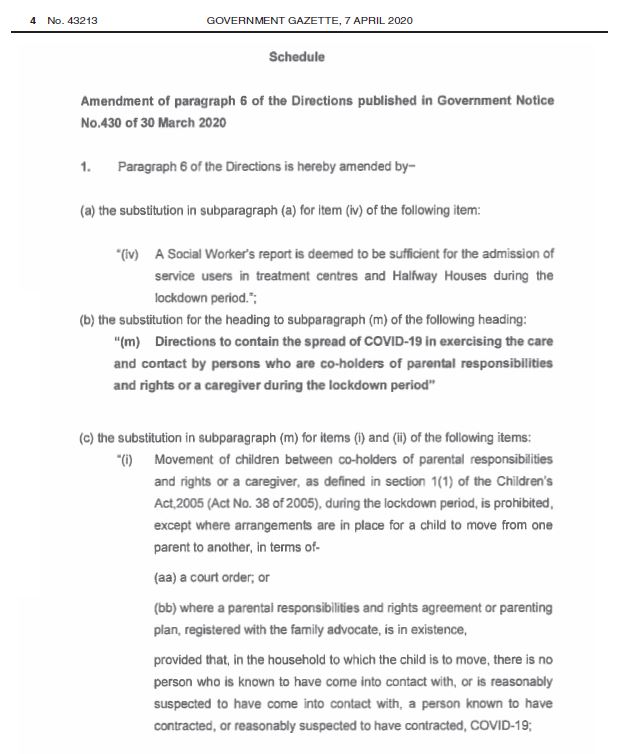
If you have a court order, or a parental responsibilities and rights agreement or parenting plan registered with the office of the Family Advocate, you can move children during the lockdown period, if certain conditions are met.

Today, the Minister of Social Development, Ms Lindiwe Zulu, MP, made changes to the regulations regarding the movement of children during the lockdown period. It is now possible for certain children to be moved between parents during the lockdown period.

The regulations apply to the following parents only:

  1. There are arrangements in place for the children to move for one parent to another in terms of a court order; or
  2. A parental responsibilities and rights agreement or parenting plan registered with the office of the Family Advocate; and
  3. In the household to which the child is to move, there is no person who is known to have come into contact with, or is reasonably suspected to have come into contact with, a person known to have contracted, or reasonably suspected to have contracted, COVID-19;
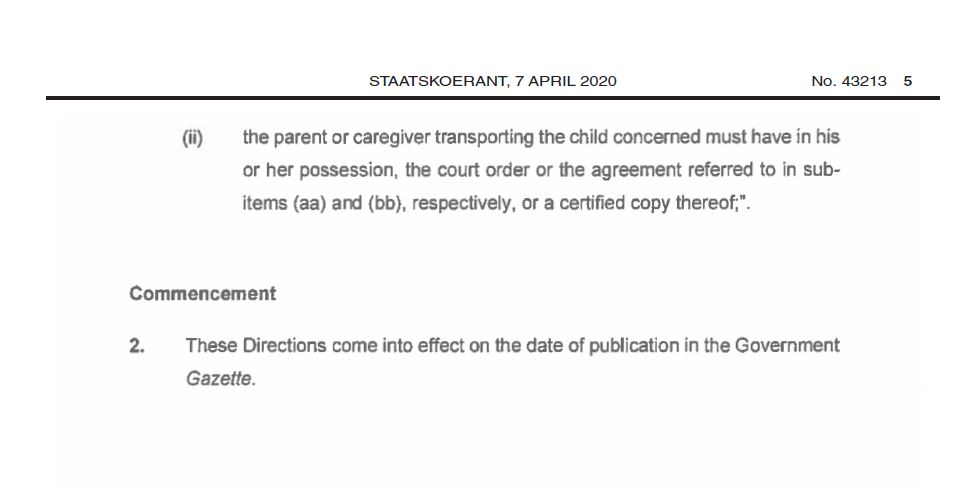
  4. The parent or caregiver transporting the child concerned must have in his or her possession, the court order or the latter agreement, or a certified copy thereof.
Below are the relevant regulations: Lockdown Regulations Movement of Children allowed with Court Order Lockdown Regulations Movement of Children allowed with Court Order  

Updated: 16 April 2020

New regulations have been issued on 16 April 2020. Click on the link below:

The material change is that you do not have to have a court order or a parental responsibilities and rights agreement or parenting plan, registered with the family advocate. Possession of a birth certificate or certified copy of a birth certificate is now also allowed.

If you have a court order, or a parental responsibilities and rights agreement or parenting plan registered with the office of the Family Advocate, you can move children during the lockdown period, if certain conditions are met.

Today, the Minister of Social Development, Ms Lindiwe Zulu, MP, made changes to the regulations regarding the movement of children during the lockdown period. It is now possible for certain children to be moved between parents during the lockdown period.

The regulations apply to the following parents only:

  1. There are arrangements in place for the children to move for one parent to another in terms of a court order; or
  2. A parental responsibilities and rights agreement or parenting plan registered with the office of the Family Advocate; and
  3. In the household to which the child is to move, there is no person who is known to have come into contact with, or is reasonably suspected to have come into contact with, a person known to have contracted, or reasonably suspected to have contracted, COVID-19;
  4. The parent or caregiver transporting the child concerned must have in his or her possession, the court order or the latter agreement, or a certified copy thereof.

Below are the relevant regulations:

Lockdown Regulations Movement of Children allowed with Court Order

Lockdown Regulations Movement of Children allowed with Court Order


Related Post

Top tips from a Senior Family Law Advocate on how to deal with your Child Custody matter in the Ulundi Children’s Court


Family law legal matters can be very stressful. This is so whether you live in Ulundi or any other city in South Africa. Especially so if you have no idea how the legal processes work. It is one thing to know that you are entitled to child support, but it is a totally different matter to know the law and procedure on how to claim child support. Luckily in child maintenance matters, the maintenance court is there to assist you in completing the application form. However, many times that is not enough. Especially so if the other parent has a lawyer and knows how to present the case for his or her client.

This article, however, deals with some top tips in care and contact or custody matters in the Children’s Court in Ulundi. It would explain the processes involved and advise on how to be best prepared for your matter. This advice is applicable whether you live in Ulundi or any other city in South Africa.

What to do before visiting the Ulundi Children’s Court

Before you approach the Children’s Court in Ulundi, first try to resolve the issues with the other parent. Therefore, if you want more contact with your child and the other parent is refusing, try to resolve the matter first with that parent. If that does not work, try mediation. The mediator can be anyone, from a trusted mutual friend, priest, or other religious leaders, or a professional like an attorney, psychologist, or the office of the Family Advocate. Ulundi has many professionals that can assist you in this regard. If resolving the matter by yourselves is not possible, or mediation fails, then we suggest you approach the Ulundi Children’s Court for assistance.

TIP: Focus on getting someone neutral to assist in mediating your matter. Organisations like FAMSA and FAMAC can be of assistance. Google them.

Approaching the Ulundi Children’s Court

The Ulundi Children’s Court should be approached if it is the closest Children’s Court to you. You need to verify with the Ulundi Children’s Court that you fall under their area of jurisdiction. If not, they would direct you to which Children’s Court is applicable to you.

Once you arrive at the Ulundi Children’s Court, they will provide you with a form headed “Bringing Matter to Court in Terms of Section 53 Children’s Act, 2005 (Act no. 38 of 2005) Regulation Relating to Children’s Court and International Child Abduction, 2008 [Regulation 6]. This form is also called Form 2.

In this form, you will provide all your particulars and that of the child or children and the other parent. The sections in the form are as follows:

  • PART A: PARTICULARS OF CHILD(REN)
  • PART B: PARTICULARS OF *CHILD WHO IS AFFECTED BY OR INVOLVED IN THE MATTER/PERSON *ACTING IN THE INTEREST OF THE CHILD/*ON BEHALF OF THE CHILD WHO CANNOT ACT IN HIS/HER OWN NAME/ *MEMBER OF A GROUP OF CLASS OF CHILDREN/*IN THE PUBLIC INTEREST (SECTION 53(2)
  • PART C: PARTICULARS OF PERSONS HAVING AN INTEREST IN THE MATTER
  • PART D: PARTICULARS OF MATTER

In part D, the following is stated which you need to provide in the form:

  • Nature of matter brought to Court: (Please give full details of the matter e.g., registration/amendment of parenting plans, removal of child to safe care, children in need of care and protection, placement in youth care centers, adoption etc.
  • Documents: Are there any documents relating to the matter? (If so please attach)

Once you have completed the form and attached the relevant documents to it, you must take it to a commissioner of Oaths to have it commissioned. It does not have to be in Ulundi.

TIP: Draft a separate affidavit explaining your case. Outline some background information and reasons why the Court should give you what you request. Attach it to Form 2.

Processing your Application at the Ulundi Children’s Court

Once you complete the Form A and submit it to the Clerk of the Ulundi Children’s Court, they will process it and allocate it a case number or reference number. The Clerk of the Court would then allocate a date to the matter and advise the parties accordingly when the court date is. Please note that some courts follow a different process for processing the application and informing the parties of the court date. Please enquire from the Court when making the application what process they follow.

TIP: Obtain the contact details of the Court for you to contact them to obtain the Court date or other information. Ask for their contact number and email address.

Appearing in the Ulundi Children’s Court

When notified of the Court date, both you and the other parent should attend. If you are making use of a lawyer (Advocate or Attorney), inform them timeously of the date. Depending on the Court, you may first see the Clerk or go directly to the Magistrate. The Children’s Court would do its best to try to resolve the matter. If the parents cannot come to an agreement, the Children’s Court may postpone the matter for either of the following:

  • Get a social worker involved in the matter;
  • Appoint a legal representative for the minor child;
  • Implement interim care and contact arrangements;
  • Having the parties attempt to agree on a parenting plan;
  •  

In serious matters, the Court may remove the minor child from both parents and place the child in foster care. The powers of the Children’s Court are extensive. It will, however, focus on what is in the child’s best interests.

TIP: Be as vocal as possible. Do not expect the Court to be understanding of your case or be on your side. It is your duty to explain your case and provide the Court with all the relevant information they require for them to make a fair decision.

Finalising the matter in the Ulundi Children’s Court

Once the Ulundi Children’s Court has enough information to make a final decision, it will do so. Depending on the facts of the matter, that could either be making a Parenting Plan, an Order of the Court or a final care and contact Order. The Court may even make further interim orders, where the parties are to return to Court after a few months, or a year later.

TIP: Do not agree to something just because the social worker, a lawyer, or the Court suggest it. You need to be happy with what is decided.

The above Ulundi Children’s Court Application tips should apply to the following provinces and cities:

Eastern Cape:

Alice, Butterworth, East London, Graaff-Reinet, Grahamstown, King William’s Town, Mthatha

Port Elizabeth, Queenstown, Uitenhage, Zwelitsha

Free State:

Bethlehem. Bloemfontein, Jagersfontein, Kroonstad, Odendaalsrus, Parys, Phuthaditjhaba, Sasolburg, Virginia, Welkom

Gauteng:

Benoni, Boksburg, Brakpan, Carletonville, Germiston, Johannesburg, Krugersdorp, Pretoria, Randburg, Randfontein, Roodepoort, Soweto, Springs, Vanderbijlpark, Vereeniging

KwaZulu-Natal:

Durban, Empangeni, Ladysmith, Newcastle, Pietermaritzburg, Pinetown, Ulundi, Umlazi

Limpopo:

Giyani, Lebowakgomo, Musina, Phalaborwa, Polokwane, Seshego, Sibasa, Thabazimbi

Mpumalanga:

Emalahleni, Nelspruit, Secunda, North West, Klerksdorp, Mahikeng, Mmabatho, Potchefstroom, Rustenburg, Northern Cape, Kimberley, Kuruman, Port Nolloth

Western Cape:

Bellville, Ulundi, Constantia, George, Hopefield, Oudtshoorn, Paarl, Simon’s Town, Stellenbosch, Swellendam, Worcester

ABC Steps to Appealing to the Constitutional Court of South Africa

If you are unhappy with a Court’s decision, you have a right to take the decision on appeal. Section 2 of the Constitution of the Republic of South Africa (Act 108 of 1996)  states: This Constitution is the supreme law of the Republic; law or conduct inconsistent with it is invalid, and the obligations imposed by it must be fulfilled. Therefore, any act of parliament (e.g. Legislation) or decision of the government must be in conformity with the rights and obligations entrenched in our Constitution. In South Africa, we have the Constitutional Court. This is stated in Section 166 of our Constitution. Section 167 of the Constitution, with its subsections, states the following:
  1. The Constitutional Court consists of the Chief Justice of South Africa, the Deputy Chief Justice and nine other judges.
  2. A matter before the Constitutional Court must be heard by at least eight judges.
  3. The Constitutional Court ­
  4. is the highest court of the Republic; and
  5. may decide
  6. constitutional matters; and
  7. any other matter, if the Constitutional Court grants leave to appeal on the grounds that the matter raises an arguable point of law of general public importance which ought to be considered by that Court; and
  8. makes the final decision whether a matter is within its jurisdiction. 
  9. Only the Constitutional Court may ­
  10. decide disputes between organs of state in the national or provincial sphere concerning the constitutional status, powers or functions of any of those organs of state;
  11. decide on the constitutionality of any parliamentary or provincial Bill, but may do so only in the circumstances anticipated in section 79 or 121;
  12. decide applications envisaged in section 80 or 122;
  13. decide on the constitutionality of any amendment to the Constitution;
  14. decide that Parliament or the President has failed to fulfil a constitutional obligation; or
  15. certify a provincial constitution in terms of section 144. 
  16. The Constitutional Court makes the final decision whether an Act of Parliament, a provincial Act or conduct of the President is constitutional, and must confirm any order of invalidity made by the Supreme Court of Appeal, the High Court if South Afirca, or a court of similar status, before that order has any force.
  17. National legislation or the rules of the Constitutional Court must allow a person, when it is in the interests of justice and with leave of the Constitutional Court ­
  18. to bring a matter directly to the Constitutional Court; or
  19. to appeal directly to the Constitutional Court from any other court. 
  20. A constitutional matter includes any issue involving the interpretation, protection or enforcement of the Constitution.
Therefore, if you want to challenge a court’s decision on a Constitutional basis, the highest court you can go to is the Constitutional Court.

How do I take a matter to the Constitutional Court?

The Constitutional Court has its own rules. Therein, you would find the procedure to follow when bringing a matter to the Constitutional Court. Constitutional Court Rule 19 deals with Appeals. It states the following:
  1. Appeals
(1) The procedure set out in this rule shall be followed in an application for leave to appeal to the Court where a decision on a constitutional matter, other than an order of constitutional invalidity under section 172(2)(a) of the Constitution, has been given by any court including the Supreme Court of Appeal, and irrespective of whether the President has refused leave or special leave to appeal. (2) A litigant who is aggrieved by the decision of a court and who wishes to appeal against it directly to the Court on a constitutional matter shall, within 15 days of the order against which the appeal is sought to be brought and after giving notice to the other party or parties concerned, lodge with the Registrar an application for leave to appeal: Provided that where the President has refused leave to appeal the period prescribed in this rule shall run from the date of the order refusing leave. (3) An application referred to in subrule (2) shall be signed by the applicant or his or her legal representative and shall contain— (a) the decision against which the appeal is brought and the grounds upon which such decision is disputed; (b) a statement setting out clearly and succinctly the constitutional matter raised in the decision; and any other issues including issues that are alleged to be connected with a decision on the constitutional matter; (c) such supplementary information or argument as the applicant considers necessary to bring to the attention of the Court; and (d) a statement indicating whether the applicant has applied or intends to apply for leave or special leave to appeal to any other court, and if so— (i) which court; (ii) whether such application is conditional upon the application to the Court being refused; and (iii) the outcome of such application, if known at the time of the application to the Court. (4) (a) Within 10 days from the date upon which an application referred to in subrule (2) is lodged, the respondent or respondents may respond thereto in writing, indicating whether or not the application for leave to appeal is being opposed, and if so the grounds for such opposition. (b) The response shall be signed by the respondent or respondents or his or her or their legal representative. (5) (a) A respondent or respondents wishing to lodge a cross-appeal to the Court on a constitutional matter shall, within 10 days from the date upon which an application in subrule (2) is lodged, lodge with the Registrar an application for leave to cross-appeal. (b) The provisions of these rules with regard to appeals shall apply, with necessary modifications, to cross-appeals. (6) (a) The Court shall decide whether or not to grant the appellant leave to appeal. (b) Applications for leave to appeal may be dealt with summarily, without receiving oral or written argument other than that contained in the application itself. (c) The Court may order that the application for leave to appeal be set down for argument and direct that the written argument of the parties deal not only with the question whether the application for leave to appeal should be granted, but also with the merits of the dispute. The provisions of rule 20 shall, with necessary modifications, apply to the procedure to be followed in such procedures. As you would note, you should first obtain leave to appeal. Once that has been granted, you can then go ahead with the next steps.

What is the procedure once leave to appeal has been granted?

Rule 20 of the Constitutional Court Rules deals with the Procedure on Appeal. It states:
  1. Procedure on appeal
(1) If leave to appeal is given in terms of rule 19, the appellant shall note and prosecute the appeal as follows— (a) The appellant shall prepare and lodge the appeal record with the Registrar within such time as may be fixed by the Chief Justice in directions. (b) Subject to the provisions of subrule (1)(c) below, the appeal record shall consist of the judgment of the court from which the appeal is noted, together with all the documentation lodged by the parties in that court and all the evidence which may have been led in the proceedings and which may be relevant to the issues that are to be determined. (c) (i) The parties shall endeavour to reach agreement on what should be included in the record and, in the absence of such agreement, the appellant shall apply to the Chief Justice for directions to be given in regard to the compilation of the record. (ii) Such application shall be made in writing and shall set out the nature of the dispute between the parties in regard to the compilation of the record and the reasons for the appellant’s contentions. (iii) The respondent may respond to the application within 10 days of being served with the application and shall set out the reasons for the respondent’s contentions. (iv) The Chief Justice may assign the application to one or more judges, who may deal with the matter on the papers or require the parties to appear before him or her or them on a specified day and at a specified time to debate the compilation of the record. (v) The judge or judges concerned shall give directions in regard to the compilation of the record, the time within which the record is to be lodged with the Registrar and any other matters which may be deemed by him or her or them to be necessary for the purpose of enabling the Court to deal with the appeal, which directions may include that the matter be referred back to the court a quo for the hearing of additional evidence specified in the directions, or that additional evidence be put before the Court by way of affidavit or otherwise for the purpose of the appeal. (2) (a) One of the copies of the record lodged with the Registrar shall be certified as correct by the Registrar of the court appealed from. (b) Copies of the record shall be clearly typed on stout A4-size paper, double-spaced in black record ink, on one side of the paper only. (c) Legible documents that were typed or printed in their original form such as cheques and the like shall not be retyped and clear photocopies on A4-size paper shall be provided instead. (d) The pages shall be numbered clearly and consecutively and every tenth line on each page shall be numbered and the pagination used in the court a quo shall be retained where possible. (e) Bulky records shall be divided into separate conveniently-sized volumes of approximately 100 pages each. The record shall be securely bound in book format to withstand constant use and shall be so bound that upon being used will lie open without manual or other restraint. (f) All records shall be securely bound in suitable covers disclosing the case number, names of the parties, the volume number and the numbers of the pages contained in that volume, the total number of volumes, the court a quo and the names of the attorneys of the parties. (g) The binding required by this rule shall be sufficiently secure to ensure the stability of the papers contained within the volume; and where the record consists of more than one volume, the number of each volume and the number of the pages contained in a volume shall appear on the upper third of the spine of the volume. (h) Where documents are lodged with the Registrar, and such documents are recorded on a computer disk, the party lodging the document shall where possible also make available to the Registrar a disk containing the file in which the document is contained, or transmit an electronic copy of the document concerned by e-mail in a format determined by the Registrar which is compatible with software that is used by the Court at the time of lodgement, to the Registrar at: [email protected]: Provided that the transmission of such copy shall not relieve the party concerned from the obligation under rule 1(3) to lodge the prescribed number of hard copies of the documents so lodged. (i) If a disk is made available to the Registrar the file will be copied and the disk will be returned to the party concerned. Where a disk or an electronic copy of a document other than a record is provided, the party need lodge only 13 copies of the document concerned with the Registrar. (3) If a record has been lodged in accordance with the provisions of paragraphs (b) and (c) of subrule (1), the Registrar shall cause a notice to be given to the parties to the appeal requiring— (a) the appellant to lodge with the Registrar written argument in support of the appeal within a period determined by the Chief Justice and specified in such notice; and (b) the respondent to lodge with the Registrar written argument in reply to the appellant’s argument by a specified date determined by the Chief Justice, which shall be subsequent to the date on which the appellant’s argument was served on the respondent. (4) The appellant may lodge with the Registrar written argument in answer to the respondent’s argument within 10 days from the date on which the respondent’s argument was served on the appellant. (5) The Chief Justice may decide whether the appeal shall be dealt with on the basis of written arguments only. (6) Subject to the provisions of subrule (5), the Chief Justice shall determine the date on which oral argument will be heard, and the Registrar shall within five days of such determination notify all parties to the appeal of the date of the hearing by registered post or facsimile.

What are the Steps in Summary:

  1. Within 15 days of the Order you are appealing against, lodged you Application for leave to appeal [Rule 19(2)]
  2. Within 10 days, the Respondent is to file its Notice to Oppose the appeal and the grounds for the opposition [Rule 19(4)(a)]
  3. The Constitutional Court would then decide whether or not to grant the leave to Appeal [Rule 19(6)(a)]
  4. If leave to appeal is granted, the appellant shall prepare and lodge the appeal record with the Registrar [Rule 20(1)(a)]
  5. The Chief Justice may decide whether the appeal shall be dealt with based on written arguments only [Rule 20(5)]
  6. The matter would be argued on the date provided by the Constitutional Court.

Best of luck with your appeal.

Do you require a video legal advice consultation?

Click here and schedule one today!