Looking for Family Legal Services in Bellville– Child Maintenance, Child Custody, Visitation Rights and Divorce Here at our law officers, we understand the struggle of your anxious search for family legal services. Most often, you under the impression that you may not find the legal services you require within close Continue Reading
Uncategorized
How do I find an Attorney Firm in Cape Town for you?
When you get yourself into legal trouble or require some type of legal services, finding an attorney is something to strongly consider. An attorney is trained in the law and would be able to advise you on the best course of action to take. If your legal problem relates to something very serious, for instance, a divorce or a criminal charge, then having a good attorney on your side is strongly encouraged. Here are some tips for finding an attorney for you:- Define Your Needs: Identify the specific legal services you require (e.g., family law, criminal defence, corporate law).
- Research Online: Use legal directories;
- Check Reviews and Ratings: Look for client reviews and ratings to gauge the firm’s reputation and client satisfaction.
- Ask for Recommendations: Reach out to friends, family, or colleagues who may have had similar legal needs for personal recommendations.
- Evaluate Experience: Consider the firm’s experience in your specific legal issue, including years in practice and case outcomes.
- Schedule Consultations: Many firms offer free or less expensive consultations. Use this opportunity to meet attorneys, discuss your case, and assess their communication style.
- Assess Costs: Inquire about fees and billing practices. Understand whether they charge hourly rates, flat fees, or contingency fees.
- Trust Your Instincts: Choose a firm that you feel comfortable with and confident in their ability to handle your case.
- Verify Credentials: Check the attorneys’ qualifications and any disciplinary history.
- Consider Location: Proximity can be important for ease of communication and meetings.
Taking the time to research and evaluate different firms will help you find the right fit for your legal needs.
How do I find an Attorney Firm in Cape Town for you? When you get yourself into legal trouble or require some type of legal services, finding an attorney is something to strongly consider. An attorney is trained in the law and would be able to advise you on the Continue Reading
Looking for Family Legal Services in Steenberg- Child Maintenance, Child Custody, Visitation Rights and Divorce
Here at our law officers, we understand the struggle of your anxious search for family legal services. Most often, you under the impression that you may not find the legal services you require within close proximity. Look no further.Family Legal Advice Consultancy
We are a family legal consultancy that strive to cater for all your legal needs by offering legal advice and guidance in family law. If you happen to be residing in the Steenberg area, then legal advice is still in your favor. Searching for a legal solution is tough enough and we are fully aware of this. With this in mind, we have made our legal advice and legal guidance easily accessible for your convenience. Our online system enables you to make an online appointment for a professional legal consultation within minutes, while in the comfort of your own home.Price listings for Family Legal Services in Steenberg
We have managed to compile a straightforward price list of some of our legal services in which we offer legal advice and legal guidance in. With that being said, we often have potential clients asking us for an overall view of what the service will cost. When it comes to child maintenance, child custody, contested/opposed divorces and so on; then an overview of the cost cannot be provided as this will be depend upon nature and circumstance of the legal matter. See our legal services page for an idea of what some of our legal services will cost.Legal Advice in Steenberg– Family law legal topics
For family law legal topics, we offer legal advice on a variety of family law topics, which include, but is not limited to:- Child Maintenance
- Ante-nuptial Contact
- Change Matrimonial Property Regime
- Child Adoption
- Child Custody and Access
- Domestic Violence Protection
- Family Trust Registration
- Fast Unopposed Divorces
- Non-Compliance with maintenance orders
- Parenting Plans
- Postnuptial Contract Registration
- Pre-nikkah Agreement
And while our consultation does come at a fee of R800; we have made our free, expert legal advice articles on our website, easily accessible for the layperson. See the following free, expert legal advice articles which was carefully crafted by the legal expert himself. These articles can be found within the following categories:Child Maintenance
- How to Apply for Child Maintenance at Court – Step by Step Guide and Advice
- Child Maintenance Question. How much should I pay or contribute as a p
- Child Support or maintenance claims. Does an unemployed father pay?
- Non-compliance with Maintenance Orders — Civil and Criminal Remedies
- Tricks and tips on how to win your child maintenance case
Child Custody
- The Law Regarding Children – The Children’s Act 38 of 2005
- Child born out of wedlock: Mother will not consent to her surname change and to be registered as her biological father. What can I do?
- How do I get full custody over my child?
- Parental Child Abuse in Custody Cases
- Relocate with minor child. Parent Refusing Consent for a Passport
- Father being refused contact to his child! What are his rights as a Father?
- Father’s Parental Responsibilities and Rights to his Child
- Urgent Access to your Children without a Lawyer
- Parenting Plans and the Law
- What happens in a custody dispute where one parent is mentally ill?
- How to win your child custody and access court case – Tips and Tricks
- Rights of care, contact and guardianship of grandparents to their grandchildren – What does the law say?
Divorce and Property
- How to Change your Matrimonial Property Regime
- Do your own Unopposed Divorce. No lawyers needed and its Free.
- Parental Rights of Divorced Muslim parents after a Talaq or Faskh
- Free Online Divorce Assistance Form – DIY Cape Town South Africa comprising of:
So whether you’re residing in the Northern or Southern suburbs, we can assist you in your legal plight. Call our law offices on 021 424 3487, and have our friendly receptionist make an online appointment for you for a face to face, telephonic or Video Chat/Skype legal consultation.Legal consultation – telephonic, face to face or via video chat / Skype legal advice for those residing in Steenberg
Are you residing in Steenbergb and concerned that legal advice and legal guidance may be out of your way? This could never be more far off from the truth. Our professional legal consultancy have taken such circumstances into account and have managed to accommodate for those residing in the Steenberg area. Our professional legal consultation can take place by virtue of video chat / Skype, email or telephonic for your convenience. We are currently based at Suit 702, 7th Floor, The Pinnacle (on the corner of Burg and Strand Street). Do you require an Attorney to handle your legal matter? No problem. Our law offices have built a wealth of legal connections to ease your plight. After assessing your legal matter during the consultation, we can refer you to an Attorney if necessary. However, we have managed to sustain a convenient online operation which will unfold within the following ways:- Call our friendly receptionist and ask to have an appointment made for you online which will only take a minute or two.
- You have the choice of deciding whether you would like a telephonic, email, video chat/Skype legal consultation.
- Once you call our law offices on 021 424 3487, the receptionist will make an appointment online for you. Thereafter, you will receive an automated email which will contain all relevant details about the legal consultation. The date, time, nature of legal matter and payments methods will be highlighted within the email.
- We urge potential clients to read their email well as well as the terms and conditions within the email.
- Only once payment has been made, will the face to face legal consultation be confirmed.
- Bear in mind that the date and time of the legal consultation is subject to change on either our part or the potential client’s part. Hence the potential client is free to change the date and time should they later find a more convenient date or time.
Call our law offices on 021 424 3487, and have our friendly receptionist make an online appointment for you for a face to face, telephonic or Video Chat/Skype legal consultation.Free legal products if you live in Steenberg
Our law offices does not offer pro bono legal services as we are a Family Legal Consultancy that aims at offering expert, efficient legal advice and assistance on child maintenance, divorce, child custody and so forth. We have however, as mentioned previously, made our free, expert legal advice accessible to the layperson on our website. The creators of this website have compiled a “Free Family Law Resources” section, which can be found on our home page. The family law resources are as follows:- Free Basic Will Tool Kit
- Free Shariah Will Template
- Free Divorce Starter Tool Kit
- Free Child Maintenance Calculator
- Free DIY Urgent Child Contact Toolkit
- Urgent Holiday Contact Toolkit
You can now enjoy free, expert legal advice at the touch of a button. Call our law offices on 021 424 3487, and have our friendly receptionist make an online appointment for you for a face to face, telephonic or Video Chat/Skype legal consultation. Connect with us today!
Looking for Family Legal Services in Steenberg- Child Maintenance, Child Custody, Visitation Rights and Divorce Here at our law officers, we understand the struggle of your anxious search for family legal services. Most often, you under the impression that you may not find the legal services you require within close Continue Reading
Updated: 16 April 2020
New regulations have been issued on 16 April 2020. Click on the link below: The material change is that you do not have to have a court order or a parental responsibilities and rights agreement or parenting plan, registered with the family advocate. Possession of a birth certificate or certified copy of a birth certificate is now also allowed.Update: 07 April 2020
NEW LOCKDOWN REGULATIONS REGARDING THE MOVEMENT OF CHILDREN – CERTAIN PARENTS MAY MOVE CHILDREN DURING THE NATIONAL LOCKDOWN PERIOD (7 April 2020)Latest Directives by the Minister of Social Development regarding the movement of children during the National Lockdown (30 March 2020)
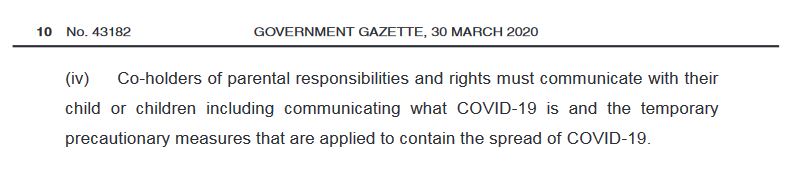
On 30 March 2020, the Minister of Social Development, Ms Lindiwe D Zulu, issued directives in order to prevent and combat the spread of the COVID-19. The directives in relation to parental contact are as follows: (m)Directions to contain the spread of COVID-19 in exercising the care and contact by persons who are co-holders of parental responsibilities and rights during the lockdown period (i) Movement of children between co-holders of parental responsibilities during the lockdown period is prohibited. This is to ensure that the child is not exposed to any possible infection whilst moving from primary caregiver premises to the other; (ii) The child must remain in the custody of the parent with whom the child was with, when lockdown period started; (iii) The parent who is not with the child during the lockdown period may, in order to maintain a personal relationship with the child, communicate on a regular basis with the child in any other manner, including telephone or any other form of electronic communication which may also include skype, WhatsApp or video call; (iv)Co-holders of parental responsibilities and rights must communicate with their child or children including communicating what COVID-19 is and the temporary precautionary measures that are applied to contain the spread of COVID-19. Click here to download the directives from the Government site. Below are images are the directives. 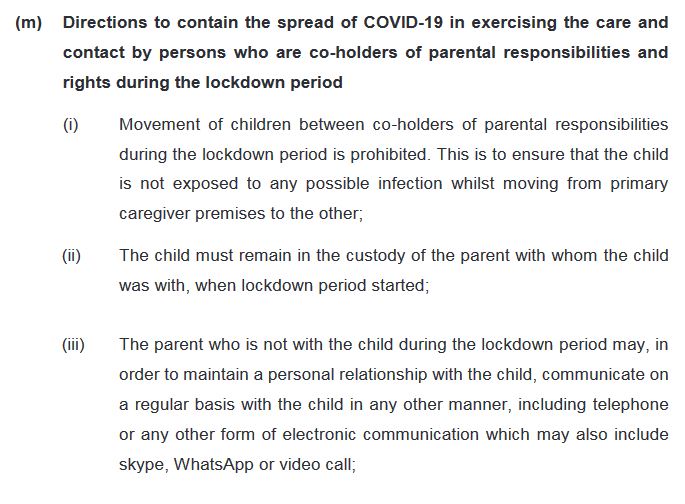
Update: 07 April 2020
NEW LOCKDOWN REGULATIONS REGARDING THE MOVEMENT OF CHILDREN – CERTAIN PARENTS MAY MOVE CHILDREN DURING THE NATIONAL LOCKDOWN PERIOD (7 April 2020)
Updated: 16 April 2020 New regulations have been issued on 16 April 2020. Click on the link below: The material change is that you do not have to have a court order or a parental responsibilities and rights agreement or parenting plan, registered with the family advocate. Possession of a Continue Reading
Top tips and tricks from a Senior Family Law Advocate on claiming maintenance for a five-year-old child in Klerksdorp.
Child Maintenance is the right of the child, and not that of the parent. It is also not a privilege granted to parents who must pay it. It is their duty to pay child maintenance and support their children. Once the child is self-supporting (being able to care for him or herself), the obligation falls away. This can happen when the child is 18, 20, or even 30. It all depends on the circumstances of the case.
Claiming child maintenance for your child in Klerksdorp
Whether you claim child maintenance in Klerksdorp, or any other city in South Africa, the procedures would be the same. There are however two (2) courts that can deal with child maintenance matters. That is a divorce court, in a divorce matter, and a Child Maintenance Court. For this article, we will focus on claiming maintenance in a Maintenance Court matter in Klerksdorp.
The maintenance scenario – Klerksdorp South Africa
In this article, we will deal with the following fictitious scenario, in a child maintenance matter:
- The Child is seven years old and attends school in Klerksdorp
- The child is cared for by the mother who works in Klerksdorp
- The mother works and earns a Salary of R 10 000
- The father sees the child every second weekend. He also lives and works in Klerksdorp
- The child’s monthly expenses are R 6000 – 00 which includes food, clothing, accommodation, education, travel etc.
- The father earns a reasonable salary and can afford the R 20 000 – 00 per month
- The mother claims R 4 000 – 00 maintenance as the father earns double her salary
What is the first step the mother must take in claiming child maintenance?
The first thing the mother must do is work out exactly what the child costs by item. She breaks down the minor child’s living expenses, starting from rent or accommodation to groceries to school fees etc. Once she has done that, she would need to determine what exactly does the minor child cost per month, seeing that she will be asking the father to contribute towards that. As best as possible, she needs to collect proof of expenses. This can be in the form of receipts.
How does she start the legal process?
The mother now needs to approach the maintenance court in the area where she lives or works to lodge a complaint for child maintenance. If she lives or works in Klerksdorp, it would be the maintenance court in Klerksdorp. She will complete a Form A wherein she will provide all the expenses for her and the minor child. She would also have to stipulate her income. Once she completed the form and submitted it to the maintenance court, she must then follow the next step.
What do you do while waiting for the maintenance court date?
While you wait to be informed of the court date by the Maintenance Court of Klerksdorp, and up until the actual first court date, you need to ensure that you keep a record of all income and expenses for you and the child. This is very important as the court allocates maintenance based on recent income and expenses.
What happens at the first court appearance at the Klerksdorp Maintenance Court?
Once you have been notified of the maintenance court date by the Klerksdorp Maintenance Court, you need to ensure that you attend it. On that day, both you and the father of the child would appear before a maintenance officer. The maintenance officer would go through both your income and expenses as well as that of the father. If all the relevant information is not before the maintenance court, then the matter may be postponed in order for the parties to submit it.
The maintenance officer will try to settle the matter and have the parents come to an agreement regarding the amount of child maintenance to be paid. If they cannot come to an agreement regarding the child maintenance to be paid, the matter would have to proceed to a formal hearing or trial before a Magistrate.
How does the Maintenance Court hearing or trial work in Klerksdorp?
Essentially, the maintenance court is called upon to make a fair ruling regarding what is a fair amount of child support that needs to be paid. For that to happen, the parents would have to give evidence in that regard. The mother would present to the court what the child costs, what she contributes and what she requires the other parent to pay. The Father would have a right to question the mother and to present evidence as to why he cannot afford the amount requested or why he feels it is an unfair amount. The mother can they also question him.
At the end of the day, the Klerksdorp Maintenance Court would be able to properly determine what is a fair and adequate amount of child maintenance to pay after being presented will all relevant information. The Klerksdorp Maintenance Court should play an active role in determining what is a fair amount of child maintenance the father should pay.
The above child maintenance application principles should apply to the following provinces and cities:
Eastern Cape:
Alice, Butterworth, East London, Graaff-Reinet, Grahamstown, King William’s Town, Mthatha
Port Elizabeth, Queenstown, Uitenhage, Zwelitsha
Free State:
Bethlehem. Bloemfontein, Jagersfontein, Kroonstad, Odendaalsrus, Parys, Phuthaditjhaba, Sasolburg, Virginia, Welkom
Gauteng:
Benoni, Boksburg, Brakpan, Carletonville, Germiston, Johannesburg, Krugersdorp, Pretoria, Randburg, Randfontein, Roodepoort, Soweto, Springs, Vanderbijlpark, Vereeniging
KwaZulu-Natal:
Durban, Empangeni, Ladysmith, Newcastle, Pietermaritzburg, Pinetown, Ulundi, Umlazi
Limpopo:
Giyani, Lebowakgomo, Musina, Phalaborwa, Polokwane, Seshego, Sibasa, Thabazimbi
Mpumalanga:
Emalahleni, Nelspruit, Secunda, North West, Klerksdorp, Mahikeng, Mmabatho, Potchefstroom, Rustenburg, Northern Cape, Kimberley, Kuruman, Port Nolloth
Western Cape:
Bellville, Klerksdorp, Constantia, George, Hopefield, Oudtshoorn, Paarl, Simon’s Town, Stellenbosch, Swellendam, Worcester
Top tips and tricks from a Senior Family Law Advocate on claiming maintenance for a five-year-old child in Klerksdorp. Child Maintenance is the right of the child, and not that of the parent. It is also not a privilege granted to parents who must pay it. It is their duty Continue Reading
Top tips from a Senior Family Law Advocate on how to deal with your Child Custody matter in the Germiston Children’s Court
Family law legal matters can be very stressful. This is so whether you live in Germiston or any other city in South Africa. Especially so if you have no idea how the legal processes work. It is one thing to know that you are entitled to child support, but it is a totally different matter to know the law and procedure on how to claim child support. Luckily in child maintenance matters, the maintenance court is there to assist you in completing the application form. However, many times that is not enough. Especially so if the other parent has a lawyer and knows how to present the case for his or her client.
This article, however, deals with some top tips in care and contact or custody matters in the Children’s Court in Germiston. It would explain the processes involved and advise on how to be best prepared for your matter. This advice is applicable whether you live in Germiston or any other city in South Africa.
What to do before visiting the Germiston Children’s Court
Before you approach the Children’s Court in Germiston, first try to resolve the issues with the other parent. Therefore, if you want more contact with your child and the other parent is refusing, try to resolve the matter first with that parent. If that does not work, try mediation. The mediator can be anyone, from a trusted mutual friend, priest, or other religious leaders, or a professional like an attorney, psychologist, or the office of the Family Advocate. Germiston has many professionals that can assist you in this regard. If resolving the matter by yourselves is not possible, or mediation fails, then we suggest you approach the Germiston Children’s Court for assistance.
TIP: Focus on getting someone neutral to assist in mediating your matter. Organisations like FAMSA and FAMAC can be of assistance. Google them.
Approaching the Germiston Children’s Court
The Germiston Children’s Court should be approached if it is the closest Children’s Court to you. You need to verify with the Germiston Children’s Court that you fall under their area of jurisdiction. If not, they would direct you to which Children’s Court is applicable to you.
Once you arrive at the Germiston Children’s Court, they will provide you with a form headed “Bringing Matter to Court in Terms of Section 53 Children’s Act, 2005 (Act no. 38 of 2005) Regulation Relating to Children’s Court and International Child Abduction, 2008 [Regulation 6]. This form is also called Form 2.
In this form, you will provide all your particulars and that of the child or children and the other parent. The sections in the form are as follows:
- PART A: PARTICULARS OF CHILD(REN)
- PART B: PARTICULARS OF *CHILD WHO IS AFFECTED BY OR INVOLVED IN THE MATTER/PERSON *ACTING IN THE INTEREST OF THE CHILD/*ON BEHALF OF THE CHILD WHO CANNOT ACT IN HIS/HER OWN NAME/ *MEMBER OF A GROUP OF CLASS OF CHILDREN/*IN THE PUBLIC INTEREST (SECTION 53(2)
- PART C: PARTICULARS OF PERSONS HAVING AN INTEREST IN THE MATTER
- PART D: PARTICULARS OF MATTER
In part D, the following is stated which you need to provide in the form:
- Nature of matter brought to Court: (Please give full details of the matter e.g., registration/amendment of parenting plans, removal of child to safe care, children in need of care and protection, placement in youth care centers, adoption etc.
- Documents: Are there any documents relating to the matter? (If so please attach)
Once you have completed the form and attached the relevant documents to it, you must take it to a commissioner of Oaths to have it commissioned. It does not have to be in Germiston.
TIP: Draft a separate affidavit explaining your case. Outline some background information and reasons why the Court should give you what you request. Attach it to Form 2.
Processing your Application at the Germiston Children’s Court
Once you complete the Form A and submit it to the Clerk of the Germiston Children’s Court, they will process it and allocate it a case number or reference number. The Clerk of the Court would then allocate a date to the matter and advise the parties accordingly when the court date is. Please note that some courts follow a different process for processing the application and informing the parties of the court date. Please enquire from the Court when making the application what process they follow.
TIP: Obtain the contact details of the Court for you to contact them to obtain the Court date or other information. Ask for their contact number and email address.
Appearing in the Germiston Children’s Court
When notified of the Court date, both you and the other parent should attend. If you are making use of a lawyer (Advocate or Attorney), inform them timeously of the date. Depending on the Court, you may first see the Clerk or go directly to the Magistrate. The Children’s Court would do its best to try to resolve the matter. If the parents cannot come to an agreement, the Children’s Court may postpone the matter for either of the following:
- Get a social worker involved in the matter;
- Appoint a legal representative for the minor child;
- Implement interim care and contact arrangements;
- Having the parties attempt to agree on a parenting plan;
-
In serious matters, the Court may remove the minor child from both parents and place the child in foster care. The powers of the Children’s Court are extensive. It will, however, focus on what is in the child’s best interests.
TIP: Be as vocal as possible. Do not expect the Court to be understanding of your case or be on your side. It is your duty to explain your case and provide the Court with all the relevant information they require for them to make a fair decision.
Finalising the matter in the Germiston Children’s Court
Once the Germiston Children’s Court has enough information to make a final decision, it will do so. Depending on the facts of the matter, that could either be making a Parenting Plan, an Order of the Court or a final care and contact Order. The Court may even make further interim orders, where the parties are to return to Court after a few months, or a year later.
TIP: Do not agree to something just because the social worker, a lawyer, or the Court suggest it. You need to be happy with what is decided.
The above Germiston Children’s Court Application tips should apply to the following provinces and cities:
Eastern Cape:
Alice, Butterworth, East London, Graaff-Reinet, Grahamstown, King William’s Town, Mthatha
Port Elizabeth, Queenstown, Uitenhage, Zwelitsha
Free State:
Bethlehem. Bloemfontein, Jagersfontein, Kroonstad, Odendaalsrus, Parys, Phuthaditjhaba, Sasolburg, Virginia, Welkom
Gauteng:
Benoni, Boksburg, Brakpan, Carletonville, Germiston, Johannesburg, Krugersdorp, Pretoria, Randburg, Randfontein, Roodepoort, Soweto, Springs, Vanderbijlpark, Vereeniging
KwaZulu-Natal:
Durban, Empangeni, Ladysmith, Newcastle, Pietermaritzburg, Pinetown, Ulundi, Umlazi
Limpopo:
Giyani, Lebowakgomo, Musina, Phalaborwa, Polokwane, Seshego, Sibasa, Thabazimbi
Mpumalanga:
Emalahleni, Nelspruit, Secunda, North West, Klerksdorp, Mahikeng, Mmabatho, Potchefstroom, Rustenburg, Northern Cape, Kimberley, Kuruman, Port Nolloth
Western Cape:
Bellville, Germiston, Constantia, George, Hopefield, Oudtshoorn, Paarl, Simon’s Town, Stellenbosch, Swellendam, Worcester
Top tips from a Senior Family Law Advocate on how to deal with your Child Custody matter in the Germiston Children’s Court Family law legal matters can be very stressful. This is so whether you live in Germiston or any other city in South Africa. Especially so if you Continue Reading
Top tips from a Senior Family Law Advocate on how to deal with your Child Custody matter in the Sasolburg Children’s Court
Family law legal matters can be very stressful. This is so whether you live in Sasolburg or any other city in South Africa. Especially so if you have no idea how the legal processes work. It is one thing to know that you are entitled to child support, but it is a totally different matter to know the law and procedure on how to claim child support. Luckily in child maintenance matters, the maintenance court is there to assist you in completing the application form. However, many times that is not enough. Especially so if the other parent has a lawyer and knows how to present the case for his or her client.
This article, however, deals with some top tips in care and contact or custody matters in the Children’s Court in Sasolburg. It would explain the processes involved and advise on how to be best prepared for your matter. This advice is applicable whether you live in Sasolburg or any other city in South Africa.
What to do before visiting the Sasolburg Children’s Court
Before you approach the Children’s Court in Sasolburg, first try to resolve the issues with the other parent. Therefore, if you want more contact with your child and the other parent is refusing, try to resolve the matter first with that parent. If that does not work, try mediation. The mediator can be anyone, from a trusted mutual friend, priest, or other religious leaders, or a professional like an attorney, psychologist, or the office of the Family Advocate. Sasolburg has many professionals that can assist you in this regard. If resolving the matter by yourselves is not possible, or mediation fails, then we suggest you approach the Sasolburg Children’s Court for assistance.
TIP: Focus on getting someone neutral to assist in mediating your matter. Organisations like FAMSA and FAMAC can be of assistance. Google them.
Approaching the Sasolburg Children’s Court
The Sasolburg Children’s Court should be approached if it is the closest Children’s Court to you. You need to verify with the Sasolburg Children’s Court that you fall under their area of jurisdiction. If not, they would direct you to which Children’s Court is applicable to you.
Once you arrive at the Sasolburg Children’s Court, they will provide you with a form headed “Bringing Matter to Court in Terms of Section 53 Children’s Act, 2005 (Act no. 38 of 2005) Regulation Relating to Children’s Court and International Child Abduction, 2008 [Regulation 6]. This form is also called Form 2.
In this form, you will provide all your particulars and that of the child or children and the other parent. The sections in the form are as follows:
- PART A: PARTICULARS OF CHILD(REN)
- PART B: PARTICULARS OF *CHILD WHO IS AFFECTED BY OR INVOLVED IN THE MATTER/PERSON *ACTING IN THE INTEREST OF THE CHILD/*ON BEHALF OF THE CHILD WHO CANNOT ACT IN HIS/HER OWN NAME/ *MEMBER OF A GROUP OF CLASS OF CHILDREN/*IN THE PUBLIC INTEREST (SECTION 53(2)
- PART C: PARTICULARS OF PERSONS HAVING AN INTEREST IN THE MATTER
- PART D: PARTICULARS OF MATTER
In part D, the following is stated which you need to provide in the form:
- Nature of matter brought to Court: (Please give full details of the matter e.g., registration/amendment of parenting plans, removal of child to safe care, children in need of care and protection, placement in youth care centers, adoption etc.
- Documents: Are there any documents relating to the matter? (If so please attach)
Once you have completed the form and attached the relevant documents to it, you must take it to a commissioner of Oaths to have it commissioned. It does not have to be in Sasolburg.
TIP: Draft a separate affidavit explaining your case. Outline some background information and reasons why the Court should give you what you request. Attach it to Form 2.
Processing your Application at the Sasolburg Children’s Court
Once you complete the Form A and submit it to the Clerk of the Sasolburg Children’s Court, they will process it and allocate it a case number or reference number. The Clerk of the Court would then allocate a date to the matter and advise the parties accordingly when the court date is. Please note that some courts follow a different process for processing the application and informing the parties of the court date. Please enquire from the Court when making the application what process they follow.
TIP: Obtain the contact details of the Court for you to contact them to obtain the Court date or other information. Ask for their contact number and email address.
Appearing in the Sasolburg Children’s Court
When notified of the Court date, both you and the other parent should attend. If you are making use of a lawyer (Advocate or Attorney), inform them timeously of the date. Depending on the Court, you may first see the Clerk or go directly to the Magistrate. The Children’s Court would do its best to try to resolve the matter. If the parents cannot come to an agreement, the Children’s Court may postpone the matter for either of the following:
- Get a social worker involved in the matter;
- Appoint a legal representative for the minor child;
- Implement interim care and contact arrangements;
- Having the parties attempt to agree on a parenting plan;
-
In serious matters, the Court may remove the minor child from both parents and place the child in foster care. The powers of the Children’s Court are extensive. It will, however, focus on what is in the child’s best interests.
TIP: Be as vocal as possible. Do not expect the Court to be understanding of your case or be on your side. It is your duty to explain your case and provide the Court with all the relevant information they require for them to make a fair decision.
Finalising the matter in the Sasolburg Children’s Court
Once the Sasolburg Children’s Court has enough information to make a final decision, it will do so. Depending on the facts of the matter, that could either be making a Parenting Plan, an Order of the Court or a final care and contact Order. The Court may even make further interim orders, where the parties are to return to Court after a few months, or a year later.
TIP: Do not agree to something just because the social worker, a lawyer, or the Court suggest it. You need to be happy with what is decided.
The above Sasolburg Children’s Court Application tips should apply to the following provinces and cities:
Eastern Cape:
Alice, Butterworth, East London, Graaff-Reinet, Grahamstown, King William’s Town, Mthatha
Port Elizabeth, Queenstown, Uitenhage, Zwelitsha
Free State:
Bethlehem. Bloemfontein, Jagersfontein, Kroonstad, Odendaalsrus, Parys, Phuthaditjhaba, Sasolburg, Virginia, Welkom
Gauteng:
Benoni, Boksburg, Brakpan, Carletonville, Germiston, Johannesburg, Krugersdorp, Pretoria, Randburg, Randfontein, Roodepoort, Soweto, Springs, Vanderbijlpark, Vereeniging
KwaZulu-Natal:
Durban, Empangeni, Ladysmith, Newcastle, Pietermaritzburg, Pinetown, Ulundi, Umlazi
Limpopo:
Giyani, Lebowakgomo, Musina, Phalaborwa, Polokwane, Seshego, Sibasa, Thabazimbi
Mpumalanga:
Emalahleni, Nelspruit, Secunda, North West, Klerksdorp, Mahikeng, Mmabatho, Potchefstroom, Rustenburg, Northern Cape, Kimberley, Kuruman, Port Nolloth
Western Cape:
Bellville, Sasolburg, Constantia, George, Hopefield, Oudtshoorn, Paarl, Simon’s Town, Stellenbosch, Swellendam, Worcester
Top tips from a Senior Family Law Advocate on how to deal with your Child Custody matter in the Sasolburg Children’s Court Family law legal matters can be very stressful. This is so whether you live in Sasolburg or any other city in South Africa. Especially so if you Continue Reading
I am in search of a trustworthy attorney or advocate. Please direct me to reputable sources to find one.
There are many reputable sources for legal advice and services. Some options include consulting with an advocate or attorney, reaching out to a legal aid organisation, or searching for legal resources through your various websites. It’s essential to research and choose a reliable source to ensure that you receive accurate and trustworthy legal guidance, advice or representation.When do I decide that there is a need to consult with a lawyer, attorney, or advocate?
Consider consulting with a lawyer, attorney, or advocate if you are facing a legal issue or have questions you need help with. Some everyday situations where you may want to consult a lawyer include: 1. You have been arrested or charged with a crime; 2. You are facing a civil lawsuit or have been served with legal papers. 3. You are considering filing for divorce or dealing with a child custody issue. 4. You are starting a business or need help with business contracts. 5. You are buying or selling a home or other real estate property. 6. You are facing an employment dispute or have questions about your rights as an employee. A lawyer can provide guidance and support throughout the legal process, ensure that your rights are protected, and help you achieve the best possible outcome in your case. I think it’s essential to choose a lawyer with experience in law that pertains to your specific issue and who you feel comfortable working with.Is it better to consult with an attorney or advocate virtually or in person?
Whether it is better to consult with a lawyer virtually or in person depends on your preferences and the nature of your legal issue. Virtual consultations, such as video or phone consultations, can be a convenient option for individuals who cannot travel to a lawyer’s office or prefer the flexibility of consulting with a lawyer from the comfort of their home. Virtual consultations can also benefit individuals with time constraints or who need to consult with a lawyer quickly. However, in-person consultations may be preferable for individuals who prefer face-to-face interaction and feel more comfortable discussing sensitive legal issues. In-person consultations can also allow for a more thorough and detailed discussion of your legal issue and the opportunity to review and sign legal documents on the spot. Ultimately, the decision to consult with a lawyer, attorney or advocate virtually or in person is a personal one and depends on your individual needs and preferences. Many lawyers offer virtual and in-person consultations, so it’s important to discuss your options with your lawyer and choose the best option.What is free legal advice by an attorney or advocate?
Free legal advice refers to providing legal guidance or information without charge or cost to the recipient. This may be provided by legal aid organisations, pro bono attorneys or advocates, or other resources that offer free legal services. Free legal advice can be helpful for individuals who are unable to afford the cost of hiring an attorney or advocate. Still, ensuring that the advice received is accurate and reliable is essential. Free legal advice may only sometimes be able to address complex legal issues or provide ongoing legal representation fully.Are all advocates and attorneys the same?
No, not all lawyers are the same. While the High Court has admitted all advocates and attorneys, they may specialise in different areas of law and have varying levels of experience and expertise. Some lawyers may focus on criminal law, while others specialise in family law, intellectual property law, or other areas. Additionally, lawyers may work in private practice, government agencies, or non-profit organisations, impacting their practice and areas of expertise. I think choosing a lawyer with experience in law is essential.Is there a guarantee that I will win my court case with a lawyer?
No, there is no guarantee that you will win your court case. The outcome of a court case depends on various factors, including the strength of the evidence, the arguments presented by each side, the judge’s interpretation of the law, and other factors. While a lawyer can provide guidance and help prepare your case, they cannot guarantee a specific outcome. It’s essential to have realistic expectations, be prepared for the possibility of an unfavourable outcome, and plan how to proceed if this occurs.How often should I consult with my attorney or advocate?
The frequency with which you should consult with your lawyer depends on the nature of your legal issue and the complexity of your case. In some cases, you may only need to consult with your lawyer once or twice throughout the entire legal process, while in other cases, you may need to communicate with them more frequently. It’s essential to set clear expectations with your lawyer regarding communication and ensure you are both on the same page regarding how often you will check in and what type of updates you can expect. Also, please feel free to ask me any questions or concerns during the legal process. In that case, reaching out to your lawyer as soon as possible would be essential to ensure they can address them effectively.What do I do if I am not happy with the outcome of the court case?
If you are not happy with the outcome of your court case, several options may be available to you, depending on the circumstances of your case. Firstly, you may have the option to file an appeal, which is a formal request for a higher court to review the decision made in your case. You would appeal to the High Court if your matter were heard in the Magistrates Court. An appeal can only be filed if there were errors in the legal process that may have affected the outcome of your case, such as the application of the wrong law, facts, procedural errors and so on. Additionally, suppose that your lawyer provided inadequate representation or made significant errors that may have impacted the outcome of your case. In that case, you may have the option to file a complaint or a malpractice claim against them. I think consulting with a lawyer is essential to determine the best course of action in your specific case. They can guide your legal options and help you make an informed decision about how to proceed.
I am in search of a trustworthy attorney or advocate. Please direct me to reputable sources to find one. There are many reputable sources for legal advice and services. Some options include consulting with an advocate or attorney, reaching out to a legal aid organisation, or searching for legal resources Continue Reading
IN THE HIGH COURT OF SOUTH AFRICA (WESTERN CAPE DIVISION, CAPE TOWN) CASE NO: /2024 In the matter between: KONRAD JOSEPH SCHÜLER (Applicant) Identity number: 590504 5229 08 0 and VANESSA GAIL SCHÜLER (Respondent) Identity number: 600904 0208 08 9 NOTICE OF MOTION TAKE NOTICE that the Applicant intends to make an Application to the above Honourable Court for an Order in the following terms:- The Applicant’s non-compliance with the requirements of forms, service, manner of service and time periods provided in the Uniform Rules of this Honorable Court be condoned insofar as necessary;
- Prior to any proceeds of the sale of portion 19,346, Koppersfontein, Western Cape (the property), being paid to the Respondent:
- the Transferring Attorneys shall retain the sum equal to the outstanding debt of the former joint estate of the parties referred to in clause 3.1.3 of the Consent Paper (the debt), which was made an Order of the Regional Court for the Regional Division of the Western Cape, held in Cape Town, on 24 October 2023, under case number 165/2023 (the divorce Order) and utilise it to settle the debt;
- The Transferring Attorneys shall retain an amount equal to the sum of all payments made by the Applicant and/or debited from his Standard Bank Account calculated from 01 November 2023, which was used to pay the Respondent’s half of the debt, and reimburse the Applicant therewith on behalf of the Respondent;
- The motor vehicle referred to in clause 4.1.2 of the Divorce Order, being a 2011 Hyundai Ix35 2.0 Gls/Executive, with registration number CAA 412805, shall be retained by the Applicant as his sole and exclusive property for which right the Applicant shall forthwith pay the Respondent the sum of R 3 661 (three thousand six hundred and sixty-one rand); and
- Costs of this Application; and
- Further and/or alternative relief.
TAKE NOTICE FURTHER that the Applicant has appointed the firm ADVOCATE MUHAMMAD ABDUROAF, with its details as stated below as his/her Legal Practitioner of record and address at which he/she shall accept notice and service of all process in these proceedings. KINDLY TAKE NOTICE FURTHER that if you intend opposing the Application, you are required to:- inform the Applicant’s Legal Practitioner within 10 (ten) days of receipt hereof of your intention to do so; and
- fifteen days after you have so given notice of your intention to oppose the Application, to file your answering affidavit, if any; and further;
- that you are required to appoint in such notification an address referred to in rule 6 (5) (b) at which you will accept notice and service of all documents in these proceedings.
KINDLY BE ADVISED FURTHER, that if no such notice of intention to oppose is given, the Application will be made on a date and time to be provided by the Registrar of this Honourable Court. TAKE NOTICE FURTHER that the Founding Affidavit of KONRAD JOSEPH SCHÜLER will be used in support of this Application. TAKE NOTICE FURTHER that the Applicant consent to service of any process in these proceedings via email using the email address [email protected]. DATED AT CAPE TOWN ON THIS DAY OF JANUARY 2024. _______________________________ Per: Adv. M Abduroaf (Legal Practitioner of the Applicant) Trust Account Advocate – An advocate as contemplated in section 34(2)(b) of the Legal Practice Act, 28 of 2014 (the Act) Chambers.: The Pinnacle | Suite 702, 7th Floor Corner Strand, Burg & Castle Streets | Cape Town, 8001 Tel.: +2721 111 0090 Email.: [email protected] (Email Service) High Court Box 115 Ref.: M22081/Schüler To: THE HONOURABLE REGISTRAR OF THE WESTERN CAPE HIGH COURT HIGH COURT CAPE TOWN And to: VANESSA GAIL SCHÜLER (Respondent) Ruby Estate, Gems 5 Unit 4, Burgundy Estate CAPE TOWN ________________________O0O___________________
- the Transferring Attorneys shall retain the sum equal to the outstanding debt of the former joint estate of the parties referred to in clause 3.1.3 of the Consent Paper (the debt), which was made an Order of the Regional Court for the Regional Division of the Western Cape, held in Cape Town, on 24 October 2023, under case number 165/2023 (the divorce Order) and utilise it to settle the debt;
- The Transferring Attorneys shall retain an amount equal to the sum of all payments made by the Applicant and/or debited from his Standard Bank Account calculated from 01 November 2023, which was used to pay the Respondent’s half of the debt, and reimburse the Applicant therewith on behalf of the Respondent;
IN THE HIGH COURT OF SOUTH AFRICA (WESTERN CAPE DIVISION, CAPE TOWN) CASE NO: /2024 In the matter between: KONRAD JOSEPH SCHÜLER (Applicant) Identity number: 590504 5229 08 0 and VANESSA GAIL SCHÜLER (Respondent) Identity number: 600904 0208 08 9 NOTICE OF MOTION Continue Reading
Family Law Service – Advocate Muhammad Abduroaf – Finding the best lawyer for you.
Choosing the right law firm (Attorney or Advocate) can be a daunting task in the intricate landscape of legal matters. Whether you’re facing a complex litigation case, navigating corporate law, or seeking legal assistance for personal issues, the decision of which law firm to engage is crucial. At the firm Advocate Muhammad Abduroaf, we understand the significance of this decision, and we aim to demonstrate why choosing our firm can make all the difference.Expertise and Specialisation
One of the primary reasons for choosing our law firm is our expertise and specialisation in diverse legal areas. As you can see from this website, advocate Muhammad Abduroaf practices in various fields of law. This breadth of expertise ensures that no matter the nature of your legal issue, you will have access to knowledgeable and experienced professionals who can provide tailored solutions.Personalised Approach
We recognise that every client and every case is unique. That’s why we prioritise a personalised approach to legal representation. From the moment you engage our services, we take the time to understand your specific needs, concerns, and objectives. This allows us to develop strategies and solutions customised to your circumstances, ensuring the best possible outcome for your case.Commitment to Excellence
At Advocate Muhammad Abduroaf, excellence is not just a goal – it’s our standard. We are committed to providing our clients with the highest quality legal services, characterized by thorough research, meticulous attention to detail, and strategic thinking. Our track record of success speaks for itself, with numerous satisfied clients who have benefited from our dedication to excellence.Responsive and Accessible
Legal matters can be stressful and overwhelming, so we prioritise responsiveness and accessibility. Our team is readily available to address your questions, concerns, and needs throughout your case. Whether you prefer to communicate via phone, WhatsApp, email, or in-person meetings, we are here to provide you with the support and guidance you need when you need it.Cost-Effective Solutions
Legal representation shouldn’t break the bank. That’s why we are committed to providing cost-effective solutions that deliver value for our clients. We offer transparent billing practices and strive to minimise unnecessary expenses wherever possible, ensuring you receive top-notch legal services without the hefty price tag.Ethical and Professional Conduct
Integrity and ethics are at the core of everything we do. Our team adheres to the highest standards of professional conduct, ensuring your case is handled with the utmost integrity, honesty, and discretion. You can trust that your legal matters will be handled with care and respect, and your confidentiality will always be protected. In conclusion, choosing the right law firm can significantly impact the outcome of your legal matters. At Advocate Muhammad Abduroaf, we offer expertise, specialisation, personalised service, commitment to excellence, responsiveness, cost-effective solutions, and ethical conduct. These qualities set us apart and make us the ideal choice for clients seeking top-notch legal representation. Contact us today to learn how we can assist you with your legal needs. If you require an Advocate Law Firm to assist you in your legal matter, feel free to contact us using the following details:- Tel.: 021 111 0090
- Email.: [email protected]
We service clients throughout South Africa. These include: Cape Town Rustenburg Kimberley East London Nelspruit Polokwane Pietermaritzburg Bloemfontein Port Elizabeth Pretoria Durban Johannesburg
- Tel.: 021 111 0090
- Email.: [email protected]
Family Law Service – Advocate Muhammad Abduroaf – Finding the best lawyer for you. Choosing the right law firm (Attorney or Advocate) can be a daunting task in the intricate landscape of legal matters. Whether you’re facing a complex litigation case, navigating corporate law, or seeking legal assistance for personal Continue Reading