 Justice Court Legal Services and Advice Cape Town South Africa[/caption] [caption id="attachment_8332" align="alignleft" width="640"]
 Rights Legal Services and Advice Cape Town South Africa[/caption] [caption id="attachment_8337" align="alignleft" width="503"]
 Legal Document Legal Services and Advice Cape Town South Africa[/caption] [caption id="attachment_8336" align="alignleft" width="640"]
 Legal Representation Legal Services and Advice Cape Town South Africa[/caption] [caption id="attachment_8335" align="alignleft" width="640"]
 Contracts Legal Services and Advice Cape Town South Africa[/caption] [caption id="attachment_8334" align="alignleft" width="640"]
 Lawyer Legal Services and Advice Cape Town South Africa[/caption] [caption id="attachment_8333" align="alignleft" width="640"]
 Consultation Legal Services and Advice Cape Town South Africa[/caption]
Our Lawyer Legal Services – South Africa Make sure you have the right lawyers on your side. Contact Our Lawyer (Pty) Ltd for all your legal needs. To connect, click here.
Uncategorized
Child Maintenance Applications, investigation, preparation and enquiries – What you need to know, and more.Everything you need to know when making a maintenance application at the maintenance court. This includes the filing of the complaint, up until the formal enquiry before a magistrate.
The internet is well-stocked with information written by Advocate Muhammad Abduroaf regarding child maintenance applications and related issues. As he gains more experience and sees the law develop, so does he publish and spread the invaluable knowledge. However, having all that information on different webpages is not forward-thinking. Therefore, we needed to do something about it. We, therefore, decided to provide this lengthy child maintenance application online post which provides practical information from start to finish. Let us begin.Child Maintenance and Applications – How does it work?
Parents must pay child maintenance according to their means. So, if a child’s expenses each month is R 90 (obviously this is a fictitious example) and the father earns R 1 000 a month and the mother R 500 a month, then if all else is equal, the father should contribute R 60 towards the minor child’s expenses, and the mother, R 30. Now that is the long and short of the matter. However, other factors also play a role. They include the necessary expenses of each parent, which determines how much they should contribute, as well as what assets the parents own. For example, if a father earns R 200 a month, and the mother R R600 – 00, the father would pay the majority of the minor child’s expenses if he owns other assets worth R 100 000 – 00 and the mother none. If a parent is not happy with the maintenance he or she is receiving, an application may then be made to the maintenance court for a maintenance order. 
Child maintenance procedure in the maintenance court
The procedures to be followed in instituting a complaint for child maintenance is regulated by the Maintenance Act 99 of 1998. Let us first unpack the basics.From whom may maintenance be claimed?
Maintenance (personal, spousal or child) may be claimed from persons who have a legal obligation to maintain you. For instance, children can claim maintenance from their parents or a wife from her husband and vice versa. Seeing that children are minors, they are assisted by their parent or guardian through the maintenance process, but in fact, it is the child who is claiming.The best interests of the minor child’s principle
When it comes to child maintenance, the child’s best interests are of paramount importance. This principle is immortalised in our Constitution and applied in our Courts of Law. Therefore, concerning child maintenance matters, and specifically to the child maintenance court, the moment a parent applies to child maintenance, the principle should apply. Before we move on, on a side note, it is not only child maintenance that the maintenance court deals with. As stated further above, a spouse may take the other to the maintenance court for personal maintenance.Parental Maintenance Obligations
Both parents have a duty of support towards their minor child’s proper living and upbringing. This should be according to their means, standard of living, station in life, and the needs of the child. This is found in our common law and further applies to divorced parents. According to section 15(2) of the Maintenance Act, the duty “extends to such support as a child reasonably requires for his or her proper living and upbringing, and includes the provision of food, clothing, accommodation, medical care and education.” Furthermore, the duty is not discharged where one parent earns substantially more than the other. According to section 15(3) of the Maintenance Act, in determining the maintenance amount, the maintenance court must take into consideration the following: “(i) that the duty of supporting a child is an obligation which the parents have incurred jointly; (ii) that the parents’ respective shares of such obligation are apportioned between them according to their respective means; and (iii) that the duty exists, irrespective of whether a child is born in or out of wedlock or is born of a first or subsequent marriage. (b) Any amount so determined shall be such amount as the maintenance court may consider fair in all the circumstances of the case.” Lastly, there is an onus on both the maintenance officer and the maintenance magistrate in placing evidence before the court in determining a fair maintenance amount. This is our starting point going forward.What is first looked at in a child maintenance matter? Income and Expenses?
Your first step when wanting to claim child maintenance is to get hold of all your proof of income. For example, payslips. If you are not working for an employer, you should get hold of proof that you earn a certain amount of money per month. Bank statements and financial records would suffice for now. If you are unemployed, you need to show proof thereof. For example, a termination letter from your previous employer.Compile and gather all your proof of expenses for you and your child
This is a crucial step. You must create a list of all monthly expenses incurred for yourself and your children. This would include rent, groceries, clothes, entertainment, etc. This information is required when filling in the maintenance application form that is dealt with in the next step below.Details of the parent you are claiming child maintenance from
Find out all the details of the person from whom you are requesting maintenance. For example, his/her home and work address and identity number. You would also need to obtain the contact details of that person. This would expedite matters. If you do not have all the information, you can still proceed with your application at court. The maintenance investigator referred to further below would be of assistance.What do I do at the Maintenance Court?
Go to the Maintenance Court closes to your area and obtain an “Application for Maintenance Order Form” also referred to as “Form A”. Use the information you have gathered in Step 1 and fill in the form. The form is in the form of an affidavit and you, therefore, have to swear to the correctness of the information under oath and sign. Therefore, do not hide any information for the Court. Caution: If your information is not 100 % correct, you may be cross-examined on such correctness in Court and if it is found that you were not honest, this would not be in your favour. If you require any assistance in filling in the form, the maintenance officers would be happy to assist you. Once you have filled in the Application for Maintenance Order Form, return it to the maintenance officer who will process it for you. If the maintenance officer can provide you with a reference/case number there and then, request it. The Maintenance Court will send you and the person you are claiming maintenance from a letter or subpoena to appear at the Maintenance Court for an inquiry with the maintenance officer. Diarise the date immediately and make arrangements with your work and a babysitter as soon as possible. If you miss the date, it can take months to get another.Processing the Maintenance Application
When a parent approaches the maintenance court for child maintenance, the maintenance clerk must expeditiously process the application. In doing so, the clerk through other resources of the maintenance court, should ascertain the details of the other parent, and ensure that he or she is brought to court as soon as possible for a maintenance enquiry before a maintenance officer. Therefore, for example, should the maintenance clerk not have the living or work address of the father, then he or she must enlist the assistance of the maintenance investigator to obtain it. For that, he or she can make use of the search and tracking resources the maintenance investigator makes use of and has access to.What do you do while waiting on the court date?
From the time you left the office of the maintenance officer and even from the time you decided to claim maintenance, keep all receipts you received for any items bought for you and your child. Therefore, if you buy nappies for your child or even a toy, keep that receipt as if it is gold. This is due to you having to prove to the court that you do spend money on the child and you have the receipts to prove it.Getting the non-paying parent to the maintenance court
After the maintenance application has been processed, the maintenance court must ensure that the non-paying parent makes his or her way to the maintenance court as soon as possible for a maintenance enquiry. This enquiry is held before a maintenance officer. Even if the maintenance court’s diary is quite full, it should still expedite this process, giving both parents adequate time to make arrangements to appear in the maintenance court. Therefore, if the next available date for a maintenance enquiry is in three (3) months, the parties can use this time to make arrangements with their work, obtain necessary information for the enquiry, or make alternative school travelling arrangements for the kids. There should therefore not be a delay in notifying the parents of the date of the maintenance enquiry. Furthermore, when notified of the court date, both parents receive a document stating what information they should bring with to the maintenance enquiry. These include three (3) months bank statements, and salary advice as well as proof of expenses. Giving the parties adequate time to obtain this information would be vital and, in the child’s best interests. The last thing we want is for the matter to be postponed to another date due to either parent not having been given adequate time to obtain the documents, even though the mother made the application many months ago. You will soon hear from the Maintenance Court where they will be giving you a date to appear back at the Maintenance Court for an inquiry. They would either inform you by post or by a subpoena. On that date, both you and the person from whom maintenance is claimed would have to appear. If you are planning on making use of a legal representative, inform him/her early about the date so that he/she can be available to assist you at Court. In the notice to appear for the maintenance enquiry, it is asked that you bring proof of all expenses and income for you and your child. This is why it is so very important for you to keep all proof of expenditure in a safe place. Hint: If you can afford to, bring original proof of expenditure and income and a photocopy thereof. The original you would then be able to take back home and bring it back when requested and the copy will stay in the Court file.The maintenance enquiry before a maintenance officer
The maintenance enquiry before the maintenance officer is the next legal step in the process. This is where things get interesting. Sometimes, at this enquiry, it is the first time the parents are in the same room together, since the child was conceived. Quite often, both parents do not know much about the current financial affairs of the other parent. The parent asked to pay child support, furthermore, does not know what the child costs to maintain. The maintenance officer will speak to each of the parties and look at the documents provided. Each party will get a chance to explain why he/she requires maintenance and also why he/she can’t afford the maintenance requested. The maintenance officer will as far as possible try to resolve the matter there and then without it having to go to court. If the parties can agree to an amount, this amount can be made an order of the court. If, however, an agreement cannot be reached at this stage, the matter, depending on the Court will either be referred to a prosecutor or for trial. Remember, if you are a father or a person currently paying maintenance/child support, a reduction is possible. The same goes for an application for an increase in maintenance/child support Again, the golden standard in which the enquiry should be conducted is that of the child’s best interests. This is of paramount importance. The maintenance officer should, therefore, ensure that all the financial information about the parties are properly disclosed. This is very important. However, at the same time, the maintenance officer should try to settle the matter, taking into consideration the child’s best interests. Should the parents not be forthcoming regarding their income and expenses, and the needs of the child, then the maintenance officer must subpoena witnesses if need be and make use of the maintenance investigator which we deal with next.Denial of paternity – Is it sometimes a delaying tactic?
What sometimes happens, is that the father denies paternity. This he would either do out of spite or due to genuine doubt on his side. This would often be the case if there was a brief encounter between the parents when the child was conceived. Sometimes the father is married to someone else, and for the sake of his current marriage, he needs to deny paternity. Once the paternity tests are finalised, the parties would need to return to court again for the results. If the results are positive, in that he is the father, then the enquiry proceeds. If he is not the biological father, the application is removed from the court roll. The maintenance investigator – Who is it?
Section 7(1)(d) of the Maintenance Act empowers the maintenance officer to “require a maintenance investigator of the maintenance court concerned to perform such other functions as may be necessary or expedient to achieve the objects of this Act.” Section 7(2)(e) of the Maintenance Act empowers the maintenance investigator after so being instructed by the maintenance officer, to: “gather information concerning- (i) the identification or whereabouts of any person who is legally liable to maintain the person mentioned in such complaint or who is allegedly so liable; (ii) the financial position of any person affected by such liability; or (iii) any other matter which may be relevant concerning the subject of such complaint; or (f) gather such information as may be relevant concerning a request referred to in subsection (1) (c). Now that we looked at the importance of the role of the maintenance officer and maintenance investigator, we move on to the role of the maintenance magistrate. This is where the formal enquiry takes place.The maintenance investigator at the Court
Each maintenance court has a maintenance investigator. What this investigator does is gather evidence in a maintenance court case. However, in practice, no one may tell you that there is a maintenance investigator who could assist you in your case. This could be because of the huge amount of maintenance cases that come through the doors of the court. Insist that the maintenance court instructs the maintenance investigator to investigate the financial affairs of the other parent. This you should even more so insist on if the father does not even provide the court with a copy of his salary slip and outline of expenses.Summary of Changes brought by the Maintenance Amendment Act (Act No.9 of 2015)
Not too long ago, amendments were made to the Maintenance Act. Below are some of the amendments:- If there was a verbal or written maintenance agreement (which was not made an order of the court), the maintenance court can be approached to substitute or discharge it. [Section 6(c)]
- You may lodge a complaint at the maintenance court within the area of jurisdiction of where you reside, carry on business or are employed. [Section 6(2)]
- The maintenance court may issue a direction directing one or more electronic communications service providers to furnish the court with the contact information of the person a complaint has been made against to obtain his or her whereabouts. For example, Vodacom, MTN or Cell C can be approached to provide their client’s contact details. [Section 7(3)]
- The maintenance court can make an interim maintenance order even if the other party does not agree to it. [Section 10(6)]
- The maintenance court can provide your details to credit bureaus if you are in default and civil execution of a maintenance order took place. [Section 26(2A)]
- Non-compliance with maintenance orders could have you imprisoned for up to 3 (three) years. [Section 31]
The Evidence – What else can I do to get the best our of my maintenance enquiry?
The outcome of your child maintenance matter would depend on the evidence presented. If there is no proof that the child cost so much, or the other parent earns that much, then you would have serious challenges convincing the court. Below are things to look into when dealing with your maintenance matter.The father’s employer – Can he be brought to court?
Ask the maintenance court to issue a subpoena against the father’s employer for the salary advice of the father. Also, request details of the father’s pension interest the father may have.The father’s banking account – Can the court obtain it?
Obtain the father’s bank statements. Here you should ask the court to subpoena various banking institutions for bank statements of the father. Bank statements hold in them valuable information about the lifestyle of a person. You may find out that the father spends half his money on his cell phone or luxury clothing. You can use this information to show the court that the father can tighten his belt and spend more money on his child. What sometimes happens is, you may find additional income coming into the father’s banking account.Father’s Credit Profile – Is it possible to obtain it without his consent?
Have the maintenance court obtain a credit profile of the father. From the profile, valuable information can be obtained. For example, where he last applied for credit, employment and residential details. If the father says he does not have money, but he applied for credit to purchase a new car, clearly there is money.Social media (Facebook, Twitter, Instagram, Pinterest etc.) – Is it of any use?
These days, many people publish their lives on social media. If the father, in this case, keeps loading pictures and posts of how he lives the good life; that information may be used to show the maintenance court that the father lives a life different than what he wants the court and you to believe. Many people also make use of LinkedIn accounts. On it, they provide updated employment details. This would be useful to show the court should the father say he is an admin clerk. but on LinkedIn tell the world he is a manager. Property Search in maintenance matters – How would it help?
What may be useful, is to do a property search on the father. Here you would find out what property that person owns. For example, the father may rent a house, but own a house in a different province where he obtains rent. That house he could have inherited.Other tips and tricks in child maintenance matters – Is there more?
Each case is different. What would work in one maintenance matter, won’t work in another. For example, if someone is self-employed, and only get paid with cash, the dynamics are different. There won’t be any bank statements or payslips. In such a case, you need to be creative. Maybe ask questions to clients of the father and find out what he does and charges. If you can obtain the names of people the father does business with; that would be very useful. You may provide that information to the maintenance court and the investigator could follow up on it. If the father sees that you are getting somewhere, he may decide to pay a fair amount.The final step – The formal enquiry before a Magistrate
Should the parties not be able to come to an agreement regarding the amount of child maintenance to be paid at the enquiry before the maintenance officer; the matter would have to go before the maintenance magistrate for a formal enquiry. Here the court has to properly consider the means and needs of the mother, the means and needs of the father, and the needs of the minor child. Thereafter, make a maintenance award. There is a legal obligation upon the maintenance officer and the magistrate to conduct a thorough enquiry. The court should not play the role of an umpire. Therefore, a passive attitude should not be taken by a judicial officer in a maintenance enquiry and then give judgment. Should all go well, at the end of the enquiry, a maintenance award would be made.How does the maintenance court make a decision?
Now, this is where it becomes challenging. The maintenance court can only make an order against a parent if there is evidence that he or she can afford the maintenance claimed, and obviously, the amount claimed is fair. The problem in practice is, the mother alleges that the father can afford the child maintenance, but she has no concrete evidence to back it up. The father is also not forthcoming, and only shows evidence that he cannot afford the amount claimed. The mother knows that he can afford the required amount due to his standard of living and what she experienced while they lived together. Your maintenance case is largely dependent on you proving that your child needs the requested amount. If you do not have proof, or cannot prove it, even if you show that the father can afford it, the court won’t order him to pay it. The court would only order him to pay what is fair and proved. Therefore, always ensure that you keep proof of your income and expenses up to date and ready to provide it to court.The parent is unhappy with the maintenance court’s decision – Can I appeal it?
If a parent is not happy with the order the court made, then he or she may appeal the Maintenance Order. What this means, is that a higher court would decide whether the maintenance court made the correct decision. In this case, the higher court would be the High Court. If the maintenance matter was heard in Cape Town, it would then be the Western Cape High Court. As you would see below, the procedure is cumbersome. The entire court record would have to be typed out and read by the High Court Judges. We are certain that you found the above article useful and interesting. Please consider sharing it on the share buttons below. They include Facebook, Twitter, LinkedIn, WhatsApp, Gmail and more. Someone may find it useful as well. Should you require business advice or services, feel free to click on these links: Business SA | Private Legal | Envirolaws
Child Maintenance Applications, investigation, preparation and enquiries – What you need to know, and more. Everything you need to know when making a maintenance application at the maintenance court. This includes the filing of the complaint, up until the formal enquiry before a magistrate. The internet is well-stocked with information Continue Reading
[caption id="attachment_10828" align="alignnone" width="682"]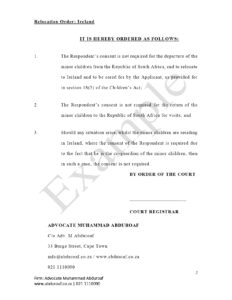 Relocation consent Court Order for minor child to Ireland – Advocate Muhammad Abduroaf[/caption]
I want to relocate from South Africa to Ireland with my minor child. The other parent does not want my child to relocate to Ireland. What can I do?
Ireland is a popular destination to emigrate to. People emigrate from South Africa for many reasons. It ranges from better employment opportunities, family relations, or for a better standard of living. Whatever the reason a parent wants to relocate to Ireland, if a minor child will be joining that parent and also relocating to Ireland, then the parent remaining in South Africa’s consent would usually be required. Let us unpack the legal issues a parent may encounter when wanting to emigrate to Ireland. Before we do so, let us list the various cities and towns in Ireland to which you may want to relocate: Dublin, Cork, Galway, Limerick, Waterford, Drogheda, Dún Dealgan, Swords, Blackrock, Tralee, Carlow, Ennis, Dunleary, Kilkenny, Naas, Sligo, Monaghan, Ros Comáin, Mullingar, Tallaght, Wicklow, Clonmel, Wexford, Longford, Trim, Carrick on Shannon, Tullamore, Nenagh, An Cabhán, Port Laoise, Castlebar, Lifford. (https://simplemaps.com/data/ie-cities) Why do I require the other parent’s Consent to relocate to Ireland?
According to South African law, if you are a co-holder of parental responsibilities and rights over your minor child, you must consent to your child leaving South Africa. In this case, relocating to Ireland. Here we refer to section 18 of the Children’s Act 38 of 2005. The entire provision is as follows: 18 Parental responsibilities and rights (1) A person may have either full or specific parental responsibilities and rights in respect of a child. (2) The parental responsibilities and rights that a person may have in respect of a child, include the responsibility and the right- (a) to care for the child; (b) to maintain contact with the child; (c) to act as guardian of the child; and (d) to contribute to the maintenance of the child. (3) Subject to subsections (4) and (5), a parent or other person who acts as guardian of a child must- (a) administer and safeguard the child’s property and property interests; (b) assist or represent the child in administrative, contractual and other legal matters; or (c) give or refuse any consent required by law in respect of the child, including- (i) consent to the child’s marriage; (ii) consent to the child’s adoption; (iii) consent to the child’s departure or removal from the Republic; (iv) consent to the child’s application for a passport; and (v) consent to the alienation or encumbrance of any immovable property of the child. (4) Whenever more than one person has guardianship of a child, each one of them is competent, subject to subsection (5), any other law or any order of a competent court to the contrary, to exercise independently and without the Consent of the other any right or responsibility arising from such guardianship. (5) Unless a competent court orders otherwise, the Consent of all the persons that have guardianship of a child is necessary in respect of matters set out in subsection (3)(c). Now let us explain what Parental Responsibilities and Rights are.What are Parental Responsibilities and Rights of a parent in relation to a child?
As can be seen from section 18(2) of the Children’s Act, when we refer to Parental Responsibilities and Rights, we refer to the following: (a) to care for the child; (b) to maintain contact with the child; (c) to act as guardian of the child; and (d) to contribute to the maintenance of the child. Therefore, if a parent has parental responsibilities and rights over a minor child, and accordingly, rights of guardianship, their Consent is required when it comes to issues of guardianship. As seen from section 18(3)(c) of the Children’s Act above, both parents’ Consent is required should a minor child depart from the Republic of South Africa. In this case, to emigrate to Ireland. Even if the minor child only wants to go for a short holiday to Ireland, both guardians’ Consent would be required.When would the other parent be seen as a guardian in the case of a relocation matter to Ireland?
It must be noted that not all parents are legal guardians over their minor children. We should therefore distinguish between married or divorced parents and parents who were never married. As you would see below, usually married, or divorced parents’ Consent would be required for a minor child to relocate or emigrate to Ireland. However, that does not automatically apply to parents who were never married. This could be because the child could have been born from a brief encounter and never met his or her father. It would not make sense that a parent who never met his or her 15-year-old child, should give Consent for relocation to Ireland.Mother’s Consent for relocation of the minor child to Ireland
Section 19 of the Children’s Act deals with the Parental responsibilities and rights of mothers. It states the following: 19 Parental responsibilities and rights of mothers (1) The biological mother of a child, whether married or unmarried, has full parental responsibilities and rights in respect of the child. (2) If- (a) the biological mother of a child is an unmarried child who does not have guardianship in respect of the child; and (b) the biological father of the child does not have guardianship in respect of the child, the guardian of the child’s biological mother is also the guardian of the child. (3) This section does not apply in respect of a child who is the subject of a surrogacy agreement. As seen from section 19(1) of the Children’s Act, in most cases involving the relocation of a minor child to Ireland, the mother’s Consent is required as she has full parental responsibilities and rights over the minor child.Married father’s Consent for the relocation of the minor child to Ireland
Section 20 of the Children’s Act deals with Parental responsibilities and rights of married fathers. It states the following: 20 Parental responsibilities and rights of married fathers The biological father of a child has full parental responsibilities and rights in respect of the child- (a) if he is married to the child’s mother; or (b) if he was married to the child’s mother at (i) the time of the child’s conception; (ii) the time of the child’s birth; or (iii) any time between the child’s conception and birth. As can be seen from sections 20 (a) and (b) of the Children’s Act, if the father and the mother were married, or are married, then his Consent is required for the minor child to relocate to Ireland. Of course, an exception to this would be should a court of law order otherwise. This would be the case should the parents be divorced and the divorce court ordered that only the mother may act as guardian. Next, we deal with the issue of an unmarried father’s Consent to relocate a minor child to Ireland.Consent of unmarried fathers for the relocation of their minor children to Ireland.
Section 21 of the Children’s Act deals with parental responsibilities and rights of unmarried fathers. The section states the following: 21 Parental responsibilities and rights of unmarried fathers (1) The biological father of a child who does not have parental responsibilities and rights in respect of the child in terms of section 20, acquires full parental responsibilities and rights in respect of the child- (a) if at the time of the child’s birth he is living with the mother in a permanent life-partnership; or (b) if he, regardless of whether he has lived or is living with the mother- (i) consents to be identified or successfully applies in terms of section 26 to be identified as the child’s father or pays damages in terms of customary law; (ii) contributes or has attempted in good faith to contribute to the child’s upbringing for a reasonable period; and (iii) contributes or has attempted in good faith to contribute towards expenses in connection with the maintenance of the child for a reasonable period. (2) This section does not affect the duty of a father to contribute towards the maintenance of the child. (3) (a) If there is a dispute between the biological father referred to in subsection (1) and the biological mother of a child with regard to the fulfilment by that father of the conditions set out in subsection (1) (a) or (b), the matter must be referred for mediation to a family advocate, social worker, social service professional or other suitably qualified person. (b) Any party to the mediation may have the outcome of the mediation reviewed by a court. (4) This section applies regardless of whether the child was born before or after the commencement of this Act. As can be seen from the latter sections, a father of a child born out of wedlock does not automatically have parental responsibilities and rights over his minor child. He may however acquire those parental responsibilities and rights over his minor child if he is materially involved in the child’s life. That would be where the father and the mother were in a permanent life partnership when the child was born or he is meaningfully involved in the child’s life, as outlined above. We shall not go into much detail regarding that. However, in most cases, if the father had regular contact with the child and paid child support, he would have acquired parental responsibilities and rights over the minor child.What do you do if the other parent does not want to consent to the minor child relocating to Ireland?
Suppose the other parent also has parental responsibilities and rights over the minor child, and he or she does not want to consent to the relocation of the minor child to Ireland, then in such a case, the Court needs to be approached. Here I refer you back to section 18(5) of the Children’s Act referred to above where it states: (5) Unless a competent court orders otherwise, the Consent of all the persons that have guardianship of a child is necessary in respect of matters set out in subsection (3)(c). Therefore, after your Court Application has been launched an both sides have been heard, the Court would make the necessary Order. If you are successful in your application for the relocation of your minor children to Ireland, then the Court will make an Order similar to that which is shown below. [caption id="attachment_10827" align="alignnone" width="644"]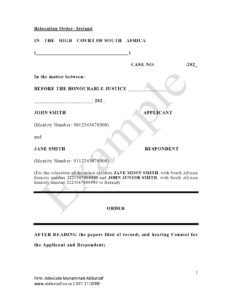 Relocation consent Court Order for minor child to Ireland – Advocate Muhammad Abduroaf[/caption] [caption id="attachment_10828" align="alignnone" width="686"] Relocation consent Court Order for minor child to Ireland – Advocate Muhammad Abduroaf[/caption]
I want to relocate from South Africa to Ireland with my minor child. The other parent does not want my child to relocate to Ireland. What can I do? Ireland is a popular destination to emigrate to. People emigrate from South Africa for many reasons. It ranges from better employment Continue Reading
Top tips and tricks from a Senior Family Law Advocate on claiming maintenance for a five-year-old child in Bethlehem.
Child Maintenance is the right of the child, and not that of the parent. It is also not a privilege granted to parents who must pay it. It is their duty to pay child maintenance and support their children. Once the child is self-supporting (being able to care for him or herself), the obligation falls away. This can happen when the child is 18, 20, or even 30. It all depends on the circumstances of the case.
Claiming child maintenance for your child in Bethlehem
Whether you claim child maintenance in Bethlehem, or any other city in South Africa, the procedures would be the same. There are however two (2) courts that can deal with child maintenance matters. That is a divorce court, in a divorce matter, and a Child Maintenance Court. For this article, we will focus on claiming maintenance in a Maintenance Court matter in Bethlehem.
The maintenance scenario – Bethlehem South Africa
In this article, we will deal with the following fictitious scenario, in a child maintenance matter:
- The Child is seven years old and attends school in Bethlehem
- The child is cared for by the mother who works in Bethlehem
- The mother works and earns a Salary of R 10 000
- The father sees the child every second weekend. He also lives and works in Bethlehem
- The child’s monthly expenses are R 6000 – 00 which includes food, clothing, accommodation, education, travel etc.
- The father earns a reasonable salary and can afford the R 20 000 – 00 per month
- The mother claims R 4 000 – 00 maintenance as the father earns double her salary
What is the first step the mother must take in claiming child maintenance?
The first thing the mother must do is work out exactly what the child costs by item. She breaks down the minor child’s living expenses, starting from rent or accommodation to groceries to school fees etc. Once she has done that, she would need to determine what exactly does the minor child cost per month, seeing that she will be asking the father to contribute towards that. As best as possible, she needs to collect proof of expenses. This can be in the form of receipts.
How does she start the legal process?
The mother now needs to approach the maintenance court in the area where she lives or works to lodge a complaint for child maintenance. If she lives or works in Bethlehem, it would be the maintenance court in Bethlehem. She will complete a Form A wherein she will provide all the expenses for her and the minor child. She would also have to stipulate her income. Once she completed the form and submitted it to the maintenance court, she must then follow the next step.
What do you do while waiting for the maintenance court date?
While you wait to be informed of the court date by the Maintenance Court of Bethlehem, and up until the actual first court date, you need to ensure that you keep a record of all income and expenses for you and the child. This is very important as the court allocates maintenance based on recent income and expenses.
What happens at the first court appearance at the Bethlehem Maintenance Court?
Once you have been notified of the maintenance court date by the Bethlehem Maintenance Court, you need to ensure that you attend it. On that day, both you and the father of the child would appear before a maintenance officer. The maintenance officer would go through both your income and expenses as well as that of the father. If all the relevant information is not before the maintenance court, then the matter may be postponed in order for the parties to submit it.
The maintenance officer will try to settle the matter and have the parents come to an agreement regarding the amount of child maintenance to be paid. If they cannot come to an agreement regarding the child maintenance to be paid, the matter would have to proceed to a formal hearing or trial before a Magistrate.
How does the Maintenance Court hearing or trial work in Bethlehem?
Essentially, the maintenance court is called upon to make a fair ruling regarding what is a fair amount of child support that needs to be paid. For that to happen, the parents would have to give evidence in that regard. The mother would present to the court what the child costs, what she contributes and what she requires the other parent to pay. The Father would have a right to question the mother and to present evidence as to why he cannot afford the amount requested or why he feels it is an unfair amount. The mother can they also question him.
At the end of the day, the Bethlehem Maintenance Court would be able to properly determine what is a fair and adequate amount of child maintenance to pay after being presented will all relevant information. The Bethlehem Maintenance Court should play an active role in determining what is a fair amount of child maintenance the father should pay.
The above child maintenance application principles should apply to the following provinces and cities:
Eastern Cape:
Alice, Butterworth, East London, Graaff-Reinet, Grahamstown, King William’s Town, Mthatha
Port Elizabeth, Queenstown, Uitenhage, Zwelitsha
Free State:
Bethlehem. Bloemfontein, Jagersfontein, Kroonstad, Odendaalsrus, Parys, Phuthaditjhaba, Sasolburg, Virginia, Welkom
Gauteng:
Benoni, Boksburg, Brakpan, Carletonville, Germiston, Johannesburg, Krugersdorp, Pretoria, Randburg, Randfontein, Roodepoort, Soweto, Springs, Vanderbijlpark, Vereeniging
KwaZulu-Natal:
Durban, Empangeni, Ladysmith, Newcastle, Pietermaritzburg, Pinetown, Ulundi, Umlazi
Limpopo:
Giyani, Lebowakgomo, Musina, Phalaborwa, Polokwane, Seshego, Sibasa, Thabazimbi
Mpumalanga:
Emalahleni, Nelspruit, Secunda, North West, Klerksdorp, Mahikeng, Mmabatho, Potchefstroom, Rustenburg, Northern Cape, Kimberley, Kuruman, Port Nolloth
Western Cape:
Bellville, Bethlehem, Constantia, George, Hopefield, Oudtshoorn, Paarl, Simon’s Town, Stellenbosch, Swellendam, Worcester
Top tips and tricks from a Senior Family Law Advocate on claiming maintenance for a five-year-old child in Bethlehem. Child Maintenance is the right of the child, and not that of the parent. It is also not a privilege granted to parents who must pay it. It is their duty Continue Reading
Top tips and tricks from a Senior Family Law Advocate on claiming maintenance for a five-year-old child in Phuthaditjhaba.
Child Maintenance is the right of the child, and not that of the parent. It is also not a privilege granted to parents who must pay it. It is their duty to pay child maintenance and support their children. Once the child is self-supporting (being able to care for him or herself), the obligation falls away. This can happen when the child is 18, 20, or even 30. It all depends on the circumstances of the case.
Claiming child maintenance for your child in Phuthaditjhaba
Whether you claim child maintenance in Phuthaditjhaba, or any other city in South Africa, the procedures would be the same. There are however two (2) courts that can deal with child maintenance matters. That is a divorce court, in a divorce matter, and a Child Maintenance Court. For this article, we will focus on claiming maintenance in a Maintenance Court matter in Phuthaditjhaba.
The maintenance scenario – Phuthaditjhaba South Africa
In this article, we will deal with the following fictitious scenario, in a child maintenance matter:
- The Child is seven years old and attends school in Phuthaditjhaba
- The child is cared for by the mother who works in Phuthaditjhaba
- The mother works and earns a Salary of R 10 000
- The father sees the child every second weekend. He also lives and works in Phuthaditjhaba
- The child’s monthly expenses are R 6000 – 00 which includes food, clothing, accommodation, education, travel etc.
- The father earns a reasonable salary and can afford the R 20 000 – 00 per month
- The mother claims R 4 000 – 00 maintenance as the father earns double her salary
What is the first step the mother must take in claiming child maintenance?
The first thing the mother must do is work out exactly what the child costs by item. She breaks down the minor child’s living expenses, starting from rent or accommodation to groceries to school fees etc. Once she has done that, she would need to determine what exactly does the minor child cost per month, seeing that she will be asking the father to contribute towards that. As best as possible, she needs to collect proof of expenses. This can be in the form of receipts.
How does she start the legal process?
The mother now needs to approach the maintenance court in the area where she lives or works to lodge a complaint for child maintenance. If she lives or works in Phuthaditjhaba, it would be the maintenance court in Phuthaditjhaba. She will complete a Form A wherein she will provide all the expenses for her and the minor child. She would also have to stipulate her income. Once she completed the form and submitted it to the maintenance court, she must then follow the next step.
What do you do while waiting for the maintenance court date?
While you wait to be informed of the court date by the Maintenance Court of Phuthaditjhaba, and up until the actual first court date, you need to ensure that you keep a record of all income and expenses for you and the child. This is very important as the court allocates maintenance based on recent income and expenses.
What happens at the first court appearance at the Phuthaditjhaba Maintenance Court?
Once you have been notified of the maintenance court date by the Phuthaditjhaba Maintenance Court, you need to ensure that you attend it. On that day, both you and the father of the child would appear before a maintenance officer. The maintenance officer would go through both your income and expenses as well as that of the father. If all the relevant information is not before the maintenance court, then the matter may be postponed in order for the parties to submit it.
The maintenance officer will try to settle the matter and have the parents come to an agreement regarding the amount of child maintenance to be paid. If they cannot come to an agreement regarding the child maintenance to be paid, the matter would have to proceed to a formal hearing or trial before a Magistrate.
How does the Maintenance Court hearing or trial work in Phuthaditjhaba?
Essentially, the maintenance court is called upon to make a fair ruling regarding what is a fair amount of child support that needs to be paid. For that to happen, the parents would have to give evidence in that regard. The mother would present to the court what the child costs, what she contributes and what she requires the other parent to pay. The Father would have a right to question the mother and to present evidence as to why he cannot afford the amount requested or why he feels it is an unfair amount. The mother can they also question him.
At the end of the day, the Phuthaditjhaba Maintenance Court would be able to properly determine what is a fair and adequate amount of child maintenance to pay after being presented will all relevant information. The Phuthaditjhaba Maintenance Court should play an active role in determining what is a fair amount of child maintenance the father should pay.
The above child maintenance application principles should apply to the following provinces and cities:
Eastern Cape:
Alice, Butterworth, East London, Graaff-Reinet, Grahamstown, King William’s Town, Mthatha
Port Elizabeth, Queenstown, Uitenhage, Zwelitsha
Free State:
Bethlehem. Bloemfontein, Jagersfontein, Kroonstad, Odendaalsrus, Parys, Phuthaditjhaba, Sasolburg, Virginia, Welkom
Gauteng:
Benoni, Boksburg, Brakpan, Carletonville, Germiston, Johannesburg, Krugersdorp, Pretoria, Randburg, Randfontein, Roodepoort, Soweto, Springs, Vanderbijlpark, Vereeniging
KwaZulu-Natal:
Durban, Empangeni, Ladysmith, Newcastle, Pietermaritzburg, Pinetown, Ulundi, Umlazi
Limpopo:
Giyani, Lebowakgomo, Musina, Phalaborwa, Polokwane, Seshego, Sibasa, Thabazimbi
Mpumalanga:
Emalahleni, Nelspruit, Secunda, North West, Klerksdorp, Mahikeng, Mmabatho, Potchefstroom, Rustenburg, Northern Cape, Kimberley, Kuruman, Port Nolloth
Western Cape:
Bellville, Phuthaditjhaba, Constantia, George, Hopefield, Oudtshoorn, Paarl, Simon’s Town, Stellenbosch, Swellendam, Worcester
Top tips and tricks from a Senior Family Law Advocate on claiming maintenance for a five-year-old child in Phuthaditjhaba. Child Maintenance is the right of the child, and not that of the parent. It is also not a privilege granted to parents who must pay it. It is their duty Continue Reading
Top tips and tricks from a Senior Family Law Advocate on claiming maintenance for a five-year-old child in Butterworth.
Child Maintenance is the right of the child, and not that of the parent. It is also not a privilege granted to parents who must pay it. It is their duty to pay child maintenance and support their children. Once the child is self-supporting (being able to care for him or herself), the obligation falls away. This can happen when the child is 18, 20, or even 30. It all depends on the circumstances of the case.
Claiming child maintenance for your child in Butterworth
Whether you claim child maintenance in Butterworth, or any other city in South Africa, the procedures would be the same. There are however two (2) courts that can deal with child maintenance matters. That is a divorce court, in a divorce matter, and a Child Maintenance Court. For this article, we will focus on claiming maintenance in a Maintenance Court matter in Butterworth.
The maintenance scenario – Butterworth South Africa
In this article, we will deal with the following fictitious scenario, in a child maintenance matter:
- The Child is seven years old and attends school in Butterworth
- The child is cared for by the mother who works in Butterworth
- The mother works and earns a Salary of R 10 000
- The father sees the child every second weekend. He also lives and works in Butterworth
- The child’s monthly expenses are R 6000 – 00 which includes food, clothing, accommodation, education, travel etc.
- The father earns a reasonable salary and can afford the R 20 000 – 00 per month
- The mother claims R 4 000 – 00 maintenance as the father earns double her salary
What is the first step the mother must take in claiming child maintenance?
The first thing the mother must do is work out exactly what the child costs by item. She breaks down the minor child’s living expenses, starting from rent or accommodation to groceries to school fees etc. Once she has done that, she would need to determine what exactly does the minor child cost per month, seeing that she will be asking the father to contribute towards that. As best as possible, she needs to collect proof of expenses. This can be in the form of receipts.
How does she start the legal process?
The mother now needs to approach the maintenance court in the area where she lives or works to lodge a complaint for child maintenance. If she lives or works in Butterworth, it would be the maintenance court in Butterworth. She will complete a Form A wherein she will provide all the expenses for her and the minor child. She would also have to stipulate her income. Once she completed the form and submitted it to the maintenance court, she must then follow the next step.
What do you do while waiting for the maintenance court date?
While you wait to be informed of the court date by the Maintenance Court of Butterworth, and up until the actual first court date, you need to ensure that you keep a record of all income and expenses for you and the child. This is very important as the court allocates maintenance based on recent income and expenses.
What happens at the first court appearance at the Butterworth Maintenance Court?
Once you have been notified of the maintenance court date by the Butterworth Maintenance Court, you need to ensure that you attend it. On that day, both you and the father of the child would appear before a maintenance officer. The maintenance officer would go through both your income and expenses as well as that of the father. If all the relevant information is not before the maintenance court, then the matter may be postponed in order for the parties to submit it.
The maintenance officer will try to settle the matter and have the parents come to an agreement regarding the amount of child maintenance to be paid. If they cannot come to an agreement regarding the child maintenance to be paid, the matter would have to proceed to a formal hearing or trial before a Magistrate.
How does the Maintenance Court hearing or trial work in Butterworth?
Essentially, the maintenance court is called upon to make a fair ruling regarding what is a fair amount of child support that needs to be paid. For that to happen, the parents would have to give evidence in that regard. The mother would present to the court what the child costs, what she contributes and what she requires the other parent to pay. The Father would have a right to question the mother and to present evidence as to why he cannot afford the amount requested or why he feels it is an unfair amount. The mother can they also question him.
At the end of the day, the Butterworth Maintenance Court would be able to properly determine what is a fair and adequate amount of child maintenance to pay after being presented will all relevant information. The Butterworth Maintenance Court should play an active role in determining what is a fair amount of child maintenance the father should pay.
The above child maintenance application principles should apply to the following provinces and cities:
Eastern Cape:
Alice, Butterworth, East London, Graaff-Reinet, Grahamstown, King William’s Town, Mthatha
Port Elizabeth, Queenstown, Uitenhage, Zwelitsha
Free State:
Bethlehem. Bloemfontein, Jagersfontein, Kroonstad, Odendaalsrus, Parys, Phuthaditjhaba, Sasolburg, Virginia, Welkom
Gauteng:
Benoni, Boksburg, Brakpan, Carletonville, Germiston, Johannesburg, Krugersdorp, Pretoria, Randburg, Randfontein, Roodepoort, Soweto, Springs, Vanderbijlpark, Vereeniging
KwaZulu-Natal:
Durban, Empangeni, Ladysmith, Newcastle, Pietermaritzburg, Pinetown, Ulundi, Umlazi
Limpopo:
Giyani, Lebowakgomo, Musina, Phalaborwa, Polokwane, Seshego, Sibasa, Thabazimbi
Mpumalanga:
Emalahleni, Nelspruit, Secunda, North West, Klerksdorp, Mahikeng, Mmabatho, Potchefstroom, Rustenburg, Northern Cape, Kimberley, Kuruman, Port Nolloth
Western Cape:
Bellville, Butterworth, Constantia, George, Hopefield, Oudtshoorn, Paarl, Simon’s Town, Stellenbosch, Swellendam, Worcester
Top tips and tricks from a Senior Family Law Advocate on claiming maintenance for a five-year-old child in Butterworth. Child Maintenance is the right of the child, and not that of the parent. It is also not a privilege granted to parents who must pay it. It is their duty Continue Reading
Top tips and tricks from a Senior Family Law Advocate on claiming maintenance for a five-year-old child in Kroonstad.
Child Maintenance is the right of the child, and not that of the parent. It is also not a privilege granted to parents who must pay it. It is their duty to pay child maintenance and support their children. Once the child is self-supporting (being able to care for him or herself), the obligation falls away. This can happen when the child is 18, 20, or even 30. It all depends on the circumstances of the case.
Claiming child maintenance for your child in Kroonstad
Whether you claim child maintenance in Kroonstad, or any other city in South Africa, the procedures would be the same. There are however two (2) courts that can deal with child maintenance matters. That is a divorce court, in a divorce matter, and a Child Maintenance Court. For this article, we will focus on claiming maintenance in a Maintenance Court matter in Kroonstad.
The maintenance scenario – Kroonstad South Africa
In this article, we will deal with the following fictitious scenario, in a child maintenance matter:
- The Child is seven years old and attends school in Kroonstad
- The child is cared for by the mother who works in Kroonstad
- The mother works and earns a Salary of R 10 000
- The father sees the child every second weekend. He also lives and works in Kroonstad
- The child’s monthly expenses are R 6000 – 00 which includes food, clothing, accommodation, education, travel etc.
- The father earns a reasonable salary and can afford the R 20 000 – 00 per month
- The mother claims R 4 000 – 00 maintenance as the father earns double her salary
What is the first step the mother must take in claiming child maintenance?
The first thing the mother must do is work out exactly what the child costs by item. She breaks down the minor child’s living expenses, starting from rent or accommodation to groceries to school fees etc. Once she has done that, she would need to determine what exactly does the minor child cost per month, seeing that she will be asking the father to contribute towards that. As best as possible, she needs to collect proof of expenses. This can be in the form of receipts.
How does she start the legal process?
The mother now needs to approach the maintenance court in the area where she lives or works to lodge a complaint for child maintenance. If she lives or works in Kroonstad, it would be the maintenance court in Kroonstad. She will complete a Form A wherein she will provide all the expenses for her and the minor child. She would also have to stipulate her income. Once she completed the form and submitted it to the maintenance court, she must then follow the next step.
What do you do while waiting for the maintenance court date?
While you wait to be informed of the court date by the Maintenance Court of Kroonstad, and up until the actual first court date, you need to ensure that you keep a record of all income and expenses for you and the child. This is very important as the court allocates maintenance based on recent income and expenses.
What happens at the first court appearance at the Kroonstad Maintenance Court?
Once you have been notified of the maintenance court date by the Kroonstad Maintenance Court, you need to ensure that you attend it. On that day, both you and the father of the child would appear before a maintenance officer. The maintenance officer would go through both your income and expenses as well as that of the father. If all the relevant information is not before the maintenance court, then the matter may be postponed in order for the parties to submit it.
The maintenance officer will try to settle the matter and have the parents come to an agreement regarding the amount of child maintenance to be paid. If they cannot come to an agreement regarding the child maintenance to be paid, the matter would have to proceed to a formal hearing or trial before a Magistrate.
How does the Maintenance Court hearing or trial work in Kroonstad?
Essentially, the maintenance court is called upon to make a fair ruling regarding what is a fair amount of child support that needs to be paid. For that to happen, the parents would have to give evidence in that regard. The mother would present to the court what the child costs, what she contributes and what she requires the other parent to pay. The Father would have a right to question the mother and to present evidence as to why he cannot afford the amount requested or why he feels it is an unfair amount. The mother can they also question him.
At the end of the day, the Kroonstad Maintenance Court would be able to properly determine what is a fair and adequate amount of child maintenance to pay after being presented will all relevant information. The Kroonstad Maintenance Court should play an active role in determining what is a fair amount of child maintenance the father should pay.
The above child maintenance application principles should apply to the following provinces and cities:
Eastern Cape:
Alice, Butterworth, East London, Graaff-Reinet, Grahamstown, King William’s Town, Mthatha
Port Elizabeth, Queenstown, Uitenhage, Zwelitsha
Free State:
Bethlehem. Bloemfontein, Jagersfontein, Kroonstad, Odendaalsrus, Parys, Phuthaditjhaba, Sasolburg, Virginia, Welkom
Gauteng:
Benoni, Boksburg, Brakpan, Carletonville, Germiston, Johannesburg, Krugersdorp, Pretoria, Randburg, Randfontein, Roodepoort, Soweto, Springs, Vanderbijlpark, Vereeniging
KwaZulu-Natal:
Durban, Empangeni, Ladysmith, Newcastle, Pietermaritzburg, Pinetown, Ulundi, Umlazi
Limpopo:
Giyani, Lebowakgomo, Musina, Phalaborwa, Polokwane, Seshego, Sibasa, Thabazimbi
Mpumalanga:
Emalahleni, Nelspruit, Secunda, North West, Klerksdorp, Mahikeng, Mmabatho, Potchefstroom, Rustenburg, Northern Cape, Kimberley, Kuruman, Port Nolloth
Western Cape:
Bellville, Kroonstad, Constantia, George, Hopefield, Oudtshoorn, Paarl, Simon’s Town, Stellenbosch, Swellendam, Worcester
Top tips and tricks from a Senior Family Law Advocate on claiming maintenance for a five-year-old child in Kroonstad. Child Maintenance is the right of the child, and not that of the parent. It is also not a privilege granted to parents who must pay it. It is their duty Continue Reading
Top tips from a Senior Family Law Advocate on how to deal with your Child Custody matter in the Swellendam Children’s Court
Family law legal matters can be very stressful. This is so whether you live in Swellendam or any other city in South Africa. Especially so if you have no idea how the legal processes work. It is one thing to know that you are entitled to child support, but it is a totally different matter to know the law and procedure on how to claim child support. Luckily in child maintenance matters, the maintenance court is there to assist you in completing the application form. However, many times that is not enough. Especially so if the other parent has a lawyer and knows how to present the case for his or her client.
This article, however, deals with some top tips in care and contact or custody matters in the Children’s Court in Swellendam. It would explain the processes involved and advise on how to be best prepared for your matter. This advice is applicable whether you live in Swellendam or any other city in South Africa.
What to do before visiting the Swellendam Children’s Court
Before you approach the Children’s Court in Swellendam, first try to resolve the issues with the other parent. Therefore, if you want more contact with your child and the other parent is refusing, try to resolve the matter first with that parent. If that does not work, try mediation. The mediator can be anyone, from a trusted mutual friend, priest, or other religious leaders, or a professional like an attorney, psychologist, or the office of the Family Advocate. Swellendam has many professionals that can assist you in this regard. If resolving the matter by yourselves is not possible, or mediation fails, then we suggest you approach the Swellendam Children’s Court for assistance.
TIP: Focus on getting someone neutral to assist in mediating your matter. Organisations like FAMSA and FAMAC can be of assistance. Google them.
Approaching the Swellendam Children’s Court
The Swellendam Children’s Court should be approached if it is the closest Children’s Court to you. You need to verify with the Swellendam Children’s Court that you fall under their area of jurisdiction. If not, they would direct you to which Children’s Court is applicable to you.
Once you arrive at the Swellendam Children’s Court, they will provide you with a form headed “Bringing Matter to Court in Terms of Section 53 Children’s Act, 2005 (Act no. 38 of 2005) Regulation Relating to Children’s Court and International Child Abduction, 2008 [Regulation 6]. This form is also called Form 2.
In this form, you will provide all your particulars and that of the child or children and the other parent. The sections in the form are as follows:
- PART A: PARTICULARS OF CHILD(REN)
- PART B: PARTICULARS OF *CHILD WHO IS AFFECTED BY OR INVOLVED IN THE MATTER/PERSON *ACTING IN THE INTEREST OF THE CHILD/*ON BEHALF OF THE CHILD WHO CANNOT ACT IN HIS/HER OWN NAME/ *MEMBER OF A GROUP OF CLASS OF CHILDREN/*IN THE PUBLIC INTEREST (SECTION 53(2)
- PART C: PARTICULARS OF PERSONS HAVING AN INTEREST IN THE MATTER
- PART D: PARTICULARS OF MATTER
In part D, the following is stated which you need to provide in the form:
- Nature of matter brought to Court: (Please give full details of the matter e.g., registration/amendment of parenting plans, removal of child to safe care, children in need of care and protection, placement in youth care centers, adoption etc.
- Documents: Are there any documents relating to the matter? (If so please attach)
Once you have completed the form and attached the relevant documents to it, you must take it to a commissioner of Oaths to have it commissioned. It does not have to be in Swellendam.
TIP: Draft a separate affidavit explaining your case. Outline some background information and reasons why the Court should give you what you request. Attach it to Form 2.
Processing your Application at the Swellendam Children’s Court
Once you complete the Form A and submit it to the Clerk of the Swellendam Children’s Court, they will process it and allocate it a case number or reference number. The Clerk of the Court would then allocate a date to the matter and advise the parties accordingly when the court date is. Please note that some courts follow a different process for processing the application and informing the parties of the court date. Please enquire from the Court when making the application what process they follow.
TIP: Obtain the contact details of the Court for you to contact them to obtain the Court date or other information. Ask for their contact number and email address.
Appearing in the Swellendam Children’s Court
When notified of the Court date, both you and the other parent should attend. If you are making use of a lawyer (Advocate or Attorney), inform them timeously of the date. Depending on the Court, you may first see the Clerk or go directly to the Magistrate. The Children’s Court would do its best to try to resolve the matter. If the parents cannot come to an agreement, the Children’s Court may postpone the matter for either of the following:
- Get a social worker involved in the matter;
- Appoint a legal representative for the minor child;
- Implement interim care and contact arrangements;
- Having the parties attempt to agree on a parenting plan;
-
In serious matters, the Court may remove the minor child from both parents and place the child in foster care. The powers of the Children’s Court are extensive. It will, however, focus on what is in the child’s best interests.
TIP: Be as vocal as possible. Do not expect the Court to be understanding of your case or be on your side. It is your duty to explain your case and provide the Court with all the relevant information they require for them to make a fair decision.
Finalising the matter in the Swellendam Children’s Court
Once the Swellendam Children’s Court has enough information to make a final decision, it will do so. Depending on the facts of the matter, that could either be making a Parenting Plan, an Order of the Court or a final care and contact Order. The Court may even make further interim orders, where the parties are to return to Court after a few months, or a year later.
TIP: Do not agree to something just because the social worker, a lawyer, or the Court suggest it. You need to be happy with what is decided.
The above Swellendam Children’s Court Application tips should apply to the following provinces and cities:
Eastern Cape:
Alice, Butterworth, East London, Graaff-Reinet, Grahamstown, King William’s Town, Mthatha
Port Elizabeth, Queenstown, Uitenhage, Zwelitsha
Free State:
Bethlehem. Bloemfontein, Jagersfontein, Kroonstad, Odendaalsrus, Parys, Phuthaditjhaba, Sasolburg, Virginia, Welkom
Gauteng:
Benoni, Boksburg, Brakpan, Carletonville, Germiston, Johannesburg, Krugersdorp, Pretoria, Randburg, Randfontein, Roodepoort, Soweto, Springs, Vanderbijlpark, Vereeniging
KwaZulu-Natal:
Durban, Empangeni, Ladysmith, Newcastle, Pietermaritzburg, Pinetown, Ulundi, Umlazi
Limpopo:
Giyani, Lebowakgomo, Musina, Phalaborwa, Polokwane, Seshego, Sibasa, Thabazimbi
Mpumalanga:
Emalahleni, Nelspruit, Secunda, North West, Klerksdorp, Mahikeng, Mmabatho, Potchefstroom, Rustenburg, Northern Cape, Kimberley, Kuruman, Port Nolloth
Western Cape:
Bellville, Swellendam, Constantia, George, Hopefield, Oudtshoorn, Paarl, Simon’s Town, Stellenbosch, Swellendam, Worcester
Top tips from a Senior Family Law Advocate on how to deal with your Child Custody matter in the Swellendam Children’s Court Family law legal matters can be very stressful. This is so whether you live in Swellendam or any other city in South Africa. Especially so if you Continue Reading
Top tips from a Senior Family Law Advocate on how to deal with your Child Custody matter in the Welkom Children’s Court
Family law legal matters can be very stressful. This is so whether you live in Welkom or any other city in South Africa. Especially so if you have no idea how the legal processes work. It is one thing to know that you are entitled to child support, but it is a totally different matter to know the law and procedure on how to claim child support. Luckily in child maintenance matters, the maintenance court is there to assist you in completing the application form. However, many times that is not enough. Especially so if the other parent has a lawyer and knows how to present the case for his or her client.
This article, however, deals with some top tips in care and contact or custody matters in the Children’s Court in Welkom. It would explain the processes involved and advise on how to be best prepared for your matter. This advice is applicable whether you live in Welkom or any other city in South Africa.
What to do before visiting the Welkom Children’s Court
Before you approach the Children’s Court in Welkom, first try to resolve the issues with the other parent. Therefore, if you want more contact with your child and the other parent is refusing, try to resolve the matter first with that parent. If that does not work, try mediation. The mediator can be anyone, from a trusted mutual friend, priest, or other religious leaders, or a professional like an attorney, psychologist, or the office of the Family Advocate. Welkom has many professionals that can assist you in this regard. If resolving the matter by yourselves is not possible, or mediation fails, then we suggest you approach the Welkom Children’s Court for assistance.
TIP: Focus on getting someone neutral to assist in mediating your matter. Organisations like FAMSA and FAMAC can be of assistance. Google them.
Approaching the Welkom Children’s Court
The Welkom Children’s Court should be approached if it is the closest Children’s Court to you. You need to verify with the Welkom Children’s Court that you fall under their area of jurisdiction. If not, they would direct you to which Children’s Court is applicable to you.
Once you arrive at the Welkom Children’s Court, they will provide you with a form headed “Bringing Matter to Court in Terms of Section 53 Children’s Act, 2005 (Act no. 38 of 2005) Regulation Relating to Children’s Court and International Child Abduction, 2008 [Regulation 6]. This form is also called Form 2.
In this form, you will provide all your particulars and that of the child or children and the other parent. The sections in the form are as follows:
- PART A: PARTICULARS OF CHILD(REN)
- PART B: PARTICULARS OF *CHILD WHO IS AFFECTED BY OR INVOLVED IN THE MATTER/PERSON *ACTING IN THE INTEREST OF THE CHILD/*ON BEHALF OF THE CHILD WHO CANNOT ACT IN HIS/HER OWN NAME/ *MEMBER OF A GROUP OF CLASS OF CHILDREN/*IN THE PUBLIC INTEREST (SECTION 53(2)
- PART C: PARTICULARS OF PERSONS HAVING AN INTEREST IN THE MATTER
- PART D: PARTICULARS OF MATTER
In part D, the following is stated which you need to provide in the form:
- Nature of matter brought to Court: (Please give full details of the matter e.g., registration/amendment of parenting plans, removal of child to safe care, children in need of care and protection, placement in youth care centers, adoption etc.
- Documents: Are there any documents relating to the matter? (If so please attach)
Once you have completed the form and attached the relevant documents to it, you must take it to a commissioner of Oaths to have it commissioned. It does not have to be in Welkom.
TIP: Draft a separate affidavit explaining your case. Outline some background information and reasons why the Court should give you what you request. Attach it to Form 2.
Processing your Application at the Welkom Children’s Court
Once you complete the Form A and submit it to the Clerk of the Welkom Children’s Court, they will process it and allocate it a case number or reference number. The Clerk of the Court would then allocate a date to the matter and advise the parties accordingly when the court date is. Please note that some courts follow a different process for processing the application and informing the parties of the court date. Please enquire from the Court when making the application what process they follow.
TIP: Obtain the contact details of the Court for you to contact them to obtain the Court date or other information. Ask for their contact number and email address.
Appearing in the Welkom Children’s Court
When notified of the Court date, both you and the other parent should attend. If you are making use of a lawyer (Advocate or Attorney), inform them timeously of the date. Depending on the Court, you may first see the Clerk or go directly to the Magistrate. The Children’s Court would do its best to try to resolve the matter. If the parents cannot come to an agreement, the Children’s Court may postpone the matter for either of the following:
- Get a social worker involved in the matter;
- Appoint a legal representative for the minor child;
- Implement interim care and contact arrangements;
- Having the parties attempt to agree on a parenting plan;
-
In serious matters, the Court may remove the minor child from both parents and place the child in foster care. The powers of the Children’s Court are extensive. It will, however, focus on what is in the child’s best interests.
TIP: Be as vocal as possible. Do not expect the Court to be understanding of your case or be on your side. It is your duty to explain your case and provide the Court with all the relevant information they require for them to make a fair decision.
Finalising the matter in the Welkom Children’s Court
Once the Welkom Children’s Court has enough information to make a final decision, it will do so. Depending on the facts of the matter, that could either be making a Parenting Plan, an Order of the Court or a final care and contact Order. The Court may even make further interim orders, where the parties are to return to Court after a few months, or a year later.
TIP: Do not agree to something just because the social worker, a lawyer, or the Court suggest it. You need to be happy with what is decided.
The above Welkom Children’s Court Application tips should apply to the following provinces and cities:
Eastern Cape:
Alice, Butterworth, East London, Graaff-Reinet, Grahamstown, King William’s Town, Mthatha
Port Elizabeth, Queenstown, Uitenhage, Zwelitsha
Free State:
Bethlehem. Bloemfontein, Jagersfontein, Kroonstad, Odendaalsrus, Parys, Phuthaditjhaba, Sasolburg, Virginia, Welkom
Gauteng:
Benoni, Boksburg, Brakpan, Carletonville, Germiston, Johannesburg, Krugersdorp, Pretoria, Randburg, Randfontein, Roodepoort, Soweto, Springs, Vanderbijlpark, Vereeniging
KwaZulu-Natal:
Durban, Empangeni, Ladysmith, Newcastle, Pietermaritzburg, Pinetown, Ulundi, Umlazi
Limpopo:
Giyani, Lebowakgomo, Musina, Phalaborwa, Polokwane, Seshego, Sibasa, Thabazimbi
Mpumalanga:
Emalahleni, Nelspruit, Secunda, North West, Klerksdorp, Mahikeng, Mmabatho, Potchefstroom, Rustenburg, Northern Cape, Kimberley, Kuruman, Port Nolloth
Western Cape:
Bellville, Welkom, Constantia, George, Hopefield, Oudtshoorn, Paarl, Simon’s Town, Stellenbosch, Swellendam, Worcester
Top tips from a Senior Family Law Advocate on how to deal with your Child Custody matter in the Welkom Children’s Court Family law legal matters can be very stressful. This is so whether you live in Welkom or any other city in South Africa. Especially so if you Continue Reading
Top tips from a Senior Family Law Advocate on how to deal with your Child Custody matter in the King William’s Town Children’s Court
Family law legal matters can be very stressful. This is so whether you live in King William’s Town or any other city in South Africa. Especially so if you have no idea how the legal processes work. It is one thing to know that you are entitled to child support, but it is a totally different matter to know the law and procedure on how to claim child support. Luckily in child maintenance matters, the maintenance court is there to assist you in completing the application form. However, many times that is not enough. Especially so if the other parent has a lawyer and knows how to present the case for his or her client.
This article, however, deals with some top tips in care and contact or custody matters in the Children’s Court in King William’s Town. It would explain the processes involved and advise on how to be best prepared for your matter. This advice is applicable whether you live in King William’s Town or any other city in South Africa.
What to do before visiting the King William’s Town Children’s Court
Before you approach the Children’s Court in King William’s Town, first try to resolve the issues with the other parent. Therefore, if you want more contact with your child and the other parent is refusing, try to resolve the matter first with that parent. If that does not work, try mediation. The mediator can be anyone, from a trusted mutual friend, priest, or other religious leaders, or a professional like an attorney, psychologist, or the office of the Family Advocate. King William’s Town has many professionals that can assist you in this regard. If resolving the matter by yourselves is not possible, or mediation fails, then we suggest you approach the King William’s Town Children’s Court for assistance.
TIP: Focus on getting someone neutral to assist in mediating your matter. Organisations like FAMSA and FAMAC can be of assistance. Google them.
Approaching the King William’s Town Children’s Court
The King William’s Town Children’s Court should be approached if it is the closest Children’s Court to you. You need to verify with the King William’s Town Children’s Court that you fall under their area of jurisdiction. If not, they would direct you to which Children’s Court is applicable to you.
Once you arrive at the King William’s Town Children’s Court, they will provide you with a form headed “Bringing Matter to Court in Terms of Section 53 Children’s Act, 2005 (Act no. 38 of 2005) Regulation Relating to Children’s Court and International Child Abduction, 2008 [Regulation 6]. This form is also called Form 2.
In this form, you will provide all your particulars and that of the child or children and the other parent. The sections in the form are as follows:
- PART A: PARTICULARS OF CHILD(REN)
- PART B: PARTICULARS OF *CHILD WHO IS AFFECTED BY OR INVOLVED IN THE MATTER/PERSON *ACTING IN THE INTEREST OF THE CHILD/*ON BEHALF OF THE CHILD WHO CANNOT ACT IN HIS/HER OWN NAME/ *MEMBER OF A GROUP OF CLASS OF CHILDREN/*IN THE PUBLIC INTEREST (SECTION 53(2)
- PART C: PARTICULARS OF PERSONS HAVING AN INTEREST IN THE MATTER
- PART D: PARTICULARS OF MATTER
In part D, the following is stated which you need to provide in the form:
- Nature of matter brought to Court: (Please give full details of the matter e.g., registration/amendment of parenting plans, removal of child to safe care, children in need of care and protection, placement in youth care centers, adoption etc.
- Documents: Are there any documents relating to the matter? (If so please attach)
Once you have completed the form and attached the relevant documents to it, you must take it to a commissioner of Oaths to have it commissioned. It does not have to be in King William’s Town.
TIP: Draft a separate affidavit explaining your case. Outline some background information and reasons why the Court should give you what you request. Attach it to Form 2.
Processing your Application at the King William’s Town Children’s Court
Once you complete the Form A and submit it to the Clerk of the King William’s Town Children’s Court, they will process it and allocate it a case number or reference number. The Clerk of the Court would then allocate a date to the matter and advise the parties accordingly when the court date is. Please note that some courts follow a different process for processing the application and informing the parties of the court date. Please enquire from the Court when making the application what process they follow.
TIP: Obtain the contact details of the Court for you to contact them to obtain the Court date or other information. Ask for their contact number and email address.
Appearing in the King William’s Town Children’s Court
When notified of the Court date, both you and the other parent should attend. If you are making use of a lawyer (Advocate or Attorney), inform them timeously of the date. Depending on the Court, you may first see the Clerk or go directly to the Magistrate. The Children’s Court would do its best to try to resolve the matter. If the parents cannot come to an agreement, the Children’s Court may postpone the matter for either of the following:
- Get a social worker involved in the matter;
- Appoint a legal representative for the minor child;
- Implement interim care and contact arrangements;
- Having the parties attempt to agree on a parenting plan;
-
In serious matters, the Court may remove the minor child from both parents and place the child in foster care. The powers of the Children’s Court are extensive. It will, however, focus on what is in the child’s best interests.
TIP: Be as vocal as possible. Do not expect the Court to be understanding of your case or be on your side. It is your duty to explain your case and provide the Court with all the relevant information they require for them to make a fair decision.
Finalising the matter in the King William’s Town Children’s Court
Once the King William’s Town Children’s Court has enough information to make a final decision, it will do so. Depending on the facts of the matter, that could either be making a Parenting Plan, an Order of the Court or a final care and contact Order. The Court may even make further interim orders, where the parties are to return to Court after a few months, or a year later.
TIP: Do not agree to something just because the social worker, a lawyer, or the Court suggest it. You need to be happy with what is decided.
The above King William’s Town Children’s Court Application tips should apply to the following provinces and cities:
Eastern Cape:
Alice, Butterworth, East London, Graaff-Reinet, Grahamstown, King William’s Town, Mthatha
Port Elizabeth, Queenstown, Uitenhage, Zwelitsha
Free State:
Bethlehem. Bloemfontein, Jagersfontein, Kroonstad, Odendaalsrus, Parys, Phuthaditjhaba, Sasolburg, Virginia, Welkom
Gauteng:
Benoni, Boksburg, Brakpan, Carletonville, Germiston, Johannesburg, Krugersdorp, Pretoria, Randburg, Randfontein, Roodepoort, Soweto, Springs, Vanderbijlpark, Vereeniging
KwaZulu-Natal:
Durban, Empangeni, Ladysmith, Newcastle, Pietermaritzburg, Pinetown, Ulundi, Umlazi
Limpopo:
Giyani, Lebowakgomo, Musina, Phalaborwa, Polokwane, Seshego, Sibasa, Thabazimbi
Mpumalanga:
Emalahleni, Nelspruit, Secunda, North West, Klerksdorp, Mahikeng, Mmabatho, Potchefstroom, Rustenburg, Northern Cape, Kimberley, Kuruman, Port Nolloth
Western Cape:
Bellville, King William’s Town, Constantia, George, Hopefield, Oudtshoorn, Paarl, Simon’s Town, Stellenbosch, Swellendam, Worcester
Top tips from a Senior Family Law Advocate on how to deal with your Child Custody matter in the King William’s Town Children’s Court Family law legal matters can be very stressful. This is so whether you live in King William’s Town or any other city in South Africa. Continue Reading