I am dissatisfied with the decision of the High Court of South Africa. How do I appeal to the Supreme Court of Appeal? And what are their contact details? Many legal disputes are adjudicated in the High Courts of South Africa. Each province in South Africa has at least one Continue Reading
Telelaw
Dear Advocate Abduroaf. My child custody case is very complicated. How do I find the best child custody lawyer, attorney or advocate for my case in Port Elizabeth?
A great child custody lawyer (attorney or advocate) is a legal practitioner who specializes in family law and has expertise in handling cases related to child custody and visitation rights. Family law matters can be very emotionally challenging for both parents. The same applies to the child concerned. Whether you live in Cape Town or in Port Elizabeth, the law applicable would be the same throughout South Africa.Here are some qualities and characteristics that can define a great child custody lawyer, or the best one for your case:
Experience and Expertise:
- Specialization in family law, particularly child custody cases.
- Proven track record of successfully handling similar cases.
Knowledge of Family Law:
- In-depth understanding of family law.
- Awareness of recent legal developments and changes in family law.
Communication Skills:
- Effective communication skills to clearly articulate your case in court.
- Ability to negotiate and mediate to reach favourable settlements.
Compassion and Empathy:
- Understanding and empathy towards the emotional challenges involved in child custody disputes.
- Ability to provide emotional support to clients during a difficult time.
Strategic Thinking:
- Ability to devise a strategic legal approach tailored to the unique aspects of your case.
- Forethought and anticipation of potential challenges.
Availability and Responsiveness:
- Prompt responses to client inquiries and concerns.
- Availability for meetings, court appearances, and consultations.
Client Reviews and References:
- Positive reviews from previous clients.
- Recommendations from colleagues or other legal professionals.
Ethical Conduct:
- Adherence to professional and ethical standards.
- Transparent and fair billing practices.
Courtroom Experience:
- Comfort and confidence in a courtroom setting.
- Skillful presentation of arguments and evidence.
Resourcefulness:
- Resourcefulness in finding legal precedents and utilizing available resources to strengthen the case.
Problem-Solving Skills:
- Creative problem-solving skills to navigate complex family dynamics and legal issues.
Custody and Visitation Knowledge:
- In-depth knowledge of various custody arrangements and visitation schedules.
- Ability to advocate for the best interests of the child.
What should you consider when meeting with a family law attorney or advocate?
When looking for a great child custody lawyer, it’s essential to schedule consultations, discuss your case, and assess whether the lawyer, attorney, or advocate possesses the qualities and skills that align with your needs and goals. Additionally, consider seeking recommendations from trusted friends, family members, or other legal professionals. Finding the best child custody lawyer involves thorough research, careful consideration of your specific needs, and evaluation of the lawyer’s qualifications. Here are some steps you can take to find the right child custody lawyer for your situation:Define Your Goals and Needs:
- Clearly identify your goals and priorities in the child custody case.
- Determine the specific services you need from a lawyer, such as legal representation, mediation, or collaborative law.
Research Local Family Law Attorneys:
- Use online legal directories and referral services to identify family law attorneys or Trust Account Advocate in your area.
- Seek recommendations from friends, family, or colleagues who have gone through similar situations.
Check Credentials and Specialization:
- Look for lawyers who specialize in family law and, more specifically, child custody cases.
- Check their credentials, education, and any certifications related to family law.
Read Reviews and Testimonials:
- Read online reviews on legal review websites, social media, or the lawyer’s own website.
- Consider testimonials from previous clients to gauge the lawyer’s reputation and success rate.
Consult with Multiple Lawyers:
- Schedule consultations with several child custody lawyers to discuss your case.
- Prepare a list of questions to ask during the consultation, covering topics such as experience, approach to cases, and expected outcomes.
Evaluate Communication Skills:
- Assess the lawyer’s communication style and whether you feel comfortable discussing your case with them.
- Ensure that the lawyer listens actively and provides clear explanations of legal processes.
Consider Experience:
- Inquire about the lawyer’s experience in handling child custody cases similar to yours.
- Ask about their success rate and outcomes in past cases.
Review Legal Fees:
- Discuss the lawyer’s fee structure during the consultation.
- Clarify billing practices, retainer fees, and any additional costs associated with your case.
Check Disciplinary Records:
- Verify the lawyer’s standing with the Legal Practice Council of South Africa.
- Check for any disciplinary actions or complaints against the lawyer.
Seek Second Opinions:
- If you have initial concerns or uncertainties, consider seeking a second opinion from another attorney or advocate.
- Compare advice and recommendations from multiple sources.
Trust Your Instincts:
- Pay attention to your instincts and gut feelings about the lawyer.
- Choose a lawyer you feel comfortable working with and who understands your unique situation.
Negotiation and Mediation Skills:
Assess the lawyer’s ability to negotiate and mediate, especially if you prefer an amicable resolution.- Remember that finding the best child custody lawyer is a personalized process, and the right fit for one person may not be the best for another. Take the time to thoroughly research and evaluate potential lawyers to make an informed decision based on your specific needs and circumstances.
We service clients in all cities: Cape Town Rustenburg Kimberley East London Nelspruit Polokwane Pietermaritzburg Bloemfontein Port Elizabeth Pretoria Durban Johannesburg
Dear Advocate Abduroaf. My child custody case is very complicated. How do I find the best child custody lawyer, attorney or advocate for my case in Port Elizabeth? A great child custody lawyer (attorney or advocate) is a legal practitioner who specializes in family law and has expertise in handling Continue Reading
If you need to use official documents in foreign countries, you may need to get them apostilled.
We have documents Notarised and then Apostilled at the Western Cape High Court. Feel free to enquire about prices. It takes about 3 to 4 days from the date of receipt of the document to the date of being apostiled. Call us on 021 111 0090 or send us an email.What is an apostille certificate?
An apostille is a certificate that verifies the authenticity of a document, like a birth certificate, marriage certificate, academic transcript, Court Order or legal document. It is important to obtain an apostille because it is recognized and accepted in foreign countries that are parties to the Hague Apostille Convention. This convention is an international treaty that simplifies the process of verifying the authenticity of documents for use abroad. It was established in 1961 and has over 120 member countries. When a document is apostilled, it means that a designated authority in the country of origin has verified its authenticity and attached an apostille certificate to it. This certificate includes information such as the issuing authority’s seal or stamp, the signature of a designated official, and other relevant details. Apostilles are necessary for many legal and administrative purposes, such as international adoptions, immigration applications, business transactions, and academic credential recognition. They streamline the process of certifying documents for use in foreign countries, reducing the need for complex authentication procedures.Are all countries part of the Hague Apostille Convention?
It’s important to note that not all countries are part of the Hague Apostille Convention, and the requirements for apostilles can vary from one country to another. So, if you need to use a document internationally, make sure to check the country’s membership status in the convention and follow the specific requirements for obtaining an apostille in that country.
If you need to use official documents in foreign countries, you may need to get them apostilled. We have documents Notarised and then Apostilled at the Western Cape High Court. Feel free to enquire about prices. It takes about 3 to 4 days from the date of receipt of the Continue Reading
Trust Account Advocate in South Africa – How does Advocate Muhammad Abduroaf’s Practice?
A relatively recent concept in South Africa is Trust Account Advocates, which came into existence in 2018. The referral advocate profession remains the prevalent type of Advocate to this day. To understand what a Trust Account Advocate is, one needs to understand what a referral advocate is. The Legal Practice Act provides a distinction between Trust Account Advocates and Referral Advocates.What is a referral advocate in South Africa?
Prior to 2018, all advocates were referred to as only “Advocates”. Advocates were instructed by an attorney. What this meant was that a client would approach an attorney, who would, in turn, instruct and advocate to do work. The work the Advocate would be instructed to do predominantly relates to matters connecting to Court or litigation. Therefore, should a client want to claim money from someone, the attorney would instruct the Advocate to assist in the litigation process. This would include drafting court documents and appearing in Court. The attorney would attend to the administrative matters regarding the case. For example, writing letters, copying documents, filing at Court, and ensuring that everything is in order. The Advocate would then invoice the attorney for work done.How does a Trust Account Advocate operate in South Africa?
A Trust Account Advocate would be a hybrid between an attorney and a Referral Advocate. The Trust Account advocate would generally do work that referral advocates do; however, they also do work that an attorney would do. The client would, however, pay fees directly to the Trust Account Advocate into his or her Trust Account. This is not possible for Referral Advocates, where fees must be paid into the Attorneys Trust Account. It can only be paid to the Advocate after the work is done.How does Advocate Muhammad Abduroaf operate as a Trust Account Advocate?
Advocate Muhammad Abduroaf’s practice is a general litigation practice. The client would approach his firm directly for an impending legal matter. After a consultation with Adv. Muhammad Abduroaf and it is resolved that the matter requires his attention, he would take on the matter. If fees are paid in advance, they will be paid into his Trust Account. The same as an attorney would do. The main difference between his practice and that of an attorney working with a Referral Advocate is that the client would deal directly with him as the Advocate in the matter. Not via the attorney.How do I instruct Advocate Muhammad Abduroaf?
If you wish to instruct Advocate Muhammad Abduroaf in a legal matter, feel free to contact him. His website is www. abduroaf.co.za. You may also contact him using the number 021 1110090.
Trust Account Advocate in South Africa – How does Advocate Muhammad Abduroaf’s Practice? A relatively recent concept in South Africa is Trust Account Advocates, which came into existence in 2018. The referral advocate profession remains the prevalent type of Advocate to this day. To understand what a Trust Account Advocate Continue Reading
Best advice on finding a top divorce lawyer for your divorce case in Gordons Bay, Cape Town
Do you live in Gordons Bay, and are you considering divorcing your spouse? Or have you been threatened with divorce? Either way, a divorce is a legal matter, and it is best to find sound legal advice or assistance. Furthermore, divorcing someone has potential severe legal consequences you may not know of. The first consequence, of course, is that you are no longer married to your former spouse, and there is no legal obligation to maintain each other (unless you qualify for alimony). You may also not inherit from your former spouse’s intestate. Lastly, and obviously, you are free to marry someone else. However, do you know of the proprietary (property) consequences of getting a divorce? What about the assets and debt you and your spouse incurred in Gordons Bay or elsewhere during your marriage? Do you know what should happen to it? If not, it is best you find out about these critical aspects and others before getting divorced. Then there is the issue of parental responsibilities and rights after the divorce should there be minor children involved. This article aims to provide guidance on finding the best attorney or advocate for your divorce matter that can adequately and properly advise you or handle your divorce. The advice would apply whether you live in Gordons Bay or anywhere else in South Africa. The issues we shall deal with are the following.- Gender of the Advocate or attorney;
- Location of the Advocate or attorney;
- Experience of the Advocate or attorney;
- Costs of the Advocate or Attorney; and
- The personality of the Advocate or Attorney.
What is the best gender of the Advocate or Attorney I need to use for my divorce? Is a male or female better?
Generally, the gender of your Advocate or Attorney should not play a role at all in a legal matter. However, depending on your background and the issues involved in your divorce, you may prefer a specific gender where you may feel more comfortable. A female who has been emotionally, physically and psychologically abused may be more comfortable with a female Attorney or Advocate. However, the same female client may prefer a male Advocate or Attorney. No more will be said on this issue.What is the ideal office location of the Advocate or attorney? Does it have to be in Gordons Bay?
The location or office of your attorney or Advocate is essential if you wish to consult with them in person. It is also ideal, but not necessary, for their offices to be close to the Court where the divorce would be handled. However, many lawyers make use of correspondent lawyers for this purpose. Furthermore, location should not be an issue if you want a specific lawyer to handle your case. This is so especially seeing that people are making use of virtual meetings.What level of experience should the Advocate or attorney have?
It is important to remember that not all legal matters require the best lawyer. If your divorce is straightforward, finding the best lawyer in the field is unnecessary. The best may be very busy and lack the time to give your case the attention it deserves. However, if your matter is complicated, then in that case, the most experienced and best lawyer out there is not warranted.What about the Costs of an Attorney or Advocate?
For many, the costs of the Attorney or Advocate are the most crucial consideration when it comes to enlisting their services. Usually, the more experienced the Attorney or Advocate, the more they would charge. Another aspect that affects costs is the nature of the expertise of the Advocate or Attorney. If the issues in your matter are highly technical and complicated, an Advocate or Attorney with expertise and experience may charge more.What about the personality of the Advocate or Attorney?
Many may discard the Advocate or Attorney’s personality as not important. However, it is essential to note that it may be time to change lawyers if you do not get along well with the Advocate or Attorney because of their personality. A lawyer and their client would develop a professional relationship in family law matters. This is especially so when the lawyer must discuss many personal issues regarding you, your marriage, children, finance, spouse etc. If you cannot get along well with your Attorney or Advocate, you may not divulge important information relevant to your case.What is our best advice to a client looking for an Advocate or Attorney in a divorce matter?
Considering all the factors mentioned above, before enlisting the services of an Advocate or Attorney, ensure you enlist the right one. Do not look for the most experience or best, or the top one in family law. You may have to change lawyers if you do so and cannot afford legal bills. Therefore consider the above and any other factors that you may consider necessary when deciding on enlisting the services of an Advocate or an Attorney. Best of luck.
Best advice on finding a top divorce lawyer for your divorce case in Gordons Bay, Cape Town Do you live in Gordons Bay, and are you considering divorcing your spouse? Or have you been threatened with divorce? Either way, a divorce is a legal matter, and it is best to Continue Reading
Best advice on finding a top divorce lawyer for your divorce case in Camps Bay, Cape Town
Do you live in Camps Bay, and are you considering divorcing your spouse? Or have you been threatened with divorce? Either way, a divorce is a legal matter, and it is best to find sound legal advice or assistance. Furthermore, divorcing someone has potential severe legal consequences you may not know of. The first consequence, of course, is that you are no longer married to your former spouse, and there is no legal obligation to maintain each other (unless you qualify for alimony). You may also not inherit from your former spouse’s intestate. Lastly, and obviously, you are free to marry someone else. However, do you know of the proprietary (property) consequences of getting a divorce? What about the assets and debt you and your spouse incurred in Camps Bay or elsewhere during your marriage? Do you know what should happen to it? If not, it is best you find out about these critical aspects and others before getting divorced. Then there is the issue of parental responsibilities and rights after the divorce should there be minor children involved. This article aims to provide guidance on finding the best attorney or advocate for your divorce matter that can adequately and properly advise you or handle your divorce. The advice would apply whether you live in Camps bay or anywhere else in South Africa. The issues we shall deal with are the following.- Gender of the Advocate or attorney;
- Location of the Advocate or attorney;
- Experience of the Advocate or attorney;
- Costs of the Advocate or Attorney; and
- The personality of the Advocate or Attorney.
What is the best gender of the Advocate or Attorney I need to use for my divorce? Is a male or female better?
Generally, the gender of your Advocate or Attorney should not play a role at all in a legal matter. However, depending on your background and the issues involved in your divorce, you may prefer a specific gender where you may feel more comfortable. A female who has been emotionally, physically and psychologically abused may be more comfortable with a female Attorney or Advocate. However, the same female client may prefer a male Advocate or Attorney. No more will be said on this issue.What is the ideal office location of the Advocate or attorney? Does it have to be in Camps Bay?
The location or office of your attorney or Advocate is essential if you wish to consult with them in person. It is also ideal, but not necessary, for their offices to be close to the Court where the divorce would be handled. However, many lawyers make use of correspondent lawyers for this purpose. Furthermore, location should not be an issue if you want a specific lawyer to handle your case. This is so especially seeing that people are making use of virtual meetings.What level of experience should the Advocate or attorney have?
It is important to remember that not all legal matters require the best lawyer. If your divorce is straightforward, finding the best lawyer in the field is unnecessary. The best may be very busy and lack the time to give your case the attention it deserves. However, if your matter is complicated, then in that case, the most experienced and best lawyer out there is not warranted.What about the Costs of an Attorney or Advocate?
For many, the costs of the Attorney or Advocate are the most crucial consideration when it comes to enlisting their services. Usually, the more experienced the Attorney or Advocate, the more they would charge. Another aspect that affects costs is the nature of the expertise of the Advocate or Attorney. If the issues in your matter are highly technical and complicated, an Advocate or Attorney with expertise and experience may charge more.What about the personality of the Advocate or Attorney?
Many may discard the Advocate or Attorney’s personality as not important. However, it is essential to note that it may be time to change lawyers if you do not get along well with the Advocate or Attorney because of their personality. A lawyer and their client would develop a professional relationship in family law matters. This is especially so when the lawyer must discuss many personal issues regarding you, your marriage, children, finance, spouse etc. If you cannot get along well with your Attorney or Advocate, you may not divulge important information relevant to your case.What is our best advice to a client looking for an Advocate or Attorney in a divorce matter?
Considering all the factors mentioned above, before enlisting the services of an Advocate or Attorney, ensure you enlist the right one. Do not look for the most experience or best, or the top one in family law. You may have to change lawyers if you do so and cannot afford legal bills. Therefore consider the above and any other factors that you may consider necessary when deciding on enlisting the services of an Advocate or an Attorney. Best of luck.
Best advice on finding a top divorce lawyer for your divorce case in Camps Bay, Cape Town Do you live in Camps Bay, and are you considering divorcing your spouse? Or have you been threatened with divorce? Either way, a divorce is a legal matter, and it is best to Continue Reading
Top tips from a Senior Family Law Advocate on how to deal with your Child Custody matter in the Bellville Children’s Court
Family law legal matters can be very stressful. This is so whether you live in Bellville or any other city in South Africa. Especially so if you have no idea how the legal processes work. It is one thing to know that you are entitled to child support, but it is a totally different matter to know the law and procedure on how to claim child support. Luckily in child maintenance matters, the maintenance court is there to assist you in completing the application form. However, many times that is not enough. Especially so if the other parent has a lawyer and knows how to present the case for his or her client.
This article, however, deals with some top tips in care and contact or custody matters in the Children’s Court in Bellville. It would explain the processes involved and advise on how to be best prepared for your matter. This advice is applicable whether you live in Bellville or any other city in South Africa.
What to do before visiting the Bellville Children’s Court
Before you approach the Children’s Court in Bellville, first try to resolve the issues with the other parent. Therefore, if you want more contact with your child and the other parent is refusing, try to resolve the matter first with that parent. If that does not work, try mediation. The mediator can be anyone, from a trusted mutual friend, priest, or other religious leaders, or a professional like an attorney, psychologist, or the office of the Family Advocate. Bellville has many professionals that can assist you in this regard. If resolving the matter by yourselves is not possible, or mediation fails, then we suggest you approach the Bellville Children’s Court for assistance.
TIP: Focus on getting someone neutral to assist in mediating your matter. Organisations like FAMSA and FAMAC can be of assistance. Google them.
Approaching the Bellville Children’s Court
The Bellville Children’s Court should be approached if it is the closest Children’s Court to you. You need to verify with the Bellville Children’s Court that you fall under their area of jurisdiction. If not, they would direct you to which Children’s Court is applicable to you.
Once you arrive at the Bellville Children’s Court, they will provide you with a form headed “Bringing Matter to Court in Terms of Section 53 Children’s Act, 2005 (Act no. 38 of 2005) Regulation Relating to Children’s Court and International Child Abduction, 2008 [Regulation 6]. This form is also called Form 2.
In this form, you will provide all your particulars and that of the child or children and the other parent. The sections in the form are as follows:
- PART A: PARTICULARS OF CHILD(REN)
- PART B: PARTICULARS OF *CHILD WHO IS AFFECTED BY OR INVOLVED IN THE MATTER/PERSON *ACTING IN THE INTEREST OF THE CHILD/*ON BEHALF OF THE CHILD WHO CANNOT ACT IN HIS/HER OWN NAME/ *MEMBER OF A GROUP OF CLASS OF CHILDREN/*IN THE PUBLIC INTEREST (SECTION 53(2)
- PART C: PARTICULARS OF PERSONS HAVING AN INTEREST IN THE MATTER
- PART D: PARTICULARS OF MATTER
In part D, the following is stated which you need to provide in the form:
- Nature of matter brought to Court: (Please give full details of the matter e.g., registration/amendment of parenting plans, removal of child to safe care, children in need of care and protection, placement in youth care centers, adoption etc.
- Documents: Are there any documents relating to the matter? (If so please attach)
Once you have completed the form and attached the relevant documents to it, you must take it to a commissioner of Oaths to have it commissioned. It does not have to be in Bellville.
TIP: Draft a separate affidavit explaining your case. Outline some background information and reasons why the Court should give you what you request. Attach it to Form 2.
Processing your Application at the Bellville Children’s Court
Once you complete the Form A and submit it to the Clerk of the Bellville Children’s Court, they will process it and allocate it a case number or reference number. The Clerk of the Court would then allocate a date to the matter and advise the parties accordingly when the court date is. Please note that some courts follow a different process for processing the application and informing the parties of the court date. Please enquire from the Court when making the application what process they follow.
TIP: Obtain the contact details of the Court for you to contact them to obtain the Court date or other information. Ask for their contact number and email address.
Appearing in the Bellville Children’s Court
When notified of the Court date, both you and the other parent should attend. If you are making use of a lawyer (Advocate or Attorney), inform them timeously of the date. Depending on the Court, you may first see the Clerk or go directly to the Magistrate. The Children’s Court would do its best to try to resolve the matter. If the parents cannot come to an agreement, the Children’s Court may postpone the matter for either of the following:
- Get a social worker involved in the matter;
- Appoint a legal representative for the minor child;
- Implement interim care and contact arrangements;
- Having the parties attempt to agree on a parenting plan;
-
In serious matters, the Court may remove the minor child from both parents and place the child in foster care. The powers of the Children’s Court are extensive. It will, however, focus on what is in the child’s best interests.
TIP: Be as vocal as possible. Do not expect the Court to be understanding of your case or be on your side. It is your duty to explain your case and provide the Court with all the relevant information they require for them to make a fair decision.
Finalising the matter in the Bellville Children’s Court
Once the Bellville Children’s Court has enough information to make a final decision, it will do so. Depending on the facts of the matter, that could either be making a Parenting Plan, an Order of the Court or a final care and contact Order. The Court may even make further interim orders, where the parties are to return to Court after a few months, or a year later.
TIP: Do not agree to something just because the social worker, a lawyer, or the Court suggest it. You need to be happy with what is decided.
The above Bellville Children’s Court Application tips should apply to the following provinces and cities:
Eastern Cape:
Alice, Butterworth, East London, Graaff-Reinet, Grahamstown, King William’s Town, Mthatha
Port Elizabeth, Queenstown, Uitenhage, Zwelitsha
Free State:
Bethlehem. Bloemfontein, Jagersfontein, Kroonstad, Odendaalsrus, Parys, Phuthaditjhaba, Sasolburg, Virginia, Welkom
Gauteng:
Benoni, Boksburg, Brakpan, Carletonville, Germiston, Johannesburg, Krugersdorp, Pretoria, Randburg, Randfontein, Roodepoort, Soweto, Springs, Vanderbijlpark, Vereeniging
KwaZulu-Natal:
Durban, Empangeni, Ladysmith, Newcastle, Pietermaritzburg, Pinetown, Ulundi, Umlazi
Limpopo:
Giyani, Lebowakgomo, Musina, Phalaborwa, Polokwane, Seshego, Sibasa, Thabazimbi
Mpumalanga:
Emalahleni, Nelspruit, Secunda, North West, Klerksdorp, Mahikeng, Mmabatho, Potchefstroom, Rustenburg, Northern Cape, Kimberley, Kuruman, Port Nolloth
Western Cape:
Bellville, Bellville, Constantia, George, Hopefield, Oudtshoorn, Paarl, Simon’s Town, Stellenbosch, Swellendam, Worcester
Top tips from a Senior Family Law Advocate on how to deal with your Child Custody matter in the Bellville Children’s Court Family law legal matters can be very stressful. This is so whether you live in Bellville or any other city in South Africa. Especially so if you Continue Reading
Top tips and tricks from a Senior Family Law Advocate on claiming maintenance for a five-year-old child in Empangeni.
Child Maintenance is the right of the child, and not that of the parent. It is also not a privilege granted to parents who must pay it. It is their duty to pay child maintenance and support their children. Once the child is self-supporting (being able to care for him or herself), the obligation falls away. This can happen when the child is 18, 20, or even 30. It all depends on the circumstances of the case.
Claiming child maintenance for your child in Empangeni
Whether you claim child maintenance in Empangeni, or any other city in South Africa, the procedures would be the same. There are however two (2) courts that can deal with child maintenance matters. That is a divorce court, in a divorce matter, and a Child Maintenance Court. For this article, we will focus on claiming maintenance in a Maintenance Court matter in Empangeni.
The maintenance scenario – Empangeni South Africa
In this article, we will deal with the following fictitious scenario, in a child maintenance matter:
- The Child is seven years old and attends school in Empangeni
- The child is cared for by the mother who works in Empangeni
- The mother works and earns a Salary of R 10 000
- The father sees the child every second weekend. He also lives and works in Empangeni
- The child’s monthly expenses are R 6000 – 00 which includes food, clothing, accommodation, education, travel etc.
- The father earns a reasonable salary and can afford the R 20 000 – 00 per month
- The mother claims R 4 000 – 00 maintenance as the father earns double her salary
What is the first step the mother must take in claiming child maintenance?
The first thing the mother must do is work out exactly what the child costs by item. She breaks down the minor child’s living expenses, starting from rent or accommodation to groceries to school fees etc. Once she has done that, she would need to determine what exactly does the minor child cost per month, seeing that she will be asking the father to contribute towards that. As best as possible, she needs to collect proof of expenses. This can be in the form of receipts.
How does she start the legal process?
The mother now needs to approach the maintenance court in the area where she lives or works to lodge a complaint for child maintenance. If she lives or works in Empangeni, it would be the maintenance court in Empangeni. She will complete a Form A wherein she will provide all the expenses for her and the minor child. She would also have to stipulate her income. Once she completed the form and submitted it to the maintenance court, she must then follow the next step.
What do you do while waiting for the maintenance court date?
While you wait to be informed of the court date by the Maintenance Court of Empangeni, and up until the actual first court date, you need to ensure that you keep a record of all income and expenses for you and the child. This is very important as the court allocates maintenance based on recent income and expenses.
What happens at the first court appearance at the Empangeni Maintenance Court?
Once you have been notified of the maintenance court date by the Empangeni Maintenance Court, you need to ensure that you attend it. On that day, both you and the father of the child would appear before a maintenance officer. The maintenance officer would go through both your income and expenses as well as that of the father. If all the relevant information is not before the maintenance court, then the matter may be postponed in order for the parties to submit it.
The maintenance officer will try to settle the matter and have the parents come to an agreement regarding the amount of child maintenance to be paid. If they cannot come to an agreement regarding the child maintenance to be paid, the matter would have to proceed to a formal hearing or trial before a Magistrate.
How does the Maintenance Court hearing or trial work in Empangeni?
Essentially, the maintenance court is called upon to make a fair ruling regarding what is a fair amount of child support that needs to be paid. For that to happen, the parents would have to give evidence in that regard. The mother would present to the court what the child costs, what she contributes and what she requires the other parent to pay. The Father would have a right to question the mother and to present evidence as to why he cannot afford the amount requested or why he feels it is an unfair amount. The mother can they also question him.
At the end of the day, the Empangeni Maintenance Court would be able to properly determine what is a fair and adequate amount of child maintenance to pay after being presented will all relevant information. The Empangeni Maintenance Court should play an active role in determining what is a fair amount of child maintenance the father should pay.
The above child maintenance application principles should apply to the following provinces and cities:
Eastern Cape:
Alice, Butterworth, East London, Graaff-Reinet, Grahamstown, King William’s Town, Mthatha
Port Elizabeth, Queenstown, Uitenhage, Zwelitsha
Free State:
Bethlehem. Bloemfontein, Jagersfontein, Kroonstad, Odendaalsrus, Parys, Phuthaditjhaba, Sasolburg, Virginia, Welkom
Gauteng:
Benoni, Boksburg, Brakpan, Carletonville, Germiston, Johannesburg, Krugersdorp, Pretoria, Randburg, Randfontein, Roodepoort, Soweto, Springs, Vanderbijlpark, Vereeniging
KwaZulu-Natal:
Durban, Empangeni, Ladysmith, Newcastle, Pietermaritzburg, Pinetown, Ulundi, Umlazi
Limpopo:
Giyani, Lebowakgomo, Musina, Phalaborwa, Polokwane, Seshego, Sibasa, Thabazimbi
Mpumalanga:
Emalahleni, Nelspruit, Secunda, North West, Klerksdorp, Mahikeng, Mmabatho, Potchefstroom, Rustenburg, Northern Cape, Kimberley, Kuruman, Port Nolloth
Western Cape:
Bellville, Empangeni, Constantia, George, Hopefield, Oudtshoorn, Paarl, Simon’s Town, Stellenbosch, Swellendam, Worcester
Top tips and tricks from a Senior Family Law Advocate on claiming maintenance for a five-year-old child in Empangeni. Child Maintenance is the right of the child, and not that of the parent. It is also not a privilege granted to parents who must pay it. It is their duty Continue Reading
30 May 2020 – Latest Regulations on the movement of minor children during the lockdown – The introduction of the Magistrate’s Permit
The Minister of Cooperative Governance and Traditional Affairs, Dr Nkosazana Dlamini Zuma, published new regulations regarding the Lockdown on 29 April 2020. As from 1 May 2020, South Africa’s lockdown would be on Level 4, one level down from when it started. The new regulations bring challenging changes regarding the movement of children between parents. For example, the provision of applying for a Magistrate’s permit. Therefore, some of the new regulations are welcomed by us, and others not. The regulations are further below. Click here to read an article regarding the previous regulations on the movement of children.  Summary of the recent regulations that will come in effect tomorrow 1 May 2020:
Local movement of children during the lockdown
Movement of Children may only take place in the same metropolitan area or district municipality if the co-holders of parental responsibilities and rights or a caregiver is: (a) in possession of a Court Order; or (b) a parental responsibilities and rights agreement or parenting plan, registered with the family advocate; or (c) a permit issued by a magistrate which corresponds with Form 3 of Annexure A if the latter documentation is not available; and (d) The household to which the child has to move must be free of COVID-19. Before a magistrate may issue a permit, he or she must be provided with a birth certificate or certified copy of a birth certificate of the child or children to prove a legitimate relationship between the co-holders of parental responsibilities and rights. Furthermore, written reasons as to why the movement of the child is necessary must be provided. In our view, the permit application is a step back. This we say as previously there was no need for the application for a permit. The courts would be inundated with such applications. Producing a birth certificate as previously required should have continued.Inter-Provincial movement of children during the National lockdown
The regulations now allow for a once-off movement of children between provinces during the lockdown. It states: “Any child who was not at the residence of their primary caregiver before the lockdown period and who could not travel between provinces, metropolitan and district areas during the lockdown will be permitted, on a once-off basis, to return to the residence of their primary caregiver if the co-holders of parental responsibilities and rights or a caregiver is in possession of a permit issued by a magistrate which corresponds with Form 3 of annexure A.” Before a magistrate issues a permit, he or she must be provided with: (a) a court order; or (b) a parental responsibilities and rights agreement or parenting plan registered with the family advocate; or (c) a birth certificate or certified copy of a birth certificate of the child or children to prove a legitimate relationship between the co-holders of parental responsibilities and rights, and (d) written reasons why the movement of the child is necessary. Furthermore, the household to which the child has to move must be free of COVID-19. Click here to read an article regarding the previous regulations on the movement of children. Below are the relevant regulations and the relevant form the Magistrate must provide. Movement of children- (1) The movement of children between co-holders of parental responsibilities and rights or a caregiver, as defined in section 1(1) of the Children’s Act, 2005 (Act No. 38 of 2005), in the same metropolitan area or district municipality is allowed subject to the following if the co-holders of parental responsibilities and rights or a caregiver is in possession of—
(a) a court order; or (b) a parental responsibilities and rights agreement or parenting plan, registered with the family advocate (c) a permit issued by a magistrate where which corresponds with Form 3 of Annexure A if the documentation in paragraphs (a) and (b) is not available. (2) The movement of children between co-holders of parental responsibilities and rights or a caregiver, as defined in section 1(1) of the Children’s Act, 2005 (Act No. 38 of 2005), between different metropolitan areas, district municipalities or provinces is allowed if the co-holders of parental responsibilities and rights or a caregiver is in possession of a permit, issued by a magistrate which corresponds with Form 3 of Annexure A. (3) Any child who was not at the residence of their primary caregiver before the lockdown period and who could not travel between provinces, metropolitan and district areas during the lockdown will be permitted, on a once-off basis, to return to the residence of their primary caregiver if the co-holders of parental responsibilities and rights or a caregiver is in possession of a permit issued by a magistrate which corresponds with Form 3 of annexure A. (4) The household to which the child has to move, must be free of COVID-19. (5) (a) Before a magistrate issues a permit referred to in regulation 17(1)(c), he or she must be provided with— (i) birth certificate or certified copy of a birth certificate of the child or children to prove a legitimate relationship between the co-holders of parental responsibilities and rights; and (ii) written reasons why the movement of the child is necessary. (b) Before a magistrate issues a permit referred to in 17(2) or (3), he or she must be provided with— (i) A court order (ii) a parental responsibilities and rights agreement or parenting plan registered with the family advocate or (iii) a birth certificate or certified copy of a birth certificate of the child or children to prove a legitimate relationship between the co-holders of parental responsibilities and rights; and (iv) written reasons why the movement of the child is necessary.
[caption id="attachment_9098" align="alignleft" width="651"]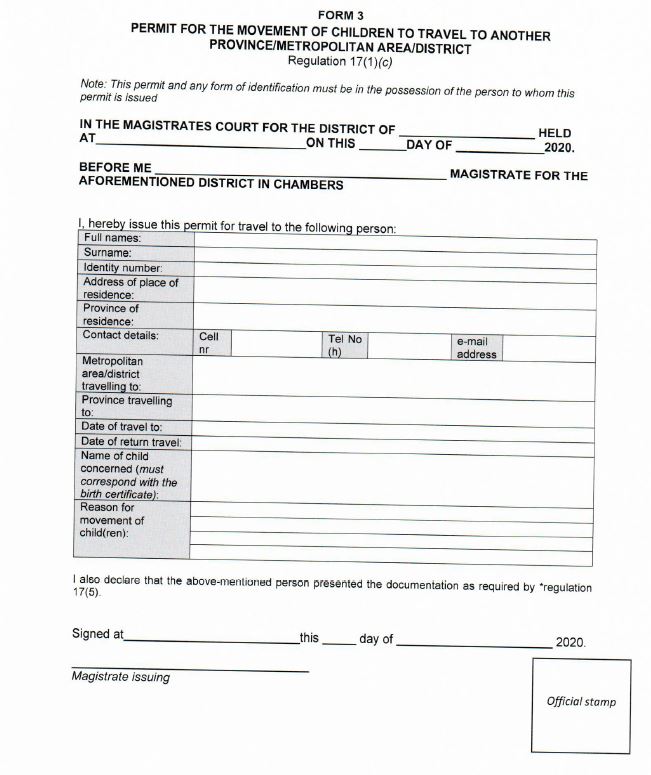 Permit issued by a Magistrate for the movement of children during the lockdown[/caption] We are certain that you found the above article useful and interesting. Please consider sharing it on the share buttons below. They include Facebook, Twitter, LinkedIn, WhatsApp, Gmail and more. Someone may find it useful as well. Should you require business advice or services, feel free to click on these links: Business SA | Private Legal | Envirolaws Click here to read an article regarding the previous regulations on the movement of children.
30 May 2020 – Latest Regulations on the movement of minor children during the lockdown – The introduction of the Magistrate’s Permit The Minister of Cooperative Governance and Traditional Affairs, Dr Nkosazana Dlamini Zuma, published new regulations regarding the Lockdown on 29 April 2020. As from 1 May 2020, South Continue Reading
What to know when wanting to appeal a High Court Judgment?
Everyone has a right to take a matter to a court of law. At the same time, everyone has a right to challenge a decision of a judicial officer. We all make mistakes and a judicial officer is no different. This article deals with the court rules relating to appeals from decisions emanating in the High Court. Therefore, should you wish to appeal a decision of a Judge in the High Court, have a look at the High Court rules below. When dealing with Appeals in the High Court, one looks at the Uniform Rules, or RULES REGULATING THE CONDUCT OF THE PROCEEDINGS OF THE SEVERAL PROVINCIAL AND LOCAL DIVISIONS OF THE HIGH COURT OF SOUTH AFRICA. The Rules are amended from time to time. Rule 49 deals with Civil appeals from the High Court. It is copied below. 49 Civil Appeals from the High Court
(1) (a) When leave to appeal is required, it may on a statement of the grounds therefor be requested at the time of the judgment or order. (b) When leave to appeal is required and it has not been requested at the time of the judgment or order, application for such leave shall be made and the grounds therefor shall be furnished within fifteen days after the date of the order appealed against: Provided that when the reasons or the full reasons for the court’s order are given on a later date than the date of the order, such application may be made within fifteen days after such later date: Provided further that the court may, upon good cause shown, extend the aforementioned periods of fifteen days. (c) When in giving an order the court declares that the reasons for the order will be furnished to any of the parties on application, such application shall be delivered within ten days after the date of the order. (d) The application mentioned in paragraph (b) above shall be set down on a date arranged by the registrar who shall give written notice thereof to the parties. (e) Such application shall be heard by the judge who presided at the trial or, if he is not available, by another judge of the division of which the said judge, when he so presided, was a member. (2) If leave to appeal to the full court is granted the notice of appeal shall be delivered to all the parties within twenty days after the date upon which leave was granted or within such longer period as may upon good cause shown be permitted. (3) The notice of appeal shall state whether the whole or part only of the judgment or order is appealed against and if only part of such judgment or order is appealed against, it shall state which part and shall further specify the finding of fact and/or ruling of law appealed against and the grounds upon which the appeal is founded. (4) A notice of cross-appeal shall be delivered within ten days after delivery of the notice of appeal or within such longer period as may upon good cause shown be permitted and the provisions of these Rules with regard to appeals shall mutatis mutandis apply to cross-appeals. (5) In the case of an appeal against the judgment or order of the court of the Witwatersrand Local Division, the judge president of the Transvaal Provincial Division shall determine whether the appeal should be heard by the full court of the said local division. As soon as possible after receipt of the notice of appeal or cross-appeal, if any, the registrar of the local division shall ascertain from the judge president his direction in the particular case. If the judge president has directed that the appeal be heard by the full court of the Witwatersrand Local Division, the said registrar shall immediately inform the parties of the direction. If not so directed by the judge president, the said registrar shall inform the registrar of the provincial division as well as the parties accordingly. (6) (a) Within sixty days after delivery of a notice of appeal, an appellant shall make written application to the registrar of the division where the appeal is to be heard for a date for the hearing of such appeal and shall at the same time furnish him with his full residential address and the name and address of every other party to the appeal and if the appellant fails to do so a respondent may within ten days after the expiry of the said period of sixty days, as in the case of the appellant, apply for the set down of the appeal or cross-appeal which he may have noted. If no such application is made by either party the appeal and cross-appeal shall be deemed to have lapsed: Provided that a respondent shall have the right to apply for an order for his wasted costs. (b) The court to which the appeal is made may, on application of the appellant or cross-appellant, and upon good cause shown, reinstate an appeal or cross-appeal which has lapsed. (7) (a) At the same time as the application for a date for the hearing of an appeal in terms of subrule (6) (a) of this rule the appellant shall file with the registrar three copies of the record on appeal and shall furnish two copies to the respondent. The registrar shall further be provided with a complete index and copies of all papers, documents and exhibits in the case, except formal and immaterial documents: Provided that such omissions shall be referred to in the said index. If the necessary copies of the record are not ready at that stage, the registrar may accept an application for a date of hearing without the necessary copies if- (i) the application is accompanied by a written agreement between the parties that the copies of the record may be handed in late; or (ii) failing such agreement, the appellant delivers an application together with an affidavit in which the reasons for his omission to hand in the copies of the record in time are set out and in which is indicated that an application for condonation of the omission will be made at the hearing of the appeal. (b) The two copies of the record to be served on the respondent shall be served at the same time as the filing of the aforementioned three copies with the registrar. (c) After delivery of the copies of the record, the registrar of the court that is to hear the appeal or cross-appeal shall assign a date for the hearing of the appeal or for the application for condonation and appeal, as the case may be, and shall set the appeal down for hearing on the said date and shall give the parties at least twenty days’ notice in writing of the date so assigned. (d) If the party who applied for a date for the hearing of the appeal neglects or fails to file or deliver the said copies of the record within 40 days after the acceptance by the registrar of the application for a date of hearing in terms of subrule (7) (a) the other party may approach the court for an order that the application has lapsed. (8) (a) Copies referred to in subrule (7) shall be clearly typed on A.4 standard paper in double spacing, paginated and bound and in addition every tenth line on every page shall be numbered. (b) The left side of each page shall be provided with a margin of at least 35 mm that shall be left clear, except in the case of exhibits that are duplicated by photoprinting, where it is impossible to obtain a margin with the said dimensions. Where the margin of the said exhibits is so small that parts of the documents will be obscured by binding, such documents shall be mounted on sheets of A4 paper and folded back to ensure that the prescribed margin is provided. (9) By consent of the parties, exhibits and annexures having no bearing on the point at issue in the appeal and immaterial portions of lengthy documents may be omitted. Such consent, setting out what documents or parts thereof have been omitted, shall be signed by the parties and shall be included in the record on appeal. The court hearing the appeal may order that the whole of the record be placed before it. (10) When the decision of an appeal turns exclusively on a point of law, the parties may agree to submit such appeal to the court in the form of a special case, in which event copies shall be submitted of only such portions of the record as may be necessary for a proper decision of the appeal: Provided that the court hearing the appeal may require that the whole of the record of the case be placed before it. (11) Where an appeal has been noted or an application for leave to appeal against or to rescind, correct, review or vary an order of a court has been made, the operation and execution of the order in question shall be suspended, pending the decision of such appeal or application, unless the court which gave such order, on the application of a party, otherwise directs. (12) If the order referred to in subrule (11) is carried into execution by order of the court the party requesting such execution shall, unless the court otherwise orders, before such execution enter into such security as the parties may agree or the registrar may decide for the restitution of any sum obtained upon such execution. The registrar’s decision shall be final. (13) (a) Unless the respondent waives his or her right to security or the court in granting leave to appeal or subsequently on application to it, has released the appellant wholly or partially from that obligation, the appellant shall, before lodging copies of the record on appeal with the registrar, enter into good and sufficient security for the respondent’s costs of appeal. (b) In the event of failure by the parties to agree on the amount of security, the registrar shall fix the amount and the appellant shall enter into security in the amount so fixed or such percentage thereof as the court has determined, as the case may be. (14) The provisions of subrules (12) and (13) shall not be applicable to the Government of the Republic of South Africa or any provincial administration. (15) Not later than fifteen days before the appeal is heard the appellant shall deliver a concise and succinct statement of the main points (without elaboration) which he intends to argue on appeal, as well as a list of the authorities to be tendered in support of each point, and not later than ten days before the appeal is heard the respondent shall deliver a similar statement. Three additional copies shall in each case be filed with the registrar. (16) A notice of appeal in terms of section 76 of the Patents Act, 1978 (Act 57 of 1978), or section 63 of the Trade Marks Act, 1963 (Act 62 of 1963), may be served on the patent agent referred to in the Patents Act, 1978, or the agent referred to in section 8 of the Trade Marks Act, 1963, who represented the respondent in the proceedings in respect of which an appeal is noted. (17) In the case of appeals to the full court in terms of the provisions of a statute in which the procedure to be followed is laid down, this rule is applicable as far as provision is made for matters not regulated by the statute. (18) Notwithstanding the provisions of this rule the judge president may, in consultation with the parties concerned, direct that a contemplated appeal be dealt with as an urgent matter and order that it be disposed of, and the appeal be prosecuted, at such time and in such manner as to him seems meet.
What to know when wanting to appeal a High Court Judgment? Everyone has a right to take a matter to a court of law. At the same time, everyone has a right to challenge a decision of a judicial officer. We all make mistakes and a judicial officer is no Continue Reading