30 May 2020 – Latest Regulations on the movement of minor children during the lockdown – The introduction of the Magistrate’s Permit

The Minister of Cooperative Governance and Traditional Affairs, Dr Nkosazana Dlamini Zuma, published new regulations regarding the Lockdown on 29 April 2020. As from 1 May 2020, South Africa’s lockdown would be on Level 4, one level down from when it started. The new regulations bring challenging changes regarding the movement of children between parents. For example, the provision of applying for a Magistrate’s permit. Therefore, some of the new regulations are welcomed by us, and others not. The regulations are further below. Click here to read an article regarding the previous regulations on the movement of children. Summary of the recent regulations that will come in effect tomorrow 1 May 2020:

Local movement of children during the lockdown

Movement of Children may only take place in the same metropolitan area or district municipality if the co-holders of parental responsibilities and rights or a caregiver is: (a) in possession of a Court Order; or (b) a parental responsibilities and rights agreement or parenting plan, registered with the family advocate; or (c) a permit issued by a magistrate which corresponds with Form 3 of Annexure A if the latter documentation is not available; and (d) The household to which the child has to move must be free of COVID-19. Before a magistrate may issue a permit, he or she must be provided with a birth certificate or certified copy of a birth certificate of the child or children to prove a legitimate relationship between the co-holders of parental responsibilities and rights. Furthermore, written reasons as to why the movement of the child is necessary must be provided. In our view, the permit application is a step back. This we say as previously there was no need for the application for a permit. The courts would be inundated with such applications. Producing a birth certificate as previously required should have continued.

Inter-Provincial movement of children during the National lockdown

The regulations now allow for a once-off movement of children between provinces during the lockdown. It states: “Any child who was not at the residence of their primary caregiver before the lockdown period and who could not travel between provinces, metropolitan and district areas during the lockdown will be permitted, on a once-off basis, to return to the residence of their primary caregiver if the co-holders of parental responsibilities and rights or a caregiver is in possession of a permit issued by a magistrate which corresponds with Form 3 of annexure A.” Before a magistrate issues a permit, he or she must be provided with: (a) a court order; or (b) a parental responsibilities and rights agreement or parenting plan registered with the family advocate; or (c) a birth certificate or certified copy of a birth certificate of the child or children to prove a legitimate relationship between the co-holders of parental responsibilities and rights, and (d) written reasons why the movement of the child is necessary. Furthermore, the household to which the child has to move must be free of COVID-19. Click here to read an article regarding the previous regulations on the movement of children. Below are the relevant regulations and the relevant form the Magistrate must provide. Movement of children
  1. (1) The movement of children between co-holders of parental responsibilities and rights or a caregiver, as defined in section 1(1) of the Children’s Act, 2005 (Act No. 38 of 2005), in the same metropolitan area or district municipality is allowed subject to the following if the co-holders of parental responsibilities and rights or a caregiver is in possession of—
(a) a court order; or (b) a parental responsibilities and rights agreement or parenting plan, registered with the family advocate (c) a permit issued by a magistrate where which corresponds with Form 3 of Annexure A if the documentation in paragraphs (a) and (b) is not available. (2) The movement of children between co-holders of parental responsibilities and rights or a caregiver, as defined in section 1(1) of the Children’s Act, 2005 (Act No. 38 of 2005), between different metropolitan areas, district municipalities or provinces is allowed if the co-holders of parental responsibilities and rights or a caregiver is in possession of a permit, issued by a magistrate which corresponds with Form 3 of Annexure A. (3) Any child who was not at the residence of their primary caregiver before the lockdown period and who could not travel between provinces, metropolitan and district areas during the lockdown will be permitted, on a once-off basis, to return to the residence of their primary caregiver if the co-holders of parental responsibilities and rights or a caregiver is in possession of a permit issued by a magistrate which corresponds with Form 3 of annexure A. (4) The household to which the child has to move, must be free of COVID-19. (5) (a) Before a magistrate issues a permit referred to in regulation 17(1)(c), he or she must be provided with— (i) birth certificate or certified copy of a birth certificate of the child or children to prove a legitimate relationship between the co-holders of parental responsibilities and rights; and (ii) written reasons why the movement of the child is necessary.   (b) Before a magistrate issues a permit referred to in 17(2) or (3), he or she must be provided with— (i) A court order (ii) a parental responsibilities and rights agreement or parenting plan registered with the family advocate or (iii) a birth certificate or certified copy of a birth certificate of the child or children to prove a legitimate relationship between the co-holders of parental responsibilities and rights; and (iv) written reasons why the movement of the child is necessary.
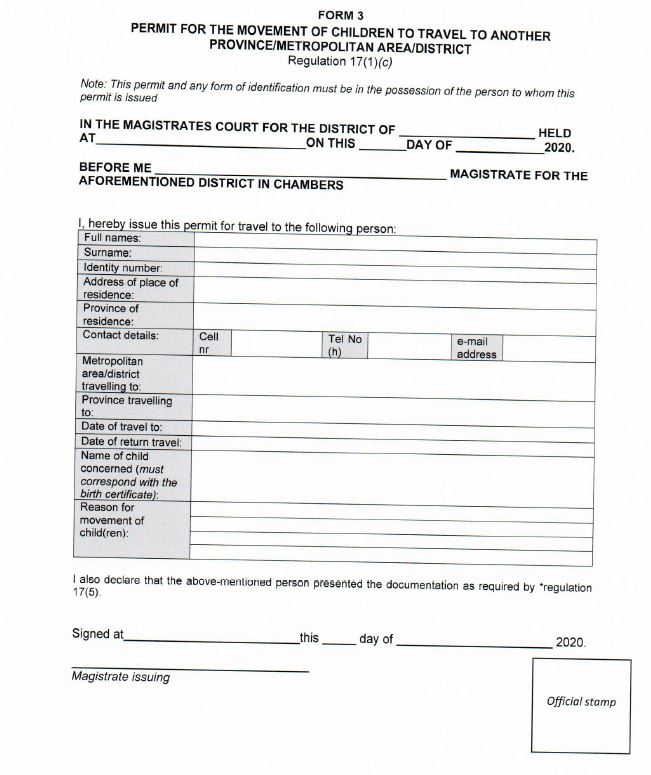
[caption id="attachment_9098" align="alignleft" width="651"]Permit issued by a Magistrate for the movement of children during the lockdown Permit issued by a Magistrate for the movement of children during the lockdown[/caption]                                           We are certain that you found the above article useful and interesting. Please consider sharing it on the share buttons below. They include Facebook, Twitter, LinkedIn, WhatsApp, Gmail and more. Someone may find it useful as well. Should you require business advice or services, feel free to click on these links: Business SA | Private Legal | Envirolaws Click here to read an article regarding the previous regulations on the movement of children.  

30 May 2020 – Latest Regulations on the movement of minor children during the lockdown – The introduction of the Magistrate’s Permit

The Minister of Cooperative Governance and Traditional Affairs, Dr Nkosazana Dlamini Zuma, published new regulations regarding the Lockdown on 29 April 2020. As from 1 May 2020, South Africa’s lockdown would be on Level 4, one level down from when it started.

The new regulations bring challenging changes regarding the movement of children between parents. For example, the provision of applying for a Magistrate’s permit. Therefore, some of the new regulations are welcomed by us, and others not. The regulations are further below.

Click here to read an article regarding the previous regulations on the movement of children.

Summary of the recent regulations that will come in effect tomorrow 1 May 2020:

Local movement of children during the lockdown

Movement of Children may only take place in the same metropolitan area or district municipality if the co-holders of parental responsibilities and rights or a caregiver is:

(a) in possession of a Court Order; or

(b) a parental responsibilities and rights agreement or parenting plan, registered with the family advocate; or

(c) a permit issued by a magistrate which corresponds with Form 3 of Annexure A if the latter documentation is not available; and

(d) The household to which the child has to move must be free of COVID-19.

Before a magistrate may issue a permit, he or she must be provided with a birth certificate or certified copy of a birth certificate of the child or children to prove a legitimate relationship between the co-holders of parental responsibilities and rights. Furthermore, written reasons as to why the movement of the child is necessary must be provided.

In our view, the permit application is a step back. This we say as previously there was no need for the application for a permit. The courts would be inundated with such applications. Producing a birth certificate as previously required should have continued.

Inter-Provincial movement of children during the National lockdown

The regulations now allow for a once-off movement of children between provinces during the lockdown. It states:

“Any child who was not at the residence of their primary caregiver before the lockdown period and who could not travel between provinces, metropolitan and district areas during the lockdown will be permitted, on a once-off basis, to return to the residence of their primary caregiver if the co-holders of parental responsibilities and rights or a caregiver is in possession of a permit issued by a magistrate which corresponds with Form 3 of annexure A.”

Before a magistrate issues a permit, he or she must be provided with:

(a) a court order; or

(b) a parental responsibilities and rights agreement or parenting plan registered with the family advocate; or

(c) a birth certificate or certified copy of a birth certificate of the child or children to prove a legitimate relationship between the co-holders of parental responsibilities and rights, and

(d) written reasons why the movement of the child is necessary.

Furthermore, the household to which the child has to move must be free of COVID-19.

Click here to read an article regarding the previous regulations on the movement of children.

Below are the relevant regulations and the relevant form the Magistrate must provide.

Movement of children

  1. (1) The movement of children between co-holders of parental responsibilities and rights or a caregiver, as defined in section 1(1) of the Children’s Act, 2005 (Act No. 38 of 2005), in the same metropolitan area or district municipality is allowed subject to the following if the co-holders of parental responsibilities and rights or a caregiver is in possession of—

(a) a court order; or

(b) a parental responsibilities and rights agreement or parenting plan, registered with the family advocate

(c) a permit issued by a magistrate where which corresponds with Form 3 of Annexure A if the documentation in paragraphs (a) and (b) is not available.

(2) The movement of children between co-holders of parental responsibilities and rights or a caregiver, as defined in section 1(1) of the Children’s Act, 2005 (Act No. 38 of 2005), between different metropolitan areas, district municipalities or provinces is allowed if the co-holders of parental responsibilities and rights or a caregiver is in possession of a permit, issued by a magistrate which corresponds with Form 3 of Annexure A.

(3) Any child who was not at the residence of their primary caregiver before the lockdown period and who could not travel between provinces, metropolitan and district areas during the lockdown will be permitted, on a once-off basis, to return to the residence of their primary caregiver if the co-holders of parental responsibilities and rights or a caregiver is in possession of a permit issued by a magistrate which corresponds with Form 3 of annexure A.

(4) The household to which the child has to move, must be free of COVID-19.

(5) (a) Before a magistrate issues a permit referred to in regulation 17(1)(c), he or she must be provided with—

(i) birth certificate or certified copy of a birth certificate of the child or children to prove a legitimate relationship between the co-holders of parental responsibilities and rights; and (ii) written reasons why the movement of the child is necessary.


(b) Before a magistrate issues a permit referred to in 17(2) or (3), he or she must be provided with—

(i) A court order

(ii) a parental responsibilities and rights agreement or parenting plan registered with the family advocate or

(iii) a birth certificate or certified copy of a birth certificate of the child or children to prove a legitimate relationship between the co-holders of parental responsibilities and rights; and

(iv) written reasons why the movement of the child is necessary.

Permit issued by a Magistrate for the movement of children during the lockdown


We are certain that you found the above article useful and interesting. Please consider sharing it on the share buttons below. They include Facebook, Twitter, LinkedIn, WhatsApp, Gmail and more. Someone may find it useful as well.

Should you require business advice or services, feel free to click on these links:

Business SA | Private Legal | Envirolaws

Click here to read an article regarding the previous regulations on the movement of children.


Related Post

Uncontested divorce in South Africa

What do we mean when we use the term “
uncontested divorce”? Our law offices have potential clients calling in on a regular basis and when asked about the nature of the divorce, we’re met with “What do you mean?“. This is perfectly normal from a layperson’s perspective. To put it simply, an uncontested divorce is a divorce in which both parties are in agreement with. Because of the less complex nature of this divorce; it can be done within a matter of three weeks with our legal expert on board. As explained by the legal expert on our website, for Undefended Divorce in the Western Cape High Court, you will have to: Complete the free online divorce form below to assist you with your unopposed divorce. View the following related pages: Free DIY Online Divorce Guide and Form A divorce guide in PDF format A Sample Summons in Word format A Particulars of Claim in Word Format A notice of Set Down in Word Format Find out more about Undefended Divorce in the Western Cape High Court and call our law offices on 021 424 3487 to make an online appointment with us for a professional legal consultation today!  

DIY divorce in Cape Town, Western Cape

Are you interested in finding out more about doing your own divorce? While this can be more economically viable option, you will need the assistance of the legal expert to guide you along the way. Our website has been designed to navigate easily for the layperson. The creators of this website have also tried to make content easy to navigate. With this in mind, we have supplied a number of free, expert legal advice articles that has been carefully crafted by the legal expert himself. According to the legal expert stated in Do Your Own Unopposed Divorce, the following will need to be done: A summons needs to be drafted which will be issued by the divorce court to commence the divorce process. It should have on it the details of the court you will be issuing divorce, details of the parties, e.g. names, occupation and address etc. Every High Court in the area where you live has the authority to attend to a divorce. There are however specialized divorce courts that may attend to a divorce as well. You should then draft a particulars of claim, outlining relevant matters concerning the marriage, children, reasons for wanting a divorce and what do you want the court to grant you in a divorce order. This particulars of claim you attach to the summons. Here is an example of a summons and particulars of claim for a divorce for a couple married in community of property with no children getting divorce in the High Court in Cape Town. For more on how to go about your DIY Divorce, see our Do Your Own Unopposed Divorce and make an online appointment with us today by calling our friendly receptionist at 021 424 3487.  

Contested divorce in South Africa

When it comes to contested divorce – we’re talking long Court procedures due to overbearing court rolls. First of all, a contested divorce is a divorce in which both, or one party opposes the divorce and is not in agreement of the divorce. We have found that the parties becomes overly emotional about the process and tend to lose track of the bigger picture. This is a major contributing factor that adds to dragging process. However, our legal expert would always inform parties that easy divorces are generally rare (even in a case of an uncontested divorce). One too many times, where there’s children involved, you will find issues of child custody, visitation rights and child maintenance will arise in the process. As advised on How to Win Your Divorce Case article, it is encouraged to acquaint yourself with the laws regarding child maintenance. The following scenario is highlighted for instance: Lets say a couple was married for 10 (years). They married in community of property. In other words, they share in everything. There are 2 children born from the marriage. They live in a home that is bonded, but purchased by the wife before the marriage. The bond is only registered on her name, and gets deducted from her personal banking account. The father however does not work, but attends to the household, which includes cleaning, taking the kids to school, making food etc. When the children are ill, the father would be the one who stays up caring for them. School projects and homework is also attended to by the father. The father does some web designing work for income, but his income is minimal compared to that of his wife. The best would be to enter into a parenting plan. For more on this, read our  How to Win Your Divorce Case article on our web page. Call our law offices on 021 424 3487 to make an online appointment with us for a professional legal consultation today!

Free divorce products and toolkits

As previously mentioned, we pride ourselves in trying to make legal information easily accessible. Do feel free to link on the relevant links below and start downloading our free, legal advice products for your convenience:
  1. How to Change your Matrimonial Property Regime
  2. Do your own Unopposed Divorce. No lawyers needed and its Free.
  3. Parental Rights of Divorced Muslim parents after a Talaq or Faskh
  4. Free Online Divorce Assistance Form – DIY Cape Town South Africa comprising of:
Call our law offices on 021 424 3487 to make an online appointment with us for a professional legal consultation today!      

Paternity disputes and Scientific DNA Testing in Child Legal Matters

Paternity disputes are not uncommon in our courts of law. What sparks them varies, however, all disputes are messy. For one, the mere allegation that he is not the father of the child may directly or indirectly affect the dignity of the mother, and that of the child. In other words, it is suggested that she had more than one sexual partner at the time, and the child was born from such a relationship. Nonetheless, the issue can speedily be resolved through scientific DNA testing.

advice-child-maintenance-child-custody-divorce

Paternity – Legal Settings

There are two common legal settings where a parent (or alleged parent) would dispute paternity. The one would be in a child maintenance dispute, where the father alleges that he is not the biological father of the child, and therefore cannot be ordered to pay child maintenance. The other situation would be in a child custody or visitation dispute. Here the mother would allege that the man is not the father, or he denies paternity.

Paternity Dispute Scenarios

There are other scenarios where paternity can become an issue. One would be in the case of inheritance. A parent would allege that a child is an heir of the person who passed on. Another would be in the case of marriage. What happens if there is a rumour your intended bride is your half-sister? These disputes and many others can only be resolved with DNA or scientific testing. Below we further deal with the question as to whether a court can force a parent and a child to submit to a blood test. That is where It gets interesting. The latter scenario laid the seed for researching and writing this post.  Read on to learn more. You may learn something new.  

The legal presumption of pater est quem nuptiae demonstrant

Now let’s start with the common law. There is a phrase or common law presumption, “Pater est quem nuptiae demonstrant”. It is a Latin phrase which states that the father is he who is married to the mother. In other words, if the child was born whilst the father was married to the mother, it is presumed that he is the father. Therefore, unless the father or mother can prove otherwise, every child born from a marriage is presumed to be the child of the husband. If the husband or wife disputes it, they must prove it. This may become an issue during divorce proceedings. The wife may allege that the husband is the father of the child and claim maintenance from him. He would then in his plea state that he is not the father and accordingly not responsible to pay child support. At the divorce trial, he would have to prove that he is not the father. A simple way of resolving the dispute would be through a blood test or scientific DNA testing. Now let’s move on to written law, in legislation and learn some more.  

The Law on paternity disputes in relation to minor children

There are two pieces of legislation that applies in relation to paternity issues regarding minor children. It is the Maintenance Act 99 of 1998, in relation to child maintenance matters, and the Children’s Act 38 of 2005, in relation to child legal matters in general. We shall, however, start with the Children’s Act 38 of 2005.  

The Children’s Act – Paternity Disputes

The Children’s Act has two (2) sections dealing with paternity issues. The first deals with the Presumption of paternity in respect of a child born out of wedlock and the other, the refusal to submit to the taking of blood samples. We quote them next.

Section 36: Presumption of paternity in respect of a child born out of wedlock

“If in any legal proceedings in which it is necessary to prove that any particular person is the father of a child born out of wedlock it is proved that that person had sexual intercourse with the mother of the child at any time when that child could have been conceived, that person is, in the absence of evidence to the contrary which raises a reasonable doubt, presumed to be the biological father of the child.”

Section 37: Refusal to submit to the taking of blood samples

“If a party to any legal proceedings in which the paternity of a child has been placed in issue has refused to submit himself or herself, or the child, to the taking of a blood sample in order to carry out scientific tests relating to the paternity of the child, the court must warn such party of the effect which such refusal might have on the credibility of that party.”

Create Reasonable Doubt

Looking at the aforementioned sections of the Children’s Act, in a paternity dispute, it is presumed that if parties had sexual intercourse at any time when that child could have been conceived, the male is the father. The father can disprove this by raising reasonable doubt. This can be done by proving that he was sterile, or through scientific DNA testing. If another man comes and says he is the father; we are sure some reasonable doubt may be created. According to the next section in the Children’s Act, if a party refuses to submit to a paternity test, it could affect his or her credibility. Therefore, if someone is truly a parent, or not a parent, and has nothing to fear from the truth, he or she should submit themselves to a blood test. Failing which, it might affect that person’s credibility in the matter. The court could then infer that he or she is lying. Now let’s move on to the Maintenance Act in child maintenance matters.  

advice-child-maintenance-child-custody-divorce

The Maintenance Act – Paternity Disputes

In our experience, it is the offices of the maintenance courts that deals mostly with paternity disputes. When the father gets called to the maintenance court, to pay child support for a child he does not have a relationship with, in some cases, he would invoke the paternity defence. In other words, he would dispute the paternity of the child. In such a case, he would request a paternity test. Section 21 of the Maintenance Act deals with orders relating to scientific tests regarding paternity. Here we quote the relevant section next.

21 Orders relating to scientific tests regarding paternity

(1) If the maintenance officer is of the opinion- (a) that the paternity of any child is in dispute;(b) that the mother of such child, as well as the person who is allegedly the father of such child, are prepared to submit themselves as well as such child, if the mother has parental authority over the said child, to the taking of blood samples in order to carry out scientific tests regarding the paternity of that child; and (c) that such mother or such person or both such mother and such person are unable to pay the costs involved in the carrying out of such scientific tests, the maintenance officer may at any time during the enquiry in question, but before the maintenance court makes any order under section 16, request the maintenance court to hold an enquiry referred to in subsection (2). (2) If the maintenance officer so requests, the maintenance court may in a summary manner enquire into- (a) the means of the mother of the child as well as the person who is allegedly the father of the child; and (b) the other circumstances which should in the opinion of the maintenance court be taken into consideration. (3) At the conclusion of the enquiry referred to in subsection (2), the maintenance court may- (a) make such provisional order as the maintenance court may think fit relating to the payment of the costs involved in the carrying out of the scientific tests in question, including a provisional order directing the State to pay the whole or any part of such costs; or (b) make no order. (4) When the maintenance court subsequently makes any order under section 16, the maintenance court may- (a) make an order confirming the provisional order referred to in subsection (3) (a); or (b) set aside such provisional order or substitute therefor any order which the maintenance court may consider just relating to the payment of the costs involved in the carrying out of the scientific tests in question.

Costs of Scientific DNA Testing in Child Maintenance Matters

Looking at the aforementioned section, it does not say much about the evidentiary aspect of paternity testing. It basically deals with the costs thereof. However, what is clear is that the Maintenance Court considers issues of paternity disputes and deals with it. Nonetheless, the aforementioned provisions of the Children’s Act would apply to matters in the Maintenance Court. Next, we move on to the issue of whether or not a court can force a party to submit to a paternity test.

Forced or Compelled Paternity Tests

The two pieces of legislation referred to above does not assist us much with regard to the issue of a court forcing a parent to submit to a paternity test. We now need to consider the case law. In other words, what do the courts have to say about this? Most of the older court decisions, do not agree with forcing a parent to submit to a blood/paternity test. However, it seems that things have changed in the past decade. Let us refer to the judgment of LB v YD 2009 (5) SA 463 (T), a Transvaal Provincial Division matter handed down by Judge Murphy less than 10 years ago.  

LB v YD 2009 (5) SA 463 (T).

One of the issues, in this case, was that the mother did not want to submit herself to a blood test. Her view, amongst other things, was that it was not in the child’s best interests. The father argued that it was his right to know whether or not he is the father of the child. He further argued that his right to the certainty of paternity outweighs any inconvenience that might be suffered by the mother and the child. With regard to the law, the Court stated the following: [18] The law on the topic of compulsory blood or DNA testing in parental disputes is not satisfactory. There is no legislation which specifically regulates the position in civil cases. Judicial pronouncements on the topic have not been unanimous in their approach to the issues and have differed on the proper legal basis for ordering tests. In relation to the child the courts have relied on their inherent jurisdiction as upper guardian, while in relation to the non-consenting adult some judges have invoked the inherent jurisdiction of a court to regulate its own procedures while others have refused to do so. In all cases the courts have been mindful of the need on the one hand to protect the privacy and bodily integrity of those to be subjected to tests, but on the other hand have asserted the court’s role to discover the truth whenever possible and to make use of scientific methods for that purpose.   [23] In short, I agree with those judges and commentators who contend that as a general rule the more correct approach is that the discovery of truth should prevail over the idea that the rights of privacy and bodily integrity should be respected – see Kemp ‘Proof of Paternity: Consent or Compulsion’ (1986) 49 THRHR 271 at 279 – 81. I also take the position, and I will return to this more fully later, that it will most often be in the best interests of a child to have any doubts about true paternity resolved  and put beyond doubt by the best available evidence.  

advice-child-maintenance-child-custody-divorce

[47] The present case is one in which a clearing of the air is called for. Both parties have at various times admitted and denied that the applicant is the biological father. The respondent was intimate with a second party, her husband, within the period of possible conception. The child is barely 1 year old and thus there is no established relationship that might be unduly disturbed or harmed by a determination of non-paternity. If  the applicant is established to be the father, the child will benefit in time from knowing the truth and from the applicant’s commitment to her financial wellbeing. The possible stigma of a disputed paternity will also be removed. And, furthermore, legislative safeguards exist for the assignment and monitoring of appropriate parental rights and responsibilities to the applicant, should that prove permissible. I accordingly  consider that it will be in the best interests of the child that paternity be scientifically determined and resolved at this early stage.   [48] I agree that the order sought by the applicant is the one that should be granted. It is ordered as follows:
  1. The respondent is ordered to submit herself and her minor child Y to DNA tests for the purpose of determining whether the applicant is the biological father of the child Y within 30 days of this order.
  2. Prayers 2 and 3 of the notice of motion are postponed sine die.
  3. The applicant is ordered to pay the costs of the tests referred to in D para 1 of this order.
  4. The costs of this application are reserved.

advice-child-maintenance-child-custody-divorce

The numbers in the square brackets denote the number of the paragraph you would find it in the judgment should you decide to make use of it. We agree with Judge Murphy. It is clear that the Courts can and should compel parents and children to submit to a blood test/DNA test when it is in the child’s best interests. Each case is different, and whereby a compelled blood test/DNA test would be warranted in one scenario, it may not be in the other. Nonetheless, with modern technology at our disposal, a simple paternity test is currently less intrusive than it was in the past.            

Do you require a video legal advice consultation?

Click here and schedule one today!