 Justice Cape Town Legal Services and Advice Cape Town South Africa[/caption] [caption id="attachment_8316" align="alignleft" width="640"]
 Judge – Legal – Legal Services and Advice Cape Town South Africa[/caption] [caption id="attachment_8315" align="alignleft" width="640"]
 Judge Law – Legal Services and Advice Cape Town South Africa[/caption] [caption id="attachment_8314" align="alignleft" width="478"]
 International Law – Legal Services and Advice Cape Town South Africa[/caption] [caption id="attachment_8313" align="alignleft" width="640"]
 Family Law – Legal Services and Advice Cape Town South Africa[/caption] [caption id="attachment_8312" align="alignleft" width="640"]
 Divorce Law – Legal Services and Advice Cape Town South Africa[/caption] [caption id="attachment_8311" align="alignleft" width="640"]
 Divorce spouses – Legal Services and Advice Cape Town South Africa[/caption]
Our Lawyer – Family Legal Services – Cape Town 0 South Africa Not all legal matters have to be complicated and daunting. Contact us today to assist you with your legal matters. We provide legal advice at your convenience.
Telelaw
Divorce – Questions and Answers on the Process and Procedure
 Divorces signify the end of marriages. However, it can also be seen as a beginning of a new life. Once a couple has tried everything to save their marriage, to no avail, a divorce is an inevitable consequence. With divorces, comes the law. Only a court can legally divorce you. And because of this, people have many questions on the divorce procedure and process. This post is intended to assist parties whose marriage had irretrievably broken down by answering frequently asked questions on divorces. Due to the nature of legal matters, it is best to make use of an attorney or get the advice of a legal professional when dealing with a divorce. However, we intend giving you a general overview of the divorce process below with the assistance of Adv. Muhammad Abduroaf.
Family Law Questions and Answers
Should you not find what you are looking for, feel free to post your questions on our blog, by clicking on the following links:
Divorces – Questions and Answers
Child Custody – Questions and Answers
Child Maintenance – Question and Answers
Domestic Violence – Questions and Answers
You are welcome to call us on 021 424 3487 / 0870735800
For other legal and business services, feel free to visit:
Divorce – Things to Consider
There are a few things to consider when proceeding with a divorce. Depending on the issues involved, it would determine how quick or how complicated your divorce could be. They are as follows:Minor Children in divorces
As a consequence of marriage, are children. If your children are 18 years or older at the time of the divorce, they would not be a factor, as they are adults. However, if they are younger than 18 years old, their interests are affected in the divorce process. The Court won’t divorce you unless it is satisfied that their best interests are taken care of. When a divorce settlement is reached, the settlement should be taken to the Office of the Family Advocate. The Family Advocate would then study the document, and, if they are satisfied with it, enforce it. If they are not happy with it or have any issues, they will usually provide it in a cover letter. Factors to consider are the following:- Child Maintenance
- Primary Residence
- Parental Responsibilities and Rights of Care and Contact
- Guardianship
- Facilitation or Dispute Resolution
 Purchase our Unopposed Divorce Package, click here.
Matrimonial Property Regime
The Matrimonial Property Regime the Parties are married in is an important aspect to consider when getting divorced. This we unpack next.In Community of Property
The default Matrimonial Property Regime is that of “In Community of Property”. What this basically means is that there is one joint estate. In other words, there are no longer two separate estates. By way of example, if the husband takes out a loan, the wife is also responsible to repay it. This is so as the Joint Estate incurred the debt. The husband could not have incurred the debt solely as he does not have a separate estate.Out of Community of Property
It has become the trend for people to get married “Out of Community of Property”. What this means is that there are two separate estates. It is as if you are not married. The wife can enter into loans and agreements without the consent of her husband, and his estate would not be affected by that. There are however two variables to being married Out of Community of Property. That is married Out of Community of Property with the inclusion of the accrual regime, and the other without.Accrual Regime Included in Your Marriage
If the accrual regime is not specifically excluded in the Ante-nuptial Contract, then it is by default included. What this means, is that during the marriage, there are two separate estates. You can do what you please without the consent or consideration of the other party’s estate. However, at divorce, or death of one of the parties, you must share in half the difference of the accruals of each estate. So, for example, if the accrual regime applies, and at divorce, the husband’s estate is worth R 10 000 – 00 and the wife’s estate is worth R 5 000 – 00; then he should pay her R 2500 – 00 in cash. The same would apply at death. Both parties would, therefore, leave the marriage with the sum of R 7 500 – 00. This regime would be beneficial where the wife or husband stays at home, looking after the household and children. The other spouse would be working on building an empire.Accrual Regime Expressly Excluded in your marriage
Let’s say the parties got married Out of Community of Property. However, in their Ante-nuptial contract, they specifically excluded the accrual regime. In that case, there would be two separate estates during the marriage. And at divorce or death, there would still be two separate estates and neither spouse would have to pay the other spouse any amount. If both spouses are working during the marriage, building their own empires, then this regime would be a better option.Pension Funds in Divorces
Pension funds would apply to marriages in Community of Property, and where the accrual regime applies, to marriages out of Community of Property. When the parties divorce, in the case of a marriage in Community of Property, a spouse has a claim to half the Pension Fund of the other spouse. If they are married Out of Community of Property with the accrual regime, then the value of the pension fund is taken into consideration when determining the accrual. Therefore, if both the pension funds are the same in value, and both parties have the same amount of assets; there would be no accrual. This would be so if all else is equal. Next, we move to the divorce process and procedure, written by Adv. Muhammad Abduroaf. Pictures are provided for some assistance.The Divorce Process
Some advice from Adv. Muhammad AbduroafFirst, some Legal Advice
If you want to get divorced from your spouse, I strongly advise that your approach a legal practitioner, or an attorney to attend to it on your behalf. This I would implore even more under the following circumstances:- There will be a dispute over care and visitation rights over the child/children;
- One of the parties shall be applying for forfeiture of patrimonial benefits from a marriage in community of property;
- The joint estate is huge or complicated; or
- The other party shall be making use of legal representation.
General Divorce Process and Procedure
If, however, you would like to know the general procedures on how to go about in obtaining a divorce decree; they are listed summarily below. There are many rules that regulate divorce processes and the summary below does exclude some of them. These include exceptions, strikeouts, compelling compliance, service addresses etc. Other matters incidental to divorce proceedings, e.g. interim arrangements, pending the divorce regarding maintenance for you or your children and care and contact regarding children are not dealt with. Therefore, please consult a legal practitioner or the divorce court throughout your divorce process should you decide to do the divorce yourself. Purchase our Unopposed Divorce Package, click here.Summons and Particulars of Claim
A summons needs to be drafted which should be issued by the divorce court to commence the divorce process. It should have on it the details of the court you will be issuing the divorce from, details of the parties, e.g. names, occupation and address etc. Every High Court in the area where you live has the authority to attend to a divorce. You should then draft a particulars of claim outlining relevant matters concerning the marriage, children, reasons for wanting a divorce and what do you want the court to grant you in a divorce order. These particulars of claim you attach to the summons. [caption id="attachment_6734" align="alignleft" width="800"]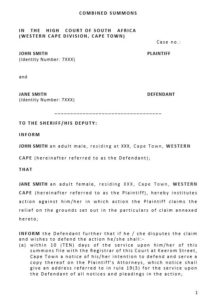 Example of a Divorce Summons[/caption] https://www.ourlawyer.co.za/wp-content/uploads/Divorce-Summons-Divorce-Lawyer-Process-217×300.jpg
Divorce Particulars of Claim
Once you have your summons and particulars of claim in order, you have to have the summons issued. To do this, make three (3) copies of your set of documents (Summons and Particulars of Claim) and have it issued at court. [caption id="attachment_6731" align="alignleft" width="800"]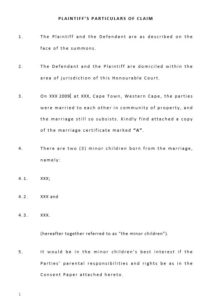 Example of A Particulars of Claim in a Divorce Action[/caption]
Issuing and Service of Divorce Summons and Particulars of Claim
Once you are at the court, go to the clerk/registrar of the court and have your documents issued. The clerk/registrar will sign the summons and provide a case number by writing it on the summons.
You should then take the original and a copy (both must be signed and stamped by the clerk/registrar of the court) and take it to the sheriff which serves documents where your spouse work, of lives. You can ask the clerk/registrar of the court for that details.
The extra—copy of the summons and particulars of claim you keep for your file and records.Notice of intention to defend
Once the sheriff served the documents, your spouse has two weeks to inform you of whether he or she shall be defending the divorce. This information is outlined in the summons. If your spouse decided not to defend the divorce action, then after a period of two weeks has elapsed, you may set the matter down as an undefended divorce. If your spouse intends to defend the divorce, he or she would then have to file the notice of intention to defend. In this notice, you would advise the Court and the Plaintiff that you are defending the divorce, and also, provide a service address. The Service Address is the address at which the Plaintiff would send notices in the court case to you. Below, kindly find an example of a Notice of Intention to Defend. [caption id="attachment_6743" align="alignleft" width="800"]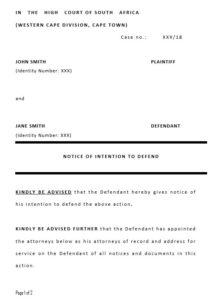 Notice of Intention to Defend[/caption]
Divorce Plea to particulars of claim
Once you received notice of your spouse’s intention to defend the divorce, about a month later, your spouse or his or attorney should serve and file a plea. The plea should outline which parts of your particulars of claim your spouse agrees (or disagree) with which would give a direction of what to prove at court. Purchase our Unopposed Divorce Package, click here. [caption id="attachment_6740" align="alignleft" width="800"]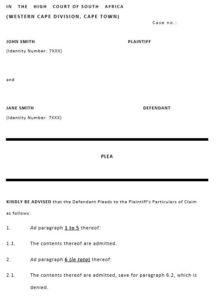 Plea in a Divorce Action[/caption] [caption id="attachment_6739" align="alignleft" width="903"]
 Plea in a Divorce Action[/caption]
Divorce Counterclaim or Claim in Reconvention
Your spouse might want to file a counterclaim or claim in reconvention. In the same way which you outlined your case as to what you want from the court and the reasons therefore in your particulars of claim; your spouse can file on you a counterclaim. A counterclaim might still be filed if your spouse agrees to a divorce, but maybe wants primary care of the children, but in your particulars of claim, you asked for primary care. You should then within 10 (ten) days plead to the counterclaim in the same manner which your spouse pleaded to your particulars of claim [caption id="attachment_6738" align="alignleft" width="789"] Divorce Counter Claim[/caption]
 Discovery
When you present evidence at Court, you want to be fully prepared. Therefore, all documents your spouse will be making use of at Court should be presented to you beforehand. And you should do the same. This is where discovery comes into play. You may ask or may be asked to provide under oath a schedule of books and documents in your possession and under your control relating to the divorce. This could be policy documents, deeds etc, and which you or your spouse might want to make use of at trial. Once you received the schedules you may inspect and request copies of the documents. [caption id="attachment_6727" align="alignleft" width="800"] Request for Discover Notice[/caption] [caption id="attachment_6726" align="alignleft" width="800"]
 Discovery Notice[/caption]
Discovery Affidavit
After receiving a notice requesting a spouse to discover, an affidavit should be provided. The wording of the Affidavit can be seen in the pictures below. [caption id="attachment_6723" align="alignleft" width="800"]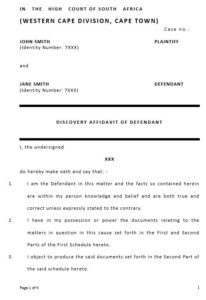 Example of a Discovery Affidavit[/caption] [caption id="attachment_6725" align="alignleft" width="800"]
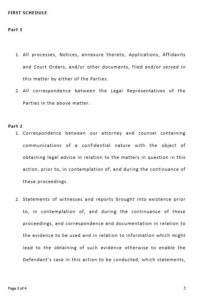 Discovery Affidavit[/caption] [caption id="attachment_6724" align="alignleft" width="800"]
 Discovery Affidavit[/caption]
Obtaining a Trial date for the Divorce
Once you received the plea, with or without a counterclaim, or have pleaded to your spouse’s counterclaim, and discovery is done, one should then approach the clerk/registrar of the court for a trial date. This you or your spouse may do. This process is a bit complicated, so it’s best to do it with the guidance of a lawyer or the clerk/registrar of the court. Purchase our Unopposed Divorce Package, click here.Pr-Trial Procedure
Before a date gets allocated to you for the divorce, the Court would want to ensure that your matter is trial ready. What this basically means, is that all that needs to be done, has been attended to and the trial will run. Many months are spent waiting for a court date, and it would be unfair to the court if a judge and other litigants are appointed to a matter, and the matter does not proceed. A judge will meet with the parties in chambers, and once the matter is trial ready, he or she will endorse the file in that regard.Divorce day / Trial / Unopposed hearing date
If your spouse does not defend the divorce within the time period, go back to court and ask for an unopposed divorce date and attend to your divorce on that date. If, however, your divorce is defended, a trial should ensure. During the trial, each party should prove his or her case. Witnesses should be called and at the end, the Magistrate or Judge shall deliver the verdict. Best of luck, and please, don’t take my word, contact a legal practitioner should you decide to get divorced. Advocate Muhammad Abduroaf [caption id="attachment_6758" align="alignleft" width="300"] Divorce Lawyer and Process[/caption]
Divorce – Questions and Answers on the Process and Procedure Divorces signify the end of marriages. However, it can also be seen as a beginning of a new life. Once a couple has tried everything to save their marriage, to no avail, a divorce is an inevitable consequence. With divorces, Continue Reading
Frequently Asked Questions on Divorce – Cape Town South Africa
How long does it take to get an uncontested divorce in South Africa?
If the parties are in agreement to the divorce, and sign a consent paper or settlement agreement, it can take about 4 weeks. However, if they cannot come to an agreement on all aspects, for example, child maintenance and custody, then it can take about a year. This is if all goes well an no party tries to delay the process.How long does it take to get an amicable divorce?
It all depend on the parties. If it is indeed amicable, then approximately four weeks. It is best to have a lawyer assist in the process. However, you can do it DIY. How much does it cost to get a divorce?
The Courts do not charge for a divorce. However, if you decide to do a divorce on your own, then it would be free. The only costs would be that which you pay the Sheriff to serve the summons on the other party.How long will it take for a divorce to be final?
It depends on when the hearing date of the divorce is. It can take a few weeks, or a year or so.How long does it take to get a divorce decree in the mail?
Divorce decrees are not posted to you by the Court. You would have to collect it from the Court.How much does it cost to get an uncontested divorce in South Africa?
If you make use of an attorney, the costs could be around R 5000 – 00 to R 20 000 – 00 depending on how much work could be involved. However, there are places that charge a lessor fee. Look around.Why does it take so long to get a divorce?
Is there a waiting period for a divorce in Cape Town?
You can get divorced in the Family Court or the High Court. Depending on whether you and your spouse agrees on the terms of the divorce, it can take quick. However, if it must proceed to Trial, it can take about a few months to get a date.How long do you have to wait to get married after a divorce in South Africa?
You can get married immediately. How long does it take to get a divorce in Cape Town if both parties agree?
It can take about four weeks. How long does it take to get a divorce in Cape Town if you are legally separated?
It can take about four weeks.Do you have to be separated before you can get a divorce in Cape Town?
No, you do not have to be separated. The marriage should have irretrievably broken down.How long does it take to get a divorce if both parties agree?
About 4 weeks.How much does it cost to get a divorce in Cape Town?
Depending on your lawyer, about R 5 000 – 00 to R 20 000 – 00 .What is a notice of entry of judgment in a divorce?
This does not Apply to South Africa.How long do you have to wait to get married after a divorce?
You may get married to next day.
Frequently Asked Questions on Divorce – Cape Town South Africa How long does it take to get an uncontested divorce in South Africa? If the parties are in agreement to the divorce, and sign a consent paper or settlement agreement, it can take about 4 weeks. However, if they cannot Continue Reading
Child Custody / Visitation / Access Questions and Answers
We introduced this Child Custody / Visitation / Access Questions and Answers page for you to post questions you may have on the topic. For example, if you want to know if you are entitled to custody, pose a question with some background facts. At the same time, should you be able to assist others who posted questions below, requiring some advice on Child Custody / Visitation / Access, please proceed and reply to their comments. In that manner, we would all be able to assist each other and increase our online knowledge base. Therefore, although we a are legal consultancy, specialising in family law, you may have problems or experiences that we have not encountered. Let us share in our knowledge of Child Custody / Visitation / Access.We are conveniently located in the Pinnacle Building, in the Cape Town CBD. Click here to call us on (021) 4243487 or send us an email.
Other family law resources on this website
There are various other family law resources on this website that you may find useful. For example, there is a downloadable child maintenance calculator. The resources may assist you with whatever questions you have, or information you require on Child Custody / Visitation / Access. Therefore, after posting your question, or any time after, have a look at the useful resources and information on our website. Some of these resources are listed hereafter.Articles and Q&A
There are a range of legal articles on this website dealing with various family law issues. Some of these articles are straight forward, outlining the legal position on a family law related topic. For example, how to apply for child maintenance, or how to get divorced. Other articles are written in the form of answering a specific legal question. For example, do I pay maintenance if I am unemployed, or what do I do if I want to leave the country with my child, and the other parent does not want to provide consent? Those articles are in blog format. This means that you are welcome to comment or pose questions to increase our knowledge base. The clear idea behind our website is that we want to make family law legal information more accessible and available to the public.Downloadable resources
We created some downloadable resources for free on this website. They are: 1 Free Basic Will Tool Kit 2. Free Shariah Will Template 3. Free Divorce Starter Tool Kit 4. Free Child Maintenance Calculator 5. Free DIY Urgent Child Contact Toolkit Feel free to download these useful resources. Click on the links above, and complete the online purchase process. The purchase price is R 0. Thereafter, a downloadable link would be emailed to you. Once you received the email, download it as soon as possible as the link would expire after two months. We hope that we assisted you with any queries you had on Child Custody / Visitation / Access. If not, feel free to arrange a consultation with us.Sharing is Caring
This and other articles and posts found on this website are written by Adv. Muhammad Abduroaf to assist people with various family law related issues they may have. If you find any of our articles, free resources and posts interesting, or possibly useful to others, please like and share it on Social Media by clicking on the icons below. For more interesting articles and information on Family Law, view our articles and Q&A page. If you have a family law related legal issue and you want someone to answer or reply to it, feel free to post it on our Family Law Blog. Therefore, kindly like and share. Should you require any other legal services and advice, not related to family law, visit Private Legal.
Child Custody / Visitation / Access Questions and Answers We introduced this Child Custody / Visitation / Access Questions and Answers page for you to post questions you may have on the topic. For example, if you want to know if you are entitled to custody, pose a question with Continue Reading
How to appeal to the Constitutional Court – Advocate Muhammad Abduroaf
A case usually commences from the Magistrate’s or High Court. If a party to the proceedings is unhappy with the outcome of the Magistrate’s Court decision, he or she will then proceed to appeal to the High Court. If, however, a case has been heard in the High Court, the Appeal would either be heard by a full-bench (usually two judges) in the High Court or the Supreme Court of Appeal would hear it. Once the Supreme Court of Appeal heard the matter and made a ruling, that would usually end it. However, a further appeal may be made to the Constitutional Court if the matter relates to constitutional rights. This Article deals with appeals to the Constitutional Court of South Africa, which has its seat in Braamfontein. Please note that although this article does not deal with it, it is also possible to make a direct application to the Constitutional Court, asking it to sit as a court of first and last instance because of the urgency of the matter or when allowed in terms of the Constitution as can be seen below. According to the website of the Constitutional Court, the contact details of the Constitutional Court is: Court Offices Director of the Constitutional Court: Tel: +27 11 359-7459
Email: [email protected] General office: of the Constitutional Court (Registrar ): Tel: +27 11 359-7468 / 7460 / 7465 / 7592
Email: [email protected] What is a Court Appeal?
An appeal is the legal process by which a party requests a formal change to an official decision. This process usually takes place after a party is dissatisfied with a ruling made by a lower court. Appeals are made to a higher court with the intention of reviewing and potentially overturning the lower court’s decision. The purpose of an appeal is to ensure that justice is served by providing a mechanism for correcting errors made by lower courts, thereby upholding the integrity of the judicial process. Therefore, if a party is not happy with the decision of the High Court or the Supreme Court of Appeal regarding a constitutional matter, he or she would then appeal to the Constitutional Court.The South African Court System
Section 166 of our Constitution (Act 108 or 1996) deals with our Judicial System. It states the following: Judicial system- The courts are—
(a) the Constitutional Court; (b) the Supreme Court of Appeal; (c) the High Court of South Africa, and any high court of appeal that may be established by an Act of Parliament to hear appeals from any court of a status similar to the High Court of South Africa; (d) the Magistrates’ Courts; and (e) any other court established or recognised in terms of an Act of Parliament, including any court of a status similar to either the High Court of South Africa or the Magistrates’ Courts. You will note that the Constitution places the Constitutional Court on top of the list, followed by the Supreme Court of Appeal, the High Court and the Magistrate’s Court. Seeing that this article deals with appeals to the Constitutional Court, for the sake of completeness, let us deal with the composition of the Constitutional Court. Section 167 of our Constitution states: Constitutional Court- (1) The Constitutional Court consists of the Chief Justice of South Africa, the Deputy Chief Justice and nine other judges.
(2) A matter before the Constitutional Court must be heard by at least eight judges. (3) The Constitutional Court— (a) is the highest court of the Republic; and (b) may decide— (i) constitutional matters; and (ii) any other matter, if the Constitutional Court grants leave to appeal on the grounds that the matter raises an arguable point of law of general public importance which ought to be considered by that Court, and (c) makes the final decision whether a matter is within its jurisdiction. (4) Only the Constitutional Court may— (a) decide disputes between organs of state in the national or provincial sphere concerning the constitutional status, powers or functions of any of those organs of state; (b) decide on the constitutionality of any parliamentary or provincial Bill, but may do so only in the circumstances anticipated in section 79 or 121; (c) decide applications envisaged in section 80 or 122; (d) decide on the constitutionality of any amendment to the Constitution; (e) decide that Parliament or the President has failed to fulfil a constitutional obligation; or (f) certify a provincial constitution in terms of section 144. (5) The Constitutional Court makes the final decision whether an Act of Parliament, a provincial Act or conduct of the President is constitutional, and must confirm any order of invalidity made by the Supreme Court of Appeal, the High Court of South Africa, or a court of similar status, before that order has any force. (6) National legislation or the rules of the Constitutional Court must allow a person, when it is in the interests of justice and with leave of the Constitutional Court— (a) to bring a matter directly to the Constitutional Court; or (b) to appeal directly to the Constitutional Court from any other court. (7) A constitutional matter includes any issue involving the interpretation, protection or enforcement of the Constitution. We don’t want to go into too much detail, but it is clear that the Constitutional Court is a specialist court dealing with constitutional matters, law important to the public, and issues regarding the government, as outlined above. Any decision that invalidates provincial or parliamentary legislation or any conduct of the President must be confirmed by the Constitutional Court before it has any effect.How do you appeal to the Constitutional Court?
If your matter relates to an issue that falls within the jurisdiction of the Constitutional Court, you may appeal to it. If the Constitutional Court agrees with you, it will make a ruling in your favour. The first step would be to make the application to the Constitutional Court. Please note that the Constitutional Court has the discretion whether or not to hear a matter. An exception is where an Act of Parliament has already been declared invalid, but another Court, and the Constitutional Court is required to confirm the finding.Rules of the Constitutional Court
The Constitutional Court has its own rules. One should consult these rules when litigating in the Constitutional Court. Relevant to this article is Rule 19, which deals with appeal process in the Constitutional Court. It states the following: 19. Appeals (1) The procedure set out in this rule shall be followed in an application for leave to appeal to the Court where a decision on a constitutional matter, other than an order of constitutional invalidity under section 172(2)(a) of the Constitution, has been given by any court including the Supreme Court of Appeal, and irrespective of whether the President has refused leave or special leave to appeal. (2) A litigant who is aggrieved by the decision of a court and who wishes to appeal against it directly to the Court on a constitutional matter shall, within 15 days of the order against which the appeal is sought to be brought and after giving notice to the other party or parties concerned, lodge with the Registrar an application for leave to appeal: Provided that where the President has refused leave to appeal the period prescribed in this rule shall run from the date of the order refusing leave. (3) An application referred to in subrule (2) shall be signed by the applicant or his or her legal representative and shall contain— (a) the decision against which the appeal is brought and the grounds upon which such decision is disputed; (b) a statement setting out clearly and succinctly the constitutional matter raised in the decision; and any other issues including issues that are alleged to be connected with a decision on the constitutional matter; (c) such supplementary information or argument as the applicant considers necessary to bring to the attention of the Court; and (d) a statement indicating whether the applicant has applied or intends to apply for leave or special leave to appeal to any other court, and if so— (i) which court; (ii) whether such application is conditional upon the application to the Court being refused; and (iii) the outcome of such application, if known at the time of the application to the Court. (4) (a) Within 10 days from the date upon which an application referred to in subrule (2) is lodged, the respondent or respondents may respond thereto in writing, indicating whether or not the application for leave to appeal is being opposed, and if so the grounds for such opposition. (b) The response shall be signed by the respondent or respondents or his or her or their legal representative. (5) (a) A respondent or respondents wishing to lodge a cross-appeal to the Court on a constitutional matter shall, within 10 days from the date upon which an application in subrule (2) is lodged, lodge with the Registrar an application for leave to cross-appeal. (b) The provisions of these rules with regard to appeals shall apply, with necessary modifications, to cross-appeals. (6) (a) The Court shall decide whether or not to grant the appellant leave to appeal. (b) Applications for leave to appeal may be dealt with summarily, without receiving oral or written argument other than that contained in the application itself. (c) The Court may order that the application for leave to appeal be set down for argument and direct that the written argument of the parties deal not only with the question whether the application for leave to appeal should be granted, but also with the merits of the dispute. The provisions of rule 20 shall, with necessary modifications, apply to the procedure to be followed in such procedures.Procedure on appeal
Section 20 of the Constitutional Court’s Rules deals with the procedure on appeal. It is states:- Procedure on appeal
(1) If leave to appeal is given in terms of rule 19, the appellant shall note and prosecute the appeal as follows— (a) The appellant shall prepare and lodge the appeal record with the Registrar within such time as may be fixed by the Chief Justice in directions. (b) Subject to the provisions of subrule (1)(c) below, the appeal record shall consist of the judgment of the court from which the appeal is noted, together with all the documentation lodged by the parties in that court and all the evidence which may have been led in the proceedings and which may be relevant to the issues that are to be determined. (c) (i) The parties shall endeavour to reach agreement on what should be included in the record and, in the absence of such agreement, the appellant shall apply to the Chief Justice for directions to be given in regard to the compilation of the record. (ii) Such application shall be made in writing and shall set out the nature of the dispute between the parties in regard to the compilation of the record and the reasons for the appellant’s contentions. (iii) The respondent may respond to the application within 10 days of being served with the application and shall set out the reasons for the respondent’s contentions. (iv) The Chief Justice may assign the application to one or more judges, who may deal with the matter on the papers or require the parties to appear before him or her or them on a specified day and at a specified time to debate the compilation of the record. (v) The judge or judges concerned shall give directions in regard to the compilation of the record, the time within which the record is to be lodged with the Registrar and any other matters which may be deemed by him or her or them to be necessary for the purpose of enabling the Court to deal with the appeal, which directions may include that the matter be referred back to the court a quo for the hearing of additional evidence specified in the directions, or that additional evidence be put before the Court by way of affidavit or otherwise for the purpose of the appeal. (2) (a) One of the copies of the record lodged with the Registrar shall be certified as correct by the Registrar of the court appealed from. (b) Copies of the record shall be clearly typed on stout A4-size paper, double-spaced in black record ink, on one side of the paper only. (c) Legible documents that were typed or printed in their original form such as cheques and the like shall not be retyped and clear photocopies on A4-size paper shall be provided instead. (d) The pages shall be numbered clearly and consecutively and every tenth line on each page shall be numbered and the pagination used in the court a quo shall be retained where possible. (e) Bulky records shall be divided into separate conveniently-sized volumes of approximately 100 pages each. The record shall be securely bound in book format to withstand constant use and shall be so bound that upon being used will lie open without manual or other restraint. (f) All records shall be securely bound in suitable covers disclosing the case number, names of the parties, the volume number and the numbers of the pages contained in that volume, the total number of volumes, the court a quo and the names of the attorneys of the parties. (g) The binding required by this rule shall be sufficiently secure to ensure the stability of the papers contained within the volume; and where the record consists of more than one volume, the number of each volume and the number of the pages contained in a volume shall appear on the upper third of the spine of the volume. (h) Where documents are lodged with the Registrar, and such documents are recorded on a computer disk, the party lodging the document shall where possible also make available to the Registrar a disk containing the file in which the document is contained, or transmit an electronic copy of the document concerned by e-mail in a format determined by the Registrar which is compatible with software that is used by the Court at the time of lodgement, to the Registrar at: [email protected]: Provided that the transmission of such copy shall not relieve the party concerned from the obligation under rule 1(3) to lodge the prescribed number of hard copies of the documents so lodged. (i) If a disk is made available to the Registrar the file will be copied and the disk will be returned to the party concerned. Where a disk or an electronic copy of a document other than a record is provided, the party need lodge only 13 copies of the document concerned with the Registrar. (3) If a record has been lodged in accordance with the provisions of paragraphs (b) and (c) of subrule (1), the Registrar shall cause a notice to be given to the parties to the appeal requiring— (a) the appellant to lodge with the Registrar written argument in support of the appeal within a period determined by the Chief Justice and specified in such notice; and (b) the respondent to lodge with the Registrar written argument in reply to the appellant’s argument by a specified date determined by the Chief Justice, which shall be subsequent to the date on which the appellant’s argument was served on the respondent. (4) The appellant may lodge with the Registrar written argument in answer to the respondent’s argument within 10 days from the date on which the respondent’s argument was served on the appellant. (5) The Chief Justice may decide whether the appeal shall be dealt with on the basis of written arguments only. (6) Subject to the provisions of subrule (5), the Chief Justice shall determine the date on which oral argument will be heard, and the Registrar shall within five days of such determination notify all parties to the appeal of the date of the hearing by registered post or facsimile.What are the Steps:
- Within 15 days of the Order you are appealing against, lodged you Application for leave to appeal [Rule 19(2)]
- Within 10 days, the Respondent is to file its Notice to Oppose the appeal and the grounds for the opposition [Rule 19(4)(a)]
- The Constitutional Court would then decide whether or not to grant the leave to Appeal [Rule 19(6)(a)]
- If leave to appeal is granted, the appellant shall prepare and lodge the appeal record with the Registrar [Rule 20(1)(a)]
- The Chief Justice may decide whether the appeal shall be dealt with on the basis of written arguments only [Rule 20(5)]
- The matter would be argued on the date provided by the Constitutional Court.
How to appeal to the Constitutional Court – Advocate Muhammad Abduroaf A case usually commences from the Magistrate’s or High Court. If a party to the proceedings is unhappy with the outcome of the Magistrate’s Court decision, he or she will then proceed to appeal to the High Court. If, Continue Reading
Relocation of a minor child from South Africa without the other parent’s consent – Is it possible?
We frequently receive inquiries from parents in South Africa who are considering relocating abroad with their minor child but lack the consent of the other parent. This situation can be complex and arises for various reasons. In some cases, the parent may have lost contact with the other parent and does not know where they are. In other instances, they might be aware of the other parent’s location but choose not to engage with them due to a strained relationship or previous negative experiences. Often, the other parent has not been involved in the child’s life for a significant period.There is no simple yes or no for relocation without the other parent’s consent
It is essential to understand that decisions regarding relocation cannot be boiled down to a simple “yes” or “no.” Several critical factors must be evaluated before proceeding. For starters, one must determine if there is a court order in place that grants the other parent any form of guardianship rights. If such a court order exists, it could significantly impact the ability to relocate without securing consent. Another consideration is whether the parents are married to each other, and whether the other parents has parental responsibilities and rights of guardianship.What efforts have you made to locate the other parent?
Additionally, it is crucial to investigate what efforts have been made to locate the other parent. Questions such as whether you have conducted a thorough search and tried to reach out through mutual acquaintances or even sought professional investigation services should be taken into consideration. Furthermore, understanding the reasons why the other parent is absent from the child’s life can provide insight into the potential implications of relocating without their consent. When determining whether the other parent should be informed about the proposed relocation or whether their consent needs to be obtained, the above mentioned factors are vital. If you conclude that the other parent cannot be located and there are no existing legal barriers preventing you from taking your child abroad, then there is generally no reason to stop the relocation from occurring.Potential challenges when relocating with the minor child without the other parent’s consent
However, potential challenges may arise when it comes to leaving South Africa, particularly if the other parent’s information appears on the child’s birth certificate. Immigration officials or other authorities may raise questions about the absence of the other parent;’s consent, which could complicate the departure process. Furthermore, even after relocation, you may encounter issues surrounding consent for various activities involving your child, such as enrolment in school or medical treatment. Schools, hospitals, and other institutions often require information about the other parent and may ask for their consent, necessitating a clear explanation of your situation.Other legal complications
Lastly, it is worth considering that the other parent could unexpectedly come forward and contest the relocation. Generally, if the other parent does not possess legal guardianship rights, their ability to dispute your decision may be limited. However, it’s wise to prepare for any potential complications that could arise. Having legal support or advice can be invaluable when navigating these intricate issues to ensure a smooth transition for both you and your child. If you require legal advise on an issue of relocation, or legal assistance, feel free to schedule a consultation with us using the link below:
Relocation of a minor child from South Africa without the other parent’s consent – Is it possible? We frequently receive inquiries from parents in South Africa who are considering relocating abroad with their minor child but lack the consent of the other parent. This situation can be complex and arises Continue Reading
Advocate Muhammad Abduroaf: The Unwavering Ally in the Appeals Process
The legal landscape can be a challenging terrain, especially for those who have faced unfair treatment in court and suffered the disappointment of a lost case. However, when it comes to appealing this outcome, the path to justice can be navigated with certainty and strength, especially with the expert guidance of Advocate Muhammad Abduroaf. A fighter for rights he is unwavering in his commitment to securing justice for his clients.Demystifying the Appeals Process
Understanding the appeals process is crucial for anyone considering an appeal. It is important to note that an appeal is not a mere reiteration of the original trial; it is a powerful challenge to the decision rendered by a lower court. The appellate court meticulously reviews the trial proceedings to identify significant legal errors that influenced the outcome. With Advocate Abduroaf by your side, you can approach this process with confidence, knowing you have an expert who understands the intricacies of appellate law.Rigorous Case Review
When you enlist Advocate Abduroaf’s services, the first step is a comprehensive review of your original case. This isn’t just a cursory glance—it’s an in-depth examination of court transcripts, evidence, and legal arguments. Advocate Abduroaf identifies precise grounds for appeal, whether they involve misapplication of the law, procedural irregularities, or issues with the sufficiency of evidence. His sharp analytical skills will illuminate critical points that could turn the tide in your favor.Crafting a Compelling Appeal
With the foundation laid, Advocate Abduroaf expertly handles the creation of the appeal itself. The notice of appeal is not just a formality; it must be meticulously crafted to include specific decisions, grounds for appeal, and desired outcomes. Advocate Abduroaf specializes in drafting documents that seize attention and assert a compelling case for reconsideration. His ability to distill complex legal arguments into clear, impactful writing serves as a powerful tool in persuading the appellate court.Leveraging Legal Research and Precedents
Success in appeals often hinges on establishing a robust legal framework. Advocate Abduroaf employs a comprehensive approach to research that digs deep into relevant case law and annotations. By integrating precedents that echo your situation, he builds a formidable foundation for your appeal. This level of preparation not only strengthens your case but also reflects Advocate Abduroaf’s authoritative grasp of the law—something that resonates with appellate judges.Expert Representation in Court
The culmination of the appeals process often leads to a critical hearing, and this is where Advocate Abduroaf shines as an exceptional oral advocate. With unparalleled confidence and poise, he presents your case before the appellate judges. His sharp intellect allows him to navigate complex questions, effectively counter opposing arguments, and communicate your position with clarity and conviction. Having Advocate Abduroaf in your corner means fighting with a seasoned warrior prepared to defend your rights at every turn.Providing Constant Support
Appealing a case is not only a legal challenge; it is also an emotional journey. Advocate Abduroaf understands the pressures involved and offers steadfast support and guidance throughout the entire process. He fosters open communication and ensures you remain informed and engaged, cultivating an empowering partnership that allows you to face the legal battle head-on.Navigating Legal Complexities with Precision
The appellate process is inherently complex, filled with stringent deadlines and procedural requirements that must be meticulously followed. Advocate Abduroaf’s breadth of experience means he knows these intricacies inside and out. He ensures that every filing is executed accurately and on time, thereby eliminating potential traps that could jeopardize your appeal. Anticipating obstacles and devising strategies to mitigate them is an integral part of his approach, keeping your case on the path to success.Final Thoughts
In summary, Advocate Muhammad Abduroaf stands as an unwavering ally in the pursuit of justice through the appeals process. His relentless dedication, tactical acumen, and expert representation ensure a formidable challenge against any unjust court ruling. Choosing the right advocate is critical for the success of your appeal, and Advocate Abduroaf’s track record speaks volumes about his ability to achieve favorable outcomes. If you’ve faced injustice, aligning yourself with Advocate Muhammad Abduroaf could very well be your strongest move in reclaiming your rights and obtaining the justice you deserve. The path may be challenging, but with him by your side, you can pursue it with confidence and determination.
Advocate Muhammad Abduroaf: The Unwavering Ally in the Appeals Process The legal landscape can be a challenging terrain, especially for those who have faced unfair treatment in court and suffered the disappointment of a lost case. However, when it comes to appealing this outcome, the path to justice can be Continue Reading
Relocation with my minor child to Spain, Barcelona (Consent and Refusal) – Advocate Muhammad Abduroaf
The world is becoming a much smaller place, and technology plays a huge role. People are moving across the world for employment, love and happiness, something that was not the norm a few decades ago. There is no reason why you should remain in South Africa if you can find a better life for yourself and your family overseas. Moving overseas may provide you with the quality of life you want or the possibility of experiencing things you always wanted. The same applies to your child or children relocating with you. Relocation of your minor child to Barcelona, Spain
If you are single and do not have any minor children, then moving around the world would not be too complicated. All you need to do is ensure that you have the necessary travel documentation and travel ticket (and spending money), and off you go. However, if you want to travel with your minor children (for example, ages seven or eight) or relocate to another country, things may not be that simple. Firstly, if there is another parent, and he or she has parental responsibilities and rights, then his or her consent is required. For example, let us say you live in Port Nolloth or Newcastle, South Africa, and you want to relocate to Barcelona, Spain, you would require the other parent’s consent to leave South Africa with your minor child. This can cause challenges, especially if the staying parent (in South Africa) does not agree to the relocation. What about Passport Consent to travel or relocate to Barcelona, Spain?
The same applies when it comes to your minor child applying for a South African passport to relocate to Spain, or any country. Both parents who have parental responsibilities and rights of guardianship will have to consent to the minor child’s passport application as well. In this regard, both parents have to be at the Department of Home Affairs (or the relevant bank that also assists with passport application) when making the Application with the minor child. This can be challenging if you have a disinterested parent who does not want to cooperate with the passport application. As you will see later, legal action would need to be taken. What are the steps to follow when I want to relocate to Barcelona, Spain with my minor child? There is another parent.
To simplify the process for relocation, the first step would be to receive the other parent’s consent in principle for the relocation and that he or she will co-operate in this regard. Once that has been resolved, the parent relocating would need to make the appointment for the minor child’s passport application as well as the application for the relevant VISA. Each country has different requirements; however, seeing that it is a relocation, you need to apply for the correct VISA. For that, you need the Passport.
Once the visa and travel arrangements have been finalised, the parent remaining behind will sign a parental consent letter for the international travel. That letter can be found on the Department of Home Affairs website. Basically, the parent remaining behind would state that he or she gives consent for the minor child to leave the Republic of South Africa and travel and/or relocate to Barcelona, Spain. What can I do if the other parent does not want to consent to the minor child’s relocation to Barcelona, Spain?
If the parent remaining in South Africa does not want to consent to the minor child’s passport application and/or his or her relocation to Barcelona, Spain, then you would need to approach the Court. The Court, as upper guardian of the minor child, may order that the parent’s consent for the passport application and relocation be dispensed with. What this entails is submitting Court documents explaining why you want to relocate to Barcelona, Spain. The other parent would also have an opportunity to give reasons why he or she objects.
At the end of the process, the Court would determine what is in the minor child’s best interests. If it is in the minor child’s best interests to relocate to Barcelona, Spain, the Court would make it possible despite the issue of consent or refusal. What is the first step I should take if the other parent does not want to consent to the minor child’s passport application and/or relocation to Barcelona, Spain?
If the other parent does not want to consent to the passport application and/or the relocation of the minor child to Barcelona, Spain – in that case, we suggest you approach an attorney or advocate (trust account) to assist you with the legal process. He or she would then contact the other parent explaining the reasons for the relocation and request the necessary consent. If the parent remaining in South Africa does still not agree to the passport application and/or to the relocation to Barcelona, Spain, then the attorney or advocate will proceed to take the matter to court. The legal route can be expensive. However, it is necessary to make the relocation of the minor child possible. You may also attend to the legal process yourself. Getting legal assistance or help with your relocation application to Barcelona, Spain
If you require legal assistance or representation with relocating to Barcelona, Spain due to the other parent not cooperating or providing consent, then feel free to contact us for assistance. The Firm Advocate, Muhammad Abduroaf, deals with these types of matters.
Relocation with my minor child to Spain, Barcelona (Consent and Refusal) – Advocate Muhammad Abduroaf The world is becoming a much smaller place, and technology plays a huge role. People are moving across the world for employment, love and happiness, something that was not the norm a few decades ago. Continue Reading
test Kind regards, Adv. Muhammad Abduroaf (LL.B LL.M) – Advocate of the High Court of South Africa Trust Account Advocate – An advocate as contemplated in section 34(2)(b) of the Legal Practice Act, 28 of 2014 (the Act) Firm Number 68503 Chambers.: The Pinnacle | Suite 702, 7th Floor Corner Strand, Burg & Castle Streets | Cape Town, 8001 Tel.: +2721 111 0090 Fax.: 086 6067 786 Email.: [email protected] Web.: www.abduroaf.co.za
test Kind regards, Adv. Muhammad Abduroaf (LL.B LL.M) – Advocate of the High Court of South Africa Trust Account Advocate – An advocate as contemplated in section 34(2)(b) of the Legal Practice Act, 28 of 2014 (the Act) Firm Number 68503 Chambers.: The Pinnacle | Suite 702, 7th Floor Corner Continue Reading
Finding the right lawyer (Attorney or Advocate) to fight for you in your contractual dispute in Johannesburg. Read further below about a “Bulldog Lawyer”)
Contract law is the bedrock of business and day-to-day transactions, providing a framework for parties to define their rights, obligations, and expectations. However, disputes can arise when one or more parties feel that the terms of the contract have been violated. This can apply to an employment contract, lease agreement, marriage contract, or one where you lent someone money. Even buying groceries at your local grocery is a contractual transaction. You pay, and he provides you with the goods. The list is endless. All is good until someone violates the terms of the contract. This is where you may want to use an attorney or advocate in Johannesburg. Read further below about what is referred to as a “bulldog lawyer”. If the other side is playing hardball or has a bulldog lawyer, then having a tough lawyer who takes no-nonsense is something that you must consider. Please note that the law on contractual disputes would be the same whether you live in Johannesburg or any other city in South Africa. Let us get into the theory. Navigating the complexities of contract law disputes requires a clear understanding of the legal principles and practical strategies for resolution. Critical Elements of Contract Law are as follows:Formation of Contract:
Before delving into disputes, it’s essential to understand how contracts are formed. A valid contract typically requires an offer, acceptance, consideration, legal capacity, and legality of purpose. Disputes may arise if any of these elements are in question. If you are entering into a high value contact, it may be best to consult with an advocate or attorney beforehand.Types of Contracts:
Contracts can take various forms, such as express, implied, unilateral, and bilateral. Understanding the nature of the contract is crucial in determining the rights and obligations of the parties involved.Common Contract Disputes:
Breach of Contract:
The most prevalent type of contract dispute arises from a breach. This occurs when one party fails to fulfil its obligations outlined in the contract. It could involve non-payment, incomplete performance, or failure to deliver goods or services.Misrepresentation:
If one party makes false statements that induce another to enter a contract, it may lead to a dispute. Misrepresentation can be innocent, negligent, or fraudulent, each carrying different legal consequences.Duress and Undue Influence:
Contracts entered under duress or undue influence may be deemed voidable. If one party was coerced or pressured into an agreement, it could lead to a dispute over the contract’s validity. What follows are resolution strategies when it comes to contract disputes.Negotiation:
Often, disputes can be resolved through negotiation. Parties can discuss the issues, explore compromises, and reach a mutually acceptable resolution without legal action. You should use a tough lawyer to represent you if the other side is unreasonable.Mediation:
Mediation involves a neutral third-party facilitating discussions between the parties to help them resolve. It is a voluntary and confidential process that can be less adversarial than litigation.Arbitration:
Arbitration is a more formal process where an arbitrator or a panel makes a binding decision after hearing both sides. It provides a faster and more private resolution compared to traditional court proceedings.Litigation:
If all else fails, parties may resort to litigation. This involves taking the dispute to court, presenting evidence, and having a judge decide. Litigation can be time-consuming and costly, but it provides a definitive resolution.Conclusion:
Contract law disputes are an inherent risk in business transactions, but understanding the principles and available resolution strategies can mitigate potential damage. Whether through negotiation, mediation, arbitration, or litigation, the goal is to find a fair and just resolution that upholds the integrity of the contractual relationship. As businesses continue to engage in complex transactions, a comprehensive understanding of contract law and dispute resolution mechanisms is essential for navigating the legal landscape successfully. When meeting with an advocate or attorney to assist you in your contractual dispute, discuss the above issues or factors with him or her to find out if they know what they are talking about.What is a bulldog lawyer?
A “bulldog lawyer” is a colloquial term used to describe a lawyer (attorney or advocate) known for their aggressive and tenacious approach to legal representation. The term draws an analogy between the lawyer’s characteristics and those of a bulldog, known for its solid and determined demeanour. Bulldog lawyers are often associated with being assertive, persistent, and unwavering in pursuing their client’s interests. Key characteristics of a bulldog lawyer may include: Aggressiveness: Bulldog lawyers are known for their assertive and forceful advocacy on behalf of their clients. They are unafraid to challenge opponents and vigorously pursue their client’s objectives.Tenacity:
Bulldog lawyers are persistent and determined in their legal pursuits. They may be willing to go to great lengths to achieve their client’s goals and are known for not easily giving up in the face of challenges.Fearlessness:
Bulldog lawyers are often unafraid to take on tough cases or confront powerful adversaries. They may be known for their willingness to face complex legal battles head-on. Advocacy Skills: Bulldog lawyers possess strong advocacy skills, including effective communication, negotiation, and litigation abilities. They can passionately argue their client’s case in court or during negotiations.Strategic Thinking:
While aggressive, bulldog lawyers are also strategic in their approach. They carefully plan their legal strategies and tactics to achieve the best possible outcome for their clients. It’s important to note that “bulldog lawyer” can have positive and negative connotations. On the positive side, it highlights an attorney’s dedication and commitment to their clients. On the negative side, it may suggest an overly aggressive or abrasive style that may not be suitable for all legal matters or personalities.
Finding the right lawyer (Attorney or Advocate) to fight for you in your contractual dispute in Johannesburg. Read further below about a “Bulldog Lawyer”) Contract law is the bedrock of business and day-to-day transactions, providing a framework for parties to define their rights, obligations, and expectations. However, disputes can arise Continue Reading