Urgent Access without a lawyer- court
Related Post
30 May 2020 – Latest Regulations on the movement of minor children during the lockdown – The introduction of the Magistrate’s Permit
The Minister of Cooperative Governance and Traditional Affairs, Dr Nkosazana Dlamini Zuma, published new regulations regarding the Lockdown on 29 April 2020. As from 1 May 2020, South Africa’s lockdown would be on Level 4, one level down from when it started. The new regulations bring challenging changes regarding the movement of children between parents. For example, the provision of applying for a Magistrate’s permit. Therefore, some of the new regulations are welcomed by us, and others not. The regulations are further below. Click here to read an article regarding the previous regulations on the movement of children.
Summary of the recent regulations that will come in effect tomorrow 1 May 2020:Local movement of children during the lockdown
Movement of Children may only take place in the same metropolitan area or district municipality if the co-holders of parental responsibilities and rights or a caregiver is: (a) in possession of a Court Order; or (b) a parental responsibilities and rights agreement or parenting plan, registered with the family advocate; or (c) a permit issued by a magistrate which corresponds with Form 3 of Annexure A if the latter documentation is not available; and (d) The household to which the child has to move must be free of COVID-19. Before a magistrate may issue a permit, he or she must be provided with a birth certificate or certified copy of a birth certificate of the child or children to prove a legitimate relationship between the co-holders of parental responsibilities and rights. Furthermore, written reasons as to why the movement of the child is necessary must be provided. In our view, the permit application is a step back. This we say as previously there was no need for the application for a permit. The courts would be inundated with such applications. Producing a birth certificate as previously required should have continued.Inter-Provincial movement of children during the National lockdown
The regulations now allow for a once-off movement of children between provinces during the lockdown. It states: “Any child who was not at the residence of their primary caregiver before the lockdown period and who could not travel between provinces, metropolitan and district areas during the lockdown will be permitted, on a once-off basis, to return to the residence of their primary caregiver if the co-holders of parental responsibilities and rights or a caregiver is in possession of a permit issued by a magistrate which corresponds with Form 3 of annexure A.” Before a magistrate issues a permit, he or she must be provided with: (a) a court order; or (b) a parental responsibilities and rights agreement or parenting plan registered with the family advocate; or (c) a birth certificate or certified copy of a birth certificate of the child or children to prove a legitimate relationship between the co-holders of parental responsibilities and rights, and (d) written reasons why the movement of the child is necessary. Furthermore, the household to which the child has to move must be free of COVID-19. Click here to read an article regarding the previous regulations on the movement of children.
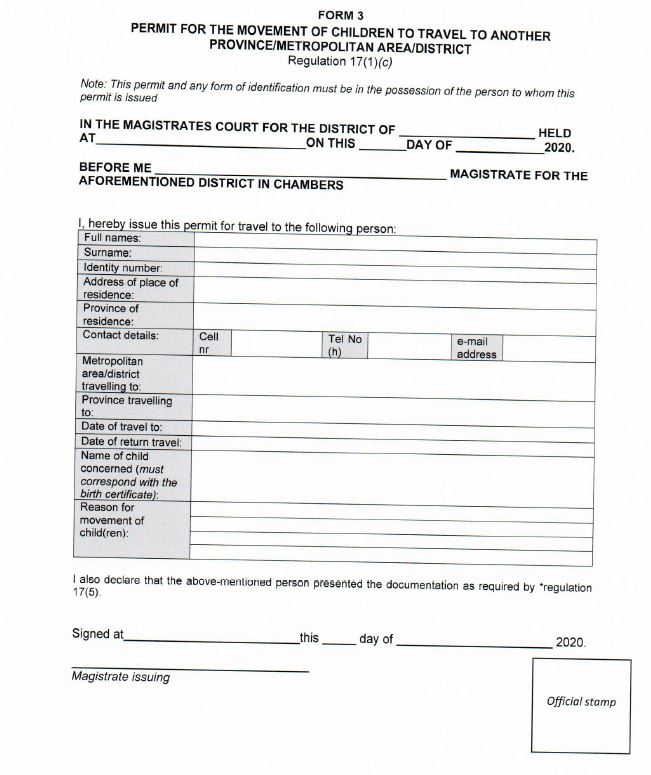
Below are the relevant regulations and the relevant form the Magistrate must provide. Movement of children- (1) The movement of children between co-holders of parental responsibilities and rights or a caregiver, as defined in section 1(1) of the Children’s Act, 2005 (Act No. 38 of 2005), in the same metropolitan area or district municipality is allowed subject to the following if the co-holders of parental responsibilities and rights or a caregiver is in possession of—
(a) a court order; or (b) a parental responsibilities and rights agreement or parenting plan, registered with the family advocate (c) a permit issued by a magistrate where which corresponds with Form 3 of Annexure A if the documentation in paragraphs (a) and (b) is not available. (2) The movement of children between co-holders of parental responsibilities and rights or a caregiver, as defined in section 1(1) of the Children’s Act, 2005 (Act No. 38 of 2005), between different metropolitan areas, district municipalities or provinces is allowed if the co-holders of parental responsibilities and rights or a caregiver is in possession of a permit, issued by a magistrate which corresponds with Form 3 of Annexure A. (3) Any child who was not at the residence of their primary caregiver before the lockdown period and who could not travel between provinces, metropolitan and district areas during the lockdown will be permitted, on a once-off basis, to return to the residence of their primary caregiver if the co-holders of parental responsibilities and rights or a caregiver is in possession of a permit issued by a magistrate which corresponds with Form 3 of annexure A. (4) The household to which the child has to move, must be free of COVID-19. (5) (a) Before a magistrate issues a permit referred to in regulation 17(1)(c), he or she must be provided with— (i) birth certificate or certified copy of a birth certificate of the child or children to prove a legitimate relationship between the co-holders of parental responsibilities and rights; and (ii) written reasons why the movement of the child is necessary. (b) Before a magistrate issues a permit referred to in 17(2) or (3), he or she must be provided with— (i) A court order (ii) a parental responsibilities and rights agreement or parenting plan registered with the family advocate or (iii) a birth certificate or certified copy of a birth certificate of the child or children to prove a legitimate relationship between the co-holders of parental responsibilities and rights; and (iv) written reasons why the movement of the child is necessary.
[caption id="attachment_9098" align="alignleft" width="651"]
Permit issued by a Magistrate for the movement of children during the lockdown[/caption] We are certain that you found the above article useful and interesting. Please consider sharing it on the share buttons below. They include Facebook, Twitter, LinkedIn, WhatsApp, Gmail and more. Someone may find it useful as well. Should you require business advice or services, feel free to click on these links: Business SA | Private Legal | Envirolaws
Click here to read an article regarding the previous regulations on the movement of children.
Posted on by Telelaw
How do I find a property law firm in Cape Town that fits your needs?
Are you in the market to sell your home, flat, or immovable property? If that is the case, you may require the services of a property lawyer. The same may apply should you wish to become a purchaser of immovable property. The sale of immovable property is a legal transaction. Furthermore, it needs to be registered in the name of the purchaser. Having the right property lawyer on your side can avoid many issues in the future. Here are some tips:- Define Your Needs: Identify the specific legal services you require (e.g., family law, criminal defence, corporate law).
- Research Online: Use legal directories;
- Check Reviews and Ratings: Look for client reviews and ratings to gauge the firm’s reputation and client satisfaction.
- Ask for Recommendations: Reach out to friends, family, or colleagues who may have had similar legal needs for personal recommendations.
- Evaluate Experience: Consider the firm’s experience in your specific legal issue, including years in practice and case outcomes.
- Schedule Consultations: Many firms offer free or less expensive consultations. Use this opportunity to meet attorneys, discuss your case, and assess their communication style.
- Assess Costs: Inquire about fees and billing practices. Understand whether they charge hourly rates, flat fees, or contingency fees.
- Trust Your Instincts: Choose a firm that you feel comfortable with and confident in their ability to handle your case.
- Verify Credentials: Check the attorneys’ qualifications and any disciplinary history.
- Consider Location: Proximity can be important for ease of communication and meetings.
Taking the time to research and evaluate different firms will help you find the right fit for your legal needs.
Posted on by Telelaw