Appealing a Maintenance Court Decision or Judgment

In its very nature, maintenance matters are complicated and never straight forward. For starters, it deals with the income and expenditure of both parents and the needs of the child. It is not easy for a maintenance court to determine with a high degree of certainty what the true income of a self-employed parent is. The same applies to the true expenses of a parent. advice-child-maintenance-child-custody-divorce

Manipulating the maintenance system

It is very easy for a parent to manipulate documentation or only present information which he or she believes would be in their favor. For example, if a parent earns extra income by selling clothing, he or she may decide not to disclose that information to the maintenance Court.  By doing so, the Maintenance Court will determine the maintenance of the child based on the incorrect facts presented. This could become more problematic when one parent knows of the other parent’s additional income but cannot prove it. If the parties have legal representatives, this issue of improper disclosure is limited to a certain extent. For example, lawyers would be in a good position to do their own investigations and verify certain relevant information.

Improper disclosure of expenses

Then there is the issue of the expenses of the child. The court requires a proper outline of all the monthly, daily and yearly expenditure of the child. Without all the relevant information before it, the court is not in a proper position to make a fair decision regarding child maintenance.  This is so as the amount of maintenance a parent should pay is directly determined by what is the child’s monthly expenditure. For example, if a parent earns a million rand a month, his or her maintenance contributions can be no more than what the child actually cost per month.

Intentionally inflating expenses

It often happens that a parent cannot, or do not provide a true reflection as to what the child actually cost. Amounts are inflated, and there is no way that the court or the other parent can really question those amounts. Let’s say the mother is taking the father to the Maintenance Court but the father only sees the child once a month.  The father, in this case, would not be able to confirm or verify whether or not the child actually eats as much as the mother makes it out to be. And many times, parents come to court with an attitude of “let me claim more and the court will give me less.”

Unhappy with the maintenance magistrate’s decision

advice-child-maintenance-child-custody-divorceLet’s say a maintenance enquiry was held by a maintenance magistrate, and a decision was handed down. Should both parents be happy with the decision of the magistrate, their lives can continue and the party who should pay maintenance should comply with the order. However, it often happens that one parent is not happy with the maintenance order. We often get queries where parents want to know what they can do when the maintenance Court did not find in their favor. Sometimes parents feel that the Maintenance Court was one-sided. In such a case he or she wants the decision of the magistrate to be relooked at. In order for this to happen, the Parent should appeal the decision of the magistrate.

Appealing a maintenance Court decision

The purpose of this article is not to explain the technical procedure of appealing a magistrate’s judgment.  The procedure is a bit complicated and we suggest you make use of a legal practitioner to assist you should you wish to appeal a decision.  However, what we want to bring home is that it is possible for the decision of a Maintenance Court to be relooked at by a higher Court and provide you with some insight as to what happens. The higher Court, in this case, will be the High Court.  If you reside in Cape Town, it is the Western Cape High Court.

What happens at the Appeal Court?

Let’s say all the court rules and procedures were complied with and the matter is now before the Appeal Court. The Appeal Court will comprise of two judges. They would have read through the entire court record in the Magistrate’s Court before the matter is heard. Taking it one step back, all proceedings in the magistrate’s court is digitally recorded. So, when you decide to appeal a decision of the magistrate’s court the recordings are sent to an authorised typist, who would type out the entire Court record. You cannot type out the record yourself.

advice-child-maintenance-child-custody-divorceHeads of Argument

Now before you argue your case at the Appeal Court you would want the judges to first know what your arguments are.  At the same time, you would like to know what the other lawyer’s arguments are. In this regard, you would file heads of argument a few weeks before the appeal hearing date. Basically, you will outline what points you will be focusing on, and what law you will be relying on.

You need to convince the Appeal Court there was an error

Your purpose at the appeal is to try to convince the judges that the magistrate erred in his or her decision. In other words, made a mistake.  In relation to a maintenance Court matter, you may even wish to convince the court that the maintenance officer did not follow the procedures outlined in the Maintenance Act or he or she did not properly investigate the maintenance complaint.  For example, the maintenance officer just took the father’s word when he said he was unemployed. Or the mother’s word when she said she earns no additional income.

Incorrect maintenance investigation

Had the maintenance officer done some further investigations by requesting relevant information, or instructing the maintenance investigator, the true facts would have been before the Maintenance Court. In other words, the magistrate would have made a different decision. Now, this would apply to a maintenance Court where the provisions in-place in the Maintenance Act was not followed. If this happened, you may appeal.

The magistrate’s reasons for his or her decision

The High Court judges would have the magistrate’s reasons for his decision before them. In other words, the magistrate would provide a document to the appeals court where he or she explains why he or she made a certain decision in the Maintenance Court matter.  He or she may, for example, say that based upon the evidence presented, the father earned an amount which does not justify him paying more than what he is currently paying.  Or the maintenance magistrate might say that based upon all the evidence presented, he could not find any information that will justify an amount greater than what the father is currently paying. The appeal Court would look at all these reasons and the evidence that was presented at court. It would listen to the arguments of the legal representatives and determine whether or not the magistrate made an error in judgment.

The appeals court’s decision

advice-child-maintenance-child-custody-divorceIf it is decided that the magistrate made an error in judgment, the court would in those circumstances change the order or refer the matter back to the maintenance court for a proper enquiry.  If the court decides that the magistrate was correct in its judgment, it will dismiss the appeal. So in short if you are dissatisfied with a maintenance magistrates court decision, you have full right to appeal it.      

Appealing a Maintenance Court Decision or Judgment

In its very nature, maintenance matters are complicated and never straight forward. For starters, it deals with the income and expenditure of both parents and the needs of the child. It is not easy for a maintenance court to determine with a high degree of certainty what the true income of a self-employed parent is. The same applies to the true expenses of a parent.

advice-child-maintenance-child-custody-divorce

Manipulating the maintenance system

It is very easy for a parent to manipulate documentation or only present information which he or she believes would be in their favor. For example, if a parent earns extra income by selling clothing, he or she may decide not to disclose that information to the maintenance Court.  By doing so, the Maintenance Court will determine the maintenance of the child based on the incorrect facts presented.

This could become more problematic when one parent knows of the other parent’s additional income but cannot prove it. If the parties have legal representatives, this issue of improper disclosure is limited to a certain extent. For example, lawyers would be in a good position to do their own investigations and verify certain relevant information.

Improper disclosure of expenses

Then there is the issue of the expenses of the child. The court requires a proper outline of all the monthly, daily and yearly expenditure of the child. Without all the relevant information before it, the court is not in a proper position to make a fair decision regarding child maintenance.  This is so as the amount of maintenance a parent should pay is directly determined by what is the child’s monthly expenditure. For example, if a parent earns a million rand a month, his or her maintenance contributions can be no more than what the child actually cost per month.

Intentionally inflating expenses

It often happens that a parent cannot, or do not provide a true reflection as to what the child actually cost. Amounts are inflated, and there is no way that the court or the other parent can really question those amounts. Let’s say the mother is taking the father to the Maintenance Court but the father only sees the child once a month.  The father, in this case, would not be able to confirm or verify whether or not the child actually eats as much as the mother makes it out to be. And many times, parents come to court with an attitude of “let me claim more and the court will give me less.”

Unhappy with the maintenance magistrate’s decision

advice-child-maintenance-child-custody-divorceLet’s say a maintenance enquiry was held by a maintenance magistrate, and a decision was handed down. Should both parents be happy with the decision of the magistrate, their lives can continue and the party who should pay maintenance should comply with the order.

However, it often happens that one parent is not happy with the maintenance order. We often get queries where parents want to know what they can do when the maintenance Court did not find in their favor. Sometimes parents feel that the Maintenance Court was one-sided.

In such a case he or she wants the decision of the magistrate to be relooked at. In order for this to happen, the Parent should appeal the decision of the magistrate.

Appealing a maintenance Court decision

The purpose of this article is not to explain the technical procedure of appealing a magistrate’s judgment.  The procedure is a bit complicated and we suggest you make use of a legal practitioner to assist you should you wish to appeal a decision.  However, what we want to bring home is that it is possible for the decision of a Maintenance Court to be relooked at by a higher Court and provide you with some insight as to what happens. The higher Court, in this case, will be the High Court.  If you reside in Cape Town, it is the Western Cape High Court.

What happens at the Appeal Court?

Let’s say all the court rules and procedures were complied with and the matter is now before the Appeal Court. The Appeal Court will comprise of two judges. They would have read through the entire court record in the Magistrate’s Court before the matter is heard. Taking it one step back, all proceedings in the magistrate’s court is digitally recorded. So, when you decide to appeal a decision of the magistrate’s court the recordings are sent to an authorised typist, who would type out the entire Court record. You cannot type out the record yourself.

advice-child-maintenance-child-custody-divorceHeads of Argument

Now before you argue your case at the Appeal Court you would want the judges to first know what your arguments are.  At the same time, you would like to know what the other lawyer’s arguments are. In this regard, you would file heads of argument a few weeks before the appeal hearing date. Basically, you will outline what points you will be focusing on, and what law you will be relying on.

You need to convince the Appeal Court there was an error

Your purpose at the appeal is to try to convince the judges that the magistrate erred in his or her decision. In other words, made a mistake.  In relation to a maintenance Court matter, you may even wish to convince the court that the maintenance officer did not follow the procedures outlined in the Maintenance Act or he or she did not properly investigate the maintenance complaint.  For example, the maintenance officer just took the father’s word when he said he was unemployed. Or the mother’s word when she said she earns no additional income.

Incorrect maintenance investigation

Had the maintenance officer done some further investigations by requesting relevant information, or instructing the maintenance investigator, the true facts would have been before the Maintenance Court. In other words, the magistrate would have made a different decision.

Now, this would apply to a maintenance Court where the provisions in-place in the Maintenance Act was not followed. If this happened, you may appeal.

The magistrate’s reasons for his or her decision

The High Court judges would have the magistrate’s reasons for his decision before them. In other words, the magistrate would provide a document to the appeals court where he or she explains why he or she made a certain decision in the Maintenance Court matter.  He or she may, for example, say that based upon the evidence presented, the father earned an amount which does not justify him paying more than what he is currently paying.  Or the maintenance magistrate might say that based upon all the evidence presented, he could not find any information that will justify an amount greater than what the father is currently paying. The appeal Court would look at all these reasons and the evidence that was presented at court. It would listen to the arguments of the legal representatives and determine whether or not the magistrate made an error in judgment.

The appeals court’s decision

advice-child-maintenance-child-custody-divorceIf it is decided that the magistrate made an error in judgment, the court would in those circumstances change the order or refer the matter back to the maintenance court for a proper enquiry.  If the court decides that the magistrate was correct in its judgment, it will dismiss the appeal. So in short if you are dissatisfied with a maintenance magistrates court decision, you have full right to appeal it.


Related Post

Top tips and tricks from a Senior Family Law Advocate on claiming maintenance for a five-year-old child in Benoni.

Child Maintenance is the right of the child, and not that of the parent. It is also not a privilege granted to parents who must pay it. It is their duty to pay child maintenance and support their children. Once the child is self-supporting (being able to care for him or herself), the obligation falls away. This can happen when the child is 18, 20, or even 30. It all depends on the circumstances of the case.

Claiming child maintenance for your child in Benoni

Whether you claim child maintenance in Benoni, or any other city in South Africa, the procedures would be the same. There are however two (2) courts that can deal with child maintenance matters. That is a divorce court, in a divorce matter, and a Child Maintenance Court. For this article, we will focus on claiming maintenance in a Maintenance Court matter in Benoni.

The maintenance scenario – Benoni South Africa

In this article, we will deal with the following fictitious scenario, in a child maintenance matter:

  1. The Child is seven years old and attends school in Benoni
  2. The child is cared for by the mother who works in Benoni
  3. The mother works and earns a Salary of R 10 000
  4. The father sees the child every second weekend. He also lives and works in Benoni
  5. The child’s monthly expenses are R 6000 – 00 which includes food, clothing, accommodation, education, travel etc.
  6. The father earns a reasonable salary and can afford the R 20 000 – 00 per month
  7. The mother claims R 4 000 – 00 maintenance as the father earns double her salary

What is the first step the mother must take in claiming child maintenance?

The first thing the mother must do is work out exactly what the child costs by item. She breaks down the minor child’s living expenses, starting from rent or accommodation to groceries to school fees etc. Once she has done that, she would need to determine what exactly does the minor child cost per month, seeing that she will be asking the father to contribute towards that. As best as possible, she needs to collect proof of expenses. This can be in the form of receipts.

How does she start the legal process?

The mother now needs to approach the maintenance court in the area where she lives or works to lodge a complaint for child maintenance. If she lives or works in Benoni, it would be the maintenance court in Benoni. She will complete a Form A wherein she will provide all the expenses for her and the minor child. She would also have to stipulate her income. Once she completed the form and submitted it to the maintenance court, she must then follow the next step.

What do you do while waiting for the maintenance court date?

While you wait to be informed of the court date by the Maintenance Court of Benoni, and up until the actual first court date, you need to ensure that you keep a record of all income and expenses for you and the child. This is very important as the court allocates maintenance based on recent income and expenses.

What happens at the first court appearance at the Benoni Maintenance Court?

Once you have been notified of the maintenance court date by the Benoni Maintenance Court, you need to ensure that you attend it. On that day, both you and the father of the child would appear before a maintenance officer. The maintenance officer would go through both your income and expenses as well as that of the father. If all the relevant information is not before the maintenance court, then the matter may be postponed in order for the parties to submit it.

The maintenance officer will try to settle the matter and have the parents come to an agreement regarding the amount of child maintenance to be paid. If they cannot come to an agreement regarding the child maintenance to be paid, the matter would have to proceed to a formal hearing or trial before a Magistrate.

How does the Maintenance Court hearing or trial work in Benoni?

Essentially, the maintenance court is called upon to make a fair ruling regarding what is a fair amount of child support that needs to be paid. For that to happen, the parents would have to give evidence in that regard. The mother would present to the court what the child costs, what she contributes and what she requires the other parent to pay. The Father would have a right to question the mother and to present evidence as to why he cannot afford the amount requested or why he feels it is an unfair amount. The mother can they also question him.

At the end of the day, the Benoni Maintenance Court would be able to properly determine what is a fair and adequate amount of child maintenance to pay after being presented will all relevant information. The Benoni Maintenance Court should play an active role in determining what is a fair amount of child maintenance the father should pay.

The above child maintenance application principles should apply to the following provinces and cities:

Eastern Cape:

Alice, Butterworth, East London, Graaff-Reinet, Grahamstown, King William’s Town, Mthatha

Port Elizabeth, Queenstown, Uitenhage, Zwelitsha

Free State:

Bethlehem. Bloemfontein, Jagersfontein, Kroonstad, Odendaalsrus, Parys, Phuthaditjhaba, Sasolburg, Virginia, Welkom

Gauteng:

Benoni, Boksburg, Brakpan, Carletonville, Germiston, Johannesburg, Krugersdorp, Pretoria, Randburg, Randfontein, Roodepoort, Soweto, Springs, Vanderbijlpark, Vereeniging

KwaZulu-Natal:

Durban, Empangeni, Ladysmith, Newcastle, Pietermaritzburg, Pinetown, Ulundi, Umlazi

Limpopo:

Giyani, Lebowakgomo, Musina, Phalaborwa, Polokwane, Seshego, Sibasa, Thabazimbi

Mpumalanga:

Emalahleni, Nelspruit, Secunda, North West, Klerksdorp, Mahikeng, Mmabatho, Potchefstroom, Rustenburg, Northern Cape, Kimberley, Kuruman, Port Nolloth

Western Cape:

Bellville, Benoni, Constantia, George, Hopefield, Oudtshoorn, Paarl, Simon’s Town, Stellenbosch, Swellendam, Worcester


Updated: 16 April 2020

New regulations have been issued on 16 April 2020. Click on the link below:
The material change is that you do not have to have a court order or a parental responsibilities and rights agreement or parenting plan, registered with the family advocate. Possession of a birth certificate or certified copy of a birth certificate is now also allowed.

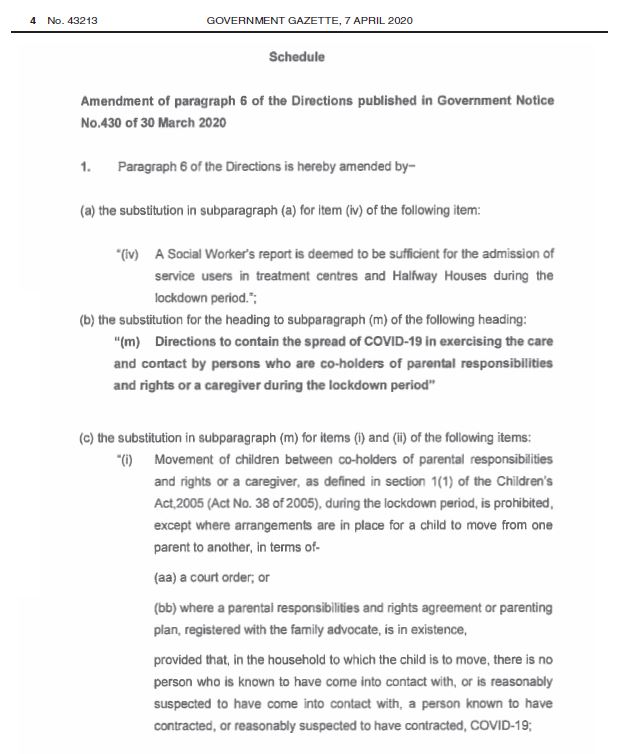
If you have a court order, or a parental responsibilities and rights agreement or parenting plan registered with the office of the Family Advocate, you can move children during the lockdown period, if certain conditions are met.

Today, the Minister of Social Development, Ms Lindiwe Zulu, MP, made changes to the regulations regarding the movement of children during the lockdown period. It is now possible for certain children to be moved between parents during the lockdown period.

The regulations apply to the following parents only:

  1. There are arrangements in place for the children to move for one parent to another in terms of a court order; or
  2. A parental responsibilities and rights agreement or parenting plan registered with the office of the Family Advocate; and
  3. In the household to which the child is to move, there is no person who is known to have come into contact with, or is reasonably suspected to have come into contact with, a person known to have contracted, or reasonably suspected to have contracted, COVID-19;
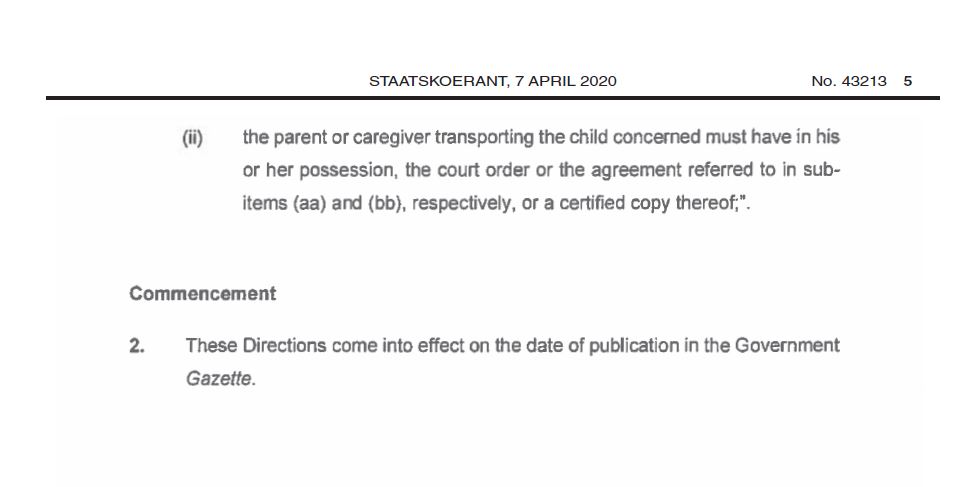
  4. The parent or caregiver transporting the child concerned must have in his or her possession, the court order or the latter agreement, or a certified copy thereof.
Below are the relevant regulations: Lockdown Regulations Movement of Children allowed with Court Order Lockdown Regulations Movement of Children allowed with Court Order  

Updated: 16 April 2020

New regulations have been issued on 16 April 2020. Click on the link below:
The material change is that you do not have to have a court order or a parental responsibilities and rights agreement or parenting plan, registered with the family advocate. Possession of a birth certificate or certified copy of a birth certificate is now also allowed.

Let’s talk Constitutionally – What about the parents whom the Minister of Social Development excluded from moving their children during the South African National Lockdown – Is this new law fair? Does it not discriminate between children and parents?

Written by Advocate Muhammad Abduroaf It is day 15 of the National Lockdown in South Africa. Our President last night announced that the lockdown would extend for a further two weeks. Lockdown, for now, would extend until the end of April 2020. What does this mean for parents who want to have contact with their children during the lockdown period? Can they collect or visit their children during the extended lockdown period? Let us unpack the legal situation.

Moving of children during the National Lockdown Period

When the lockdown was announced, there was uncertainty as to whether parents may move children during this period. We are referring to parents and children living in separate homes. After the lockdown commenced, a directive was then issued stating that children may not be moved between homes. This brought certainty to the issue, however, had far-reaching consequences. The directive said that the child should remain with the parent he or she is at, at the start of the lockdown period.

The current regulations on the movement of children between parents

On Tuesday 07 April 2020, the Minister of Social Development, Ms Lindiwe Zulu, MP, made changes to the regulations regarding the movement of children during the lockdown period. It is now possible for certain children to be moved between parents during the lockdown period. The regulations apply to the following parents only:
  1. There are arrangements in place for the children to move for one parent to another in terms of a court order; or
  2. A parental responsibilities and rights agreement or parenting plan registered with the office of the Family Advocate; and
  3. In the household to which the child is to move, there is no person who is known to have come into contact with, or is reasonably suspected to have come into contact with, a person known to have contracted, or reasonably suspected to have contracted, COVID-19;
  4. The parent or caregiver transporting the child concerned must have in his or her possession, the court order or the latter agreement, or a certified copy thereof.

Are these new regulations potentially unconstitutional?

Any law that discriminates against a class of people unjustifiably is unconstitutional. The class of people this new regulation discriminates against are one or more of the following parents:
  • Parents who are not divorced, but separated;
  • Never enforced their parental responsibilities and rights by obtaining a court order;
  • Parents who do not have any co-parenting issues;
  • Unmarried parents who did not see the need to approach the Court for a Court Order;
  • Parents who did not see the need to register a parenting plan or responsibilities and rights agreement with the Office of the Family Advocate; and
  • Parents who could not afford to obtain a court order or register a parenting plan or responsibilities and rights agreement with the Office of the Family Advocate; and
  • So on.

Infringement of the right to equality of the aforementioned parents and children

Section 9 of our Constitution (Act 108 of 1996) states the following: (1) Everyone is equal before the law and has the right to equal protection and benefit of the law. (2) Equality includes the full and equal enjoyment of all rights and freedoms. To promote the achievement of equality, legislative and other measures designed to protect or advance persons, or categories of persons, disadvantaged by unfair discrimination may be taken. (3) The state may not unfairly discriminate directly or indirectly against anyone on one or more grounds, including race, gender, sex, pregnancy, marital status, ethnic or social origin, colour, sexual orientation, age, disability, religion, conscience, belief, culture, language and birth. (4) No person may unfairly discriminate directly or indirectly against anyone on one or more grounds in terms of subsection (3). National legislation must be enacted to prevent or prohibit unfair discrimination. (5) Discrimination on one or more of the grounds listed in subsection (3) is unfair unless it is established that the discrimination is fair. Parents and minor children are not being treated equally. Only parents and children who are part of court orders and a parenting plan or responsibilities and rights agreement with the Office of the Family Advocate are taken care of by the Minister. Not the rest of the South African population. This infringement of constitutional rights cannot be justified. Let us unpack it.

Infringement of the right to human dignity

Concerning human dignity, section 10 of our Consitution states, “Everyone has inherent dignity and the right to have their dignity respected and protected.” I am sure, that all parents who do not have a court order or a parenting plan or responsibilities and rights agreement with the Office of the Family Advocate feel that their dignity has been violated. This is so as the government now allows another parent who has the latter documents to move their children. There is further no logical justification to preference some parents over others. Or to put it differently some children over others.

What can parents do who do not have a court order or a parenting plan or responsibilities and rights agreement with the Office of the Family Advocate?

It seems that the only recourse for parents who do not have a court order or a parenting plan or responsibilities and rights agreement registered with the Office of the Family Advocate has two options:
  • Approach the court urgently for a court order;
  • Approach the office of the family advocate to register a parenting plan or responsibilities and rights agreement.
Whether or not the court would be of adequate assistance during the lockdown and entertain your application, depends on many factors. However, in our view, if there is sufficient urgency, and as we are dealing with the best interests of children, the application would properly be dealt with. Concerning approaching the office of the family advocate to register a parenting plan or responsibilities and rights agreement; this could come with its challenges. But not necessarily so for all cases. Contacting their offices beforehand would be advised. Written by Advocate Muhammad Abduroaf (LL.B LL.M) – Advocate of the High Court of South Africa Advocate Muhammad Abduroaf is a member of the Legal Practice Council of South Africa     No equality and dignity for parents without Court Order and Registered Plans and Agreements We are certain that you found the above article useful and interesting. Please consider sharing it on the share buttons below. They include Facebook, Twitter, LinkedIn, WhatsApp, Gmail and more. Someone may find it useful as well. Should you require business advice or services, feel free to click on these links: Business SA | Private Legal | Envirolaws        

Do you require a video legal advice consultation?

Click here and schedule one today!