Updated: 16 April 2020

New regulations have been issued on 16 April 2020. Click on the link below: The material change is that you do not have to have a court order or a parental responsibilities and rights agreement or parenting plan, registered with the family advocate. Possession of a birth certificate or certified copy of a birth certificate is now also allowed.

Update: 07 April 2020

NEW LOCKDOWN REGULATIONS REGARDING THE MOVEMENT OF CHILDREN – CERTAIN PARENTS MAY MOVE CHILDREN DURING THE NATIONAL LOCKDOWN PERIOD (7 April 2020)

“The child must remain in the custody of the parent with whom the child was with, when lockdown period started” – Directive 6(m)(ii) in terms of the Regulations [30 March 2020]

South Africa is in a state of a national lockdown. Our borders are closed, the economy is standing still or barely moving. There are troops on the ground and police on high alert. The doors of businesses are closed and people are to remain at home. All these measures are in place to limit the spread of COVID-19 or the Coronavirus. This is an important and necessary measure implemented by the State to flatten the curve. The South Africa, we are living in today is far different than the one we lived in 10 days ago. Not many people saw it coming.
“Continue paying your child support or child maintenance.”

Co-parenting during the National Lockdown Period

Before the commencement of the National Lockdown period, there was uncertainty about how the National Lockdown would affect co-parenting. And rightfully so. Parents had to consider the possibility of no movement of children during the national lockdown period. Not only for their safety and risking infection but for their children as well. What would then happen? Did it mean that the child would have to remain with one parent during the entire lockdown period? Or may they move the children around? This issue was resolved by the government and we wish to bring it to your attention.

What does the regulation or law say?

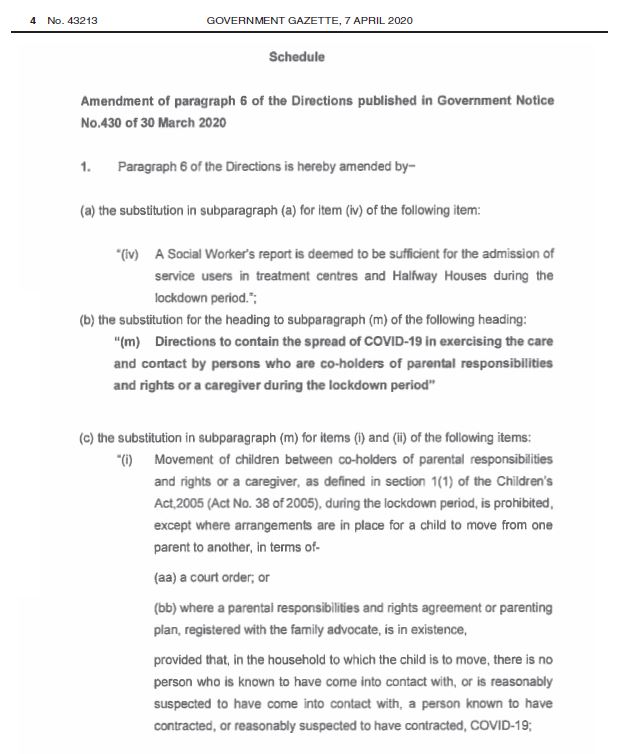
In summary, and in layman terms, children are not to be moved between parents during the lockdown period. Have a look at the recent regulations. The regulations in place brought about serious challenges for all. Firstly, what if the parent who is not the primary caregiver, and not capable of caring for the children for extended periods had the children during the start of the lockdown? This parent-only knows how to care for the children for a few days at a time – not at all for 21 days. What if the conditions at his or her home are not the same as the primary home of the children? For example, in the primary home, the children have their room to share, and a bigger place to play, etc. All their clothes are there, also their schoolwork and extramural equipment. This is not the case at the home they are at during the lockdown period. Stepsiblings may also be living with them. The example above is a mellow one, but there are far more serious real examples out there. What if the child is prone to fall ill, and everything he or she needs is at the primary home? The list goes on.

Parents abusing the lockdown situation

Then there is the issue of abusing the National lockdown situation. If a parent refused to return the minor child before the lockdown, then that situation would remain. The primary caregiver would then have to wait 21 days before he or she can physically see the minor child. This is the sad reality of the situation. Should you wish to approach the court for urgent relief, you would have to have very strong and compelling reasons why the child should be removed despite the regulations in place.

What to do 8 days later?

Now that we passed the first week of lockdown, many parents never saw their children for the entire period. Many of those parents may prefer that there be a change in caring arrangements where the other parent can now care for the children for another week. Or a parent may want to only see the children for a few hours. Unless the government changes the regulations, that would not be possible.

What advice do we have for parents during the remainder lockdown period?

Parents should work together to ensure that the child’s best interests are upheld during the lockdown period. Telephone calls, WhatsApp messages, and video calls, to mention a few should constantly be used, if possible, between parents and children. We also remind parents to continue paying child maintenance and child support during this lockdown period.

Final advice during the lockdown period

Our final advice to all parents is to remain patient during these challenging times. The entire country is in lockdown and many other nations as well. Everyone is, therefore, going through challenges. Businesses are suffering, and people do not know if they would have an income after the lockdown period. If all goes well, and there is no reason to doubt that it would, at the end of the 21-days of lockdown, things would better. We, therefore, should all respect the government’s decision. Should the situation change during the lockdown period, Our Lawyer (Pty) Ltd would update its website accordingly. If you require legal advice, our online appointment portal is still running. All appointments are done telephonically or via video. We make use of WhatsApp Video, FaceTime, Zoom, and Skype. Stay home and stay safe.

Update: 07 April 2020

NEW LOCKDOWN REGULATIONS REGARDING THE MOVEMENT OF CHILDREN – CERTAIN PARENTS MAY MOVE CHILDREN DURING THE NATIONAL LOCKDOWN PERIOD (7 April 2020) We are certain that you found the above article useful and interesting. Please consider sharing it on the share buttons below. They include Facebook, Twitter, LinkedIn, WhatsApp, Gmail and more. Someone may find it useful as well. Should you require business advice or services, feel free to click on these links: Business SA | Private Legal | Envirolaws  
Updated: 16 April 2020

New regulations have been issued on 16 April 2020. Click on the link below:

The material change is that you do not have to have a court order or a parental responsibilities and rights agreement or parenting plan, registered with the family advocate. Possession of a birth certificate or certified copy of a birth certificate is now also allowed.

Update: 07 April 2020

NEW LOCKDOWN REGULATIONS REGARDING THE MOVEMENT OF CHILDREN – CERTAIN PARENTS MAY MOVE CHILDREN DURING THE NATIONAL LOCKDOWN PERIOD (7 April 2020)

“The child must remain in the custody of the parent with whom the child was with, when lockdown period started” – Directive 6(m)(ii) in terms of the Regulations [30 March 2020]

South Africa is in a state of a national lockdown. Our borders are closed, the economy is standing still or barely moving. There are troops on the ground and police on high alert. The doors of businesses are closed and people are to remain at home. All these measures are in place to limit the spread of COVID-19 or the Coronavirus. This is an important and necessary measure implemented by the State to flatten the curve. The South Africa, we are living in today is far different than the one we lived in 10 days ago. Not many people saw it coming.

“Continue paying your child support or child maintenance.”

Co-parenting during the National Lockdown Period

Before the commencement of the National Lockdown period, there was uncertainty about how the National Lockdown would affect co-parenting. And rightfully so. Parents had to consider the possibility of no movement of children during the national lockdown period. Not only for their safety and risking infection but for their children as well. What would then happen? Did it mean that the child would have to remain with one parent during the entire lockdown period? Or may they move the children around? This issue was resolved by the government and we wish to bring it to your attention.

What does the regulation or law say?

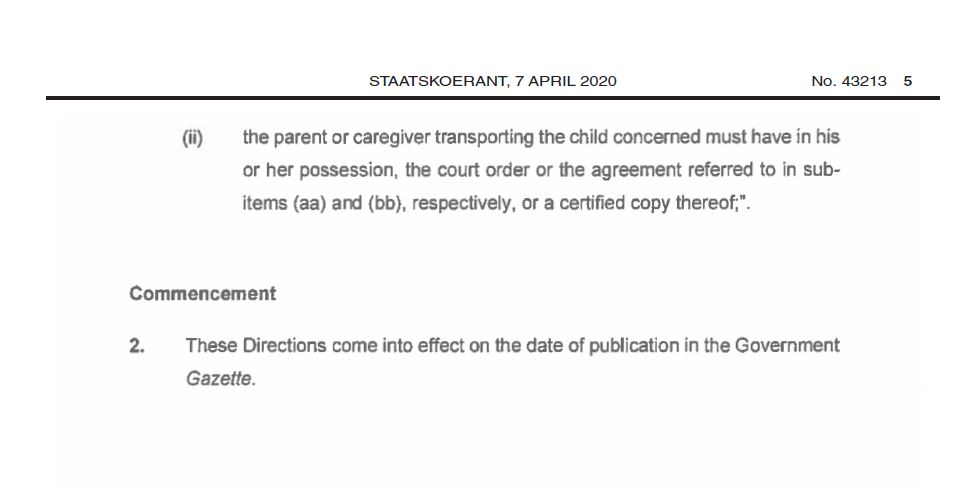
In summary, and in layman terms, children are not to be moved between parents during the lockdown period. Have a look at the recent regulations.

The regulations in place brought about serious challenges for all. Firstly, what if the parent who is not the primary caregiver, and not capable of caring for the children for extended periods had the children during the start of the lockdown? This parent-only knows how to care for the children for a few days at a time – not at all for 21 days. What if the conditions at his or her home are not the same as the primary home of the children? For example, in the primary home, the children have their room to share, and a bigger place to play, etc. All their clothes are there, also their schoolwork and extramural equipment. This is not the case at the home they are at during the lockdown period. Stepsiblings may also be living with them. The example above is a mellow one, but there are far more serious real examples out there. What if the child is prone to fall ill, and everything he or she needs is at the primary home? The list goes on.

Parents abusing the lockdown situation

Then there is the issue of abusing the National lockdown situation. If a parent refused to return the minor child before the lockdown, then that situation would remain. The primary caregiver would then have to wait 21 days before he or she can physically see the minor child. This is the sad reality of the situation. Should you wish to approach the court for urgent relief, you would have to have very strong and compelling reasons why the child should be removed despite the regulations in place.

What to do 8 days later?

Now that we passed the first week of lockdown, many parents never saw their children for the entire period. Many of those parents may prefer that there be a change in caring arrangements where the other parent can now care for the children for another week. Or a parent may want to only see the children for a few hours. Unless the government changes the regulations, that would not be possible.

What advice do we have for parents during the remainder lockdown period?

Parents should work together to ensure that the child’s best interests are upheld during the lockdown period. Telephone calls, WhatsApp messages, and video calls, to mention a few should constantly be used, if possible, between parents and children.

We also remind parents to continue paying child maintenance and child support during this lockdown period.

Final advice during the lockdown period

Our final advice to all parents is to remain patient during these challenging times. The entire country is in lockdown and many other nations as well. Everyone is, therefore, going through challenges. Businesses are suffering, and people do not know if they would have an income after the lockdown period. If all goes well, and there is no reason to doubt that it would, at the end of the 21-days of lockdown, things would better. We, therefore, should all respect the government’s decision.

Should the situation change during the lockdown period, Our Lawyer (Pty) Ltd would update its website accordingly. If you require legal advice, our online appointment portal is still running. All appointments are done telephonically or via video. We make use of WhatsApp Video, FaceTime, Zoom, and Skype. Stay home and stay safe.

Update: 07 April 2020

NEW LOCKDOWN REGULATIONS REGARDING THE MOVEMENT OF CHILDREN – CERTAIN PARENTS MAY MOVE CHILDREN DURING THE NATIONAL LOCKDOWN PERIOD (7 April 2020)

We are certain that you found the above article useful and interesting. Please consider sharing it on the share buttons below. They include Facebook, Twitter, LinkedIn, WhatsApp, Gmail and more. Someone may find it useful as well.

Should you require business advice or services, feel free to click on these links:

Business SA | Private Legal | Envirolaws
 

Related Post

Daniella Mair – Psychological Counsellor Professional Summary                                           I am a passionate, positive and driven person. I strive for excellence in everything I do while keeping my own limitations in mind. I am dedicated to being an being an honest, ethical and valuable member of society. I conduct myself from an empathetic internal point of reference and enjoy helping people learn and grow in their own lives. I am a psychological Counsellor who deals with many cases of family trauma and family disjointment and am passionate about helping with the process of repair. I have always been a very maternal person who connects well with children, I am dedicated to being part of decision making that will allow children to have the best possible opportunities, love and care and feel grateful to be able to do so as a divorce mediator. Employment history                                                     Psychological Counsellor & Divorce Mediator, Self. Cape Town                         Mar. 2010 – Present I run a private practice dealing with all areas of psychological well being focusing on child and adolescent development, psychopathology, family therapy and divorce mediation with specific focus on creating parenting plans. My main area of interest is to Counsel individuals, groups, or families to help them understand problems, deal with crisis situations, define goals, and develop realistic action plans.  Facilitator, Various. Cape Town Jan. 2004 – Dec. 2012 Facilitator at Herzlia school for various learners with learning difficulties. Provide ongoing support and advance them in their studies, offer motivational and mental health support.  HR, Ashdan Electronics. Cape Town Jan. 2005 – Jan. 2008 Implement staffing guidelines, Project managed various products. Research and development. Education FAMAC, Cape Town Course, Divorce Mediation, Oct. 2012 UNISA, Cape Town HONORS, Psychology, Nov. 2010 UNISA, Cape Town Bachelor of Arts, Communications, Nov. 2008

How to get urgent Access to your Children without the services of a Lawyer (Attorney or Advocate)

Are you a father or mother of a child and the other parent refuses you access/contact to that child? If that is the case, you have a right to relief from the Court for Urgent Access. A couple would bring a child into this world. Whilst the relationship is ongoing, they can see eye to eye on what is best for the child and both parties form a productive part of the child’s life. Even if the couple is not living together, the father would see the child regularly and bond with the child as is needed. However, once the relationship has severed, it often happens that the parties cannot see eye to eye on what is best for the child regarding regular contact by the father. The mother would either blatantly refuse the father access or would place strict measures on when and how the father can see the child. Should the mother refuse access or prescribe access to the child, which is not in the child’s best interest, the father, in this case, would have grounds to urgently approach the Court for relief. Court procedure is very complicated. It is therefore strongly advised that you approach an attorney with knowledge and experience with these urgent applications. Furthermore, the attorney should have an advocate at hand to move the Application with or without opposition at Court. However, if you wish to do it yourself, read further should you wish to make the Application in the High Court.

The Procedure

Your application is urgent and therefore it is done on affidavit and not orally in Court. You may, however, be called to give oral evidence if the Judge so wishes. This is to clarify certain issues. However, this can mostly be avoided if your papers are properly drafted. You should firstly draft a document called a Notice of Motion and a founding affidavit. I shall explain these documents next. Although reference below may be made to an attorney or advocate, you may attend to the process yourself. Lastly, for the sake of simplicity, the term contact and access is used, as opposed to care and contact.

Notice of Motion

In this document, you state exactly what you want the Judge to grant you. It is similar to the prayers in a summons. Of course, you want the Judge to grant you urgent access to your child. You are making the application urgently and sidestepping some rules of Court regarding time periods and procedure. The first thing you should, therefore, ask the Court is to condone non-compliance with its Rules. You will then ask the Court what relief you want, usually in the form of an interim order to be finalised later. Usually, you will ask for a rule nisi. An example of the prayers in an urgent access application in the High Court are as follows:
  • Condoning the Applicant’s non-compliance with forms and service and time periods provided in the Uniform Rules of this Honourable Court and permitting this Application to be entertained as a matter of urgency in terms of Rule 6(12) of the Rules of Court;
  • That a Rule Nisi be issued, calling upon the Respondent to appear before Court on ____________________ 2026 at 10:00, in order to show cause why an Interim Order should not be confirmed in the following terms:-
    • That the Applicant shall have unsupervised contact to the minor child as follows:
    • Every alternative weekend commencing from Friday 18:00 to Sunday at 18:00.
  • That the provisions above shall operate as an Interim Order, with immediate effect, pending the return date of the Rule Nisi;
This document is signed by your attorney, or by you if, you are acting in person.

Founding Affidavit

In your Founding Affidavit, you provide relevant information under oath. Here you would provide details of you, the mother and the child. You would also need to provide information on a few or more of the following matters:
  • Background information about your relationship with the mother of the child;
  • Past access to the child;
  • Past involvement in the child’s life;
  • When access to the child seized/lessened and the circumstances surrounding it;
  • Past maintenance or attempts to maintain the child;
  • Why the application is urgent and substantive redress in due course would not be afforded to you; and
  • Any other relevant information.

Issue and Service of the Application

Once the Notice of Motion and Founding Affidavit is in order, your attorney would make the necessary copies. Thereafter he would have the application issued at Court. A case number would be provided. If possible, you would have the application served on the mother of the child timeously. The Office of the Family Advocate should also be served.  Here you may make use of the office of the Sheriff or your attorney would serve the papers on the mother.

Opposition

If the mother of the child opposes the relief sort after being served with the Application, she should file an opposing affidavit to which you would have to reply. The parties would then have to argue the matter before the Judge.

Urgent Hearing at the High Court

If your matter has been set down on the Motion Court Roll, the Judge would have already read over the papers filed.  You would then wait for your matter to be called up. Should your matter is to be heard before the Urgent Judge on duty that day, you or your Advocate would have to take the file to the Judge beforehand to read. If the mother or her Advocate is present at Court, and the parties cannot settle the matter, they would then have to argue the matter before the Judge. If, however, the mother after having been duly served does not appear at court, then the process is a bit faster.

After the judge decided on the matter, the following might happen:

  • The Judge would grant the urgent access requested;
  • Grant you urgent access but not on the terms as requested;
  • Refuse to grant you any relief without a family advocate report;
  • Dismiss your application for lack of merits and/or urgency.

Sharing is Caring

We are certain that you found the above article useful and interesting. Please consider sharing it on the share buttons below. They include Facebook, Twitter, LinkedIn, WhatsApp, Gmail and more. Someone may find it useful as well. Should you require business advice or services, feel free to click on these links:
Business SA | Private Legal | Envirolaws  

Do you require a video legal advice consultation?

Click here and schedule one today!