22 Relocation with my minor child to Macau, Macau (Consent and Refusal) – Advocate Muhammad Abduroaf The world is becoming a much smaller place, and technology plays a huge role. People are moving across the world for employment, love and happiness, something that was not the norm a few decades Continue Reading
Relocation with my minor child to the United States of America, New York (Consent and Refusal) – Advocate Muhammad Abduroaf
The world is becoming a much smaller place, and technology plays a huge role. People are moving across the world for employment, love and happiness, something that was not the norm a few decades ago. There is no reason why you should remain in South Africa if you can find a better life for yourself and your family overseas. Moving overseas may provide you with the quality of life you want or the possibility of experiencing things you always wanted. Relocation of your minor child to New York, the United States of America
If you are single and do not have any minor children, then moving around the world would not be too complicated. All you need to do is ensure that you have the necessary travel documentation and travel ticket (and spending money), and off you go. However, if you want to travel with your minor child or relocate to another country, things may not be that simple. Firstly, if there is another parent, and he or she has parental responsibilities and rights, then his or her consent is required. For example, let us say you live in Cape Town or Johannesburg, and you want to relocate to Miami or New York, the United States of America, you would require the other parent’s consent to leave South Africa with your minor child. This can cause challenges, especially if the staying parent does not agree to the relocation. What about Passport Consent to travel or relocate to New York, the United States of America?
The same applies when it comes to your minor child applying for a South African passport to relocate to the United States of America, or any country. Both parents who have parental responsibilities and rights of guardianship will have to consent to the minor child’s passport application. In this regard, both parents have to be at the Department of Home Affairs when making the Application with the minor child. This can be challenging if you have a disinterested parent who does not want to co-operate with the passport application. What are the steps to follow when I want to relocate to New York, the United States of America with my minor child?
To simplify the process for relocation, the first step would be to receive the other parent’s consent in principle for the relocation and that he or she will co-operate in this regard. Once that has been resolved, the parent relocating would need to make the appointment for the minor child’s passport application as well as the application for the relevant VISA. Each country has different requirements; however, seeing that it is a relocation, you need to apply for the correct VISA. For that, you need the Passport.
Once the visa and travel arrangements have been finalised, the parent remaining behind will sign a parental consent letter for the international travel. That letter can be found on the Department of Home Affairs website. Basically, the parent remaining behind would state that he or she gives consent for the minor child to leave the Republic of South Africa. What can I do if the other parent does not want to consent to the minor child’s relocation to the United States of America?
If the parent remaining in South Africa does not want to consent to the minor child’s passport application and/or his or her relocation to New York, the United States of America, then you would need to approach the Court. The Court, as upper guardian of the minor child, may order that the parent’s consent for the passport application and relocation be dispensed with. What this entails is submitting Court documents explaining why you want to relocate to New York, the United States of America. The other parent would also have an opportunity to give reasons why he or she objects. At the end of the process, the Court would determine what is in the minor child’s best interests. If it is in the minor child’s best interests to relocate, the Court would make it possible despite the issue of consent. What is the first step I should take if the other parent does not want to consent to the minor child’s passport application and/or relocation to New York, the United States of America?
If the other parent does not want to consent to the passport application and/or the relocation of the minor child to New York, the United States of America – in that case, we suggest you approach an attorney or advocate (trust account) to assist you with the legal process. He or she would then contact the other parent explaining the reasons for the relocation and request the necessary consent. If the parent remaining in South Africa does still not agree to the passport application and/or to the relocation to New York, the United States of America, then the attorney or advocate will proceed to take the matter to court. The legal route can be expensive. However, it is necessarily to make the relocation of the minor child possible.
Relocation with my minor child to the United States of America, New York (Consent and Refusal) – Advocate Muhammad Abduroaf The world is becoming a much smaller place, and technology plays a huge role. People are moving across the world for employment, love and happiness, something that was not the Continue Reading
Family Law Service – Advocate Muhammad Abduroaf – Finding the best lawyer for you.
Choosing the right law firm (Attorney or Advocate) can be a daunting task in the intricate landscape of legal matters. Whether you’re facing a complex litigation case, navigating corporate law, or seeking legal assistance for personal issues, the decision of which law firm to engage is crucial. At the firm Advocate Muhammad Abduroaf, we understand the significance of this decision, and we aim to demonstrate why choosing our firm can make all the difference.Expertise and Specialisation
One of the primary reasons for choosing our law firm is our expertise and specialisation in diverse legal areas. As you can see from this website, advocate Muhammad Abduroaf practices in various fields of law. This breadth of expertise ensures that no matter the nature of your legal issue, you will have access to knowledgeable and experienced professionals who can provide tailored solutions.Personalised Approach
We recognise that every client and every case is unique. That’s why we prioritise a personalised approach to legal representation. From the moment you engage our services, we take the time to understand your specific needs, concerns, and objectives. This allows us to develop strategies and solutions customised to your circumstances, ensuring the best possible outcome for your case.Commitment to Excellence
At Advocate Muhammad Abduroaf, excellence is not just a goal – it’s our standard. We are committed to providing our clients with the highest quality legal services, characterized by thorough research, meticulous attention to detail, and strategic thinking. Our track record of success speaks for itself, with numerous satisfied clients who have benefited from our dedication to excellence.Responsive and Accessible
Legal matters can be stressful and overwhelming, so we prioritise responsiveness and accessibility. Our team is readily available to address your questions, concerns, and needs throughout your case. Whether you prefer to communicate via phone, WhatsApp, email, or in-person meetings, we are here to provide you with the support and guidance you need when you need it.Cost-Effective Solutions
Legal representation shouldn’t break the bank. That’s why we are committed to providing cost-effective solutions that deliver value for our clients. We offer transparent billing practices and strive to minimise unnecessary expenses wherever possible, ensuring you receive top-notch legal services without the hefty price tag.Ethical and Professional Conduct
Integrity and ethics are at the core of everything we do. Our team adheres to the highest standards of professional conduct, ensuring your case is handled with the utmost integrity, honesty, and discretion. You can trust that your legal matters will be handled with care and respect, and your confidentiality will always be protected. In conclusion, choosing the right law firm can significantly impact the outcome of your legal matters. At Advocate Muhammad Abduroaf, we offer expertise, specialisation, personalised service, commitment to excellence, responsiveness, cost-effective solutions, and ethical conduct. These qualities set us apart and make us the ideal choice for clients seeking top-notch legal representation. Contact us today to learn how we can assist you with your legal needs. If you require an Advocate Law Firm to assist you in your legal matter, feel free to contact us using the following details:- Tel.: 021 111 0090
- Email.: [email protected]
We service clients throughout South Africa. These include: Cape Town Rustenburg Kimberley East London Nelspruit Polokwane Pietermaritzburg Bloemfontein Port Elizabeth Pretoria Durban Johannesburg
- Tel.: 021 111 0090
- Email.: [email protected]
Family Law Service – Advocate Muhammad Abduroaf – Finding the best lawyer for you. Choosing the right law firm (Attorney or Advocate) can be a daunting task in the intricate landscape of legal matters. Whether you’re facing a complex litigation case, navigating corporate law, or seeking legal assistance for personal Continue Reading
Family Law Service – Advocate Muhammad Abduroaf – Finding the best lawyer for you.
Choosing the right law firm (Attorney or Advocate) can be a daunting task in the intricate landscape of legal matters. Whether you’re facing a complex litigation case, navigating corporate law, or seeking legal assistance for personal issues, the decision of which law firm to engage is crucial. At the firm Advocate Muhammad Abduroaf, we understand the significance of this decision, and we aim to demonstrate why choosing our firm can make all the difference.Expertise and Specialisation
One of the primary reasons for choosing our law firm is our expertise and specialisation in diverse legal areas. As you can see from this website, advocate Muhammad Abduroaf practices in various fields of law. This breadth of expertise ensures that no matter the nature of your legal issue, you will have access to knowledgeable and experienced professionals who can provide tailored solutions.Personalised Approach
We recognise that every client and every case is unique. That’s why we prioritise a personalised approach to legal representation. From the moment you engage our services, we take the time to understand your specific needs, concerns, and objectives. This allows us to develop strategies and solutions customised to your circumstances, ensuring the best possible outcome for your case.Commitment to Excellence
At Advocate Muhammad Abduroaf, excellence is not just a goal – it’s our standard. We are committed to providing our clients with the highest quality legal services, characterized by thorough research, meticulous attention to detail, and strategic thinking. Our track record of success speaks for itself, with numerous satisfied clients who have benefited from our dedication to excellence.Responsive and Accessible
Legal matters can be stressful and overwhelming, so we prioritise responsiveness and accessibility. Our team is readily available to address your questions, concerns, and needs throughout your case. Whether you prefer to communicate via phone, WhatsApp, email, or in-person meetings, we are here to provide you with the support and guidance you need when you need it.Cost-Effective Solutions
Legal representation shouldn’t break the bank. That’s why we are committed to providing cost-effective solutions that deliver value for our clients. We offer transparent billing practices and strive to minimise unnecessary expenses wherever possible, ensuring you receive top-notch legal services without the hefty price tag.Ethical and Professional Conduct
Integrity and ethics are at the core of everything we do. Our team adheres to the highest standards of professional conduct, ensuring your case is handled with the utmost integrity, honesty, and discretion. You can trust that your legal matters will be handled with care and respect, and your confidentiality will always be protected. In conclusion, choosing the right law firm can significantly impact the outcome of your legal matters. At Advocate Muhammad Abduroaf, we offer expertise, specialisation, personalised service, commitment to excellence, responsiveness, cost-effective solutions, and ethical conduct. These qualities set us apart and make us the ideal choice for clients seeking top-notch legal representation. Contact us today to learn how we can assist you with your legal needs. If you require an Advocate Law Firm to assist you in your legal matter, feel free to contact us using the following details:- Tel.: 021 111 0090
- Email.: [email protected]
We service clients throughout South Africa. These include: Cape Town Rustenburg Kimberley East London Nelspruit Polokwane Pietermaritzburg Bloemfontein Port Elizabeth Pretoria Durban Johannesburg
- Tel.: 021 111 0090
- Email.: [email protected]
Family Law Service – Advocate Muhammad Abduroaf – Finding the best lawyer for you. Choosing the right law firm (Attorney or Advocate) can be a daunting task in the intricate landscape of legal matters. Whether you’re facing a complex litigation case, navigating corporate law, or seeking legal assistance for personal Continue Reading
What is the Status of Muslim Marriage in South Africa?
Women’s Legal Centre Trust v President of the Republic of South Africa and Others (CCT 24/21) [2022] ZACC 23; 2022 (5) SA 323 (CC); 2023 (1) BCLR 80 (CC) (28 June 2022)
In the case of Women’s Legal Centre Trust v President of the Republic of South Africa and Others (CCT 24/21) [2022] ZACC 23; 2022 (5) SA 323 (CC); 2023 (1) BCLR 80 (CC) (28 June 2022), the Constitutional Court deal with an issue relating to Muslim Marriage. The parties in the case where the following:WOMEN’S LEGAL CENTRE TRUST Applicant
and
PRESIDENT OF THE REPUBLIC OF SOUTH AFRICA First Respondent
MINISTER OF JUSTICE AND CONSTITUTIONAL
DEVELOPMENT Second Respondent
MINISTER OF HOME AFFAIRS Third Respondent
SPEAKER OF THE NATIONAL ASSEMBLY Fourth Respondent
CHAIRPERSON OF THE NATIONAL COUNCIL
OF PROVINCES Fifth Respondent
SOUTH AFRICAN HUMAN RIGHTS COMMISSION Sixth Respondent
COMMISSION FOR THE PROMOTION AND PROTECTION
OF THE RIGHTS OF CULTURAL, RELIGIOUS
AND LINGUISTIC COMMUNITIES Seventh Respondent
LAJNATUN NISAA-IL MUSLIMAAT (ASSOCIATION
OF MUSLIM WOMEN OF SOUTH AFRICA) Eighth Respondent
and
COMMISSION FOR GENDER EQUALITY Intervening Party
and
MUSLIM ASSEMBLY CAPE First Amicus Curiae
UNITED ULAMA COUNCIL OF SOUTH AFRICA Second Amicus Curiae
The Constitutional Court gave the following ruling:
“On application for confirmation of an order of constitutional invalidity granted by the Supreme Court of Appeal: 1. The Supreme Court of Appeal’s order of constitutional invalidity is confirmed: 1.1. The Marriage Act 25 of 1961 (Marriage Act) and the Divorce Act 70 of 1979 (Divorce Act) are declared to be inconsistent with sections 9, 10, 28 and 34 of the Constitution in that they fail to recognise marriages solemnised in accordance with Sharia law (Muslim marriages) which have not been registered as civil marriages, as valid marriages for all purposes in South Africa, and to regulate the consequences of such recognition. 1.2. It is declared that section 6 of the Divorce Act is inconsistent with sections 9, 10, 28(2) and 34 of the Constitution, insofar as it fails to provide for mechanisms to safeguard the welfare of minor or dependent children born of Muslim marriages, at the time of dissolution of the Muslim marriage in the same or similar manner as it provides for mechanisms to safeguard the welfare of minor or dependent children born of other marriages that are dissolved. 1.3. It is declared that section 7(3) of the Divorce Act is inconsistent with sections 9, 10, and 34 of the Constitution, insofar as it fails to provide for the redistribution of assets, on the dissolution of a Muslim marriage, when such redistribution would be just. 1.4. It is declared that section 9(1) of the Divorce Act is inconsistent with sections 9, 10 and 34 of the Constitution, insofar as it fails to make provision for the forfeiture of the patrimonial benefits of a Muslim marriage at the time of its dissolution in the same or similar terms as it does in respect of other marriages that are dissolved. 1.5. The common law definition of marriage is declared to be inconsistent with the Constitution and invalid to the extent that it excludes Muslim marriages. 1.6. The declarations of invalidity in paragraphs 1.1 to 1.5 above are suspended for a period of 24 months to enable the President and Cabinet, together with Parliament, to remedy the foregoing defects by either amending existing legislation, or initiating and passing new legislation within 24 months, in order to ensure the recognition of Muslim marriages as valid marriages for all purposes in South Africa and to regulate the consequences arising from such recognition. 1.7. Pending the coming into force of legislation or amendments to existing legislation referred to in paragraph 1.6, it is declared that Muslim marriages subsisting at 15 December 2014, being the date when this action was instituted in the High Court, or which had been terminated in terms of Sharia law as at 15 December 2014, but in respect of which legal proceedings have been instituted and which proceedings have not been finally determined as at the date of this order, may be dissolved in accordance with the Divorce Act as follows: (a) all the provisions of the Divorce Act shall be applicable, save that all Muslim marriages shall be treated as if they are out of community of property, except where there are agreements to the contrary, and (b) the provisions of section 7(3) of Divorce Act shall apply to such a union regardless of when it was concluded. (c) In the case of a husband who is a spouse in more than one Muslim marriage, the court: (i) shall take into consideration all relevant factors, including any contract or agreement between the relevant spouses, and must make any equitable order that it deems just; and (ii) may order that any person who in the court’s opinion has a sufficient interest in the matter be joined in the proceedings. 1.8. Pending the coming into force of legislation or amendments to existing legislation referred to in paragraph 1.6, it is declared that, from the date of this order, section 12(2) of the Children’s Act 38 of 2005 applies to a prospective spouse in a Muslim marriage concluded after the date of this order. 1.9. Pending the coming into force of legislation or amendments to existing legislation referred to in paragraph 1.6, for the purpose of paragraph 1.8 above, the provisions of sections 3(1)(a), 3(3)(a) and 3(3)(b), 3(4)(a) and 3(4)(b), and 3(5) of the Recognition of Customary Marriages Act 120 of 1998 shall apply, mutatis mutandis, to Muslim marriages. 1.10. If administrative or practical problems arise in the implementation of this order, any interested person may approach this Court for a variation of this order. 1.11. The Department of Home Affairs and the Department of Justice and Constitutional Development shall publish a summary of the orders in paragraphs 1.1 to 1.10 above widely in newspapers and on radio stations, whichever is feasible, without delay. 2. The conditional cross appeal by the Women’s Legal Centre Trust, and the appeals by the South African Human Rights Commission and Commission for Gender Equality are dismissed. 3. The President and the Minister of Justice and Constitutional Development must pay the Women’s Legal Centre Trust’s costs of this application, including the costs of two counsel.”Status of Muslim Marriages in South Africa
Considering the latter judgment, Muslim Marriages are seen as valid marriages. However, the South African legal framework needs to be changed to allow for its incorporation.
What is the Status of Muslim Marriage in South Africa? Women’s Legal Centre Trust v President of the Republic of South Africa and Others (CCT 24/21) [2022] ZACC 23; 2022 (5) SA 323 (CC); 2023 (1) BCLR 80 (CC) (28 June 2022) In the case of Women’s Legal Centre Trust Continue Reading
Best advice on finding a top divorce lawyer for your divorce case in Hout Bay, Cape Town
Do you live in Hout Bay, and are you considering divorcing your spouse? Or have you been threatened with divorce? Either way, a divorce is a legal matter, and it is best to find sound legal advice or assistance. Furthermore, divorcing someone has potential severe legal consequences you may not know of. The first consequence, of course, is that you are no longer married to your former spouse, and there is no legal obligation to maintain each other (unless you qualify for alimony). You may also not inherit from your former spouse’s intestate. Lastly, and obviously, you are free to marry someone else. However, do you know of the proprietary (property) consequences of getting a divorce? What about the assets and debt you and your spouse incurred in Hout Bay or elsewhere during your marriage? Do you know what should happen to it? If not, it is best you find out about these critical aspects and others before getting divorced. Then there is the issue of parental responsibilities and rights after the divorce should there be minor children involved. This article aims to provide guidance on finding the best attorney or advocate for your divorce matter that can adequately and properly advise you or handle your divorce. The advice would apply whether you live in Hout Bay or anywhere else in South Africa. The issues we shall deal with are the following.- Gender of the Advocate or attorney;
- Location of the Advocate or attorney;
- Experience of the Advocate or attorney;
- Costs of the Advocate or Attorney; and
- The personality of the Advocate or Attorney.
What is the best gender of the Advocate or Attorney I need to use for my divorce? Is a male or female better?
Generally, the gender of your Advocate or Attorney should not play a role at all in a legal matter. However, depending on your background and the issues involved in your divorce, you may prefer a specific gender where you may feel more comfortable. A female who has been emotionally, physically and psychologically abused may be more comfortable with a female Attorney or Advocate. However, the same female client may prefer a male Advocate or Attorney. No more will be said on this issue.What is the ideal office location of the Advocate or attorney? Does it have to be in Hout Bay?
The location or office of your attorney or Advocate is essential if you wish to consult with them in person. It is also ideal, but not necessary, for their offices to be close to the Court where the divorce would be handled. However, many lawyers make use of correspondent lawyers for this purpose. Furthermore, location should not be an issue if you want a specific lawyer to handle your case. This is so especially seeing that people are making use of virtual meetings.What level of experience should the Advocate or attorney have?
It is important to remember that not all legal matters require the best lawyer. If your divorce is straightforward, finding the best lawyer in the field is unnecessary. The best may be very busy and lack the time to give your case the attention it deserves. However, if your matter is complicated, then in that case, the most experienced and best lawyer out there is not warranted.What about the Costs of an Attorney or Advocate?
For many, the costs of the Attorney or Advocate are the most crucial consideration when it comes to enlisting their services. Usually, the more experienced the Attorney or Advocate, the more they would charge. Another aspect that affects costs is the nature of the expertise of the Advocate or Attorney. If the issues in your matter are highly technical and complicated, an Advocate or Attorney with expertise and experience may charge more.What about the personality of the Advocate or Attorney?
Many may discard the Advocate or Attorney’s personality as not important. However, it is essential to note that it may be time to change lawyers if you do not get along well with the Advocate or Attorney because of their personality. A lawyer and their client would develop a professional relationship in family law matters. This is especially so when the lawyer must discuss many personal issues regarding you, your marriage, children, finance, spouse etc. If you cannot get along well with your Attorney or Advocate, you may not divulge important information relevant to your case.What is our best advice to a client looking for an Advocate or Attorney in a divorce matter?
Considering all the factors mentioned above, before enlisting the services of an Advocate or Attorney, ensure you enlist the right one. Do not look for the most experience or best, or the top one in family law. You may have to change lawyers if you do so and cannot afford legal bills. Therefore consider the above and any other factors that you may consider necessary when deciding on enlisting the services of an Advocate or an Attorney. Best of luck.
Best advice on finding a top divorce lawyer for your divorce case in Hout Bay, Cape Town Do you live in Hout Bay, and are you considering divorcing your spouse? Or have you been threatened with divorce? Either way, a divorce is a legal matter, and it is best to Continue Reading
Top tips and tricks from a Senior Family Law Advocate on claiming maintenance for a five-year-old child in Randfontein.
Child Maintenance is the right of the child, and not that of the parent. It is also not a privilege granted to parents who must pay it. It is their duty to pay child maintenance and support their children. Once the child is self-supporting (being able to care for him or herself), the obligation falls away. This can happen when the child is 18, 20, or even 30. It all depends on the circumstances of the case.
Claiming child maintenance for your child in Randfontein
Whether you claim child maintenance in Randfontein, or any other city in South Africa, the procedures would be the same. There are however two (2) courts that can deal with child maintenance matters. That is a divorce court, in a divorce matter, and a Child Maintenance Court. For this article, we will focus on claiming maintenance in a Maintenance Court matter in Randfontein.
The maintenance scenario – Randfontein South Africa
In this article, we will deal with the following fictitious scenario, in a child maintenance matter:
- The Child is seven years old and attends school in Randfontein
- The child is cared for by the mother who works in Randfontein
- The mother works and earns a Salary of R 10 000
- The father sees the child every second weekend. He also lives and works in Randfontein
- The child’s monthly expenses are R 6000 – 00 which includes food, clothing, accommodation, education, travel etc.
- The father earns a reasonable salary and can afford the R 20 000 – 00 per month
- The mother claims R 4 000 – 00 maintenance as the father earns double her salary
What is the first step the mother must take in claiming child maintenance?
The first thing the mother must do is work out exactly what the child costs by item. She breaks down the minor child’s living expenses, starting from rent or accommodation to groceries to school fees etc. Once she has done that, she would need to determine what exactly does the minor child cost per month, seeing that she will be asking the father to contribute towards that. As best as possible, she needs to collect proof of expenses. This can be in the form of receipts.
How does she start the legal process?
The mother now needs to approach the maintenance court in the area where she lives or works to lodge a complaint for child maintenance. If she lives or works in Randfontein, it would be the maintenance court in Randfontein. She will complete a Form A wherein she will provide all the expenses for her and the minor child. She would also have to stipulate her income. Once she completed the form and submitted it to the maintenance court, she must then follow the next step.
What do you do while waiting for the maintenance court date?
While you wait to be informed of the court date by the Maintenance Court of Randfontein, and up until the actual first court date, you need to ensure that you keep a record of all income and expenses for you and the child. This is very important as the court allocates maintenance based on recent income and expenses.
What happens at the first court appearance at the Randfontein Maintenance Court?
Once you have been notified of the maintenance court date by the Randfontein Maintenance Court, you need to ensure that you attend it. On that day, both you and the father of the child would appear before a maintenance officer. The maintenance officer would go through both your income and expenses as well as that of the father. If all the relevant information is not before the maintenance court, then the matter may be postponed in order for the parties to submit it.
The maintenance officer will try to settle the matter and have the parents come to an agreement regarding the amount of child maintenance to be paid. If they cannot come to an agreement regarding the child maintenance to be paid, the matter would have to proceed to a formal hearing or trial before a Magistrate.
How does the Maintenance Court hearing or trial work in Randfontein?
Essentially, the maintenance court is called upon to make a fair ruling regarding what is a fair amount of child support that needs to be paid. For that to happen, the parents would have to give evidence in that regard. The mother would present to the court what the child costs, what she contributes and what she requires the other parent to pay. The Father would have a right to question the mother and to present evidence as to why he cannot afford the amount requested or why he feels it is an unfair amount. The mother can they also question him.
At the end of the day, the Randfontein Maintenance Court would be able to properly determine what is a fair and adequate amount of child maintenance to pay after being presented will all relevant information. The Randfontein Maintenance Court should play an active role in determining what is a fair amount of child maintenance the father should pay.
The above child maintenance application principles should apply to the following provinces and cities:
Eastern Cape:
Alice, Butterworth, East London, Graaff-Reinet, Grahamstown, King William’s Town, Mthatha
Port Elizabeth, Queenstown, Uitenhage, Zwelitsha
Free State:
Bethlehem. Bloemfontein, Jagersfontein, Kroonstad, Odendaalsrus, Parys, Phuthaditjhaba, Sasolburg, Virginia, Welkom
Gauteng:
Benoni, Boksburg, Brakpan, Carletonville, Germiston, Johannesburg, Krugersdorp, Pretoria, Randburg, Randfontein, Roodepoort, Soweto, Springs, Vanderbijlpark, Vereeniging
KwaZulu-Natal:
Durban, Empangeni, Ladysmith, Newcastle, Pietermaritzburg, Pinetown, Ulundi, Umlazi
Limpopo:
Giyani, Lebowakgomo, Musina, Phalaborwa, Polokwane, Seshego, Sibasa, Thabazimbi
Mpumalanga:
Emalahleni, Nelspruit, Secunda, North West, Klerksdorp, Mahikeng, Mmabatho, Potchefstroom, Rustenburg, Northern Cape, Kimberley, Kuruman, Port Nolloth
Western Cape:
Bellville, Randfontein, Constantia, George, Hopefield, Oudtshoorn, Paarl, Simon’s Town, Stellenbosch, Swellendam, Worcester
Top tips and tricks from a Senior Family Law Advocate on claiming maintenance for a five-year-old child in Randfontein. Child Maintenance is the right of the child, and not that of the parent. It is also not a privilege granted to parents who must pay it. It is their duty Continue Reading
[caption id="attachment_10806" align="alignnone" width="707"]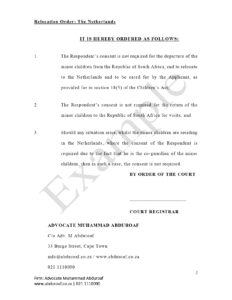 Relocation consent for minor child to the Netherlands – Advocate Muhammad Abduroaf[/caption]
I want to relocate from South Africa to the Netherlands with my minor child. The other parent does not want my child to relocate to the Netherlands. What can I do?
The Netherlands is a popular destination to emigrate to. People emigrate from South Africa for many reasons. It ranges from better employment opportunities, family relations, or for a better standard of living. Whatever the reason a parent wants to relocate to the Netherlands, if a minor child will be joining that parent and also relocating to the Netherlands, then the parent remaining in South Africa’s consent would usually be required. Let us unpack the legal issues a parent may encounter when wanting to emigrate to the Netherlands. Before we do so, let us list the various cities and towns in the Netherlands to which you may want to relocate:Drenthe (province), Meppel, Flevoland (province), Lelystad, Friesland (province), Leeuwarden, Sneek, Gelderland (province), Nijmegen, Renkum, Rheden, Tiel, Zutphen, Groningen (province), Groningen, Limburg (province), Kerkrade, Maastricht, Roermond, Sittard, Tegelen, Venlo, Noord-Brabant (province), Oss, Roosendaal, ’s-Hertogenbosch, Tilburg, Noord-Holland (province), the Netherlands, Den Helder, Marken, Velsen, Volendam, Zaanstad, Overijssel (province), Kampen, Zwolle, Utrecht (province), Soest, Utrecht, Zeist, Zeeland (province), Middelburg, Vlissingen, Zuid-Holland (province), The Hague, Scheveningen, Katwijk, Leiden, Lisse, Rijswijk, Rotterdam, Schiedam, Vlaardingen, Zoetermeer, Caribbean Netherlands (special municipalities), Bonaire (special municipality), Saba (special municipality), Sint Eustatius (special municipality), Aruba (unitary state), Oranjestad, San Nicolas, Curaçao (unitary state), Willemstad, Sint Maarten (unitary state)
(https://www.britannica.com/topic/list-of-cities-and-towns-in-the-Netherlands-2055398)
Why do I require the other parent’s Consent to relocate to the Netherlands?
According to South African law, if you are a co-holder of parental responsibilities and rights over your minor child, you must consent to your child leaving South Africa. In this case, relocating to the Netherlands. Here we refer to section 18 of the Children’s Act 38 of 2005. The entire provision is as follows:18 Parental responsibilities and rights
(1) A person may have either full or specific parental responsibilities and rights in respect of a child.
(2) The parental responsibilities and rights that a person may have in respect of a child, include the responsibility and the right-
(a) to care for the child;
(b) to maintain contact with the child;
(c) to act as guardian of the child; and
(d) to contribute to the maintenance of the child.
(3) Subject to subsections (4) and (5), a parent or other person who acts as guardian of a child must-
(a) administer and safeguard the child’s property and property interests;
(b) assist or represent the child in administrative, contractual and other legal matters; or
(c) give or refuse any consent required by law in respect of the child, including-
(i) consent to the child’s marriage;
(ii) consent to the child’s adoption;
(iii) consent to the child’s departure or removal from the Republic;
(iv) consent to the child’s application for a passport; and
(v) consent to the alienation or encumbrance of any immovable property of the child.
(4) Whenever more than one person has guardianship of a child, each one of them is competent, subject to subsection (5), any other law or any order of a competent court to the contrary, to exercise independently and without the Consent of the other any right or responsibility arising from such guardianship.
(5) Unless a competent court orders otherwise, the Consent of all the persons that have guardianship of a child is necessary in respect of matters set out in subsection (3)(c).
Now let us explain what Parental Responsibilities and Rights are.What are parental Responsibilities and Rights of a parent in relation to a child?
As can be seen from section 18(2) of the Children’s Act, when we refer to Parental Responsibilities and Rights, we refer to the following:(a) to care for the child;
(b) to maintain contact with the child;
(c) to act as guardian of the child; and
(d) to contribute to the maintenance of the child.
Therefore, if a parent has parental responsibilities and rights over a minor child, and accordingly, rights of guardianship, their Consent is required when it comes to issues of guardianship. As seen from section 18(3)(c) of the Children’s Act above, both parents’ Consent is required should a minor child depart from the Republic of South Africa. In this case, to emigrate to the Netherlands. Even if the minor child only wants to go for a short holiday to the Netherlands, both guardians’ Consent would be required.When would the other parent be seen as a guardian in the case of a relocation matter to the Netherlands?
It must be noted that not all parents are legal guardians over their minor children. We should therefore distinguish between married or divorced parents and parents who were never married. As you would see below, usually married, or divorced parents’ Consent would be required for a minor child to relocate or emigrate to the Netherlands. However, that does not automatically apply to parents who were never married. This could be because the child could have been born from a brief encounter and never met his or her father. It would not make sense that a parent who never met his or her 15-year-old child, should give Consent for relocation to the Netherlands.Mother’s Consent for relocation of the minor child to the Netherlands
Section 19 of the Children’s Act deals with the Parental responsibilities and rights of mothers. It states the following:19 Parental responsibilities and rights of mothers
(1) The biological mother of a child, whether married or unmarried, has full parental responsibilities and rights in respect of the child.
(2) If-
(a) the biological mother of a child is an unmarried child who does not have guardianship in respect of the child; and
(b) the biological father of the child does not have guardianship in respect of the child, the guardian of the child’s biological mother is also the guardian of the child.
(3) This section does not apply in respect of a child who is the subject of a surrogacy agreement.
As seen from section 19(1) of the Children’s Act, in most cases involving the relocation of a minor child to the Netherlands, the mother’s Consent is required as she has full parental responsibilities and rights over the minor child.Married father’s Consent for the relocation of the minor child to the Netherlands
Section 20 of the Children’s Act deals with Parental responsibilities and rights of married fathers. It states the following:20 Parental responsibilities and rights of married fathers
The biological father of a child has full parental responsibilities and rights in respect of the child-
(a) if he is married to the child’s mother; or
(b) if he was married to the child’s mother at (i) the time of the child’s conception; (ii) the time of the child’s birth; or (iii) any time between the child’s conception and birth.
As can be seen from sections 20 (a) and (b) of the Children’s Act, if the father and the mother were married, or are married, then his Consent is required for the minor child to relocate to the Netherlands. Of course, an exception to this would be should a court of law order otherwise. This would be the case should the parents be divorced and the divorce court ordered that only the mother may act as guardian. Next, we deal with the issue of an unmarried father’s Consent to relocate a minor child to the Netherlands.Consent of unmarried fathers for the relocation of their minor children to the Netherlands.
Section 21 of the Children’s Act deals with parental responsibilities and rights of unmarried fathers. The section states the following:21 Parental responsibilities and rights of unmarried fathers
(1) The biological father of a child who does not have parental responsibilities and rights in respect of the child in terms of section 20, acquires full parental responsibilities and rights in respect of the child-
(a) if at the time of the child’s birth he is living with the mother in a permanent life-partnership; or
(b) if he, regardless of whether he has lived or is living with the mother-
(i) consents to be identified or successfully applies in terms of section 26 to be identified as the child’s father or pays damages in terms of customary law;
(ii) contributes or has attempted in good faith to contribute to the child’s upbringing for a reasonable period; and
(iii) contributes or has attempted in good faith to contribute towards expenses in connection with the maintenance of the child for a reasonable period.
(2) This section does not affect the duty of a father to contribute towards the maintenance of the child.
(3) (a) If there is a dispute between the biological father referred to in subsection (1) and the biological mother of a child with regard to the fulfilment by that father of the conditions set out in subsection (1) (a) or (b), the matter must be referred for mediation to a family advocate, social worker, social service professional or other suitably qualified person.
(b) Any party to the mediation may have the outcome of the mediation reviewed by a
court.
(4) This section applies regardless of whether the child was born before or after the commencement of this Act.
As can be seen from the latter sections, a father of a child born out of wedlock does not automatically have parental responsibilities and rights over his minor child. He may however acquire those parental responsibilities and rights over his minor child if he is materially involved in the child’s life. That would be where the father and the mother were in a permanent life partnership when the child was born or he is meaningfully involved in the child’s life, as outlined above. We shall not go into much detail regarding that. However, in most cases, if the father had regular contact with the child and paid child support, he would have acquired parental responsibilities and rights over the minor child.What do you do if the other parent does not want to consent to the minor child relocating to the Netherlands?
Suppose the other parent also has parental responsibilities and rights over the minor child, and he or she does not want to consent to the relocation of the minor child to the Netherlands, then in such a case, the Court needs to be approached. Here I refer you back to section 18(5) of the Children’s Act referred to above where it states:(5) Unless a competent court orders otherwise, the Consent of all the persons that have guardianship of a child is necessary in respect of matters set out in subsection (3)(c).
Therefore, after your Court Application has been launched an both sides have been heard, the Court would make the necessary Order. If you are successful in your application for the relocation of your minor children to the Netherlands, then the Court will make an Order similar to that which is shown below. [caption id="attachment_10805" align="alignnone" width="715"]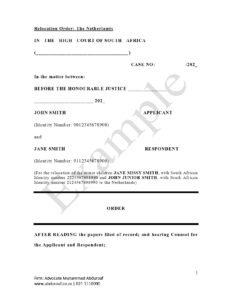 Relocation consent Order for minor child to the Netherlands – Advocate Muhammad Abduroaf[/caption] [caption id="attachment_10806" align="alignnone" width="694"] Relocation consent Order for minor child to the Netherlands – Advocate Muhammad Abduroaf[/caption]
I want to relocate from South Africa to the Netherlands with my minor child. The other parent does not want my child to relocate to the Netherlands. What can I do? The Netherlands is a popular destination to emigrate to. People emigrate from South Africa for many reasons. It ranges Continue Reading
[wp_sitemap_page only=”post” sort=”count”]
[wp_sitemap_page only=”post” sort=”count”]
Western Cape High Court and Advocate Muhammad Abduroaf
For those who do not know, Cape Town boasts the seat of the Western Cape High Court, the Highest Court of Law in the Western Cape. Therefore, most major court cases makes its way to Cape Town. This could either be due to the nature of the court case, or that a decision is being appealed and has to be heard in the Western Cape High Court. For that very reason, you will find many law offices in Cape Town. These offices could either belong to a legal practitioner, who is an attorney or an advocate.Advocate Muhammad Abduroaf
One such legal practitioner, is Advocate Muhammad Abduroaf whose chambers (offices) are very close to the Western Cape High Court. Academically, he holds an LL.B Degree (Bachelor of Laws Degree), as well as an LL.M Degree (Master of Laws Degree). As to the amount of years he has been practising as an advocate; it is over 15 (fifteen years). He gained prominence very early in his legal career, when he won a ground-breaking case for his client. Because of this case, it is now possible to claim maintenance from paternal grandparents of children born out of wedlock? This was not possible for over 80 years. The relevant case is Petersen v Maintenance Officer Simon’s Town Maintenance Court and Others 2004 2 SA 56 (C) 381 heard in 2014. Moreover, over a decade ago, Advocate Muhammad Abduroaf was an advocate in an important constitutional case. This was where the Western Cape High Court confirmed the extensive powers of the Maintenance Court, which includes interdicting pension funds. The relevant case is Soller v Maintenance Magistrate, Wynberg and Others 2006 2 SA 66 (C) 2006 446 heard in 2016.Picture outside the Western Cape High Court
The picture in this post was taken when Advocate Muhammad Abduroaf exited the Western Cape High Court. To read more about the advocate, go ahead and Google him. Furthermore, have a look at this link https://www.ourlawyer.co.za/about-advocate-muhammad-abduroaf/
Western Cape High Court and Advocate Muhammad Abduroaf For those who do not know, Cape Town boasts the seat of the Western Cape High Court, the Highest Court of Law in the Western Cape. Therefore, most major court cases makes its way to Cape Town. This could either be due to Continue Reading