Spousal Legal Services and Advice Cape Town South Africa
Divorce – Questions and Answers on the Process and Procedure
 Divorces signify the end of marriages. However, it can also be seen as a beginning of a new life. Once a couple has tried everything to save their marriage, to no avail, a divorce is an inevitable consequence. With divorces, comes the law. Only a court can legally divorce you. And because of this, people have many questions on the divorce procedure and process. This post is intended to assist parties whose marriage had irretrievably broken down by answering frequently asked questions on divorces. Due to the nature of legal matters, it is best to make use of an attorney or get the advice of a legal professional when dealing with a divorce. However, we intend giving you a general overview of the divorce process below with the assistance of Adv. Muhammad Abduroaf.
Family Law Questions and Answers
Should you not find what you are looking for, feel free to post your questions on our blog, by clicking on the following links:
Divorces – Questions and Answers
Child Custody – Questions and Answers
Child Maintenance – Question and Answers
Domestic Violence – Questions and Answers
You are welcome to call us on 021 424 3487 / 0870735800
For other legal and business services, feel free to visit:
Divorce – Things to Consider
There are a few things to consider when proceeding with a divorce. Depending on the issues involved, it would determine how quick or how complicated your divorce could be. They are as follows:Minor Children in divorces
As a consequence of marriage, are children. If your children are 18 years or older at the time of the divorce, they would not be a factor, as they are adults. However, if they are younger than 18 years old, their interests are affected in the divorce process. The Court won’t divorce you unless it is satisfied that their best interests are taken care of. When a divorce settlement is reached, the settlement should be taken to the Office of the Family Advocate. The Family Advocate would then study the document, and, if they are satisfied with it, enforce it. If they are not happy with it or have any issues, they will usually provide it in a cover letter. Factors to consider are the following:- Child Maintenance
- Primary Residence
- Parental Responsibilities and Rights of Care and Contact
- Guardianship
- Facilitation or Dispute Resolution
 Purchase our Unopposed Divorce Package, click here.
Matrimonial Property Regime
The Matrimonial Property Regime the Parties are married in is an important aspect to consider when getting divorced. This we unpack next.In Community of Property
The default Matrimonial Property Regime is that of “In Community of Property”. What this basically means is that there is one joint estate. In other words, there are no longer two separate estates. By way of example, if the husband takes out a loan, the wife is also responsible to repay it. This is so as the Joint Estate incurred the debt. The husband could not have incurred the debt solely as he does not have a separate estate.Out of Community of Property
It has become the trend for people to get married “Out of Community of Property”. What this means is that there are two separate estates. It is as if you are not married. The wife can enter into loans and agreements without the consent of her husband, and his estate would not be affected by that. There are however two variables to being married Out of Community of Property. That is married Out of Community of Property with the inclusion of the accrual regime, and the other without.Accrual Regime Included in Your Marriage
If the accrual regime is not specifically excluded in the Ante-nuptial Contract, then it is by default included. What this means, is that during the marriage, there are two separate estates. You can do what you please without the consent or consideration of the other party’s estate. However, at divorce, or death of one of the parties, you must share in half the difference of the accruals of each estate. So, for example, if the accrual regime applies, and at divorce, the husband’s estate is worth R 10 000 – 00 and the wife’s estate is worth R 5 000 – 00; then he should pay her R 2500 – 00 in cash. The same would apply at death. Both parties would, therefore, leave the marriage with the sum of R 7 500 – 00. This regime would be beneficial where the wife or husband stays at home, looking after the household and children. The other spouse would be working on building an empire.Accrual Regime Expressly Excluded in your marriage
Let’s say the parties got married Out of Community of Property. However, in their Ante-nuptial contract, they specifically excluded the accrual regime. In that case, there would be two separate estates during the marriage. And at divorce or death, there would still be two separate estates and neither spouse would have to pay the other spouse any amount. If both spouses are working during the marriage, building their own empires, then this regime would be a better option.Pension Funds in Divorces
Pension funds would apply to marriages in Community of Property, and where the accrual regime applies, to marriages out of Community of Property. When the parties divorce, in the case of a marriage in Community of Property, a spouse has a claim to half the Pension Fund of the other spouse. If they are married Out of Community of Property with the accrual regime, then the value of the pension fund is taken into consideration when determining the accrual. Therefore, if both the pension funds are the same in value, and both parties have the same amount of assets; there would be no accrual. This would be so if all else is equal. Next, we move to the divorce process and procedure, written by Adv. Muhammad Abduroaf. Pictures are provided for some assistance.The Divorce Process
Some advice from Adv. Muhammad AbduroafFirst, some Legal Advice
If you want to get divorced from your spouse, I strongly advise that your approach a legal practitioner, or an attorney to attend to it on your behalf. This I would implore even more under the following circumstances:- There will be a dispute over care and visitation rights over the child/children;
- One of the parties shall be applying for forfeiture of patrimonial benefits from a marriage in community of property;
- The joint estate is huge or complicated; or
- The other party shall be making use of legal representation.
General Divorce Process and Procedure
If, however, you would like to know the general procedures on how to go about in obtaining a divorce decree; they are listed summarily below. There are many rules that regulate divorce processes and the summary below does exclude some of them. These include exceptions, strikeouts, compelling compliance, service addresses etc. Other matters incidental to divorce proceedings, e.g. interim arrangements, pending the divorce regarding maintenance for you or your children and care and contact regarding children are not dealt with. Therefore, please consult a legal practitioner or the divorce court throughout your divorce process should you decide to do the divorce yourself. Purchase our Unopposed Divorce Package, click here.Summons and Particulars of Claim
A summons needs to be drafted which should be issued by the divorce court to commence the divorce process. It should have on it the details of the court you will be issuing the divorce from, details of the parties, e.g. names, occupation and address etc. Every High Court in the area where you live has the authority to attend to a divorce. You should then draft a particulars of claim outlining relevant matters concerning the marriage, children, reasons for wanting a divorce and what do you want the court to grant you in a divorce order. These particulars of claim you attach to the summons. [caption id="attachment_6734" align="alignleft" width="800"]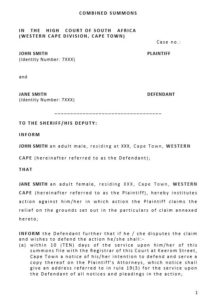 Example of a Divorce Summons[/caption] https://www.ourlawyer.co.za/wp-content/uploads/Divorce-Summons-Divorce-Lawyer-Process-217×300.jpg
Divorce Particulars of Claim
Once you have your summons and particulars of claim in order, you have to have the summons issued. To do this, make three (3) copies of your set of documents (Summons and Particulars of Claim) and have it issued at court. [caption id="attachment_6731" align="alignleft" width="800"]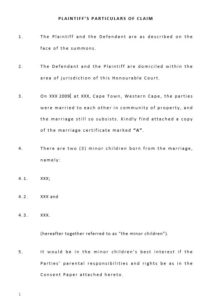 Example of A Particulars of Claim in a Divorce Action[/caption]
Issuing and Service of Divorce Summons and Particulars of Claim
Once you are at the court, go to the clerk/registrar of the court and have your documents issued. The clerk/registrar will sign the summons and provide a case number by writing it on the summons.
You should then take the original and a copy (both must be signed and stamped by the clerk/registrar of the court) and take it to the sheriff which serves documents where your spouse work, of lives. You can ask the clerk/registrar of the court for that details.
The extra—copy of the summons and particulars of claim you keep for your file and records.Notice of intention to defend
Once the sheriff served the documents, your spouse has two weeks to inform you of whether he or she shall be defending the divorce. This information is outlined in the summons. If your spouse decided not to defend the divorce action, then after a period of two weeks has elapsed, you may set the matter down as an undefended divorce. If your spouse intends to defend the divorce, he or she would then have to file the notice of intention to defend. In this notice, you would advise the Court and the Plaintiff that you are defending the divorce, and also, provide a service address. The Service Address is the address at which the Plaintiff would send notices in the court case to you. Below, kindly find an example of a Notice of Intention to Defend. [caption id="attachment_6743" align="alignleft" width="800"]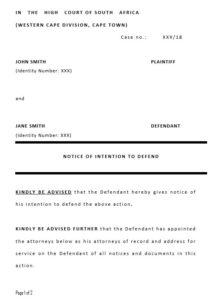 Notice of Intention to Defend[/caption]
Divorce Plea to particulars of claim
Once you received notice of your spouse’s intention to defend the divorce, about a month later, your spouse or his or attorney should serve and file a plea. The plea should outline which parts of your particulars of claim your spouse agrees (or disagree) with which would give a direction of what to prove at court. Purchase our Unopposed Divorce Package, click here. [caption id="attachment_6740" align="alignleft" width="800"]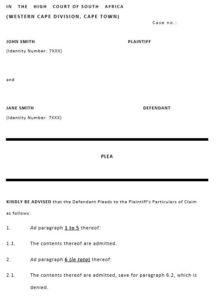 Plea in a Divorce Action[/caption] [caption id="attachment_6739" align="alignleft" width="903"]
 Plea in a Divorce Action[/caption]
Divorce Counterclaim or Claim in Reconvention
Your spouse might want to file a counterclaim or claim in reconvention. In the same way which you outlined your case as to what you want from the court and the reasons therefore in your particulars of claim; your spouse can file on you a counterclaim. A counterclaim might still be filed if your spouse agrees to a divorce, but maybe wants primary care of the children, but in your particulars of claim, you asked for primary care. You should then within 10 (ten) days plead to the counterclaim in the same manner which your spouse pleaded to your particulars of claim [caption id="attachment_6738" align="alignleft" width="789"] Divorce Counter Claim[/caption]
 Discovery
When you present evidence at Court, you want to be fully prepared. Therefore, all documents your spouse will be making use of at Court should be presented to you beforehand. And you should do the same. This is where discovery comes into play. You may ask or may be asked to provide under oath a schedule of books and documents in your possession and under your control relating to the divorce. This could be policy documents, deeds etc, and which you or your spouse might want to make use of at trial. Once you received the schedules you may inspect and request copies of the documents. [caption id="attachment_6727" align="alignleft" width="800"] Request for Discover Notice[/caption] [caption id="attachment_6726" align="alignleft" width="800"]
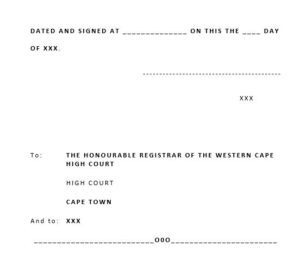 Discovery Notice[/caption]
Discovery Affidavit
After receiving a notice requesting a spouse to discover, an affidavit should be provided. The wording of the Affidavit can be seen in the pictures below. [caption id="attachment_6723" align="alignleft" width="800"]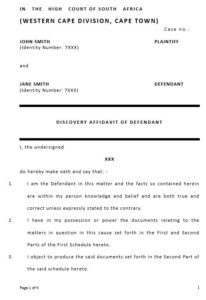 Example of a Discovery Affidavit[/caption] [caption id="attachment_6725" align="alignleft" width="800"]
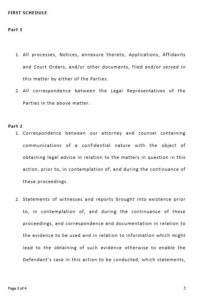 Discovery Affidavit[/caption] [caption id="attachment_6724" align="alignleft" width="800"]
 Discovery Affidavit[/caption]
Obtaining a Trial date for the Divorce
Once you received the plea, with or without a counterclaim, or have pleaded to your spouse’s counterclaim, and discovery is done, one should then approach the clerk/registrar of the court for a trial date. This you or your spouse may do. This process is a bit complicated, so it’s best to do it with the guidance of a lawyer or the clerk/registrar of the court. Purchase our Unopposed Divorce Package, click here.Pr-Trial Procedure
Before a date gets allocated to you for the divorce, the Court would want to ensure that your matter is trial ready. What this basically means, is that all that needs to be done, has been attended to and the trial will run. Many months are spent waiting for a court date, and it would be unfair to the court if a judge and other litigants are appointed to a matter, and the matter does not proceed. A judge will meet with the parties in chambers, and once the matter is trial ready, he or she will endorse the file in that regard.Divorce day / Trial / Unopposed hearing date
If your spouse does not defend the divorce within the time period, go back to court and ask for an unopposed divorce date and attend to your divorce on that date. If, however, your divorce is defended, a trial should ensure. During the trial, each party should prove his or her case. Witnesses should be called and at the end, the Magistrate or Judge shall deliver the verdict. Best of luck, and please, don’t take my word, contact a legal practitioner should you decide to get divorced. Advocate Muhammad Abduroaf [caption id="attachment_6758" align="alignleft" width="300"] Divorce Lawyer and Process[/caption]
 Adv. Muhammad Abduroaf[/caption]