I want to relocate from South Africa to Japan with my minor child. The other parent does not want my child to relocate to Japan. What can I do?

Japan is a popular destination to emigrate to. People emigrate from South Africa for many reasons. It ranges from better employment opportunities, family relations, or for a better standard of living. Whatever the reason a parent wants to relocate to Japan, if a minor child will be joining that parent and also relocating to Japan, then the parent remaining in South Africa’s consent would usually be required. Let us unpack the legal issues a parent may encounter when wanting to emigrate to Japan. Before we do so, let us list the various cities and towns in Japan to which you may want to relocate: Aichi, Anjō, Atsuta, Gamagōri, Handa, Hekinan, Ichinomiya, Inazawa, Kariya, Kasugai, Komaki, Kōnan, Nagoya, Nishio, Okazaki, Seto, Tokoname, Toyohashi, Toyokawa, Toyota, Akita, Noshiro, Ōdate, Aomori, Aomori, Hachinohe, Hirosaki, Chiba, Chiba, Chōshi, Funabashi, Ichihara, Ichikawa, Kashiwa, Kisarazu, Matsudo, Narashino, Narita, Noda, Sawara, Urayasu, Ehime, Imabari, Matsuyama, Niihama, Saijō, Uwajima, Yawatahama, Fukui, Sabae, Takefu, Tsuruga, Fukuoka, Iizuka, Kitakyūshū, Kurume, Nōgata, Ōkawa, Ōmuta, Tagawa, Fukushima, Aizu-wakamatsu, Iwaki, Kōriyama, Gifu, Gifu, Kakamigahara, Ōgaki, Tajimi, Takayama, Toki, Gumma, Isesaki, Kiryū, Maebashi, Ōta, Takasaki, Tatebayashi, Tomioka, Hiroshima, Fukuyama, Hiroshima, Innoshima, Kure, Mihara, Onomichi, Hokkaido, Asahikawa, Bibai, Chitose, Ebetsu, Hakodate, Iwamizawa, Kitami, Kushiro, Muroran, Nemuro, Noboribetsu, Obihiro, Otaru, Rumoi, Sapporo, Tomakomai, Wakkanai, Yūbari, Hyōgo, Akashi, Akō, Amagasaki, Ashiya, Himeji, Itami, Kakogawa, Kawanishi, Kōbe, Miki, Nishinomiya, Takarazuka, Takasago, Ibaraki, Hitachi, Hitachinaka, Kitaibaraki, Koga, Mito, Shimodate, Tsuchiura, Tsukuba Science City, Ishikawa, Kaga, Kanazawa, Komatsu, Nanao, Iwate, Kamaishi, Miyako, Mizusawa, Morioka, Kagawa, Marugame, Sakaide, Takamatsu, Kagoshima, Kanoya, Sendai, Kanagawa, Atsugi, Chigasaki, Fujisawa, Hadano, Hakone, Hiratsuka, Kamakura, Kawasaki, Miura, Odawara, Sagamihara, Yamato, Yokohama, Yokosuka, Kōchi, Kumamoto, Arao, Kumamoto, Minamata, Yatsushiro, Kyōto, Kyōto, Maizuru, Uji, Mie, Ise, Kuwana, Matsuzaka, Suzuka, Tsu, Ueno, Yokkaichi, Miyagi, Ishinomaki, Kesennuma, Sendai, Shiogama, Miyazaki, Miyakonojō, Miyazaki, Nichinan, Nobeoka, Nagano, Matsumoto, Nagano, Okaya, Suwa, Ueda, Nagasaki, Hirado, Isahaya, Nagasaki, Ōmura, Sasebo, Shimabara, Nara, Kashihara, Nara, Tenri, Yamato-Kōriyama, Niigata, Jōetsu, Kashiwazaki, Nagaoka, Niigata, Niitsu, Sanjō, Ōita, Beppu, Hita, Nakatsu, Ōita, Saiki, Usa, Usuki, Okayama, Kasaoka, Kurashiki, Okayama, Tamano, Tsuyama, Okinawa, Naha, Okinawa, Ōsaka, Daitō, Higashiōsaka, Hirakata, Ikeda, Izumiōtsu, Izumisano, Kadoma, Kishiwada, Matsubara, Moriguchi, Neyagawa, Ōsaka, Sakai, Suita, Takatsuki, Toyonaka, Yao, Saga, Imari, Karatsu, Saga, Tosu, Saitama, Ageo, Asaka, Chichibu, Fukaya, Gyōda, Iruma, Kawagoe, Kawaguchi, Koshigaya, Kumagaya, Saitama, Sōka, Toda, Warabi, Shiga, Hikone, Ōtsu, Shigaraki, Shimane, Izumo, Masuda, Matsue, Shizuoka, Atami, Fuji, Fujieda, Fujinomiya, Gotemba, Hamakita, Hamamatsu, Itō, Mishima, Numazu, Shimada, Shimizu, Shizuoka, Yaizu, Tochigi, Ashikaga, Kanuma, Nikkō, Oyama, Sano, Utsunomiya, Tokushima, Anan, Komatsushima, Naruto, Tokushima, Tokyo, Chōfu, Fuchū, Ginza, Hachiōji, Higashimurayama, Hino, Kodaira, Koganei, Kokubunji, Machida, Mitaka, Musashino, Ōme, Tachikawa, Tokyo, Tottori, Kurayoshi, Yonago, Toyama, Takaoka, Wakayama, Kainan, Nachi-katsuura, Sakata, Tsuruoka, Wakayama, Yamagata, Yonezawa, Yamagata, Yamaguchi, Hagi, Hōfu, Iwakuni, Kudamatsu, Shimonoseki, Tokuyama, Ube, Yamanashi, Kōfu. (https://www.britannica.com/topic/list-of-cities-and-towns-in-Japan-2039519)  

Why do I require the other parent’s Consent to relocate to Japan?

According to South African law, if you are a co-holder of parental responsibilities and rights over your minor child, you must consent to your child leaving South Africa. In this case, relocating to Japan. Here we refer to section 18 of the Children’s Act 38 of 2005. The entire provision is as follows: 18 Parental responsibilities and rights  (1) A person may have either full or specific parental responsibilities and rights in respect of a child.  (2) The parental responsibilities and rights that a person may have in respect of a child, include the responsibility and the right-  (a) to care for the child;  (b) to maintain contact with the child;  (c) to act as guardian of the child; and  (d) to contribute to the maintenance of the child.  (3) Subject to subsections (4) and (5), a parent or other person who acts as guardian of a child must-  (a) administer and safeguard the child’s property and property interests;  (b) assist or represent the child in administrative, contractual and other legal matters; or  (c) give or refuse any consent required by law in respect of the child, including-  (i) consent to the child’s marriage;  (ii) consent to the child’s adoption;  (iii) consent to the child’s departure or removal from the Republic;  (iv) consent to the child’s application for a passport; and  (v) consent to the alienation or encumbrance of any immovable property of the child.  (4) Whenever more than one person has guardianship of a child, each one of them is competent, subject to subsection (5), any other law or any order of a competent court to the contrary, to exercise independently and without the Consent of the other any right or responsibility arising from such guardianship. (5) Unless a competent court orders otherwise, the Consent of all the persons that have guardianship of a child is necessary in respect of matters set out in subsection (3)(c). Now let us explain what Parental Responsibilities and Rights are.

What are Parental Responsibilities and Rights of a parent in relation to a child?

As can be seen from section 18(2) of the Children’s Act, when we refer to Parental Responsibilities and Rights, we refer to the following: (a) to care for the child;  (b) to maintain contact with the child;  (c) to act as guardian of the child; and  (d) to contribute to the maintenance of the child. Therefore, if a parent has parental responsibilities and rights over a minor child, and accordingly, rights of guardianship, their Consent is required when it comes to issues of guardianship. As seen from section 18(3)(c) of the Children’s Act above, both parents’ Consent is required should a minor child depart from the Republic of South Africa. In this case, to emigrate to Japan. Even if the minor child only wants to go for a short holiday to Japan, both guardians’ Consent would be required.

When would the other parent be seen as a guardian in the case of a relocation matter to Japan?

It must be noted that not all parents are legal guardians over their minor children. We should therefore distinguish between married or divorced parents and parents who were never married. As you would see below, usually married, or divorced parents’ Consent would be required for a minor child to relocate or emigrate to Japan. However, that does not automatically apply to parents who were never married. This could be because the child could have been born from a brief encounter and never met his or her father. It would not make sense that a parent who never met his or her 15-year-old child, should give Consent for relocation to Japan.

Mother’s Consent for relocation of the minor child to Japan

Section 19 of the Children’s Act deals with the Parental responsibilities and rights of mothers. It states the following: 19 Parental responsibilities and rights of mothers  (1) The biological mother of a child, whether married or unmarried, has full parental responsibilities and rights in respect of the child.  (2) If-  (a) the biological mother of a child is an unmarried child who does not have guardianship in respect of the child; and  (b) the biological father of the child does not have guardianship in respect of the child, the guardian of the child’s biological mother is also the guardian of the child.  (3) This section does not apply in respect of a child who is the subject of a surrogacy agreement. As seen from section 19(1) of the Children’s Act, in most cases involving the relocation of a minor child to Japan, the mother’s Consent is required as she has full parental responsibilities and rights over the minor child.

Married father’s Consent for the relocation of the minor child to Japan

Section 20 of the Children’s Act deals with Parental responsibilities and rights of married fathers. It states the following: 20 Parental responsibilities and rights of married fathers The biological father of a child has full parental responsibilities and rights in respect of the child- (a) if he is married to the child’s mother; or (b) if he was married to the child’s mother at (i) the time of the child’s conception; (ii) the time of the child’s birth; or (iii) any time between the child’s conception and birth. As can be seen from sections 20 (a) and (b) of the Children’s Act, if the father and the mother were married, or are married, then his Consent is required for the minor child to relocate to Japan. Of course, an exception to this would be should a court of law order otherwise. This would be the case should the parents be divorced and the divorce court ordered that only the mother may act as guardian. Next, we deal with the issue of an unmarried father’s Consent to relocate a minor child to Japan.

Consent of unmarried fathers for the relocation of their minor children to Japan.

Section 21 of the Children’s Act deals with parental responsibilities and rights of unmarried fathers. The section states the following: 21 Parental responsibilities and rights of unmarried fathers  (1) The biological father of a child who does not have parental responsibilities and rights in respect of the child in terms of section 20, acquires full parental responsibilities and rights in respect of the child-  (a) if at the time of the child’s birth he is living with the mother in a permanent life-partnership; or  (b) if he, regardless of whether he has lived or is living with the mother-  (i) consents to be identified or successfully applies in terms of section 26 to be identified as the child’s father or pays damages in terms of customary law;  (ii) contributes or has attempted in good faith to contribute to the child’s upbringing for a reasonable period; and  (iii) contributes or has attempted in good faith to contribute towards expenses in connection with the maintenance of the child for a reasonable period.  (2) This section does not affect the duty of a father to contribute towards the maintenance of the child.  (3) (a) If there is a dispute between the biological father referred to in subsection (1) and the biological mother of a child with regard to the fulfilment by that father of the conditions set out in subsection (1) (a) or (b), the matter must be referred for mediation to a family advocate, social worker, social service professional or other suitably qualified person.  (b) Any party to the mediation may have the outcome  of the mediation reviewed by a court.  (4) This section applies regardless of whether the child was born before or after the commencement of this Act. As can be seen from the latter sections, a father of a child born out of wedlock does not automatically have parental responsibilities and rights over his minor child. He may however acquire those parental responsibilities and rights over his minor child if he is materially involved in the child’s life. That would be where the father and the mother were in a permanent life partnership when the child was born or he is meaningfully involved in the child’s life, as outlined above. We shall not go into much detail regarding that. However, in most cases, if the father had regular contact with the child and paid child support, he would have acquired parental responsibilities and rights over the minor child.

What do you do if the other parent does not want to consent to the minor child relocating to Japan?

Suppose the other parent also has parental responsibilities and rights over the minor child, and he or she does not want to consent to the relocation of the minor child to Japan, then in such a case, the Court needs to be approached. Here I refer you back to section 18(5) of the Children’s Act referred to above where it states: (5) Unless a competent court orders otherwise, the Consent of all the persons that have guardianship of a child is necessary in respect of matters set out in subsection (3)(c). Therefore, after your Court Application has been launched an both sides have been heard, the Court would make the necessary Order. If you are successful in your application for the relocation of your minor children to Japan, then the Court will make an Order similar to that which is shown below. [caption id="attachment_10829" align="alignnone" width="662"]Relocation consent Court Order for minor child to Japan - Advocate Muhammad Abduroaf Relocation consent Court Order for minor child to Japan – Advocate Muhammad Abduroaf[/caption]  

I want to relocate from South Africa to Japan with my minor child. The other parent does not want my child to relocate to Japan. What can I do?

Japan is a popular destination to emigrate to. People emigrate from South Africa for many reasons. It ranges from better employment opportunities, family relations, or for a better standard of living. Whatever the reason a parent wants to relocate to Japan, if a minor child will be joining that parent and also relocating to Japan, then the parent remaining in South Africa’s consent would usually be required. Let us unpack the legal issues a parent may encounter when wanting to emigrate to Japan. Before we do so, let us list the various cities and towns in Japan to which you may want to relocate:

Aichi, Anjō, Atsuta, Gamagōri, Handa, Hekinan, Ichinomiya, Inazawa, Kariya, Kasugai, Komaki, Kōnan, Nagoya, Nishio, Okazaki, Seto, Tokoname, Toyohashi, Toyokawa, Toyota, Akita, Noshiro, Ōdate, Aomori, Aomori, Hachinohe, Hirosaki, Chiba, Chiba, Chōshi, Funabashi, Ichihara, Ichikawa, Kashiwa, Kisarazu, Matsudo, Narashino, Narita, Noda, Sawara, Urayasu, Ehime, Imabari, Matsuyama, Niihama, Saijō, Uwajima, Yawatahama, Fukui, Sabae, Takefu, Tsuruga, Fukuoka, Iizuka, Kitakyūshū, Kurume, Nōgata, Ōkawa, Ōmuta, Tagawa, Fukushima, Aizu-wakamatsu, Iwaki, Kōriyama, Gifu, Gifu, Kakamigahara, Ōgaki, Tajimi, Takayama, Toki, Gumma, Isesaki, Kiryū, Maebashi, Ōta, Takasaki, Tatebayashi, Tomioka, Hiroshima, Fukuyama, Hiroshima, Innoshima, Kure, Mihara, Onomichi, Hokkaido, Asahikawa, Bibai, Chitose, Ebetsu, Hakodate, Iwamizawa, Kitami, Kushiro, Muroran, Nemuro, Noboribetsu, Obihiro, Otaru, Rumoi, Sapporo, Tomakomai, Wakkanai, Yūbari, Hyōgo, Akashi, Akō, Amagasaki, Ashiya, Himeji, Itami, Kakogawa, Kawanishi, Kōbe, Miki, Nishinomiya, Takarazuka, Takasago, Ibaraki, Hitachi, Hitachinaka, Kitaibaraki, Koga, Mito, Shimodate, Tsuchiura, Tsukuba Science City, Ishikawa, Kaga, Kanazawa, Komatsu, Nanao, Iwate, Kamaishi, Miyako, Mizusawa, Morioka, Kagawa, Marugame, Sakaide, Takamatsu, Kagoshima, Kanoya, Sendai, Kanagawa, Atsugi, Chigasaki, Fujisawa, Hadano, Hakone, Hiratsuka, Kamakura, Kawasaki, Miura, Odawara, Sagamihara, Yamato, Yokohama, Yokosuka, Kōchi, Kumamoto, Arao, Kumamoto, Minamata, Yatsushiro, Kyōto, Kyōto, Maizuru, Uji, Mie, Ise, Kuwana, Matsuzaka, Suzuka, Tsu, Ueno, Yokkaichi, Miyagi, Ishinomaki, Kesennuma, Sendai, Shiogama, Miyazaki, Miyakonojō, Miyazaki, Nichinan, Nobeoka, Nagano, Matsumoto, Nagano, Okaya, Suwa, Ueda, Nagasaki, Hirado, Isahaya, Nagasaki, Ōmura, Sasebo, Shimabara, Nara, Kashihara, Nara, Tenri, Yamato-Kōriyama, Niigata, Jōetsu, Kashiwazaki, Nagaoka, Niigata, Niitsu, Sanjō, Ōita, Beppu, Hita, Nakatsu, Ōita, Saiki, Usa, Usuki, Okayama, Kasaoka, Kurashiki, Okayama, Tamano, Tsuyama, Okinawa, Naha, Okinawa, Ōsaka, Daitō, Higashiōsaka, Hirakata, Ikeda, Izumiōtsu, Izumisano, Kadoma, Kishiwada, Matsubara, Moriguchi, Neyagawa, Ōsaka, Sakai, Suita, Takatsuki, Toyonaka, Yao, Saga, Imari, Karatsu, Saga, Tosu, Saitama, Ageo, Asaka, Chichibu, Fukaya, Gyōda, Iruma, Kawagoe, Kawaguchi, Koshigaya, Kumagaya, Saitama, Sōka, Toda, Warabi, Shiga, Hikone, Ōtsu, Shigaraki, Shimane, Izumo, Masuda, Matsue, Shizuoka, Atami, Fuji, Fujieda, Fujinomiya, Gotemba, Hamakita, Hamamatsu, Itō, Mishima, Numazu, Shimada, Shimizu, Shizuoka, Yaizu, Tochigi, Ashikaga, Kanuma, Nikkō, Oyama, Sano, Utsunomiya, Tokushima, Anan, Komatsushima, Naruto, Tokushima, Tokyo, Chōfu, Fuchū, Ginza, Hachiōji, Higashimurayama, Hino, Kodaira, Koganei, Kokubunji, Machida, Mitaka, Musashino, Ōme, Tachikawa, Tokyo, Tottori, Kurayoshi, Yonago, Toyama, Takaoka, Wakayama, Kainan, Nachi-katsuura, Sakata, Tsuruoka, Wakayama, Yamagata, Yonezawa, Yamagata, Yamaguchi, Hagi, Hōfu, Iwakuni, Kudamatsu, Shimonoseki, Tokuyama, Ube, Yamanashi, Kōfu.

(https://www.britannica.com/topic/list-of-cities-and-towns-in-Japan-2039519)


Why do I require the other parent’s Consent to relocate to Japan?

According to South African law, if you are a co-holder of parental responsibilities and rights over your minor child, you must consent to your child leaving South Africa. In this case, relocating to Japan.

Here we refer to section 18 of the Children’s Act 38 of 2005. The entire provision is as follows:

18 Parental responsibilities and rights

 (1) A person may have either full or specific parental responsibilities and rights in respect of a child.

 (2) The parental responsibilities and rights that a person may have in respect of a child, include the responsibility and the right-

 (a) to care for the child;

 (b) to maintain contact with the child;

 (c) to act as guardian of the child; and

 (d) to contribute to the maintenance of the child.

 (3) Subject to subsections (4) and (5), a parent or other person who acts as guardian of a child must-

 (a) administer and safeguard the child’s property and property interests;

 (b) assist or represent the child in administrative, contractual and other legal matters; or

 (c) give or refuse any consent required by law in respect of the child, including-

 (i) consent to the child’s marriage;

 (ii) consent to the child’s adoption;

 (iii) consent to the child’s departure or removal from the Republic;

 (iv) consent to the child’s application for a passport; and

 (v) consent to the alienation or encumbrance of any immovable property of the child.

 (4) Whenever more than one person has guardianship of a child, each one of them is competent, subject to subsection (5), any other law or any order of a competent court to the contrary, to exercise independently and without the Consent of the other any right or responsibility arising from such guardianship.

(5) Unless a competent court orders otherwise, the Consent of all the persons that have guardianship of a child is necessary in respect of matters set out in subsection (3)(c).

Now let us explain what Parental Responsibilities and Rights are.

What are Parental Responsibilities and Rights of a parent in relation to a child?

As can be seen from section 18(2) of the Children’s Act, when we refer to Parental Responsibilities and Rights, we refer to the following:

(a) to care for the child;

 (b) to maintain contact with the child;

 (c) to act as guardian of the child; and

 (d) to contribute to the maintenance of the child.

Therefore, if a parent has parental responsibilities and rights over a minor child, and accordingly, rights of guardianship, their Consent is required when it comes to issues of guardianship. As seen from section 18(3)(c) of the Children’s Act above, both parents’ Consent is required should a minor child depart from the Republic of South Africa. In this case, to emigrate to Japan. Even if the minor child only wants to go for a short holiday to Japan, both guardians’ Consent would be required.

When would the other parent be seen as a guardian in the case of a relocation matter to Japan?

It must be noted that not all parents are legal guardians over their minor children. We should therefore distinguish between married or divorced parents and parents who were never married. As you would see below, usually married, or divorced parents’ Consent would be required for a minor child to relocate or emigrate to Japan. However, that does not automatically apply to parents who were never married. This could be because the child could have been born from a brief encounter and never met his or her father. It would not make sense that a parent who never met his or her 15-year-old child, should give Consent for relocation to Japan.

Mother’s Consent for relocation of the minor child to Japan

Section 19 of the Children’s Act deals with the Parental responsibilities and rights of mothers. It states the following:

19 Parental responsibilities and rights of mothers

 (1) The biological mother of a child, whether married or unmarried, has full parental responsibilities and rights in respect of the child.

 (2) If-

 (a) the biological mother of a child is an unmarried child who does not have guardianship in respect of the child; and

 (b) the biological father of the child does not have guardianship in respect of the child, the guardian of the child’s biological mother is also the guardian of the child.

 (3) This section does not apply in respect of a child who is the subject of a surrogacy agreement.

As seen from section 19(1) of the Children’s Act, in most cases involving the relocation of a minor child to Japan, the mother’s Consent is required as she has full parental responsibilities and rights over the minor child.

Married father’s Consent for the relocation of the minor child to Japan

Section 20 of the Children’s Act deals with Parental responsibilities and rights of married fathers. It states the following:

20 Parental responsibilities and rights of married fathers

The biological father of a child has full parental responsibilities and rights in respect of the child-

(a) if he is married to the child’s mother; or

(b) if he was married to the child’s mother at (i) the time of the child’s conception; (ii) the time of the child’s birth; or (iii) any time between the child’s conception and birth.

As can be seen from sections 20 (a) and (b) of the Children’s Act, if the father and the mother were married, or are married, then his Consent is required for the minor child to relocate to Japan. Of course, an exception to this would be should a court of law order otherwise. This would be the case should the parents be divorced and the divorce court ordered that only the mother may act as guardian. Next, we deal with the issue of an unmarried father’s Consent to relocate a minor child to Japan.

Consent of unmarried fathers for the relocation of their minor children to Japan.

Section 21 of the Children’s Act deals with parental responsibilities and rights of unmarried fathers. The section states the following:

21 Parental responsibilities and rights of unmarried fathers

 (1) The biological father of a child who does not have parental responsibilities and rights in respect of the child in terms of section 20, acquires full parental responsibilities and rights in respect of the child-

 (a) if at the time of the child’s birth he is living with the mother in a permanent life-partnership; or

 (b) if he, regardless of whether he has lived or is living with the mother-

 (i) consents to be identified or successfully applies in terms of section 26 to be identified as the child’s father or pays damages in terms of customary law;

 (ii) contributes or has attempted in good faith to contribute to the child’s upbringing for a reasonable period; and

 (iii) contributes or has attempted in good faith to contribute towards expenses in connection with the maintenance of the child for a reasonable period.

 (2) This section does not affect the duty of a father to contribute towards the maintenance of the child.

 (3) (a) If there is a dispute between the biological father referred to in subsection (1) and the biological mother of a child with regard to the fulfilment by that father of the conditions set out in subsection (1) (a) or (b), the matter must be referred for mediation to a family advocate, social worker, social service professional or other suitably qualified person.

 (b) Any party to the mediation may have the outcome  of the mediation reviewed by a

court.

 (4) This section applies regardless of whether the child was born before or after the commencement of this Act.

As can be seen from the latter sections, a father of a child born out of wedlock does not automatically have parental responsibilities and rights over his minor child. He may however acquire those parental responsibilities and rights over his minor child if he is materially involved in the child’s life. That would be where the father and the mother were in a permanent life partnership when the child was born or he is meaningfully involved in the child’s life, as outlined above. We shall not go into much detail regarding that. However, in most cases, if the father had regular contact with the child and paid child support, he would have acquired parental responsibilities and rights over the minor child.

What do you do if the other parent does not want to consent to the minor child relocating to Japan?

Suppose the other parent also has parental responsibilities and rights over the minor child, and he or she does not want to consent to the relocation of the minor child to Japan, then in such a case, the Court needs to be approached. Here I refer you back to section 18(5) of the Children’s Act referred to above where it states:

(5) Unless a competent court orders otherwise, the Consent of all the persons that have guardianship of a child is necessary in respect of matters set out in subsection (3)(c).

Therefore, after your Court Application has been launched an both sides have been heard, the Court would make the necessary Order. If you are successful in your application for the relocation of your minor children to Japan, then the Court will make an Order similar to that which is shown below.
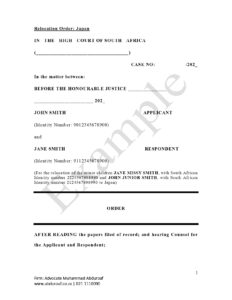
Relocation consent Court Order for minor child to Japan - Advocate Muhammad Abduroaf
Relocation consent Court Order for minor child to Japan – Advocate Muhammad Abduroaf


Related Post

Victory for Muslim Marriages in South Africa – Court gives the State 2 (two) years to enact legislation

[Re-post] On 31 August 2018, the Western Cape High Court handed down a ground-breaking judgment. In effect, it Orders the State to prepare, initiate, introduce, enact, and bring into operation, diligently, and without delay, legislation to recognise Muslim marriages. The High Court gave the State exactly two (2) years to attend to the latter process. This two (2) years would only be suspended if the matter is taken to the Constitutional Court. However, should the matter not be taken to the Constitutional Court for final determination, and the State does not enact the legislation, then by default, Muslim marriages may be dissolved in accordance with the Divorce Act 70 of 1979. Therefore, it is up to the State to action matters urgently.
Download a Copy of the Judgment by clicking here.

How does this benefit Muslim Marriages?

To understand how the judgment benefits Muslim Marriages, one needs to understand the legal nature of Muslim Marriages in South Africa. Let us refer to the judgment for  some insight: In the judgment, the following is stated: “The issues before us concern recognition and regulation of marriages solemnised and celebrated according to the tenets of Islamic (also referred to as ‘Muslim marriages’). It is undisputed that marriages entered into in terms of the tenets of Islam have not been afforded legal recognition for all purposes. The applicants argue that non-recognition and non-regulation of these marriages violates the rights of women and children in particular in these marriages. According to them. the State has failed in its duty of respect, protect promote and fulfil the Bill of’ Rights as required in section 7(2) of the Constitution, in the face of its constitutional and international obligations and that the most effective way of dealing with this systemic violation of rights, is an enactment of statute. This approach. according to the applicants has been postulated by the courts in a number of judgments dealing with issues concerning Muslim marriages before.”

What is the current state of Muslim Marriages?

Unfortunately, until the Muslim Marriages Act comes into operation, Muslim Marriages are not valid marriages in terms of South African Law. The consequences are however enforceable. For example, spousal support, succession, contracts etc. However, a Muslim spouse cannot get a divorce in terms of the Divorce Act, or make use of certain legislation as in the case of civil marriages. If a party is married in terms of civil law, he or she must approach a court of law for a valid divorce. That, unfortunately, does not apply to Muslim Marriages. Therefore, the Judgement is welcomed.

The Judgment Order

To get a better understanding of what the order of the court was, you can read it below. Feel free to leave your comments below.   Order [252] In the result. the following orders are proposed: 1 . It is declared that the State is obliged by section 7(2) of the Constitution to respect, protect, promote and fulfil the rights in sections 9, 10, 15. 28, 31 and 34 of the Constitution by preparing, initiating. introducing, enacting and bringing into operation. diligently and without delay as required by section 237 of the Constitution, legislation to recognise marriages solemnised in accordance with the tenets of Sharia law (‘Muslim marriages’) as valid marriages and to regulate the consequences of such recognition. 2. It is declared that the President and the Cabinet have failed to fulfil their respective constitutional obligations as stipulated in paragraph 1 above and such conduct is invalid. 3. The President and Cabinet together with Parliament are directed to rectify the failure within 24 months of the date of this order as contemplated in paragraph 1 above. 4. In the event that the contemplated legislation is referred to the Constitutional Court by the President in terms of section 79(4)(b) of the Constitution, or is referred by members of the National Assembly in terms of section 80 of the Constitution, the relevant deadline will be suspended pending the final determination of the matter by the Constitutional Court: 5. In the event that legislation as contemplated in paragraph 1 above is not enacted within 24 months from the date of this order or such later date as contemplated in paragraph 4 above, and until such time as the coming into force thereafter of such contemplated legislation, the following order shall come into effect: 5.1 It is declared that a union validly concluded as a marriage in terms of Sharia law and which subsists at the time this order becomes operative, may (even after its dissolution in terms of Sharia Law) be dissolved in accordance with the Divorce Act 79 of 1979 and all the provisions of the Act shall be applicable, provided that the provisions of section 7(3) shall apply to such a union regardless of when it was concluded: and 5.2 In the case of a husband who is a spouse in more than one Muslim marriage, the court shall: (a) take into consideration all relevant factors including any contract or agreement and must male any equitable order that it deems just; and (b) may order that any person who in the court’s opinion has a sufficient interest in the matter be joined in the proceedings. 5.3 If administrative or practical problems arise in the implementation of this order, any interested person may approach this Court for a variation of this order. 5.4 The Department of Home Affairs and the Department of Justice shall publish a summary of the orders in paragraphs 5.1 to 5.2 above widely in newspapers and on radio stations, whatever is feasible, without unreasonable delay. 6. An order directing the Minister of Justice to put in place policies and procedures regulating the holding of enquiries by the master of the High Court into the validity of marriages solemnised in accordance with the tenets of Islamic law is refused. 7. An order declaring the pro forma marriage contract attached as annexure “A” to the Women’s Legal Centre Trust’s founding affidavit, to be contrary to public policy is refused. 8. In respect of matters under case numbers 22481/2014 and 4406/2013, the president, the Minister of Justice and the Minister of Home Affairs are to pay the costs of the Women’s Legal Centre Trust respectively, such costs to include costs of three counsel to the extent of their employment. 9. In respect of the matter under case number 13877/2015: 9.1 Ruwayda Esau’s claim to a part of the Mogamat Riethaw estate, if any. is postponed for hearing at trial along with Parts B and E, of the particulars of claim. 9.2 The Cabinet and the Minister of justice shall pay Ruwayda Esau’s costs in respect of Claim A, such costs to include costs of two counsel to the extent of their employment. Download a Copy of the Judgment by clicking here. Feel free to leave your comments below.

Do you require a video legal advice consultation?

Click here and schedule one today!