I need Child Maintenance for my Child. How to Apply for Child Maintenance – Advocate Muhammad Abduroaf

I need Child Maintenance for my Child. How to Apply for Child Maintenance – Advocate Muhammad Abduroaf

Related Post

Have an Ante – Nuptial Contract in place

It is not uncommon for people wanting to change their property regime. When we deal with legal matters of this nature, we urge people to make sure that they understand the process and what it means going forward once this has been done. For those of you contemplating marriage, the
legal expert would advise that you have an Ante – Nuptial Contract in place. Here he explains why this is crucial in protecting your assets: The usual process to be married Out of Community of Property is to enter into an ante nuptial contract before the marriage. The contract will have clauses in it stating:
  • That there shall be no community of property;
  • That there shall be no community of profit or loss; and
  • That the accrual system provided for in Chapter 1 of the Matrimonial Property Act, no 88 of 1984 is expressly excluded from the marriage.
However, if you did not do so, there is a way of changing your matrimonial property regime from In Community of Property to Out of Community of Property. For this, you need the consent of the High Court in your Jurisdiction. Here you will make use of section 21 of the Matrimonial Property Act 88 of 1984. For more on this topic, see How to Change Your Matrimonial Property Regime . The creators of this website had made free, expert legal advice easily accessible for your convenience. For more on your legal options and ideas, see the following links:
  1. How to Change your Matrimonial Property Regime
  2. Do your own Unopposed Divorce. No lawyers needed and its Free.
  3. Parental Rights of Divorced Muslim parents after a Talaq or Faskh
  4. Free Online Divorce Assistance Form – DIY Cape Town South Africa
comprising of:
  1. Divorce guide
For a one on one professional legal consultation with the family legal expert, call our law offices for an online legal appointment today!

Registering an Ante – Nuptial Contract

First of all, it is crucial to note that if you get married without an Ante Nuptial Contract, you are automatically married in community of property. But what exactly is the purpose of having an ANC? An ANC is an agreement in black and white between two parties before entering into marriage. The agreement stipulates how assets will be dealt with in the event of divorce or death. Having an ante nuptial contract benefits you in the following ways:
  • Debt incurred by the other party, will not be affect you financially due to the ANC in place.
  • The ANC allows the parties to remain separate in estates.
  • Parties will not need each other’s consent in financial dealings.
  • Parties can maintain their own financial independence.
Engage with our efficient online appointment system and have us make an online appointment for you today!

Professional legal drafting services

Our legal expert at our law offices is a professional legal drafter with years of experiences in legal drafting and offering expert legal advice on specific family law topics. These family legal topics range from: Do you require expert legal advice in any of these topics? Do feel free to give our law offices a call on 021 424 3487 for an online appointment today.

In Community of Property VS Out of Community of Property

First of all, for this process to unfold legally, you need to have the guidance of a family legal expert. The legal professional will explain the different ways you can go about altering your matrimonial regime between you and your spouse. In turn, the parties involved must gain a clear understanding of why they’re changing their property regime and how this will impact their financial situation. It is therefore the duty of the legal expert to ensure that you are doing things legally correct. Do you have some questions you would like to ask regarding this topic? See Changing your Matrimonial Property Regime Questions and Answers page. Our professional legal consultation can be conducted telephonically, whereby we will be making the call to the potential client for 40 minutes or for part thereof. We are highly accommodating towards our clients and strive to make this website, and the process of obtaining legal advice, as efficient as possible. For a one on one professional legal consultation with the family legal expert, call our law offices for an online legal appointment today!    

Parental consent for a minor child’s enrolment into a school – What can you do if co-guardianship consent is refused?

Children have a right to a decent education—one which would benefit them in life. Every caring parent wants to give their child the best education possible according to their specific circumstances and station in life.  Not all parents earn the same amount of money or have access the best type of education. However, most parents will do their best, which the law and society expect of all parents. In doing so, they ensure that their child has the best opportunities in life.

Parents co-operating in educating their minor children

It is vitally important for parents to co-operate when it comes to their minor child’s education. This relates to the enrollment into a school, the paying of school fees, transportation, parent involvement, homework, etc. If one parent does not wish to be involved in the child’s education, they should not hinder or obstruct the other parent from attending to the minor child’s education. For example, if the primary caregiver wants to enrol the minor child into a school, the other parent should co-operate in signing the necessary documents etc. It would be gravely unfortunate if a child’s right to a reasonable education is being prejudiced because the uninterested parent does not want to co-operate.

Parents not agreeing on the school the minor child should attend

Having dealt with the critical aspect of a minor child receiving a decent education and them co-operating; parents sometimes have conflicting views on what type of education is in the minor child’s best interests. Disputes may arise as to what school the minor child should attend or the subjects they should do. Parents being unable to agree on the essential aspects of the minor child’s education can cause severe problems for the minor child’s future. The law does not expect parents to agree on all aspects of the minor child’s education. However, the disagreement should not compromise the minor child’s education. If there is an impasse, a parent must give in. The law, therefore, expects parents to agree on those important issues regarding the minor child’s education and work together on making the minor child’s educational journey as smooth as possible.

Where do most educational disputes stem from?

Most parental disputes regarding a minor child’s education arise when the parents are separated or not living together. Here the reference is made to divorced parents or parents who were in a relationship and now separated. This is unfortunate as the minor child already has to deal with having parents living in separate homes and sharing time with each parent. It is not the minor child’s fault that his or her parents are not together or have issues. An issue may be where one parent prefers a school closer to their home and the other closer to their work. Or a parent prefers the minor child to attend a school which historically excelled in sport or academia.

Issue of affordability of education

Other considerations are that of affordability or the cost of education. One parent may not be able to afford the school fees of the current or new school. These are challenges that are not easy to resolve. When it comes to money issues, it is difficult to find solutions without looking into the parents’ pocket. This also comes with its own challenges. This is so as you would have to firstly deal with the issue of what is a better school for the minor child, and then the issue of affordability, location and so on. It is easy to determine which school is in theory better than the other by ticking off boxes. However, if school fees would not be paid, the exercise may be futile, when dealing with schools outside the affordability bracket of the parents.

When does the issue of a change in schooling arise?

Most of the minor child’s educational disputes between the parents comes to play when the child has to enrol into a new school. Usually in grade R or grade 7. If the child is attending a school, parents would usually not bring up any issues until those grades have been completed (or are soon to be completed). As a primary care giver of your child, you would want to ensure that your child has a school ready to attend the following year. You would also want to ensure that the school is an ideal school, considering the fees, location, subjects they offer and so on. If you leave this issue of application and enrolment into schools too late, you may end up having to enrol your child into as school far from your home or work. It may happen that the school your child ultimately attends do not have the curriculum you want for your child.

Parental consent for enrolment into a new school

Schools require both guardians of a minor child to enrol them into a school. This is especially so if the father’s name is on the birth certificate. If the parents are separated, and either parent is uncooperative, the child may not get accepted into a school timeously or into the best-suited school for him or her. If parents have their own personal issues between the two of them, then the situation becomes worse. One parent may try to use his or her right to consent as leverage for something else. For example, he or she will only consent if her or she does not have to pay any school fees.

What do you do if parental consent is not provided?

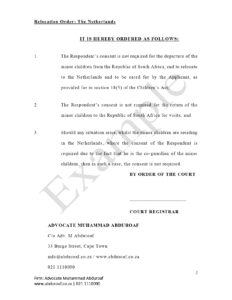
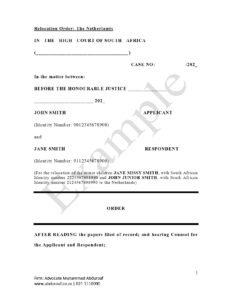
If there is a dispute regarding the school your child should attend, and it cannot be resolved between the parents; we suggest you try to mediate the issue with an experienced mediator or family counsellor. If that does not happen because the other parent does not want to partake, or the outcome is unsatisfactory to you, then you would have to approach the Court for assistance in resolving the matter. This is unfortunate as the child is the one who would suffer as he or she would be attending the school. The Court can make an order that only one parent’s consent is required for the enrolment of the minor child into a school.

What does the Court look at when deciding on parental consent?

As always, the court always looks at what is in the minor child’s best interest when it comes to issues surrounding him or her. Therefore, when it comes to parental consent issues in relation to education, the court would have to decide what is best for the minor child. Is it best that the minor child attend school A, or School B.? Before the court so decides, it would firstly hear from both parents. It may even ask the Office of the Family Advocate to first investigate and give their recommendations.

Court overriding the parents rights

If the court orders that School B would be best, then it would order that the parent who does not support School B should provide his or her consent, failing which, his or her consent is dispensed with. This process can take very long and can become very expensive. It would have been best if the parents used their money towards the minor child’s education. At the end of the day, litigation does not serve the minor child in the long run, especially when it comes to his or her education.    

Do you require a video legal advice consultation?

Click here and schedule one today!