Child Custody and Child Maintenance in divorces – Advocate Muhammad Abduroaf

Child Custody and Child Maintenance in divorces – Advocate Muhammad Abduroaf

Related Post

How to get urgent Access to your Children without the services of a Lawyer (Attorney or Advocate)

Are you a father or mother of a child and the other parent refuses you access/contact to that child? If that is the case, you have a right to relief from the Court for Urgent Access. A couple would bring a child into this world. Whilst the relationship is ongoing, they can see eye to eye on what is best for the child and both parties form a productive part of the child’s life. Even if the couple is not living together, the father would see the child regularly and bond with the child as is needed. However, once the relationship has severed, it often happens that the parties cannot see eye to eye on what is best for the child regarding regular contact by the father. The mother would either blatantly refuse the father access or would place strict measures on when and how the father can see the child. Should the mother refuse access or prescribe access to the child, which is not in the child’s best interest, the father, in this case, would have grounds to urgently approach the Court for relief. Court procedure is very complicated. It is therefore strongly advised that you approach an attorney with knowledge and experience with these urgent applications. Furthermore, the attorney should have an advocate at hand to move the Application with or without opposition at Court. However, if you wish to do it yourself, read further should you wish to make the Application in the High Court.

The Procedure

Your application is urgent and therefore it is done on affidavit and not orally in Court. You may, however, be called to give oral evidence if the Judge so wishes. This is to clarify certain issues. However, this can mostly be avoided if your papers are properly drafted. You should firstly draft a document called a Notice of Motion and a founding affidavit. I shall explain these documents next. Although reference below may be made to an attorney or advocate, you may attend to the process yourself. Lastly, for the sake of simplicity, the term contact and access is used, as opposed to care and contact.

Notice of Motion

In this document, you state exactly what you want the Judge to grant you. It is similar to the prayers in a summons. Of course, you want the Judge to grant you urgent access to your child. You are making the application urgently and sidestepping some rules of Court regarding time periods and procedure. The first thing you should, therefore, ask the Court is to condone non-compliance with its Rules. You will then ask the Court what relief you want, usually in the form of an interim order to be finalised later. Usually, you will ask for a rule nisi. An example of the prayers in an urgent access application in the High Court are as follows:
  • Condoning the Applicant’s non-compliance with forms and service and time periods provided in the Uniform Rules of this Honourable Court and permitting this Application to be entertained as a matter of urgency in terms of Rule 6(12) of the Rules of Court;
  • That a Rule Nisi be issued, calling upon the Respondent to appear before Court on ____________________ 2026 at 10:00, in order to show cause why an Interim Order should not be confirmed in the following terms:-
    • That the Applicant shall have unsupervised contact to the minor child as follows:
    • Every alternative weekend commencing from Friday 18:00 to Sunday at 18:00.
  • That the provisions above shall operate as an Interim Order, with immediate effect, pending the return date of the Rule Nisi;
This document is signed by your attorney, or by you if, you are acting in person.

Founding Affidavit

In your Founding Affidavit, you provide relevant information under oath. Here you would provide details of you, the mother and the child. You would also need to provide information on a few or more of the following matters:
  • Background information about your relationship with the mother of the child;
  • Past access to the child;
  • Past involvement in the child’s life;
  • When access to the child seized/lessened and the circumstances surrounding it;
  • Past maintenance or attempts to maintain the child;
  • Why the application is urgent and substantive redress in due course would not be afforded to you; and
  • Any other relevant information.

Issue and Service of the Application

Once the Notice of Motion and Founding Affidavit is in order, your attorney would make the necessary copies. Thereafter he would have the application issued at Court. A case number would be provided. If possible, you would have the application served on the mother of the child timeously. The Office of the Family Advocate should also be served.  Here you may make use of the office of the Sheriff or your attorney would serve the papers on the mother.

Opposition

If the mother of the child opposes the relief sort after being served with the Application, she should file an opposing affidavit to which you would have to reply. The parties would then have to argue the matter before the Judge.

Urgent Hearing at the High Court

If your matter has been set down on the Motion Court Roll, the Judge would have already read over the papers filed.  You would then wait for your matter to be called up. Should your matter is to be heard before the Urgent Judge on duty that day, you or your Advocate would have to take the file to the Judge beforehand to read. If the mother or her Advocate is present at Court, and the parties cannot settle the matter, they would then have to argue the matter before the Judge. If, however, the mother after having been duly served does not appear at court, then the process is a bit faster.

After the judge decided on the matter, the following might happen:

  • The Judge would grant the urgent access requested;
  • Grant you urgent access but not on the terms as requested;
  • Refuse to grant you any relief without a family advocate report;
  • Dismiss your application for lack of merits and/or urgency.

Sharing is Caring

We are certain that you found the above article useful and interesting. Please consider sharing it on the share buttons below. They include Facebook, Twitter, LinkedIn, WhatsApp, Gmail and more. Someone may find it useful as well. Should you require business advice or services, feel free to click on these links:
Business SA | Private Legal | Envirolaws  

[caption id="attachment_10799" align="alignnone" width="720"]Relocation consent for minor child to Brazil - Advocate Muhammad Abduroaf Relocation consent for minor child to Brazil – Advocate Muhammad Abduroaf[/caption]
I want to relocate from South Africa to Brazil with my minor child. The other parent does not want my child to relocate to Brazil. What can I do?

Brazil is a popular destination to emigrate to. People emigrate from South Africa for many reasons. It ranges from better employment opportunities, family relations, or for a better standard of living. Whatever the reason a parent wants to relocate to Brazil, if a minor child will be joining that parent and also relocating to Brazil, then the parent remaining in South Africa’s consent would usually be required. Let us unpack the legal issues a parent may encounter when wanting to emigrate to Brazil. Before we do so, let us list the various cities and towns in Brazil to which you may want to relocate: Acre, Rio Branco, Alagoas, Maceió, União dos Palmares, Amapá, Macapá, Amazonas, Itacoatiara, Manaus, Tefé, Bahia, Alagoinhas, Feira de Santana, Ilhéus, Itabuna, Jequié, Juazeiro, Paulo Afonso, Salvador, Vitória da Conquista, Ceará, Aracati, Crato, Fortaleza, Juazeiro do Norte, Sobral, Distrito Federal, Brasília, Espírito Santo, Cachoeiro de Itapemirim, Colatina, Fundão, Vila Velha, Vitória, Goiás, Anápolis, Catalão, Goiânia, Goiás, Ipameri, Jataí, Maranhão, Alcântara, Caxias, São Luís, Mato Grosso, Cuiabá, Mato Grosso do Sul, Campo Grande, Corumbá, Três Lagoas, Minas Gerais, Araguari, Barbacena, Belo Horizonte, Congonhas, Conselheiro Lafaiete, Diamantina, Divinópolis, Governador Valadares, Juiz de Fora, Mariana, Montes Claros, Nova Lima, Ouro Prêto, Passos, Patos de Minas, Poços de Caldas, Sabará, São João del Rei, Sete Lagoas, Teófilo Otoni, Uberaba, Uberlândia, Pará, Belém, Bragança, Monte Alegre, Óbidos, Santarém, Campina Grande, Paraíba, Campina Grande, João Pessoa, Paraná, Curitiba, Londrina, Maringá, Paranaguá, Ponta Grossa, Pernambuco, Caruaru, Garanhuns, Jaboatão, Olinda, Petrolândia, Petrolina, Recife, Piauí, Floriano, Parnaíba, Teresina, Rio de Janeiro, Angra dos Reis, Barra Mansa, Campos dos Goytacazes, Copacabana, Duque de Caxias, Nilópolis, Niterói, Nova Friburgo, Nova Iguaçu, Petrópolis, Resende, Rio de Janeiro, São Gonçalo, São João de Meriti, Teresópolis, Volta Redonda, Rio Grande do Norte, Mossoró, Natal, Rio Grande do Sul, Bagé, Bento Gonçalves, Canoas, Caxias do Sul, Novo Hamburgo, Passo Fundo, Pelotas, Porto Alegre, Rio Grande, Santa Maria, São Leopoldo, Uruguaiana, Rondônia, Guajará-Mirim, Pôrto Velho, Roraima, Boa Vista, Santa Catarina, Blumenau, Criciúma, Florianópolis, Itajaí, Lajes, Tubarão, São Paulo, Americana, Araçatuba, Araraquara, Barretos, Bauru, Botucatu, Campinas, Catanduva, Cubatão, Franca, Guaratinguetá, Guarujá, Guarulhos, Itapetininga, Jacareí, Jaú, Jundiaí, Limeira, Marília, Mogi das Cruzes, Osasco, Ourinhos, Piracicaba, Presidente Prudente, Ribeirão Prêto, Rio Claro, Santo André, Santos, São Bernardo do Campo, São Caetano do Sul, São Carlos, São José do Rio Prêto, São José dos Campos, São Paulo, São Vicente, Sorocaba, Taubaté, Sergipe, Aracaju, São Cristóvão, Tocantins, Palmas. (https://www.britannica.com/topic/list-of-cities-and-towns-in-Brazil-2055400)

Why do I require the other parent’s Consent to relocate to Brazil?

According to South African law, if you are a co-holder of parental responsibilities and rights over your minor child, you must consent to your child leaving South Africa. In this case, relocating to Brazil. Here we refer to section 18 of the Children’s Act 38 of 2005. The entire provision is as follows: 18 Parental responsibilities and rights  (1) A person may have either full or specific parental responsibilities and rights in respect of a child.  (2) The parental responsibilities and rights that a person may have in respect of a child, include the responsibility and the right-  (a) to care for the child;  (b) to maintain contact with the child;  (c) to act as guardian of the child; and  (d) to contribute to the maintenance of the child.  (3) Subject to subsections (4) and (5), a parent or other person who acts as guardian of a child must-  (a) administer and safeguard the child’s property and property interests;  (b) assist or represent the child in administrative, contractual and other legal matters; or  (c) give or refuse any consent required by law in respect of the child, including-  (i) consent to the child’s marriage;  (ii) consent to the child’s adoption;  (iii) consent to the child’s departure or removal from the Republic;  (iv) consent to the child’s application for a passport; and  (v) consent to the alienation or encumbrance of any immovable property of the child.  (4) Whenever more than one person has guardianship of a child, each one of them is competent, subject to subsection (5), any other law or any order of a competent court to the contrary, to exercise independently and without the Consent of the other any right or responsibility arising from such guardianship. (5) Unless a competent court orders otherwise, the Consent of all the persons that have guardianship of a child is necessary in respect of matters set out in subsection (3)(c). Now let us explain what Parental Responsibilities and Rights are.

What are Parental Responsibilities and Rights of a parent in relation to a child?

As can be seen from section 18(2) of the Children’s Act, when we refer to Parental Responsibilities and Rights, we refer to the following: (a) to care for the child;  (b) to maintain contact with the child;  (c) to act as guardian of the child; and  (d) to contribute to the maintenance of the child. Therefore, if a parent has parental responsibilities and rights over a minor child, and accordingly, rights of guardianship, their Consent is required when it comes to issues of guardianship. As seen from section 18(3)(c) of the Children’s Act above, both parents’ Consent is required should a minor child depart from the Republic of South Africa. In this case, to emigrate to Brazil. Even if the minor child only wants to go for a short holiday to Brazil, both guardians’ Consent would be required.

When would the other parent be seen as a guardian in the case of a relocation matter to Brazil?

It must be noted that not all parents are legal guardians over their minor children. We should therefore distinguish between married or divorced parents and parents who were never married. As you would see below, usually married, or divorced parents’ Consent would be required for a minor child to relocate or emigrate to Brazil. However, that does not automatically apply to parents who were never married. This could be because the child could have been born from a brief encounter and never met his or her father. It would not make sense that a parent who never met his or her 15-year-old child, should give Consent for relocation to Brazil.

Mother’s Consent for relocation of the minor child to Brazil

Section 19 of the Children’s Act deals with the Parental responsibilities and rights of mothers. It states the following: 19 Parental responsibilities and rights of mothers  (1) The biological mother of a child, whether married or unmarried, has full parental responsibilities and rights in respect of the child.  (2) If-  (a) the biological mother of a child is an unmarried child who does not have guardianship in respect of the child; and  (b) the biological father of the child does not have guardianship in respect of the child, the guardian of the child’s biological mother is also the guardian of the child.  (3) This section does not apply in respect of a child who is the subject of a surrogacy agreement. As seen from section 19(1) of the Children’s Act, in most cases involving the relocation of a minor child to Brazil, the mother’s Consent is required as she has full parental responsibilities and rights over the minor child.

Married father’s Consent for the relocation of the minor child to Brazil

Section 20 of the Children’s Act deals with Parental responsibilities and rights of married fathers. It states the following: 20 Parental responsibilities and rights of married fathers The biological father of a child has full parental responsibilities and rights in respect of the child- (a) if he is married to the child’s mother; or (b) if he was married to the child’s mother at (i) the time of the child’s conception; (ii) the time of the child’s birth; or (iii) any time between the child’s conception and birth. As can be seen from sections 20 (a) and (b) of the Children’s Act, if the father and the mother were married, or are married, then his Consent is required for the minor child to relocate to Brazil. Of course, an exception to this would be should a court of law order otherwise. This would be the case should the parents be divorced and the divorce court ordered that only the mother may act as guardian. Next, we deal with the issue of an unmarried father’s Consent to relocate a minor child to Brazil.

Consent of unmarried fathers for the relocation of their minor children to Brazil.

Section 21 of the Children’s Act deals with parental responsibilities and rights of unmarried fathers. The section states the following: 21 Parental responsibilities and rights of unmarried fathers  (1) The biological father of a child who does not have parental responsibilities and rights in respect of the child in terms of section 20, acquires full parental responsibilities and rights in respect of the child-  (a) if at the time of the child’s birth he is living with the mother in a permanent life-partnership; or  (b) if he, regardless of whether he has lived or is living with the mother-  (i) consents to be identified or successfully applies in terms of section 26 to be identified as the child’s father or pays damages in terms of customary law;  (ii) contributes or has attempted in good faith to contribute to the child’s upbringing for a reasonable period; and  (iii) contributes or has attempted in good faith to contribute towards expenses in connection with the maintenance of the child for a reasonable period.  (2) This section does not affect the duty of a father to contribute towards the maintenance of the child.  (3) (a) If there is a dispute between the biological father referred to in subsection (1) and the biological mother of a child with regard to the fulfilment by that father of the conditions set out in subsection (1) (a) or (b), the matter must be referred for mediation to a family advocate, social worker, social service professional or other suitably qualified person.  (b) Any party to the mediation may have the outcome  of the mediation reviewed by a court.  (4) This section applies regardless of whether the child was born before or after the commencement of this Act. As can be seen from the latter sections, a father of a child born out of wedlock does not automatically have parental responsibilities and rights over his minor child. He may however acquire those parental responsibilities and rights over his minor child if he is materially involved in the child’s life. That would be where the father and the mother were in a permanent life partnership when the child was born or he is meaningfully involved in the child’s life, as outlined above. We shall not go into much detail regarding that. However, in most cases, if the father had regular contact with the child and paid child support, he would have acquired parental responsibilities and rights over the minor child.

What do you do if the other parent does not want to consent to the minor child relocating to Brazil?

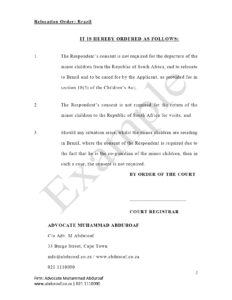
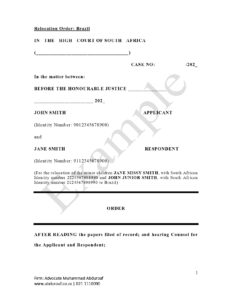
Suppose the other parent also has parental responsibilities and rights over the minor child, and he or she does not want to consent to the relocation of the minor child to Brazil, then in such a case, the Court needs to be approached. Here I refer you back to section 18(5) of the Children’s Act referred to above where it states: (5) Unless a competent court orders otherwise, the Consent of all the persons that have guardianship of a child is necessary in respect of matters set out in subsection (3)(c). Therefore, after your Court Application has been launched an both sides have been heard, the Court would make the necessary Order. If you are successful in your application for the relocation of your minor children to Brazil, then the Court will make an Order similar to that which is shown below. [caption id="attachment_10798" align="alignnone" width="694"]Relocation consent for minor child to Brazil - Advocate Muhammad Abduroaf Relocation consent for minor child to Brazil – Advocate Muhammad Abduroaf[/caption] [caption id="attachment_10799" align="alignnone" width="690"]Relocation consent for minor child to Brazil - Advocate Muhammad Abduroaf Relocation consent for minor child to Brazil – Advocate Muhammad Abduroaf[/caption]  

Do you require a video legal advice consultation?

Click here and schedule one today!