
The role of antenuptial contracts in South Africa – What do you need to know before getting married? When people are in love, they often want to spend the rest of their lives together. And one way of doing so is to get married. Usually, after they got married, they Continue Reading
Uncategorized
Best Divorce Lawyer Advice – Focus on your case – not the emotions involved
Once upon a time, an individual and their spouse were deeply engaged in a profound romantic relationship, characterized by love and mutual respect. This connection led to the pivotal decision to enter into marriage and embark on a shared life journey. Following their union, they may have welcomed children into their family and created a multitude of cherished memories—celebrations, milestones, and everyday moments that strengthened their bond. However, over time, a significant turning point emerged, one that fundamentally altered the trajectory of their relationship. Disagreements began to surface, leading to a gradual emotional detachment between the partners. Despite their best efforts to restore the affection they once felt for each other, these attempts proved unsuccessful, ultimately culminating in the contemplation of divorce.Best Strategies for Navigating Divorce for Optimal Outcomes
It is not uncommon to witness clients struggling with the emotional ramifications of divorce as they seek assistance in addressing various legal matters. When clients approach us, they often face challenges that extend beyond emotional distress, including the complexities associated with child custody, division of assets, and personal maintenance. Some clients may operate under the misconception that criticizing their partner or airing grievances will enhance their chances of obtaining a more favorable outcome. However, it is crucial to understand that while these emotions are valid and significant, they do not directly impact the objective issues at hand concerning children, property, and financial support.Best Legal Strategy to employ in Divorces
As legal professionals, our primary goal is to assist clients in navigating their emotional challenges effectively, allowing us to redirect our focus toward the substantive issues that require resolution. This pivotal transition is essential; it serves as a breakthrough moment that enables both the client and their attorney to approach the case with clarity and a constructive mindset. While we remain empathetic to our clients’ emotional experiences, it becomes evident that managing these emotions better facilitates a more effective and favorable resolution to their legal matters.Focusing on Relevant Legal Issues
Once we have successfully guided clients beyond the emotional turmoil associated with divorce, a concerted focus can be established on the critical legal issues that need to be addressed. The primary objectives during this phase encompass securing an equitable settlement or achieving a favorable judgment through trial proceedings. It is imperative to recognize that triumph in these legal matters rests on the foundation of factual evidence rather than emotional arguments, leading to improved outcomes for the client. For instance, when determining child support, if the monthly cost of raising a child is established at R 10,000, the court adheres to this figure, irrespective of any negative behavior exhibited by the other parent—such as infidelity or other actions that may have contributed to the marital breakdown. These considerations, while emotionally charged, do not influence the financial outcome in a legal context.Best way to proceed with your divorce case
Therefore, it is essential for parents involved in divorce proceedings to present comprehensive and accurate evidence that substantiates the actual costs associated with the care of their children. This encompasses not only basic necessities but also additional financial obligations that may arise. Furthermore, it is crucial to clearly outline the financial responsibilities that both parents should assume in relation to these costs. This process emphasizes the necessity of grounding discussions in factual data, thereby highlighting that the legal proceedings should focus on practical issues rather than the emotional narratives surrounding the separation. Such an approach can significantly enhance the likelihood of a favorable resolution that meets the needs of all parties involved. If you wish to consult with us, complete the form below:
Best Divorce Lawyer Advice – Focus on your case – not the emotions involved Once upon a time, an individual and their spouse were deeply engaged in a profound romantic relationship, characterized by love and mutual respect. This connection led to the pivotal decision to enter into marriage and embark Continue Reading
The rights of parents to have contact with their children during the holiday season
It is that time of the year where schools are closed and most parents can take off work. This is either due to being allowed to take some leave days or the business itself is closed during that period. Whatever the reason, parents wants to spend time with their children during the holidays. And rightfully so. If parents are children live in the same home, there would not be much of a problem regarding contact. Or no problem at all. Parents and children would see each other every moring and before going to sleep. The challenge arise when parents and children do not live in the same home.Parenal Responsibilities and Rights of parents
Alot has been written on the top of parental responsiblities and rights on this website. Extensive reference is made to relevant sections of the Children’s Act. However, to simply things, parental responsiblities and rights refers to the parental responsiblities and rights a parent has to look after a child. That can be in the form of food, shelter, clothing, education, visitation and so on. Basically, to form part of the child’s life in a meaningful way. Parental responsiblities and rights refers to responsiblities and rights. They go hand in hand. You cannot say you have a right to have contact with your child, but not interested in execising your responsibility of feeding and clothing the child. The law does not work that way.What should parents do if they are not allowed contact during the holidays?
Firstly, it is the right of the child to have contact with both parents during their school holidays. It not not neccessary the right of the parents as the law focuses of what is best for the child. Seconldy, it is the duly and responsiblity of both parents to ensure that they make it possible for both parents to have contact with the minor child. This is so, despite the issues and differences the parents might have.What do you do if contact is frutrated?
If they cannot come to an agreement, then it is stronly recommened that they have the issue mediated as soon as possible. There are many people that can assist in mediaton. That can be someone you both trust and respect or a professional personal trained in family mediation. With regard to someone you trust and respect, it could be your religious leader, family elder or a trusted friend. Regarding professionals, that can be a social worker, lawyer, pyschologist or someone with mediation training. It is best to make use of some who has family law experience. However, it is not always neccessary depending on the issues at hand.What do I do if mediation is now possible or unsuccessful?
Mediation will not always be successful. Howewer, depite it now always being successful, many benefits comes from a mediation session. For one, the parents would be one step closer in understanding what the issues are, at least from the other side. That can be invaluable as it often happens, couples usually speak or argue past each other when they are alone. In a mediation setting, whether formal or informal, the are forced to listen to each other. However, if the mediation session is unsuccessful or not possible, then the the law comes into play. Before going to court, you may want to consider seeing an attorney or advocate if you can afford it. They may consider the option of sending the other parent letter and try to resolve the matter out of court. Often it works and it is something you may wish to consider. However, if it is something you cannot afford, or it does not yield any noteworthy results, then approaching the court is your next option. This we deal with next.When to approach the Court when it comes to care and contact disputes?
It does not benefit the child nor you to execise contact or care which is not adequate. In other words, if you should have more contact to your child, you should fight for it. The same applies to a parent who is abusing his or her parental responsibilities and rights. If you feel that they are doing so, the situation must changes which is in the child’s best interest. This could mean affording him or her last contact and care. Therefore, if speaking to the other party, mediation, or lawyer’s letter does not work, then taking it to a court of law is the only viable option. The Court is the upper guardian of all minor children. Therefore, it overrides the rights of both parents. It can therefore limit, take it away or increase or assign parental rigths. Ultimatley, the Court would decide what is best for the minor child involved.Can I urgently have contact to my child during the holiday season?
If you are denied adequate contact rights to your minor child, you have the right to urgenly approach the court to relief. The High Court would need to be approach for urgenly relief. The Children’s Court may be able to assist, but not as fast as the High Court would. However, the High Court can be expensive if you are making use of attorney and advocates. Therefore, to avoid approaching the High Court and have your matter heard in the Children’s Court, do not wait until the last minuite to enforce your rights. Especially when it comes to end of year holdiday contact.
The rights of parents to have contact with their children during the holiday season It is that time of the year where schools are closed and most parents can take off work. This is either due to being allowed to take some leave days or the business itself is closed Continue Reading
[caption id="attachment_10839" align="alignnone" width="667"]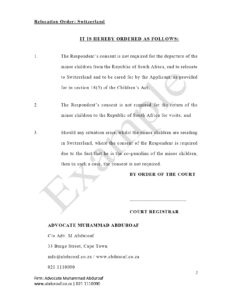 Relocation consent Court Order for minor child to Switzerland – Advocate Muhammad Abduroaf[/caption]
I want to relocate from South Africa to Switzerland with my minor child. The other parent does not want my child to relocate to Switzerland. What can I do?
Switzerland is a popular destination to emigrate to. People emigrate from South Africa for many reasons. It ranges from better employment opportunities, family relations, or for a better standard of living. Whatever the reason a parent wants to relocate to Switzerland, if a minor child will be joining that parent and also relocating to Switzerland, then the parent remaining in South Africa’s consent would usually be required. Let us unpack the legal issues a parent may encounter when wanting to emigrate to Switzerland. Before we do so, let us list the various cities and towns in Switzerland to which you may want to relocate: Zürich, Geneva, Basel, Lausanne, Bern, Winterthur, Lucerne, Sankt Gallen, Lugano, Biel/Bienne, Thun, Bellinzona, Köniz, La Chaux-de-Fonds, Fribourg, Schaffhausen, Vernier, Chur, Sion, Uster, Neuchâtel, Landecy, Zug, Yverdon-les-Bains, Emmen, Dübendorf, Kriens, Rapperswil-Jona, Dietikon, Montreux, Wetzikon, Baar, Meyrin, Wil, Bulle, Horgen, Carouge, Frauenfeld, Kreuzlingen, Wädenswil, Riehen, Aarau, Allschwil, Renens, Wettingen, Nyon, Bülach, Vevey, Opfikon, Kloten, Reinach, Baden, Onex, Adliswil, Schlieren, Volketswil, Pully, Regensdorf, Gossau, Muttenz, Thalwil, Monthey, Ostermundigen, Littau, Grenchen, Olten, Sierre, Solothurn, Pratteln, Burgdorf, Freienbach, Wohlen, Locarno, Wallisellen, Morges, Steffisburg, Herisau, Langenthal, Binningen, Einsiedeln, Lyss, Mendrisio, Arbon, Liestal, Stäfa, Küsnacht, Horw, Schwyz, Thônex, Meilen, Oftringen, Amriswil, Versoix, Richterswil, Rheinfelden, Brig-Glis, Gland, Küssnacht, Muri, Zollikon, Ecublens, Spiez, Delémont, Buchs, Prilly, Chêne-Bougeries, Le Grand-Saconnex, Rüti, Münchenstein, Villars-sur-Glâne, Affoltern am Albis, Arth, La Tour-de-Peilz, Pfäffikon, Spreitenbach, Altstätten, Zofingen, Veyrier, Bassersdorf, Weinfelden, Belp, Worb, Hinwil, Romanshorn, Oberwil, Brugg, Möhlin, Männedorf, Davos, Plan-les-Ouates, Waltikon, Lenzburg, Flawil, Neuhausen am Rheinfall, Le Locle, Suhr, Sarnen, Aesch, Birsfelden, Lutry, Bernex, Maur, Aigle, Naters, Steinhaus, Therwil, Payerne, Gossau, Sursee, Hochdorf, Urdorf, Wald, Estavayer-le-Lac, Wittenbach, Widnau, Epalinges, Rorschach, Embrach, Altdorf, Langnau, Goldach, Schübelbach, Arlesheim, Niederhasli, Rothrist, Aadorf, Ingenbohl, Oberriet, Zuchwil, Unterägeri, Landquart, Neuenhof, Hünenberg, Fully, Lachen, Wattwil, Bussy, Conthey, Mels, Egg, Hombrechtikon, Fällanden, Biberist, Obersiggenthal, Le Mont-sur-Lausanne, Reinach, Kilchberg, Stans, Oberentfelden, Murten, Bagnes, Aarburg, Domat/Ems, Chiasso, Buchs, Düdingen, Crissier, Rümlang, Visp, Muri, Au, Willisau, Bex, Sirnach, Bremgarten, Gränichen, Chavannes-près-Renens, Savièse, Dietlikon, Windisch, Rothenburg, Dürnten, Langnau am Albis, Ollon, Hirslen, Moutier, Villmergen, Minusio, Seuzach, Rorschacherberg, Wollerau, Untersiggenthal, Meggen, Herzogenbuchsee, Bubikon, Reiden, Altendorf, Grabs, Orbe, Châtel-Saint-Denis, Oberglatt, Frutigen, Ruswil, Schwarzenburg, Heimberg, Saanen, Nidau, Dornach, Losone, Bottmingen, Sissach, Porrentruy, Beromünster, Thal, Oberengstringen, Trimbach, Wiesendangen, Derendingen, Würenlos, Diepoldsau, Frenkendorf, Uznach, Oberuzwil, Birmensdorf, Fehraltorf, Vétroz, Kerns, Menziken, Buchs, Herrliberg, Oensingen, Teufen, Bolligen, Rolle, Massagno, Gelterkinden, Küttigen, Blonay, Boudry, Uetikon am See, Moudon, Balsthal, Buchrain, Biasca, Obererli, Alpnach, Bischofszell, Glarus, Kirchberg, Dielsdorf, Zell, Saxon, Uetendorf, Sankt Margrethen, Rüschlikon, Peseux, Hergiswil, Villeneuve, Unterseen, Jegenstorf, Echallens, Neftenbach, Saint-Prex, Walenstadt, Appenzell, Zermatt, Mellingen, Lindau, Interlaken, Sennwald, Nürensdorf, Kaiseraugst, Cologny, Erlenbach, Frick, Laufen, Colombier, Fislisbach, Bonstetten, Ascona, Dagmersellen, Rupperswil, Thayngen, Courtepin, Schattdorf, Gebenstorf, Adligenswil, Münchwilen, Greifensee, Obfelden, Buochs, Vechigen, Seon, Préverenges, Konolfingen Dorf, Romont, Feusisberg, Lengnau, Bellach, Lausen, Gerlafingen, Hitzkirch, Glattfelden, Saint Légier-La Chiésaz, Eglisau, Gommiswald, Ettingen, Sachseln, Hägendorf, Zumikon, Fraubrunnen, Sevelen, Schwerzenbach, Oberrieden, Wangen bei Olten, Wangen, Dulliken, Sumiswald, Root, Ebnat-Kappel, Bäretswil, Chavornay, Saint Moritz, Bauma, Geroldswil, Niederglatt, Schönenwerd, Bettlach, Elgg, Strengelbach, Mettmenstetten, Sainte-Croix, Flums, Kaltbrunn, Huttwil, Sigriswil, Ehrendingen, Ennetbürgen, Balgach, Zuzwil, Niederlenz, Berikon, Weiningen, Oetwil am See, Turbenthal, Cortaillod, Wängi, Niederbipp, Egnach, Oberkirch, Würenlingen, Gordola, Troistorrents, Saint-Sulpice, Triengen, Le Landeron, Beringen, Tägerwilen, Aarberg, Confignon, Meiringen, Stabio, Scuol, Le Chenit, Stansstad, Morbio Inferiore, Saint-Maurice, Tramelan, Menzingen, Monte Ceneri, Bronschhofen, Aarwangen, Winkel, Füllinsdorf, Zufikon, Kölliken, Rafz, Oberbüren, Agno, Klosters Platz, Schötz, Schöftland, Bubendorf, Brügg, Rebstein, Speicher, Eschlikon, Weggis, Gachnang, Caslano, Russikon, Birr, Cheseaux-sur-Lausanne, Wolhusen, Utzenstorf, Kehrsatz, Wichtrach, Avenches, Sins, Bad Zurzach, Uitikon, Schüpfheim, Lucens, Lens, Vouvry, Satigny, Engelberg, Sempach, Gross Höchstetten, Heiden, Unterentfelden, Lützelflüh, Paradiso, Degersheim, Niederrohrdorf, Matten, Dällikon, Roggwil, Oberrohrdorf, Ayent, Döttingen, Hilterfingen, Prangins, Leysin, Hunzenschwil, Diessenhofen, Seengen, Bürglen, Berneck, Brittnau, Böttstein, Lostorf, Leuk, Magden, Chamoson, Dottikon, Muhen, Sulgen, Niedergösgen, Nottwil, Breitenbach, Pfungen, Safenwil, Bürglen, Vallorbe, Schänis, Unterengstringen, Grindelwald, Bevaix, Langendorf, Founex, Jonschwil, Steckborn, Reichenburg, Erlen, La Neuveville, Hedingen, Schüpfen, Belmont-sur-Lausanne, Mönchaltorf, Schmerikon, Widen, Port, Stallikon, Egerkingen, Beckenried, Walchwil, Elsau, Giswil, Rüti, Hausen am Albis, Feuerthalen, Hausen, Tavannes, Laufenburg, Reichenbach im Kandertal, Hittnau, Stein, Plaffeien, Eschenbach, Mörschwil, Büren an der Aare, Ins, Erlinsbach, Merenschwand, Chalais, Attalens, Poschiavo, Waldkirch, Ennetbaden, Klingnau, Luterbach, Gams, Steinmaur, Château-d’Oex, Ermatingen, Selzach, Münsterlingen, Grimisuat, Zizers, Yvonand, Rheineck, Steinen, Berg, Bösingen, Vacallo, Thunstetten, Corsier-sur-Vevey, Stein am Rhein, Adelboden, Rickenbach, Grüningen, Grandson, Savigny, Staufen, Bonaduz, Entlebuch, Courroux, Romanel-sur-Lausanne, Tuggen, Trimmis, Weisslingen, Bellevue, Buttisholz, Penthalaz, Belfaux, Madiswil, Beinwil am See, Balerna, Rüegsbach, Bätterkinden, Aubonne, Grosswangen, Kappel, Thusis, Ardon, Saint-Blaise, Leytron, Subingen, Stein, Ursy, Arosa, Orsières, Kirchlindach, Hofstetten, Le Mouret, Coppet, Niederhelfenschwil, Hettlingen, Neerach, Laupen, Oberdorf, Seedorf, Stettlen, Lupfig, Brienz, Torricella, Unterkulm, Gais, Roggwil, Echichens, Benken, Niederweningen, Zweisimmen, Grossaffoltern, Turgi, Schafisheim, Courrendlin, Birmenstorf, Müllheim, Mühleberg, Murgenthal, Meisterschwanden, Chardonne, Geuensee, Coldrerio, Schenkon, Quarten, Wattenwil, Oberburg, Waltenschwil, Cadenazzo, Samedan, Matzingen, Faido, Sarmenstorf, Etoy, Märstetten, Othmarsingen, Mosnang, Menznau, Puidoux, Commugny, Täuffelen, Däniken, Rorbas, Boswil, Flims, Otelfingen, Niederwil, Bergdietikon, Ennenda, Orpund, Fischingen, Ballwil, Gretzenbach, Genthod, Riaz, Rickenbach bei Wil, Rain, Horn, Ettiswil, Lengnau, Cugy, Lauterbrunnen, Vionnaz, Höri, Oberkulm, Corminboeuf, Muralto, Montanaire, Schiers, Pfaffnau, Evilard, Kaisten, Signau, Rickenbach, Wilderswil, Mont-sur-Rolle, Broc, Riva San Vitale, Lenzerheide, Nebikon, Bioggio, Hauterive, Felsberg, Saillon, Rapperswil, Lauperswil, Courtételle, Saignelégier, La Sarraz, Lonay, Maggia, Buchegg, Froideville, Saint-Cergue, Endingen, Neyruz, Lotzwil, Ringgenberg, Zunzgen, Inwil, Ottenbach, Riggisberg, Affeltrangen, Kemmen, Büron, Wimmis, Bönigen, Hölstein, Sant’ Antonino, Roveredo, Wilen, Untervaz, Toffen, Fischenthal, Troinex, Vandœuvres, Corcelles-près-Payerne, Hohenrain, Puplinge, Oetwil an der Limmat, Meikirch, Wigoltingen, Saint-Léonard, Eggiwil, Oberdorf, Thierachern, Hägglingen, Grône, Rothenthurm, Vuadens, Anières, Zwingen, Saint-Aubin-Sauges, Rüthi, Unteriberg, Rüderswil, Novazzano, Malans, Wiedlisbach, Freienstein, Ueberstorf, Lufingen, Krauchthal, Pfeffingen, Hildisrieden, Gersau, Courgenay, Vuisternens-devant-Romont, Reconvilier, Urnäsch, Martigny-Combe, Wangen an der Aare, Riedholz, Zeiningen, Knonau, Bardonnex, Büsserach, Oberbuchsiten, Eiken, Neunkirch, Worben, Corseaux, Udligenswil, Wolfwil, Stadel bei Niederglatt, Henggart, Neuheim, Schinznach Dorf, Canobbio, Diemtigen, Wauwil, Sankt Niklaus, Chexbres, Gimel, Siviriez, Neuendorf, Knutwil, Dintikon, Bottighofen, Cazis, Hallau, Ormalingen, Savosa, Altnau, Deitingen, Obergösgen, Stetten, Andelfingen, Gruyères, Ennetmoos, Gontenschwil, Leuggern, Pontresina, Castel San Pietro, Aegerten, Itingen, Auw, Seftigen, Fahrwangen, Meinier, Villigen, Werthenstein, Lungern, Mägenwil, Corsier, Jonen, Marbach, Wolfenschiessen, Koppigen, Mies, Forel, Kleinandelfingen, Sankt Antoni, Grüsch, Killwangen, Ersigen, Wynigen, Oberlunkhofen, Zell, Comano, Alterswil, Gorgier, Vollèges, Brütten, Pfyn, Andwil, Recherswil, Remetschwil, Silenen, Aeugst am Albis, Flüeln, Walzenhausen, Wila, Barbengo, Val-d’Illiez, Flühli, Vordemwald, Begnins, Marthalen, Churwalden, Servion, Raron, Sattel, Genolier, Tolochenaz, Dachsen, Hochfelden, Avry-sur-Matran, Grolley, Winznau, Kallnach, Oberegg, Vezia, Marsens, Ponte Capriasca, Malleray, Cressier, Vernayaz, Nunningen, Lichtensteig, Dänikon, Waldstatt, Dardagny, Röschenz, Seedorf, Uttwil, Laax, Charrat, Alle, Le Noirmont, Grellingen, Dallenwil, Kirchdorf, Schönenberg, Arni, Wolfhalden, Veyras, Pont-en-Ogoz, Laupersdorf, Biglen, Vex, Acquarossa, Kestenholz, Melide, Saint-Aubin, Bühler, Oberweningen, Niederdorf, Rüeggisberg, Massongex, Amden, Fulenbach, Sorengo, Brissago, Römerswil, Oberbipp, Walkringen, Avully, Cugy, Weiach, Penthaz, Künten, Rehetobel, Erlenbach im Simmental, Eschenz, Hasle, Lamone, Wilchingen, Trogen, Lengwil, Hüttwilen, Attinghausen, Weesen, Oberdorf, Starrkirch, La Roche, Schwarzenberg, Corgémont, Wagenhausen, Bellmund, Chancy, Fontenais, Evolène, Schleitheim, Teufenthal, Niederönz, Langwiesen, Rüschegg, Koblenz, Diegten, Gunzgen, Brislach, Roche, Härkingen, Arisdorf, Giffers, Villnachern, Cudrefin, Wynau, Eich, Magliaso, Chippis, Sisseln, Denges, Eysins, Saas-Fee, Zäziwil, Arch, Güttingen, Hirschthal, Bière, Ziefen, Berg, Reigoldswil, Luzein, Auenstein, Heimiswil, Porza, Altishofen, Lütisburg, Tannay, Schwellbrunn, Biberstein, Ossingen, Wohlenschwil, Pfäfers, Cornaux, Bellikon, Seeberg, Auvernier, Bedano, Dinhard, Salgesch, Herznach, Homburg, Duggingen, Perroy, Lommiswil, Jongny, Oberrüti, Cadempino, Wikon, Airolo, Zernez, Les Breuleux, Rue, Buchholterberg, Eichberg, Matran, Melchnau, Niederbüren, Lumino, Tägerig, Cottens, Guggisberg, Bossonnens, Paudex, Attiswil, Aristau, Rhäzüns, Rohrbach, Messen, L’Abbaye, Les Montets, Löhningen, Treyvaux, Ramsen, Apples, Mumpf, Veltheim, Wahlen, Schneisingen, Rüttenen, Tübach, Meierskappel, Mauensee, Origlio. (https://simplemaps.com/data/ch-cities) Why do I require the other parent’s Consent to relocate to Switzerland?
According to South African law, if you are a co-holder of parental responsibilities and rights over your minor child, you must consent to your child leaving South Africa. In this case, relocating to Switzerland. Here we refer to section 18 of the Children’s Act 38 of 2005. The entire provision is as follows: 18 Parental responsibilities and rights (1) A person may have either full or specific parental responsibilities and rights in respect of a child. (2) The parental responsibilities and rights that a person may have in respect of a child, include the responsibility and the right- (a) to care for the child; (b) to maintain contact with the child; (c) to act as guardian of the child; and (d) to contribute to the maintenance of the child. (3) Subject to subsections (4) and (5), a parent or other person who acts as guardian of a child must- (a) administer and safeguard the child’s property and property interests; (b) assist or represent the child in administrative, contractual and other legal matters; or (c) give or refuse any consent required by law in respect of the child, including- (i) consent to the child’s marriage; (ii) consent to the child’s adoption; (iii) consent to the child’s departure or removal from the Republic; (iv) consent to the child’s application for a passport; and (v) consent to the alienation or encumbrance of any immovable property of the child. (4) Whenever more than one person has guardianship of a child, each one of them is competent, subject to subsection (5), any other law or any order of a competent court to the contrary, to exercise independently and without the Consent of the other any right or responsibility arising from such guardianship. (5) Unless a competent court orders otherwise, the Consent of all the persons that have guardianship of a child is necessary in respect of matters set out in subsection (3)(c). Now let us explain what Parental Responsibilities and Rights are.What are Parental Responsibilities and Rights of a parent in relation to a child?
As can be seen from section 18(2) of the Children’s Act, when we refer to Parental Responsibilities and Rights, we refer to the following: (a) to care for the child; (b) to maintain contact with the child; (c) to act as guardian of the child; and (d) to contribute to the maintenance of the child. Therefore, if a parent has parental responsibilities and rights over a minor child, and accordingly, rights of guardianship, their Consent is required when it comes to issues of guardianship. As seen from section 18(3)(c) of the Children’s Act above, both parents’ Consent is required should a minor child depart from the Republic of South Africa. In this case, to emigrate to Switzerland. Even if the minor child only wants to go for a short holiday to Switzerland, both guardians’ Consent would be required.When would the other parent be seen as a guardian in the case of a relocation matter to Switzerland?
It must be noted that not all parents are legal guardians over their minor children. We should therefore distinguish between married or divorced parents and parents who were never married. As you would see below, usually married, or divorced parents’ Consent would be required for a minor child to relocate or emigrate to Switzerland. However, that does not automatically apply to parents who were never married. This could be because the child could have been born from a brief encounter and never met his or her father. It would not make sense that a parent who never met his or her 15-year-old child, should give Consent for relocation to Switzerland.Mother’s Consent for relocation of the minor child to Switzerland
Section 19 of the Children’s Act deals with the Parental responsibilities and rights of mothers. It states the following: 19 Parental responsibilities and rights of mothers (1) The biological mother of a child, whether married or unmarried, has full parental responsibilities and rights in respect of the child. (2) If- (a) the biological mother of a child is an unmarried child who does not have guardianship in respect of the child; and (b) the biological father of the child does not have guardianship in respect of the child, the guardian of the child’s biological mother is also the guardian of the child. (3) This section does not apply in respect of a child who is the subject of a surrogacy agreement. As seen from section 19(1) of the Children’s Act, in most cases involving the relocation of a minor child to Switzerland, the mother’s Consent is required as she has full parental responsibilities and rights over the minor child.Married father’s Consent for the relocation of the minor child to Switzerland
Section 20 of the Children’s Act deals with Parental responsibilities and rights of married fathers. It states the following: 20 Parental responsibilities and rights of married fathers The biological father of a child has full parental responsibilities and rights in respect of the child- (a) if he is married to the child’s mother; or (b) if he was married to the child’s mother at (i) the time of the child’s conception; (ii) the time of the child’s birth; or (iii) any time between the child’s conception and birth. As can be seen from sections 20 (a) and (b) of the Children’s Act, if the father and the mother were married, or are married, then his Consent is required for the minor child to relocate to Switzerland. Of course, an exception to this would be should a court of law order otherwise. This would be the case should the parents be divorced and the divorce court ordered that only the mother may act as guardian. Next, we deal with the issue of an unmarried father’s Consent to relocate a minor child to Switzerland.Consent of unmarried fathers for the relocation of their minor children to Switzerland.
Section 21 of the Children’s Act deals with parental responsibilities and rights of unmarried fathers. The section states the following: 21 Parental responsibilities and rights of unmarried fathers (1) The biological father of a child who does not have parental responsibilities and rights in respect of the child in terms of section 20, acquires full parental responsibilities and rights in respect of the child- (a) if at the time of the child’s birth he is living with the mother in a permanent life-partnership; or (b) if he, regardless of whether he has lived or is living with the mother- (i) consents to be identified or successfully applies in terms of section 26 to be identified as the child’s father or pays damages in terms of customary law; (ii) contributes or has attempted in good faith to contribute to the child’s upbringing for a reasonable period; and (iii) contributes or has attempted in good faith to contribute towards expenses in connection with the maintenance of the child for a reasonable period. (2) This section does not affect the duty of a father to contribute towards the maintenance of the child. (3) (a) If there is a dispute between the biological father referred to in subsection (1) and the biological mother of a child with regard to the fulfilment by that father of the conditions set out in subsection (1) (a) or (b), the matter must be referred for mediation to a family advocate, social worker, social service professional or other suitably qualified person. (b) Any party to the mediation may have the outcome of the mediation reviewed by a court. (4) This section applies regardless of whether the child was born before or after the commencement of this Act. As can be seen from the latter sections, a father of a child born out of wedlock does not automatically have parental responsibilities and rights over his minor child. He may however acquire those parental responsibilities and rights over his minor child if he is materially involved in the child’s life. That would be where the father and the mother were in a permanent life partnership when the child was born or he is meaningfully involved in the child’s life, as outlined above. We shall not go into much detail regarding that. However, in most cases, if the father had regular contact with the child and paid child support, he would have acquired parental responsibilities and rights over the minor child.What do you do if the other parent does not want to consent to the minor child relocating to Switzerland?
Suppose the other parent also has parental responsibilities and rights over the minor child, and he or she does not want to consent to the relocation of the minor child to Switzerland, then in such a case, the Court needs to be approached. Here I refer you back to section 18(5) of the Children’s Act referred to above where it states: (5) Unless a competent court orders otherwise, the Consent of all the persons that have guardianship of a child is necessary in respect of matters set out in subsection (3)(c). Therefore, after your Court Application has been launched an both sides have been heard, the Court would make the necessary Order. If you are successful in your application for the relocation of your minor children to Switzerland, then the Court will make an Order similar to that which is shown below. 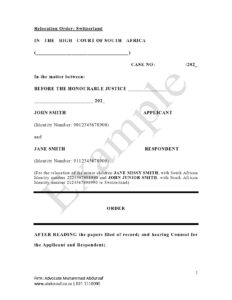 [caption id="attachment_10839" align="alignnone" width="676"] Relocation consent Court Order for minor child to Switzerland – Advocate Muhammad Abduroaf[/caption]
I want to relocate from South Africa to Switzerland with my minor child. The other parent does not want my child to relocate to Switzerland. What can I do? Switzerland is a popular destination to emigrate to. People emigrate from South Africa for many reasons. It ranges from better employment Continue Reading
[caption id="attachment_10833" align="alignnone" width="674"] Relocation consent Court Order for minor child to Norway – Advocate Muhammad Abduroaf[/caption]
 I want to relocate from South Africa to Norway with my minor child. The other parent does not want my child to relocate to Norway. What can I do?
Norway is a popular destination to emigrate to. People emigrate from South Africa for many reasons. It ranges from better employment opportunities, family relations, or for a better standard of living. Whatever the reason a parent wants to relocate to Norway, if a minor child will be joining that parent and also relocating to Norway, then the parent remaining in South Africa’s consent would usually be required. Let us unpack the legal issues a parent may encounter when wanting to emigrate to Norway. Before we do so, let us list the various cities and towns in Norway to which you may want to relocate: Ålesund, Arendal, Bærum, Bergen, Fana, Bodø, Drammen, Fredrikstad, Halden, Hamar, Hammerfest, Haugesund, Kabelvåg, Kristiansand, Kristiansund, Lillehammer, Molde, Moss, Narvik, Oslo, Porsgrunn, Ringsaker, Sandefjord, Sandnes, Skien, Stavanger, Steinkjer, Svolvær, Tønsberg, Tromsø, Trondheim, Vadsø. (https://www.britannica.com/topic/list-of-cities-and-towns-in-Norway-2050561) Why do I require the other parent’s Consent to relocate to Norway?
According to South African law, if you are a co-holder of parental responsibilities and rights over your minor child, you must consent to your child leaving South Africa. In this case, relocating to Norway. Here we refer to section 18 of the Children’s Act 38 of 2005. The entire provision is as follows: 18 Parental responsibilities and rights (1) A person may have either full or specific parental responsibilities and rights in respect of a child. (2) The parental responsibilities and rights that a person may have in respect of a child, include the responsibility and the right- (a) to care for the child; (b) to maintain contact with the child; (c) to act as guardian of the child; and (d) to contribute to the maintenance of the child. (3) Subject to subsections (4) and (5), a parent or other person who acts as guardian of a child must- (a) administer and safeguard the child’s property and property interests; (b) assist or represent the child in administrative, contractual and other legal matters; or (c) give or refuse any consent required by law in respect of the child, including- (i) consent to the child’s marriage; (ii) consent to the child’s adoption; (iii) consent to the child’s departure or removal from the Republic; (iv) consent to the child’s application for a passport; and (v) consent to the alienation or encumbrance of any immovable property of the child. (4) Whenever more than one person has guardianship of a child, each one of them is competent, subject to subsection (5), any other law or any order of a competent court to the contrary, to exercise independently and without the Consent of the other any right or responsibility arising from such guardianship. (5) Unless a competent court orders otherwise, the Consent of all the persons that have guardianship of a child is necessary in respect of matters set out in subsection (3)(c). Now let us explain what Parental Responsibilities and Rights are.What are Parental Responsibilities and Rights of a parent in relation to a child?
As can be seen from section 18(2) of the Children’s Act, when we refer to Parental Responsibilities and Rights, we refer to the following: (a) to care for the child; (b) to maintain contact with the child; (c) to act as guardian of the child; and (d) to contribute to the maintenance of the child. Therefore, if a parent has parental responsibilities and rights over a minor child, and accordingly, rights of guardianship, their Consent is required when it comes to issues of guardianship. As seen from section 18(3)(c) of the Children’s Act above, both parents’ Consent is required should a minor child depart from the Republic of South Africa. In this case, to emigrate to Norway. Even if the minor child only wants to go for a short holiday to Norway, both guardians’ Consent would be required.When would the other parent be seen as a guardian in the case of a relocation matter to Norway?
It must be noted that not all parents are legal guardians over their minor children. We should therefore distinguish between married or divorced parents and parents who were never married. As you would see below, usually married, or divorced parents’ Consent would be required for a minor child to relocate or emigrate to Norway. However, that does not automatically apply to parents who were never married. This could be because the child could have been born from a brief encounter and never met his or her father. It would not make sense that a parent who never met his or her 15-year-old child, should give Consent for relocation to Norway.Mother’s Consent for relocation of the minor child to Norway
Section 19 of the Children’s Act deals with the Parental responsibilities and rights of mothers. It states the following: 19 Parental responsibilities and rights of mothers (1) The biological mother of a child, whether married or unmarried, has full parental responsibilities and rights in respect of the child. (2) If- (a) the biological mother of a child is an unmarried child who does not have guardianship in respect of the child; and (b) the biological father of the child does not have guardianship in respect of the child, the guardian of the child’s biological mother is also the guardian of the child. (3) This section does not apply in respect of a child who is the subject of a surrogacy agreement. As seen from section 19(1) of the Children’s Act, in most cases involving the relocation of a minor child to Norway, the mother’s Consent is required as she has full parental responsibilities and rights over the minor child.Married father’s Consent for the relocation of the minor child to Norway
Section 20 of the Children’s Act deals with Parental responsibilities and rights of married fathers. It states the following: 20 Parental responsibilities and rights of married fathers The biological father of a child has full parental responsibilities and rights in respect of the child- (a) if he is married to the child’s mother; or (b) if he was married to the child’s mother at (i) the time of the child’s conception; (ii) the time of the child’s birth; or (iii) any time between the child’s conception and birth. As can be seen from sections 20 (a) and (b) of the Children’s Act, if the father and the mother were married, or are married, then his Consent is required for the minor child to relocate to Norway. Of course, an exception to this would be should a court of law order otherwise. This would be the case should the parents be divorced and the divorce court ordered that only the mother may act as guardian. Next, we deal with the issue of an unmarried father’s Consent to relocate a minor child to Norway.Consent of unmarried fathers for the relocation of their minor children to Norway.
Section 21 of the Children’s Act deals with parental responsibilities and rights of unmarried fathers. The section states the following: 21 Parental responsibilities and rights of unmarried fathers (1) The biological father of a child who does not have parental responsibilities and rights in respect of the child in terms of section 20, acquires full parental responsibilities and rights in respect of the child- (a) if at the time of the child’s birth he is living with the mother in a permanent life-partnership; or (b) if he, regardless of whether he has lived or is living with the mother- (i) consents to be identified or successfully applies in terms of section 26 to be identified as the child’s father or pays damages in terms of customary law; (ii) contributes or has attempted in good faith to contribute to the child’s upbringing for a reasonable period; and (iii) contributes or has attempted in good faith to contribute towards expenses in connection with the maintenance of the child for a reasonable period. (2) This section does not affect the duty of a father to contribute towards the maintenance of the child. (3) (a) If there is a dispute between the biological father referred to in subsection (1) and the biological mother of a child with regard to the fulfilment by that father of the conditions set out in subsection (1) (a) or (b), the matter must be referred for mediation to a family advocate, social worker, social service professional or other suitably qualified person. (b) Any party to the mediation may have the outcome of the mediation reviewed by a court. (4) This section applies regardless of whether the child was born before or after the commencement of this Act. As can be seen from the latter sections, a father of a child born out of wedlock does not automatically have parental responsibilities and rights over his minor child. He may however acquire those parental responsibilities and rights over his minor child if he is materially involved in the child’s life. That would be where the father and the mother were in a permanent life partnership when the child was born or he is meaningfully involved in the child’s life, as outlined above. We shall not go into much detail regarding that. However, in most cases, if the father had regular contact with the child and paid child support, he would have acquired parental responsibilities and rights over the minor child.What do you do if the other parent does not want to consent to the minor child relocating to Norway?
Suppose the other parent also has parental responsibilities and rights over the minor child, and he or she does not want to consent to the relocation of the minor child to Norway, then in such a case, the Court needs to be approached. Here I refer you back to section 18(5) of the Children’s Act referred to above where it states: (5) Unless a competent court orders otherwise, the Consent of all the persons that have guardianship of a child is necessary in respect of matters set out in subsection (3)(c). Therefore, after your Court Application has been launched an both sides have been heard, the Court would make the necessary Order. If you are successful in your application for the relocation of your minor children to Norway, then the Court will make an Order similar to that which is shown below. [caption id="attachment_10832" align="alignnone" width="638"] Relocation consent Court Order for minor child to Norway – Advocate Muhammad Abduroaf[/caption] [caption id="attachment_10833" align="alignnone" width="643"] Relocation consent Court Order for minor child to Norway – Advocate Muhammad Abduroaf[/caption]
I want to relocate from South Africa to Norway with my minor child. The other parent does not want my child to relocate to Norway. What can I do? Norway is a popular destination to emigrate to. People emigrate from South Africa for many reasons. It ranges from better Continue Reading
Top tips and tricks from a Senior Family Law Advocate on claiming maintenance for a five-year-old child in Constantia.
Child Maintenance is the right of the child, and not that of the parent. It is also not a privilege granted to parents who must pay it. It is their duty to pay child maintenance and support their children. Once the child is self-supporting (being able to care for him or herself), the obligation falls away. This can happen when the child is 18, 20, or even 30. It all depends on the circumstances of the case.Claiming child maintenance for your child in Constantia
Whether you claim child maintenance in Constantia, or any other city in South Africa, the procedures would be the same. There are however two (2) courts that can deal with child maintenance matters. That is a divorce court, in a divorce matter, and a Child Maintenance Court. For this article, we will focus on claiming maintenance in a Maintenance Court matter in Constantia.The maintenance scenario – Constantia South Africa
In this article, we will deal with the following fictitious scenario, in a child maintenance matter:- The Child is seven years old and attends school in Constantia
- The child is cared for by the mother who works in Constantia
- The mother works and earns a Salary of R 10 000
- The father sees the child every second weekend. He also lives and works in Constantia
- The child’s monthly expenses are R 6000 – 00 which includes food, clothing, accommodation, education, travel etc.
- The father earns a reasonable salary and can afford the R 20 000 – 00 per month
- The mother claims R 4 000 – 00 maintenance as the father earns double her salary
What is the first step the mother must take in claiming child maintenance?
The first thing the mother must do is work out exactly what the child costs by item. She breaks down the minor child’s living expenses, starting from rent or accommodation to groceries to school fees etc. Once she has done that, she would need to determine what exactly does the minor child cost per month, seeing that she will be asking the father to contribute towards that. As best as possible, she needs to collect proof of expenses. This can be in the form of receipts.How does she start the legal process?
The mother now needs to approach the maintenance court in the area where she lives or works to lodge a complaint for child maintenance. If she lives or works in Constantia, it would be the maintenance court in Constantia. She will complete a Form A wherein she will provide all the expenses for her and the minor child. She would also have to stipulate her income. Once she completed the form and submitted it to the maintenance court, she must then follow the next step.What do you do while waiting for the maintenance court date?
While you wait to be informed of the court date by the Maintenance Court of Constantia, and up until the actual first court date, you need to ensure that you keep a record of all income and expenses for you and the child. This is very important as the court allocates maintenance based on recent income and expenses.What happens at the first court appearance at the Constantia Maintenance Court?
Once you have been notified of the maintenance court date by the Constantia Maintenance Court, you need to ensure that you attend it. On that day, both you and the father of the child would appear before a maintenance officer. The maintenance officer would go through both your income and expenses as well as that of the father. If all the relevant information is not before the maintenance court, then the matter may be postponed in order for the parties to submit it. The maintenance officer will try to settle the matter and have the parents come to an agreement regarding the amount of child maintenance to be paid. If they cannot come to an agreement regarding the child maintenance to be paid, the matter would have to proceed to a formal hearing or trial before a Magistrate.How does the Maintenance Court hearing or trial work in Constantia?
Essentially, the maintenance court is called upon to make a fair ruling regarding what is a fair amount of child support that needs to be paid. For that to happen, the parents would have to give evidence in that regard. The mother would present to the court what the child costs, what she contributes and what she requires the other parent to pay. The Father would have a right to question the mother and to present evidence as to why he cannot afford the amount requested or why he feels it is an unfair amount. The mother can they also question him. At the end of the day, the Constantia Maintenance Court would be able to properly determine what is a fair and adequate amount of child maintenance to pay after being presented will all relevant information. The Constantia Maintenance Court should play an active role in determining what is a fair amount of child maintenance the father should pay. The above child maintenance application principles should apply to the following provinces and cities:Eastern Cape:
Alice, Butterworth, East London, Graaff-Reinet, Grahamstown, King William’s Town, Mthatha Port Elizabeth, Queenstown, Uitenhage, ZwelitshaFree State:
Bethlehem. Bloemfontein, Jagersfontein, Kroonstad, Odendaalsrus, Parys, Phuthaditjhaba, Sasolburg, Virginia, WelkomGauteng:
Benoni, Boksburg, Brakpan, Carletonville, Germiston, Johannesburg, Krugersdorp, Pretoria, Randburg, Randfontein, Roodepoort, Soweto, Springs, Vanderbijlpark, VereenigingKwaZulu-Natal:
Durban, Empangeni, Ladysmith, Newcastle, Pietermaritzburg, Pinetown, Ulundi, UmlaziLimpopo:
Giyani, Lebowakgomo, Musina, Phalaborwa, Polokwane, Seshego, Sibasa, ThabazimbiMpumalanga:
Emalahleni, Nelspruit, Secunda, North West, Klerksdorp, Mahikeng, Mmabatho, Potchefstroom, Rustenburg, Northern Cape, Kimberley, Kuruman, Port NollothWestern Cape:
Bellville, Constantia, Constantia, George, Hopefield, Oudtshoorn, Paarl, Simon’s Town, Stellenbosch, Swellendam, Worcester
Top tips and tricks from a Senior Family Law Advocate on claiming maintenance for a five-year-old child in Constantia. Child Maintenance is the right of the child, and not that of the parent. It is also not a privilege granted to parents who must pay it. It is their duty Continue Reading
Top tips and tricks from a Senior Family Law Advocate on claiming maintenance for a five-year-old child in North West.
Child Maintenance is the right of the child, and not that of the parent. It is also not a privilege granted to parents who must pay it. It is their duty to pay child maintenance and support their children. Once the child is self-supporting (being able to care for him or herself), the obligation falls away. This can happen when the child is 18, 20, or even 30. It all depends on the circumstances of the case.
Claiming child maintenance for your child in North West
Whether you claim child maintenance in North West, or any other city in South Africa, the procedures would be the same. There are however two (2) courts that can deal with child maintenance matters. That is a divorce court, in a divorce matter, and a Child Maintenance Court. For this article, we will focus on claiming maintenance in a Maintenance Court matter in North West.
The maintenance scenario – North West South Africa
In this article, we will deal with the following fictitious scenario, in a child maintenance matter:
- The Child is seven years old and attends school in North West
- The child is cared for by the mother who works in North West
- The mother works and earns a Salary of R 10 000
- The father sees the child every second weekend. He also lives and works in North West
- The child’s monthly expenses are R 6000 – 00 which includes food, clothing, accommodation, education, travel etc.
- The father earns a reasonable salary and can afford the R 20 000 – 00 per month
- The mother claims R 4 000 – 00 maintenance as the father earns double her salary
What is the first step the mother must take in claiming child maintenance?
The first thing the mother must do is work out exactly what the child costs by item. She breaks down the minor child’s living expenses, starting from rent or accommodation to groceries to school fees etc. Once she has done that, she would need to determine what exactly does the minor child cost per month, seeing that she will be asking the father to contribute towards that. As best as possible, she needs to collect proof of expenses. This can be in the form of receipts.
How does she start the legal process?
The mother now needs to approach the maintenance court in the area where she lives or works to lodge a complaint for child maintenance. If she lives or works in North West, it would be the maintenance court in North West. She will complete a Form A wherein she will provide all the expenses for her and the minor child. She would also have to stipulate her income. Once she completed the form and submitted it to the maintenance court, she must then follow the next step.
What do you do while waiting for the maintenance court date?
While you wait to be informed of the court date by the Maintenance Court of North West, and up until the actual first court date, you need to ensure that you keep a record of all income and expenses for you and the child. This is very important as the court allocates maintenance based on recent income and expenses.
What happens at the first court appearance at the North West Maintenance Court?
Once you have been notified of the maintenance court date by the North West Maintenance Court, you need to ensure that you attend it. On that day, both you and the father of the child would appear before a maintenance officer. The maintenance officer would go through both your income and expenses as well as that of the father. If all the relevant information is not before the maintenance court, then the matter may be postponed in order for the parties to submit it.
The maintenance officer will try to settle the matter and have the parents come to an agreement regarding the amount of child maintenance to be paid. If they cannot come to an agreement regarding the child maintenance to be paid, the matter would have to proceed to a formal hearing or trial before a Magistrate.
How does the Maintenance Court hearing or trial work in North West?
Essentially, the maintenance court is called upon to make a fair ruling regarding what is a fair amount of child support that needs to be paid. For that to happen, the parents would have to give evidence in that regard. The mother would present to the court what the child costs, what she contributes and what she requires the other parent to pay. The Father would have a right to question the mother and to present evidence as to why he cannot afford the amount requested or why he feels it is an unfair amount. The mother can they also question him.
At the end of the day, the North West Maintenance Court would be able to properly determine what is a fair and adequate amount of child maintenance to pay after being presented will all relevant information. The North West Maintenance Court should play an active role in determining what is a fair amount of child maintenance the father should pay.
The above child maintenance application principles should apply to the following provinces and cities:
Eastern Cape:
Alice, Butterworth, East London, Graaff-Reinet, Grahamstown, King William’s Town, Mthatha
Port Elizabeth, Queenstown, Uitenhage, Zwelitsha
Free State:
Bethlehem. Bloemfontein, Jagersfontein, Kroonstad, Odendaalsrus, Parys, Phuthaditjhaba, Sasolburg, Virginia, Welkom
Gauteng:
Benoni, Boksburg, Brakpan, Carletonville, Germiston, Johannesburg, Krugersdorp, Pretoria, Randburg, Randfontein, Roodepoort, Soweto, Springs, Vanderbijlpark, Vereeniging
KwaZulu-Natal:
Durban, Empangeni, Ladysmith, Newcastle, Pietermaritzburg, Pinetown, Ulundi, Umlazi
Limpopo:
Giyani, Lebowakgomo, Musina, Phalaborwa, Polokwane, Seshego, Sibasa, Thabazimbi
Mpumalanga:
Emalahleni, Nelspruit, Secunda, North West, Klerksdorp, Mahikeng, Mmabatho, Potchefstroom, Rustenburg, Northern Cape, Kimberley, Kuruman, Port Nolloth
Western Cape:
Bellville, North West, Constantia, George, Hopefield, Oudtshoorn, Paarl, Simon’s Town, Stellenbosch, Swellendam, Worcester
Top tips and tricks from a Senior Family Law Advocate on claiming maintenance for a five-year-old child in North West. Child Maintenance is the right of the child, and not that of the parent. It is also not a privilege granted to parents who must pay it. It is their Continue Reading
Top tips and tricks from a Senior Family Law Advocate on claiming maintenance for a five-year-old child in Newcastle.
Child Maintenance is the right of the child, and not that of the parent. It is also not a privilege granted to parents who must pay it. It is their duty to pay child maintenance and support their children. Once the child is self-supporting (being able to care for him or herself), the obligation falls away. This can happen when the child is 18, 20, or even 30. It all depends on the circumstances of the case.
Claiming child maintenance for your child in Newcastle
Whether you claim child maintenance in Newcastle, or any other city in South Africa, the procedures would be the same. There are however two (2) courts that can deal with child maintenance matters. That is a divorce court, in a divorce matter, and a Child Maintenance Court. For this article, we will focus on claiming maintenance in a Maintenance Court matter in Newcastle.
The maintenance scenario – Newcastle South Africa
In this article, we will deal with the following fictitious scenario, in a child maintenance matter:
- The Child is seven years old and attends school in Newcastle
- The child is cared for by the mother who works in Newcastle
- The mother works and earns a Salary of R 10 000
- The father sees the child every second weekend. He also lives and works in Newcastle
- The child’s monthly expenses are R 6000 – 00 which includes food, clothing, accommodation, education, travel etc.
- The father earns a reasonable salary and can afford the R 20 000 – 00 per month
- The mother claims R 4 000 – 00 maintenance as the father earns double her salary
What is the first step the mother must take in claiming child maintenance?
The first thing the mother must do is work out exactly what the child costs by item. She breaks down the minor child’s living expenses, starting from rent or accommodation to groceries to school fees etc. Once she has done that, she would need to determine what exactly does the minor child cost per month, seeing that she will be asking the father to contribute towards that. As best as possible, she needs to collect proof of expenses. This can be in the form of receipts.
How does she start the legal process?
The mother now needs to approach the maintenance court in the area where she lives or works to lodge a complaint for child maintenance. If she lives or works in Newcastle, it would be the maintenance court in Newcastle. She will complete a Form A wherein she will provide all the expenses for her and the minor child. She would also have to stipulate her income. Once she completed the form and submitted it to the maintenance court, she must then follow the next step.
What do you do while waiting for the maintenance court date?
While you wait to be informed of the court date by the Maintenance Court of Newcastle, and up until the actual first court date, you need to ensure that you keep a record of all income and expenses for you and the child. This is very important as the court allocates maintenance based on recent income and expenses.
What happens at the first court appearance at the Newcastle Maintenance Court?
Once you have been notified of the maintenance court date by the Newcastle Maintenance Court, you need to ensure that you attend it. On that day, both you and the father of the child would appear before a maintenance officer. The maintenance officer would go through both your income and expenses as well as that of the father. If all the relevant information is not before the maintenance court, then the matter may be postponed in order for the parties to submit it.
The maintenance officer will try to settle the matter and have the parents come to an agreement regarding the amount of child maintenance to be paid. If they cannot come to an agreement regarding the child maintenance to be paid, the matter would have to proceed to a formal hearing or trial before a Magistrate.
How does the Maintenance Court hearing or trial work in Newcastle?
Essentially, the maintenance court is called upon to make a fair ruling regarding what is a fair amount of child support that needs to be paid. For that to happen, the parents would have to give evidence in that regard. The mother would present to the court what the child costs, what she contributes and what she requires the other parent to pay. The Father would have a right to question the mother and to present evidence as to why he cannot afford the amount requested or why he feels it is an unfair amount. The mother can they also question him.
At the end of the day, the Newcastle Maintenance Court would be able to properly determine what is a fair and adequate amount of child maintenance to pay after being presented will all relevant information. The Newcastle Maintenance Court should play an active role in determining what is a fair amount of child maintenance the father should pay.
The above child maintenance application principles should apply to the following provinces and cities:
Eastern Cape:
Alice, Butterworth, East London, Graaff-Reinet, Grahamstown, King William’s Town, Mthatha
Port Elizabeth, Queenstown, Uitenhage, Zwelitsha
Free State:
Bethlehem. Bloemfontein, Jagersfontein, Kroonstad, Odendaalsrus, Parys, Phuthaditjhaba, Sasolburg, Virginia, Welkom
Gauteng:
Benoni, Boksburg, Brakpan, Carletonville, Germiston, Johannesburg, Krugersdorp, Pretoria, Randburg, Randfontein, Roodepoort, Soweto, Springs, Vanderbijlpark, Vereeniging
KwaZulu-Natal:
Durban, Empangeni, Ladysmith, Newcastle, Pietermaritzburg, Pinetown, Ulundi, Umlazi
Limpopo:
Giyani, Lebowakgomo, Musina, Phalaborwa, Polokwane, Seshego, Sibasa, Thabazimbi
Mpumalanga:
Emalahleni, Nelspruit, Secunda, North West, Klerksdorp, Mahikeng, Mmabatho, Potchefstroom, Rustenburg, Northern Cape, Kimberley, Kuruman, Port Nolloth
Western Cape:
Bellville, Newcastle, Constantia, George, Hopefield, Oudtshoorn, Paarl, Simon’s Town, Stellenbosch, Swellendam, Worcester
Top tips and tricks from a Senior Family Law Advocate on claiming maintenance for a five-year-old child in Newcastle. Child Maintenance is the right of the child, and not that of the parent. It is also not a privilege granted to parents who must pay it. It is their duty Continue Reading
Top tips from a Senior Family Law Advocate on how to deal with your Child Custody matter in the Klerksdorp Children’s Court
Family law legal matters can be very stressful. This is so whether you live in Klerksdorp or any other city in South Africa. Especially so if you have no idea how the legal processes work. It is one thing to know that you are entitled to child support, but it is a totally different matter to know the law and procedure on how to claim child support. Luckily in child maintenance matters, the maintenance court is there to assist you in completing the application form. However, many times that is not enough. Especially so if the other parent has a lawyer and knows how to present the case for his or her client.
This article, however, deals with some top tips in care and contact or custody matters in the Children’s Court in Klerksdorp. It would explain the processes involved and advise on how to be best prepared for your matter. This advice is applicable whether you live in Klerksdorp or any other city in South Africa.
What to do before visiting the Klerksdorp Children’s Court
Before you approach the Children’s Court in Klerksdorp, first try to resolve the issues with the other parent. Therefore, if you want more contact with your child and the other parent is refusing, try to resolve the matter first with that parent. If that does not work, try mediation. The mediator can be anyone, from a trusted mutual friend, priest, or other religious leaders, or a professional like an attorney, psychologist, or the office of the Family Advocate. Klerksdorp has many professionals that can assist you in this regard. If resolving the matter by yourselves is not possible, or mediation fails, then we suggest you approach the Klerksdorp Children’s Court for assistance.
TIP: Focus on getting someone neutral to assist in mediating your matter. Organisations like FAMSA and FAMAC can be of assistance. Google them.
Approaching the Klerksdorp Children’s Court
The Klerksdorp Children’s Court should be approached if it is the closest Children’s Court to you. You need to verify with the Klerksdorp Children’s Court that you fall under their area of jurisdiction. If not, they would direct you to which Children’s Court is applicable to you.
Once you arrive at the Klerksdorp Children’s Court, they will provide you with a form headed “Bringing Matter to Court in Terms of Section 53 Children’s Act, 2005 (Act no. 38 of 2005) Regulation Relating to Children’s Court and International Child Abduction, 2008 [Regulation 6]. This form is also called Form 2.
In this form, you will provide all your particulars and that of the child or children and the other parent. The sections in the form are as follows:
- PART A: PARTICULARS OF CHILD(REN)
- PART B: PARTICULARS OF *CHILD WHO IS AFFECTED BY OR INVOLVED IN THE MATTER/PERSON *ACTING IN THE INTEREST OF THE CHILD/*ON BEHALF OF THE CHILD WHO CANNOT ACT IN HIS/HER OWN NAME/ *MEMBER OF A GROUP OF CLASS OF CHILDREN/*IN THE PUBLIC INTEREST (SECTION 53(2)
- PART C: PARTICULARS OF PERSONS HAVING AN INTEREST IN THE MATTER
- PART D: PARTICULARS OF MATTER
In part D, the following is stated which you need to provide in the form:
- Nature of matter brought to Court: (Please give full details of the matter e.g., registration/amendment of parenting plans, removal of child to safe care, children in need of care and protection, placement in youth care centers, adoption etc.
- Documents: Are there any documents relating to the matter? (If so please attach)
Once you have completed the form and attached the relevant documents to it, you must take it to a commissioner of Oaths to have it commissioned. It does not have to be in Klerksdorp.
TIP: Draft a separate affidavit explaining your case. Outline some background information and reasons why the Court should give you what you request. Attach it to Form 2.
Processing your Application at the Klerksdorp Children’s Court
Once you complete the Form A and submit it to the Clerk of the Klerksdorp Children’s Court, they will process it and allocate it a case number or reference number. The Clerk of the Court would then allocate a date to the matter and advise the parties accordingly when the court date is. Please note that some courts follow a different process for processing the application and informing the parties of the court date. Please enquire from the Court when making the application what process they follow.
TIP: Obtain the contact details of the Court for you to contact them to obtain the Court date or other information. Ask for their contact number and email address.
Appearing in the Klerksdorp Children’s Court
When notified of the Court date, both you and the other parent should attend. If you are making use of a lawyer (Advocate or Attorney), inform them timeously of the date. Depending on the Court, you may first see the Clerk or go directly to the Magistrate. The Children’s Court would do its best to try to resolve the matter. If the parents cannot come to an agreement, the Children’s Court may postpone the matter for either of the following:
- Get a social worker involved in the matter;
- Appoint a legal representative for the minor child;
- Implement interim care and contact arrangements;
- Having the parties attempt to agree on a parenting plan;
-
In serious matters, the Court may remove the minor child from both parents and place the child in foster care. The powers of the Children’s Court are extensive. It will, however, focus on what is in the child’s best interests.
TIP: Be as vocal as possible. Do not expect the Court to be understanding of your case or be on your side. It is your duty to explain your case and provide the Court with all the relevant information they require for them to make a fair decision.
Finalising the matter in the Klerksdorp Children’s Court
Once the Klerksdorp Children’s Court has enough information to make a final decision, it will do so. Depending on the facts of the matter, that could either be making a Parenting Plan, an Order of the Court or a final care and contact Order. The Court may even make further interim orders, where the parties are to return to Court after a few months, or a year later.
TIP: Do not agree to something just because the social worker, a lawyer, or the Court suggest it. You need to be happy with what is decided.
The above Klerksdorp Children’s Court Application tips should apply to the following provinces and cities:
Eastern Cape:
Alice, Butterworth, East London, Graaff-Reinet, Grahamstown, King William’s Town, Mthatha
Port Elizabeth, Queenstown, Uitenhage, Zwelitsha
Free State:
Bethlehem. Bloemfontein, Jagersfontein, Kroonstad, Odendaalsrus, Parys, Phuthaditjhaba, Sasolburg, Virginia, Welkom
Gauteng:
Benoni, Boksburg, Brakpan, Carletonville, Germiston, Johannesburg, Krugersdorp, Pretoria, Randburg, Randfontein, Roodepoort, Soweto, Springs, Vanderbijlpark, Vereeniging
KwaZulu-Natal:
Durban, Empangeni, Ladysmith, Newcastle, Pietermaritzburg, Pinetown, Ulundi, Umlazi
Limpopo:
Giyani, Lebowakgomo, Musina, Phalaborwa, Polokwane, Seshego, Sibasa, Thabazimbi
Mpumalanga:
Emalahleni, Nelspruit, Secunda, North West, Klerksdorp, Mahikeng, Mmabatho, Potchefstroom, Rustenburg, Northern Cape, Kimberley, Kuruman, Port Nolloth
Western Cape:
Bellville, Klerksdorp, Constantia, George, Hopefield, Oudtshoorn, Paarl, Simon’s Town, Stellenbosch, Swellendam, Worcester
Top tips from a Senior Family Law Advocate on how to deal with your Child Custody matter in the Klerksdorp Children’s Court Family law legal matters can be very stressful. This is so whether you live in Klerksdorp or any other city in South Africa. Especially so if you Continue Reading
Top tips from a Senior Family Law Advocate on how to deal with your Child Custody matter in the Vereeniging Children’s Court
Family law legal matters can be very stressful. This is so whether you live in Vereeniging or any other city in South Africa. Especially so if you have no idea how the legal processes work. It is one thing to know that you are entitled to child support, but it is a totally different matter to know the law and procedure on how to claim child support. Luckily in child maintenance matters, the maintenance court is there to assist you in completing the application form. However, many times that is not enough. Especially so if the other parent has a lawyer and knows how to present the case for his or her client.
This article, however, deals with some top tips in care and contact or custody matters in the Children’s Court in Vereeniging. It would explain the processes involved and advise on how to be best prepared for your matter. This advice is applicable whether you live in Vereeniging or any other city in South Africa.
What to do before visiting the Vereeniging Children’s Court
Before you approach the Children’s Court in Vereeniging, first try to resolve the issues with the other parent. Therefore, if you want more contact with your child and the other parent is refusing, try to resolve the matter first with that parent. If that does not work, try mediation. The mediator can be anyone, from a trusted mutual friend, priest, or other religious leaders, or a professional like an attorney, psychologist, or the office of the Family Advocate. Vereeniging has many professionals that can assist you in this regard. If resolving the matter by yourselves is not possible, or mediation fails, then we suggest you approach the Vereeniging Children’s Court for assistance.
TIP: Focus on getting someone neutral to assist in mediating your matter. Organisations like FAMSA and FAMAC can be of assistance. Google them.
Approaching the Vereeniging Children’s Court
The Vereeniging Children’s Court should be approached if it is the closest Children’s Court to you. You need to verify with the Vereeniging Children’s Court that you fall under their area of jurisdiction. If not, they would direct you to which Children’s Court is applicable to you.
Once you arrive at the Vereeniging Children’s Court, they will provide you with a form headed “Bringing Matter to Court in Terms of Section 53 Children’s Act, 2005 (Act no. 38 of 2005) Regulation Relating to Children’s Court and International Child Abduction, 2008 [Regulation 6]. This form is also called Form 2.
In this form, you will provide all your particulars and that of the child or children and the other parent. The sections in the form are as follows:
- PART A: PARTICULARS OF CHILD(REN)
- PART B: PARTICULARS OF *CHILD WHO IS AFFECTED BY OR INVOLVED IN THE MATTER/PERSON *ACTING IN THE INTEREST OF THE CHILD/*ON BEHALF OF THE CHILD WHO CANNOT ACT IN HIS/HER OWN NAME/ *MEMBER OF A GROUP OF CLASS OF CHILDREN/*IN THE PUBLIC INTEREST (SECTION 53(2)
- PART C: PARTICULARS OF PERSONS HAVING AN INTEREST IN THE MATTER
- PART D: PARTICULARS OF MATTER
In part D, the following is stated which you need to provide in the form:
- Nature of matter brought to Court: (Please give full details of the matter e.g., registration/amendment of parenting plans, removal of child to safe care, children in need of care and protection, placement in youth care centers, adoption etc.
- Documents: Are there any documents relating to the matter? (If so please attach)
Once you have completed the form and attached the relevant documents to it, you must take it to a commissioner of Oaths to have it commissioned. It does not have to be in Vereeniging.
TIP: Draft a separate affidavit explaining your case. Outline some background information and reasons why the Court should give you what you request. Attach it to Form 2.
Processing your Application at the Vereeniging Children’s Court
Once you complete the Form A and submit it to the Clerk of the Vereeniging Children’s Court, they will process it and allocate it a case number or reference number. The Clerk of the Court would then allocate a date to the matter and advise the parties accordingly when the court date is. Please note that some courts follow a different process for processing the application and informing the parties of the court date. Please enquire from the Court when making the application what process they follow.
TIP: Obtain the contact details of the Court for you to contact them to obtain the Court date or other information. Ask for their contact number and email address.
Appearing in the Vereeniging Children’s Court
When notified of the Court date, both you and the other parent should attend. If you are making use of a lawyer (Advocate or Attorney), inform them timeously of the date. Depending on the Court, you may first see the Clerk or go directly to the Magistrate. The Children’s Court would do its best to try to resolve the matter. If the parents cannot come to an agreement, the Children’s Court may postpone the matter for either of the following:
- Get a social worker involved in the matter;
- Appoint a legal representative for the minor child;
- Implement interim care and contact arrangements;
- Having the parties attempt to agree on a parenting plan;
-
In serious matters, the Court may remove the minor child from both parents and place the child in foster care. The powers of the Children’s Court are extensive. It will, however, focus on what is in the child’s best interests.
TIP: Be as vocal as possible. Do not expect the Court to be understanding of your case or be on your side. It is your duty to explain your case and provide the Court with all the relevant information they require for them to make a fair decision.
Finalising the matter in the Vereeniging Children’s Court
Once the Vereeniging Children’s Court has enough information to make a final decision, it will do so. Depending on the facts of the matter, that could either be making a Parenting Plan, an Order of the Court or a final care and contact Order. The Court may even make further interim orders, where the parties are to return to Court after a few months, or a year later.
TIP: Do not agree to something just because the social worker, a lawyer, or the Court suggest it. You need to be happy with what is decided.
The above Vereeniging Children’s Court Application tips should apply to the following provinces and cities:
Eastern Cape:
Alice, Butterworth, East London, Graaff-Reinet, Grahamstown, King William’s Town, Mthatha
Port Elizabeth, Queenstown, Uitenhage, Zwelitsha
Free State:
Bethlehem. Bloemfontein, Jagersfontein, Kroonstad, Odendaalsrus, Parys, Phuthaditjhaba, Sasolburg, Virginia, Welkom
Gauteng:
Benoni, Boksburg, Brakpan, Carletonville, Germiston, Johannesburg, Krugersdorp, Pretoria, Randburg, Randfontein, Roodepoort, Soweto, Springs, Vanderbijlpark, Vereeniging
KwaZulu-Natal:
Durban, Empangeni, Ladysmith, Newcastle, Pietermaritzburg, Pinetown, Ulundi, Umlazi
Limpopo:
Giyani, Lebowakgomo, Musina, Phalaborwa, Polokwane, Seshego, Sibasa, Thabazimbi
Mpumalanga:
Emalahleni, Nelspruit, Secunda, North West, Klerksdorp, Mahikeng, Mmabatho, Potchefstroom, Rustenburg, Northern Cape, Kimberley, Kuruman, Port Nolloth
Western Cape:
Bellville, Vereeniging, Constantia, George, Hopefield, Oudtshoorn, Paarl, Simon’s Town, Stellenbosch, Swellendam, Worcester
Top tips from a Senior Family Law Advocate on how to deal with your Child Custody matter in the Vereeniging Children’s Court Family law legal matters can be very stressful. This is so whether you live in Vereeniging or any other city in South Africa. Especially so if you Continue Reading