[caption id="attachment_10837" align="alignnone" width="654"]Relocation consent Court Order for minor child to Spain - Advocate Muhammad Abduroaf Relocation consent Court Order for minor child to Spain – Advocate Muhammad Abduroaf[/caption]

I want to relocate from South Africa to Spain with my minor child. The other parent does not want my child to relocate to Spain. What can I do?

Spain is a popular destination to emigrate to. People emigrate from South Africa for many reasons. It ranges from better employment opportunities, family relations, or for a better standard of living. Whatever the reason a parent wants to relocate to Spain, if a minor child will be joining that parent and also relocating to Spain, then the parent remaining in South Africa’s consent would usually be required. Let us unpack the legal issues a parent may encounter when wanting to emigrate to Spain. Before we do so, let us list the various cities and towns in Spain to which you may want to relocate: Andalusia, Almería, Almería, Cádiz, Algeciras, Arcos de la Frontera, Cádiz, Chiclana de la Frontera, El Puerto de Santa María, Jerez de la Frontera, La Línea, Puerto Real, San Fernando, Sanlúcar de Barrameda, Córdoba, Bujalance, Cabra, Córdoba, Lucena, Montilla, Peñarroya-Pueblonuevo, Priego de Córdoba, Puente-Genil, Granada, Andújar, Baza, Granada, Guadix, Motril, Huelva, Huelva, Jaén, Jaén, Linares, Martos, Úbeda, Málaga, Antequera, Coín, Málaga, Melilla, Ronda, Sevilla, Alcalá de Guadaira, Carmona, Dos Hermanas, Ecija, Lebrija, Lora del Río, Marchena, Morón de la Frontera, Osuna, Sevilla, Utrera, Aragon, Huesca, Huesca, Jaca, Teruel, Teruel, Zaragoza, Zaragoza, Asturias, Avilés, Cabañaquinta, Cangas de Narcea, Covadonga, Gijón, Luarca, Mieres, Oviedo, Pola de Siero, San Martín del Rey Aurelio, Tineo, Villaviciosa, Balearic Islands, Palma, Maó, Basque Country, Álava, Vitoria-Gasteiz, Guipúzcoa, Donostia–San Sebastián, Eibar, Irun, Vizcaya, Barakaldo, Bilbao, Getxo, Guernica, Portugalete, Santurtzi, Sestao, Canary Islands, Las Palmas, Arucas, Las Palmas, Telde, Santa Cruz de Tenerife, La Orotava, Santa Cruz de Tenerife, Cantabria, Santander, Torrelavega, Castile–La Mancha, Albacete, Albacete, Hellín, Villarrobledo, Ciudad Real, Alcázar de San Juan, Almadén, Ciudad Real, Puertollano, Tomelloso, Valdepeñas, Cuenca, Cuenca, Guadalajara, Guadalajara, Toledo, Talavera de la Reina, Toledo, Castile–León, Ávila, Ávila, Burgos, Burgos, Miranda de Ebro, León, Astorga, León, Ponferrada, Palencia, Palencia, Salamanca, Ciudad Rodrigo, Salamanca, Segovia, San Ildefonso, Segovia, Soria, Soria, Valladolid, Simancas, Valladolid, Zamora, Toro, Zamora, Catalonia, Barcelona, Badalona, Barcelona, Cornellà, Granollers, L’Hospitalet de Llobregat, Manresa, Mataró, Reus, Sabadell, Santa Coloma de Gramenet, Terrassa, Vic, Vilanova i la Geltrú, Girona, Girona, Llívia, Lleida, Lleida, Tarragona, Tarragona, Tortosa, Ceuta (autonomous city), Extremadura, Badajoz, Almendralejo, Badajoz, Don Benito, Mérida, Villanueva de la Serena, Cáceres, Alcántara, Cáceres, Guadalupe, Plasencia, Trujillo, Galicia, A Coruña, A Coruña, Carballo, Ferrol, Ortigueira, Ribeira, Santiago de Compostela, Lugo, Lugo, Mondoñedo, Monforte de Lemos, Vilalba, Ourense, Ourense, Vigo, Vilagarcía de Arousa, Pontevedra, Pontevedra, Madrid, Alcalá de Henares, Aranjuez, El Escorial, Getafe, Madrid, Melilla, Murcia, Caravaca, Cartagena, Cieza, Jumilla, Lorca, Murcia, Yecla, Navarra, Funes, Pamplona, Roncesvalles, La Rioja, Calahorra, Logroño, Valencia, Alicante, Alcoy, Alicante, Elche, Elda, Orihuela, Villena, Castellón, Castellón de la Plana, Villarreal, Valencia, Alzira, Gandía, Requena, Sagunto, Sueca, Torrent, Valencia. (https://www.britannica.com/topic/list-of-cities-and-towns-in-Spain-2041711)  

Why do I require the other parent’s Consent to relocate to Spain?

According to South African law, if you are a co-holder of parental responsibilities and rights over your minor child, you must consent to your child leaving South Africa. In this case, relocating to Spain. Here we refer to section 18 of the Children’s Act 38 of 2005. The entire provision is as follows: 18 Parental responsibilities and rights  (1) A person may have either full or specific parental responsibilities and rights in respect of a child.  (2) The parental responsibilities and rights that a person may have in respect of a child, include the responsibility and the right-  (a) to care for the child;  (b) to maintain contact with the child;  (c) to act as guardian of the child; and  (d) to contribute to the maintenance of the child.  (3) Subject to subsections (4) and (5), a parent or other person who acts as guardian of a child must-  (a) administer and safeguard the child’s property and property interests;  (b) assist or represent the child in administrative, contractual and other legal matters; or  (c) give or refuse any consent required by law in respect of the child, including-  (i) consent to the child’s marriage;  (ii) consent to the child’s adoption;  (iii) consent to the child’s departure or removal from the Republic;  (iv) consent to the child’s application for a passport; and  (v) consent to the alienation or encumbrance of any immovable property of the child.  (4) Whenever more than one person has guardianship of a child, each one of them is competent, subject to subsection (5), any other law or any order of a competent court to the contrary, to exercise independently and without the Consent of the other any right or responsibility arising from such guardianship. (5) Unless a competent court orders otherwise, the Consent of all the persons that have guardianship of a child is necessary in respect of matters set out in subsection (3)(c). Now let us explain what Parental Responsibilities and Rights are.

What are Parental Responsibilities and Rights of a parent in relation to a child?

As can be seen from section 18(2) of the Children’s Act, when we refer to Parental Responsibilities and Rights, we refer to the following: (a) to care for the child;  (b) to maintain contact with the child;  (c) to act as guardian of the child; and  (d) to contribute to the maintenance of the child. Therefore, if a parent has parental responsibilities and rights over a minor child, and accordingly, rights of guardianship, their Consent is required when it comes to issues of guardianship. As seen from section 18(3)(c) of the Children’s Act above, both parents’ Consent is required should a minor child depart from the Republic of South Africa. In this case, to emigrate to Spain. Even if the minor child only wants to go for a short holiday to Spain, both guardians’ Consent would be required.

When would the other parent be seen as a guardian in the case of a relocation matter to Spain?

It must be noted that not all parents are legal guardians over their minor children. We should therefore distinguish between married or divorced parents and parents who were never married. As you would see below, usually married, or divorced parents’ Consent would be required for a minor child to relocate or emigrate to Spain. However, that does not automatically apply to parents who were never married. This could be because the child could have been born from a brief encounter and never met his or her father. It would not make sense that a parent who never met his or her 15-year-old child, should give Consent for relocation to Spain.

Mother’s Consent for relocation of the minor child to Spain

Section 19 of the Children’s Act deals with the Parental responsibilities and rights of mothers. It states the following: 19 Parental responsibilities and rights of mothers  (1) The biological mother of a child, whether married or unmarried, has full parental responsibilities and rights in respect of the child.  (2) If-  (a) the biological mother of a child is an unmarried child who does not have guardianship in respect of the child; and  (b) the biological father of the child does not have guardianship in respect of the child, the guardian of the child’s biological mother is also the guardian of the child.  (3) This section does not apply in respect of a child who is the subject of a surrogacy agreement. As seen from section 19(1) of the Children’s Act, in most cases involving the relocation of a minor child to Spain, the mother’s Consent is required as she has full parental responsibilities and rights over the minor child.

Married father’s Consent for the relocation of the minor child to Spain

Section 20 of the Children’s Act deals with Parental responsibilities and rights of married fathers. It states the following: 20 Parental responsibilities and rights of married fathers The biological father of a child has full parental responsibilities and rights in respect of the child- (a) if he is married to the child’s mother; or (b) if he was married to the child’s mother at (i) the time of the child’s conception; (ii) the time of the child’s birth; or (iii) any time between the child’s conception and birth. As can be seen from sections 20 (a) and (b) of the Children’s Act, if the father and the mother were married, or are married, then his Consent is required for the minor child to relocate to Spain. Of course, an exception to this would be should a court of law order otherwise. This would be the case should the parents be divorced and the divorce court ordered that only the mother may act as guardian. Next, we deal with the issue of an unmarried father’s Consent to relocate a minor child to Spain.

Consent of unmarried fathers for the relocation of their minor children to Spain.

Section 21 of the Children’s Act deals with parental responsibilities and rights of unmarried fathers. The section states the following: 21 Parental responsibilities and rights of unmarried fathers  (1) The biological father of a child who does not have parental responsibilities and rights in respect of the child in terms of section 20, acquires full parental responsibilities and rights in respect of the child-  (a) if at the time of the child’s birth he is living with the mother in a permanent life-partnership; or  (b) if he, regardless of whether he has lived or is living with the mother-  (i) consents to be identified or successfully applies in terms of section 26 to be identified as the child’s father or pays damages in terms of customary law;  (ii) contributes or has attempted in good faith to contribute to the child’s upbringing for a reasonable period; and  (iii) contributes or has attempted in good faith to contribute towards expenses in connection with the maintenance of the child for a reasonable period.  (2) This section does not affect the duty of a father to contribute towards the maintenance of the child.  (3) (a) If there is a dispute between the biological father referred to in subsection (1) and the biological mother of a child with regard to the fulfilment by that father of the conditions set out in subsection (1) (a) or (b), the matter must be referred for mediation to a family advocate, social worker, social service professional or other suitably qualified person.  (b) Any party to the mediation may have the outcome  of the mediation reviewed by a court.  (4) This section applies regardless of whether the child was born before or after the commencement of this Act. As can be seen from the latter sections, a father of a child born out of wedlock does not automatically have parental responsibilities and rights over his minor child. He may however acquire those parental responsibilities and rights over his minor child if he is materially involved in the child’s life. That would be where the father and the mother were in a permanent life partnership when the child was born or he is meaningfully involved in the child’s life, as outlined above. We shall not go into much detail regarding that. However, in most cases, if the father had regular contact with the child and paid child support, he would have acquired parental responsibilities and rights over the minor child.

What do you do if the other parent does not want to consent to the minor child relocating to Spain?

Suppose the other parent also has parental responsibilities and rights over the minor child, and he or she does not want to consent to the relocation of the minor child to Spain, then in such a case, the Court needs to be approached. Here I refer you back to section 18(5) of the Children’s Act referred to above where it states: (5) Unless a competent court orders otherwise, the Consent of all the persons that have guardianship of a child is necessary in respect of matters set out in subsection (3)(c). Therefore, after your Court Application has been launched an both sides have been heard, the Court would make the necessary Order. If you are successful in your application for the relocation of your minor children to Spain, then the Court will make an Order similar to that which is shown below. [caption id="attachment_10836" align="alignnone" width="667"]Relocation consent Court Order for minor child to Spain - Advocate Muhammad Abduroaf Relocation consent Court Order for minor child to Spain – Advocate Muhammad Abduroaf[/caption] [caption id="attachment_10837" align="alignnone" width="667"]Relocation consent Court Order for minor child to Spain - Advocate Muhammad Abduroaf Relocation consent Court Order for minor child to Spain – Advocate Muhammad Abduroaf[/caption]
Relocation consent Court Order for minor child to Spain - Advocate Muhammad Abduroaf
Relocation consent Court Order for minor child to Spain – Advocate Muhammad Abduroaf

I want to relocate from South Africa to Spain with my minor child. The other parent does not want my child to relocate to Spain. What can I do?

Spain is a popular destination to emigrate to. People emigrate from South Africa for many reasons. It ranges from better employment opportunities, family relations, or for a better standard of living. Whatever the reason a parent wants to relocate to Spain, if a minor child will be joining that parent and also relocating to Spain, then the parent remaining in South Africa’s consent would usually be required. Let us unpack the legal issues a parent may encounter when wanting to emigrate to Spain. Before we do so, let us list the various cities and towns in Spain to which you may want to relocate:

Andalusia, Almería, Almería, Cádiz, Algeciras, Arcos de la Frontera, Cádiz, Chiclana de la Frontera, El Puerto de Santa María, Jerez de la Frontera, La Línea, Puerto Real, San Fernando, Sanlúcar de Barrameda, Córdoba, Bujalance, Cabra, Córdoba, Lucena, Montilla, Peñarroya-Pueblonuevo, Priego de Córdoba, Puente-Genil, Granada, Andújar, Baza, Granada, Guadix, Motril, Huelva, Huelva, Jaén, Jaén, Linares, Martos, Úbeda, Málaga, Antequera, Coín, Málaga, Melilla, Ronda, Sevilla, Alcalá de Guadaira, Carmona, Dos Hermanas, Ecija, Lebrija, Lora del Río, Marchena, Morón de la Frontera, Osuna, Sevilla, Utrera, Aragon, Huesca, Huesca, Jaca, Teruel, Teruel, Zaragoza, Zaragoza, Asturias, Avilés, Cabañaquinta, Cangas de Narcea, Covadonga, Gijón, Luarca, Mieres, Oviedo, Pola de Siero, San Martín del Rey Aurelio, Tineo, Villaviciosa, Balearic Islands, Palma, Maó, Basque Country, Álava, Vitoria-Gasteiz, Guipúzcoa, Donostia–San Sebastián, Eibar, Irun, Vizcaya, Barakaldo, Bilbao, Getxo, Guernica, Portugalete, Santurtzi, Sestao, Canary Islands, Las Palmas, Arucas, Las Palmas, Telde, Santa Cruz de Tenerife, La Orotava, Santa Cruz de Tenerife, Cantabria, Santander, Torrelavega, Castile–La Mancha, Albacete, Albacete, Hellín, Villarrobledo, Ciudad Real, Alcázar de San Juan, Almadén, Ciudad Real, Puertollano, Tomelloso, Valdepeñas, Cuenca, Cuenca, Guadalajara, Guadalajara, Toledo, Talavera de la Reina, Toledo, Castile–León, Ávila, Ávila, Burgos, Burgos, Miranda de Ebro, León, Astorga, León, Ponferrada, Palencia, Palencia, Salamanca, Ciudad Rodrigo, Salamanca, Segovia, San Ildefonso, Segovia, Soria, Soria, Valladolid, Simancas, Valladolid, Zamora, Toro, Zamora, Catalonia, Barcelona, Badalona, Barcelona, Cornellà, Granollers, L’Hospitalet de Llobregat, Manresa, Mataró, Reus, Sabadell, Santa Coloma de Gramenet, Terrassa, Vic, Vilanova i la Geltrú, Girona, Girona, Llívia, Lleida, Lleida, Tarragona, Tarragona, Tortosa, Ceuta (autonomous city), Extremadura, Badajoz, Almendralejo, Badajoz, Don Benito, Mérida, Villanueva de la Serena, Cáceres, Alcántara, Cáceres, Guadalupe, Plasencia, Trujillo, Galicia, A Coruña, A Coruña, Carballo, Ferrol, Ortigueira, Ribeira, Santiago de Compostela, Lugo, Lugo, Mondoñedo, Monforte de Lemos, Vilalba, Ourense, Ourense, Vigo, Vilagarcía de Arousa, Pontevedra, Pontevedra, Madrid, Alcalá de Henares, Aranjuez, El Escorial, Getafe, Madrid, Melilla, Murcia, Caravaca, Cartagena, Cieza, Jumilla, Lorca, Murcia, Yecla, Navarra, Funes, Pamplona, Roncesvalles, La Rioja, Calahorra, Logroño, Valencia, Alicante, Alcoy, Alicante, Elche, Elda, Orihuela, Villena, Castellón, Castellón de la Plana, Villarreal, Valencia, Alzira, Gandía, Requena, Sagunto, Sueca, Torrent, Valencia. (https://www.britannica.com/topic/list-of-cities-and-towns-in-Spain-2041711)


Why do I require the other parent’s Consent to relocate to Spain?

According to South African law, if you are a co-holder of parental responsibilities and rights over your minor child, you must consent to your child leaving South Africa. In this case, relocating to Spain.

Here we refer to section 18 of the Children’s Act 38 of 2005. The entire provision is as follows:

18 Parental responsibilities and rights

 (1) A person may have either full or specific parental responsibilities and rights in respect of a child.

 (2) The parental responsibilities and rights that a person may have in respect of a child, include the responsibility and the right-

 (a) to care for the child;

 (b) to maintain contact with the child;

 (c) to act as guardian of the child; and

 (d) to contribute to the maintenance of the child.

 (3) Subject to subsections (4) and (5), a parent or other person who acts as guardian of a child must-

 (a) administer and safeguard the child’s property and property interests;

 (b) assist or represent the child in administrative, contractual and other legal matters; or

 (c) give or refuse any consent required by law in respect of the child, including-

 (i) consent to the child’s marriage;

 (ii) consent to the child’s adoption;

 (iii) consent to the child’s departure or removal from the Republic;

 (iv) consent to the child’s application for a passport; and

 (v) consent to the alienation or encumbrance of any immovable property of the child.

 (4) Whenever more than one person has guardianship of a child, each one of them is competent, subject to subsection (5), any other law or any order of a competent court to the contrary, to exercise independently and without the Consent of the other any right or responsibility arising from such guardianship.

(5) Unless a competent court orders otherwise, the Consent of all the persons that have guardianship of a child is necessary in respect of matters set out in subsection (3)(c).

Now let us explain what Parental Responsibilities and Rights are.

What are Parental Responsibilities and Rights of a parent in relation to a child?

As can be seen from section 18(2) of the Children’s Act, when we refer to Parental Responsibilities and Rights, we refer to the following:

(a) to care for the child;

 (b) to maintain contact with the child;

 (c) to act as guardian of the child; and

 (d) to contribute to the maintenance of the child.

Therefore, if a parent has parental responsibilities and rights over a minor child, and accordingly, rights of guardianship, their Consent is required when it comes to issues of guardianship. As seen from section 18(3)(c) of the Children’s Act above, both parents’ Consent is required should a minor child depart from the Republic of South Africa. In this case, to emigrate to Spain. Even if the minor child only wants to go for a short holiday to Spain, both guardians’ Consent would be required.

When would the other parent be seen as a guardian in the case of a relocation matter to Spain?

It must be noted that not all parents are legal guardians over their minor children. We should therefore distinguish between married or divorced parents and parents who were never married. As you would see below, usually married, or divorced parents’ Consent would be required for a minor child to relocate or emigrate to Spain. However, that does not automatically apply to parents who were never married. This could be because the child could have been born from a brief encounter and never met his or her father. It would not make sense that a parent who never met his or her 15-year-old child, should give Consent for relocation to Spain.

Mother’s Consent for relocation of the minor child to Spain

Section 19 of the Children’s Act deals with the Parental responsibilities and rights of mothers. It states the following:

19 Parental responsibilities and rights of mothers

 (1) The biological mother of a child, whether married or unmarried, has full parental responsibilities and rights in respect of the child.

 (2) If-

 (a) the biological mother of a child is an unmarried child who does not have guardianship in respect of the child; and

 (b) the biological father of the child does not have guardianship in respect of the child, the guardian of the child’s biological mother is also the guardian of the child.

 (3) This section does not apply in respect of a child who is the subject of a surrogacy agreement.

As seen from section 19(1) of the Children’s Act, in most cases involving the relocation of a minor child to Spain, the mother’s Consent is required as she has full parental responsibilities and rights over the minor child.

Married father’s Consent for the relocation of the minor child to Spain

Section 20 of the Children’s Act deals with Parental responsibilities and rights of married fathers. It states the following:

20 Parental responsibilities and rights of married fathers

The biological father of a child has full parental responsibilities and rights in respect of the child-

(a) if he is married to the child’s mother; or

(b) if he was married to the child’s mother at (i) the time of the child’s conception; (ii) the time of the child’s birth; or (iii) any time between the child’s conception and birth.

As can be seen from sections 20 (a) and (b) of the Children’s Act, if the father and the mother were married, or are married, then his Consent is required for the minor child to relocate to Spain. Of course, an exception to this would be should a court of law order otherwise. This would be the case should the parents be divorced and the divorce court ordered that only the mother may act as guardian. Next, we deal with the issue of an unmarried father’s Consent to relocate a minor child to Spain.

Consent of unmarried fathers for the relocation of their minor children to Spain.

Section 21 of the Children’s Act deals with parental responsibilities and rights of unmarried fathers. The section states the following:

21 Parental responsibilities and rights of unmarried fathers

 (1) The biological father of a child who does not have parental responsibilities and rights in respect of the child in terms of section 20, acquires full parental responsibilities and rights in respect of the child-

 (a) if at the time of the child’s birth he is living with the mother in a permanent life-partnership; or

 (b) if he, regardless of whether he has lived or is living with the mother-

 (i) consents to be identified or successfully applies in terms of section 26 to be identified as the child’s father or pays damages in terms of customary law;

 (ii) contributes or has attempted in good faith to contribute to the child’s upbringing for a reasonable period; and

 (iii) contributes or has attempted in good faith to contribute towards expenses in connection with the maintenance of the child for a reasonable period.

 (2) This section does not affect the duty of a father to contribute towards the maintenance of the child.

 (3) (a) If there is a dispute between the biological father referred to in subsection (1) and the biological mother of a child with regard to the fulfilment by that father of the conditions set out in subsection (1) (a) or (b), the matter must be referred for mediation to a family advocate, social worker, social service professional or other suitably qualified person.

 (b) Any party to the mediation may have the outcome  of the mediation reviewed by a

court.

 (4) This section applies regardless of whether the child was born before or after the commencement of this Act.

As can be seen from the latter sections, a father of a child born out of wedlock does not automatically have parental responsibilities and rights over his minor child. He may however acquire those parental responsibilities and rights over his minor child if he is materially involved in the child’s life. That would be where the father and the mother were in a permanent life partnership when the child was born or he is meaningfully involved in the child’s life, as outlined above. We shall not go into much detail regarding that. However, in most cases, if the father had regular contact with the child and paid child support, he would have acquired parental responsibilities and rights over the minor child.

What do you do if the other parent does not want to consent to the minor child relocating to Spain?

Suppose the other parent also has parental responsibilities and rights over the minor child, and he or she does not want to consent to the relocation of the minor child to Spain, then in such a case, the Court needs to be approached. Here I refer you back to section 18(5) of the Children’s Act referred to above where it states:

(5) Unless a competent court orders otherwise, the Consent of all the persons that have guardianship of a child is necessary in respect of matters set out in subsection (3)(c).

Therefore, after your Court Application has been launched an both sides have been heard, the Court would make the necessary Order. If you are successful in your application for the relocation of your minor children to Spain, then the Court will make an Order similar to that which is shown below.
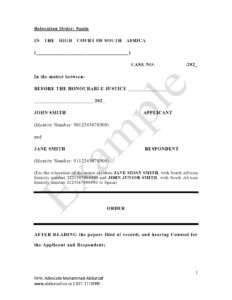
Relocation consent Court Order for minor child to Spain - Advocate Muhammad Abduroaf
Relocation consent Court Order for minor child to Spain – Advocate Muhammad Abduroaf
Relocation consent Court Order for minor child to Spain - Advocate Muhammad Abduroaf
Relocation consent Court Order for minor child to Spain – Advocate Muhammad Abduroaf

Related Post

Latest regulations regarding the movement of children between co-holders of parental responsibilities and rights or a caregiver. Essentially, all children can move, with specific requirements to be in place – 16 April 2020

On 16 April 2020, the Minister of Cooperative Governance and Traditional Affairs Dr Nkosazana Dlamini Zuma made changes to the regulations regarding the movement of children during the lockdown.

The material change is that you do not have to have a court order or a parental responsibilities and rights agreement or parenting plan, registered with the family advocate. Possession of a birth certificate or certified copy of a birth certificate is now also allowed.

In summary, the new regulations published today applies as follows:
  1. The movement of children should be between co-holders of parental responsibilities and rights or a caregiver;
  2. The following must be in existence:
    • A court order;
    • a parental responsibilities and rights agreement or parenting plan, registered with the family advocate, or
  3. the co-holder of parental responsibilities and rights is in possession of a birth certificate or certified copy of a birth certificate of the child or children. This is required to prove a legitimate relationship between the co-holders of parental responsibilities and rights;
  4. In the household to which the child is to move, there is no person who is known to have come into contact with, or is reasonably suspected to have come into contact with, a person known to have contracted, or reasonably suspected to have contracted, COVID-19;
  5. The parent or caregiver transporting the child concerned must have in his or her possession, the court order or the parental responsibilities and rights agreement or a parenting plan or the birth certificate of the child or children, as required.
  6. All forms must be completed in full, including full names, identification or passport numbers and full contact details as required in the form and failure to do so will result in the form being rejected as invalid.
 

The relevant regulations are copied below:

  [caption id="attachment_9046" align="alignleft" width="856"]regulations-movement-children-16-April-lockdown regulations-movement-children-16-April-lockdown[/caption]  

Finding the right lawyer (Attorney or Advocate) to fight for you in your contractual dispute in Durban. Read further below about a “Bulldog Lawyer”)

Contract law is the bedrock of business and day-to-day transactions, providing a framework for parties to define their rights, obligations, and expectations. However, disputes can arise when one or more parties feel that the terms of the contract have been violated. This can apply to an employment contract, lease agreement, marriage contract, or one where you lent someone money. Even buying groceries at your local grocery is a contractual transaction. You pay, and he provides you with the goods. The list is endless.

All is good until someone violates the terms of the contract. This is where you may want to use an attorney or advocate in Durban. Read further below about what is referred to as a “bulldog lawyer”. If the other side is playing hardball or has a bulldog lawyer, then having a tough lawyer who takes no-nonsense is something that you must consider. Please note that the law on contractual disputes would be the same whether you live in Durban or any other city in South Africa.

Let us get into the theory. Navigating the complexities of contract law disputes requires a clear understanding of the legal principles and practical strategies for resolution.

Critical Elements of Contract Law are as follows:

Formation of Contract:

Before delving into disputes, it’s essential to understand how contracts are formed. A valid contract typically requires an offer, acceptance, consideration, legal capacity, and legality of purpose. Disputes may arise if any of these elements are in question. If you are entering into a high value contact, it may be best to consult with an advocate or attorney beforehand.

Types of Contracts:

Contracts can take various forms, such as express, implied, unilateral, and bilateral. Understanding the nature of the contract is crucial in determining the rights and obligations of the parties involved.

Common Contract Disputes:

Breach of Contract:

The most prevalent type of contract dispute arises from a breach. This occurs when one party fails to fulfil its obligations outlined in the contract. It could involve non-payment, incomplete performance, or failure to deliver goods or services.

Misrepresentation:

If one party makes false statements that induce another to enter a contract, it may lead to a dispute. Misrepresentation can be innocent, negligent, or fraudulent, each carrying different legal consequences.

Duress and Undue Influence:

Contracts entered under duress or undue influence may be deemed voidable. If one party was coerced or pressured into an agreement, it could lead to a dispute over the contract’s validity.

What follows are resolution strategies when it comes to contract disputes.

Negotiation:

Often, disputes can be resolved through negotiation. Parties can discuss the issues, explore compromises, and reach a mutually acceptable resolution without legal action. You should use a tough lawyer to represent you if the other side is unreasonable.

Mediation:

Mediation involves a neutral third-party facilitating discussions between the parties to help them resolve. It is a voluntary and confidential process that can be less adversarial than litigation.

Arbitration:

Arbitration is a more formal process where an arbitrator or a panel makes a binding decision after hearing both sides. It provides a faster and more private resolution compared to traditional court proceedings.

Litigation:

If all else fails, parties may resort to litigation. This involves taking the dispute to court, presenting evidence, and having a judge decide. Litigation can be time-consuming and costly, but it provides a definitive resolution.

Conclusion:

Contract law disputes are an inherent risk in business transactions, but understanding the principles and available resolution strategies can mitigate potential damage. Whether through negotiation, mediation, arbitration, or litigation, the goal is to find a fair and just resolution that upholds the integrity of the contractual relationship. As businesses continue to engage in complex transactions, a comprehensive understanding of contract law and dispute resolution mechanisms is essential for navigating the legal landscape successfully. When meeting with an advocate or attorney to assist you in your contractual dispute, discuss the above issues or factors with him or her to find out if they know what they are talking about.

What is a bulldog lawyer?

A “bulldog lawyer” is a colloquial term used to describe a lawyer (attorney or advocate) known for their aggressive and tenacious approach to legal representation. The term draws an analogy between the lawyer’s characteristics and those of a bulldog, known for its solid and determined demeanour. Bulldog lawyers are often associated with being assertive, persistent, and unwavering in pursuing their client’s interests.

Key characteristics of a bulldog lawyer may include:

Aggressiveness: Bulldog lawyers are known for their assertive and forceful advocacy on behalf of their clients. They are unafraid to challenge opponents and vigorously pursue their client’s objectives.

Tenacity:

Bulldog lawyers are persistent and determined in their legal pursuits. They may be willing to go to great lengths to achieve their client’s goals and are known for not easily giving up in the face of challenges.

Fearlessness:

Bulldog lawyers are often unafraid to take on tough cases or confront powerful adversaries. They may be known for their willingness to face complex legal battles head-on.

Advocacy Skills: Bulldog lawyers possess strong advocacy skills, including effective communication, negotiation, and litigation abilities. They can passionately argue their client’s case in court or during negotiations.

Strategic Thinking:

While aggressive, bulldog lawyers are also strategic in their approach. They carefully plan their legal strategies and tactics to achieve the best possible outcome for their clients.

It’s important to note that “bulldog lawyer” can have positive and negative connotations. On the positive side, it highlights an attorney’s dedication and commitment to their clients. On the negative side, it may suggest an overly aggressive or abrasive style that may not be suitable for all legal matters or personalities.


Do you require a video legal advice consultation?

Click here and schedule one today!