Advocate Muhammad Abduroaf – Trust Account Lawyer- Best Legal Law Practitioners (Advocate Attorney) Child Custody Maintenance Contact Divorce Relocation Passport Consent High Court Cape Town
Related Post
Father battles for 3 years to finally see his child. This he did with the help of a social worker, lawyer and the court. He now has regular contact to his child.
Custody, Contact and Guardianship are parental responsibilities of all parents. Once the child is born, both parents not only have a right but a duty to form part of a child’s life. This is also the right of the child. Therefore, a parent cannot deny the other parent from exercising his or her parental responsibilities and rights. The Courts have a duty to ensure that a child’s best interests are met when approached. It is therefore of paramount importance that parents ensure that parental responsibilities and rights are exercise and enforced where necessarily. This includes the responsibility of paying child maintenance. Before we head into the article, let us first outline what the law says on the parental responsibilities of parents. In the end, we will deal with the law regarding the inclusion of a father’s name on the child’s birth certificate. Read further to what the Children’s Act 38 of 2005 says about parental responsibilities and rights. You can skip this section by clicking here.The Children’s Act 38 of 2005
Section 18 of the Children’s Act 38 of 38 2005 states the following: “(1) A person may have either full or specific parental responsibilities or rights in respect of a child. (2) The parental responsibilities and rights that a person may have in respect of a Child, include the responsibility and the right- (a) To care for the child; (b) To maintain contact with the child; (c) To act as guardian of the child; and (d) To contribute to the maintenance of the child. (3) Subject to subsections (4) and (5), a parent or other person who acts as guardian of a child must (a) Administer and safeguard the child’s property and property interests; (b) Assist or represent the child in administrative, contractual and other legal Matters; or (c) Give or refuse any consent required by law in respect of the child, including- (I) consent to the child marriage (ii) Consent to the child adoption; (iii) Consent to the child departure or removal from the Republic; (iv) Consent to the child application for a passport; and (v) Consent to the alienation or encumbrance of any immovable property of the child. (4) Whenever more than one person has guardianship of a child, each one of them is competent, subject to subsection (5), any other law or any order of a competent court to the contrary, to exercise independently and without the consent of the other any right or responsibility arising from such guardianship. (5) Unless a competent court orders otherwise, the consent of all the persons that have guardianship of a child is necessary in respect of matters set out in subsection (3)(c).” [ps2id id=’care-id’ target=”/]Father’s right to his child
If you are a parent and confronted with a situation where you are denied rights to your child; read on. Notwithstanding this article has been written in relation to the rights of a father; a mother can find it useful too. Mike was a typical office worker, age 25. He lived with his parents and was studying part-time to earn his teaching degree. This is where he met Mary, on a Saturday morning, when visiting the campus library. She was in her final year of medicine. One thing led to another and 6 months later, Mary fell pregnant. Marry came from a wealthy family. Her father was a businessman and her mother a psychology professor. What’s more, Mary was the only child. When her parents found out who the father was, they forbid her to see him. According to them, he was unworthy of their daughter. Read on to find out the meaning of Care and Contact as provide for in the Children’s Act 38 of 2005. You can skip this section by click here.Meaning of Care
The Children’s Act 38 of 2005 defines care as follows: Care in relation to a child, includes, where appropriate- (a) Within available means, providing the child with- (i) a suitable place to live; (ii) Living conditions that are conducive to the child’s health well-being and development; and (iii) The necessary financial support; (b) Safeguarding and promoting the well-being of the child; (c) protecting the child from maltreatment, abuse, neglect, degradation, discrimination, exploitation and any other physical, emotional or moral harm or hazards; (d) respecting, protecting, promoting and securing the fulfilment of, and guarding against any infringement of, the child rights set out in the Bill of Rights and the principles set out in Chapter 2 of this Act; (e) guiding, directing and securing the child education and upbringing, including religious and cultural education and upbringing, in a manner appropriate to the child age, maturity and stage of development; guiding, advising and assisting the child in decisions to be taken by the child in a manner appropriate to the child age, maturity and stage of development; (g) Guiding the behaviour of the child in a humane manner; (h) Maintaining a sound relationship with the child; (I) accommodating any special needs that the child may have; and (j) Generally, ensuring that the best interests of the child is the paramount Concern in all matters affecting the child;
Contact
According to the Children’s Act 38 of 2005, contact means the following: Contact in relation to a child, means- (a) Maintaining a personal relationship with the child; and (b) If the child lives with someone else- (I) communication on a regular basis with the child in person, including- (AA) visiting the child; or (Bb) being visited by the child; or (ii) Communication on a regular basis with the child in any other manner, Including- (AA) through the post; or (Bb) by telephone or any other form of electronic communication; [ps2id id=’care2-id’ target=”/]The Pregnancy
Mike tried very hard to find out how the pregnancy was going along. All cell phone calls were blocked and he was refused access to Mary’s home. He felt obligated to make some type of contribution towards the gynaecological and other medical expenses. He spoke to his family about the situation, and they too were very stressed out. This would be the first grandchild and experienced a profound sense of responsibility. They met Mary once and liked her very much. She was smart, pretty and easy going. They then consulted with a family lawyer. The advice was to wait until the child was born and then to enforce parental responsibilities and rights. The lawyer, however, wrote a letter to Mary saying that Mike wants to be part and parcel of the child’s life, even before the birth. Furthermore, Mike wants to contribute towards the medical expenses incurred thus far and any future expenses. Needless to say, the letter was ignored. The Lawyer then advised that they wait until the child was born and then enforce his parental responsibilities and rights.The Birth and Registration
Obviously, Mike was not at the birth of his child. That saddened him very much. Mike then found out through a friend of Mary that she gave birth to a healthy baby boy. The name Mary gave him was Mark. That was great news for Mike. His parents were also very happy. When Mary registered Mark at the Department of Home Affairs, she did not stipulate that Mike was the father. As Mike thus far did not spend any money on the birth or on his son, he opened an investment account where he deposited money into each month.Lawyer’s Letter
Mike then set up a meeting with his lawyer. He explained to him that he wanted to see his son, who was almost 2 months old. The lawyer knew this was a sensitive matter, in that nothing was known about the current circumstances of Mary and Mark. They needed to approach this matter very delicately. All that Mike wanted at this stage was to see his son. The lawyer then wrote a letter to Mary asking that his client, Mike, could see Mark for a few minutes at a convenient place and time for Mary. The lawyer made use of the office of the Sheriff to serve the letter to ensure that Mary receives it. On receipt of the latter, Mary showed it to her father. Her father then met with his lawyer. They replied to the letter advising that Mary wants nothing to do with Mike. According to them, it would not be in the child’s best interests for Mike to make any contact with him. They advise that should Mike persist in wanting to meet with Mark, they are instructed to launch an application to the court for harassment.Legal Advice
Mikes’ lawyer then again advised him of his rights. The difficulty that he had was he knew nothing about the personal circumstances of Mary and Mark. All he knew was that Mark was about 4 months old, living with Mary and her parents. He did not know whether Mary was working or studying, whether Mark was being breastfed and so on. It is therefore difficult to enforce one’s rights, or demand for rights to be enforced under those circumstances. Mike’s lawyer then recommended that a social worker is approached for advice and support on this matter. It is possible that the social worker could mediate the matter.Social worker
When Mike met with the Social worker he told her everything he knew about Marry and Mark. However, information after the birth of Mark was limited. Basically, all he knew was that he was a boy. He did not even know his son’s date of birth. The Social worker appreciated the sensitivity of the matter. She agreed that due to not knowing what the actual circumstances were, the way forward is challenging. Although Mike is the father of Mark and has parental rights, that should not be enforced without considering Mark’s best interests. The Social worker then agreed that she will try to contact Mary. She sends Mary a letter advising her that she was instructed by Mike to arrange contact between him and his son. Needless to say, Mary did not reply to the letter. The Social worker subsequently decided to call Mary. Mary answered and said she doesn’t want to speak to the social worker and that she must leave her alone. The Social worker then met with Mike and his lawyer, and they concluded that the only way forward was to ask for the help of the Court.The Court Application
Mikes lawyer then drafted an Urgent Application to the Western Cape High Court. The relief requested was for reasonable supervised contact until Mark is a year old, and then unsupervised contact. What was also requested, was an Order that the Office of the Family Advocate investigates the matter and provide a report to the Court? The Application was filed and served on Mary. Needless to say, she appointed attorneys to oppose the application.
Mary submitted an opposing affidavit. Her argument was that Mark does not know his father, and it would be best that he only has contact when he is considerably older. But for now, contact rights should be suspended. Mike obviously replied with a replying affidavit.First High Court hearing date
On the hearing date, the Court played it safe. The Judge first wanted the Office of the Family Advocate to intervene and provide a report for the Court to consider. Mike’s advocate did not argue with the Judge on this point. The matter was then postponed for a period of 3 months for the report.Family Advocate’s Report
On the return date, the Court had before it the report of the Office of the Family Advocate. They consulted with Mike and Mary, and it so happens, they came to an agreement regarding phased in contact rights. It was agreed that contact would be exercised at her home, once a week for the first 2 months. Thereafter contact would be every week until Mark is a year old. Once he turns 1, Mike would be able to take Mark with to his home for a period of 4 hours. Further contact would then be relooked at once Mark is 2 years old. At this point, overnight contact may be considered.Child Maintenance
Mike also offered to pay child maintenance and put Mark on his medical aid as a beneficiary. Mary was happy to hear this as she was the one who solely supported Mark. Her parents were getting fed-up with all the expenses involved.Next High Court date
The Judge was very happy that the parties came to an agreement. She subsequently made the agreement and Order of Court. According to the report, Mike met Mark at the Office of the family advocate and spent about a half an hour with him. The report also stated that Mike visited Mark at Mary’s home and bonded. Therefore, according to the Court, this was the best type of arrangement as the parties drafted their own agreement. If they did not settle the matter, the Court could make an Order, which both parties may be unhappy with or unwilling to implement. The Court, therefore, made the settlement agreement an Order of Court.Father’s name on the birth’s registry
Mike exercised contact as per the High Court Order. When he requested Mark’s birth certificate in order to put him on his Medical Aid Scheme, he noticed his name was not on it. Mike then approached the Department of Home Affairs for a change of the birth records. Mary co-operated and the changes were made. Mike was now mentioned as the father on Marks’s birth certificate.This is the law applicable
Section 11 of the Births and Deaths Registration Act 51 of 1992 Section 11 of the Births and Deaths Registration Act 51 of 1992 deals with the amendment of birth registration of a child born out of wedlock. An extract of the Act is as follows: Amendment of birth registration of child born out of wedlock (1) Any parent of a child born out of wedlock whose parents married each other after the registration of his or her birth, may, if such child is a minor, or such child himself or herself may, if he or she is of age, apply in the prescribed manner to the Director-General to amend the registration of his or her birth as if his or her parents were married to each other at the time of his or her birth, and thereupon the Director-General shall, if satisfied that the applicant is competent to make the application, that the alleged parents of the child are in fact his or her parents and that they legally married each other, amend the registration of birth in the prescribed manner as if such child’s parents were legally married to each other at the time of his or her birth. (2) If the parents of a child born out of wedlock marry each other before notice of his or her birth is given, notice of such birth shall be given and the birth registered as if the parents were married to each other at the time of his or her birth. (3) … (4) A person who wishes to acknowledge himself to be the father of a child born out of wedlock, may, in the prescribed manner, with the consent of the mother of the child, apply to the Director-General, who shall amend the registration of the birth of such child by recording such acknowledgement and by entering the prescribed particulars of such person in the registration of the birth of such child. (4A) An amendment of the particulars of a person who has acknowledged himself as a father of a child as contemplated in subsection (4) and section 10(1)(b) of the Act shall be supported by the prescribed conclusive proof of that person being the father of the child. (5) Where the mother of a child has not given her consent to the amendment of the registration of the birth of her child in terms of subsection (4), the father of such a child shall apply to the High Court of competent jurisdiction for a declaratory order which confirms his or her paternity of the child and dispenses with the requirement of consent of the mother contemplated in subsection (4). (6) When the court considers the application contemplated in subsection (5) the provisions of section 26(b) of the Children’s Act shall apply.In conclusion
Although Mike and Mary never became a couple again, they learned to accept the reality of their situation and tried to make the best of it. If there were any issues, they always referred back to the Order the Court made. Even though it took Mike almost 3 years to obtain regular contact, he says it was worth it. 
Sharing is Caring
This and other articles and posts found on this website are written by Adv. Muhammad Abduroaf to assist people with various family law related issues they may have. If you find any of our articles, free resources and posts interesting, or possibly useful to others, please share it on Social Media. Should you require any other legal services and advice, not related to family law, visit Private Legal. Purchase a Consultation with us from our Online Shop, by clicking here.View some of our other Child Articles Articles below
[pt_view id=”af5c243q4t”]
Contact Posted on by Telelaw
[caption id="attachment_10799" align="alignnone" width="720"]
Relocation consent for minor child to Brazil – Advocate Muhammad Abduroaf[/caption]I want to relocate from South Africa to Brazil with my minor child. The other parent does not want my child to relocate to Brazil. What can I do?
Brazil is a popular destination to emigrate to. People emigrate from South Africa for many reasons. It ranges from better employment opportunities, family relations, or for a better standard of living. Whatever the reason a parent wants to relocate to Brazil, if a minor child will be joining that parent and also relocating to Brazil, then the parent remaining in South Africa’s consent would usually be required. Let us unpack the legal issues a parent may encounter when wanting to emigrate to Brazil. Before we do so, let us list the various cities and towns in Brazil to which you may want to relocate: Acre, Rio Branco, Alagoas, Maceió, União dos Palmares, Amapá, Macapá, Amazonas, Itacoatiara, Manaus, Tefé, Bahia, Alagoinhas, Feira de Santana, Ilhéus, Itabuna, Jequié, Juazeiro, Paulo Afonso, Salvador, Vitória da Conquista, Ceará, Aracati, Crato, Fortaleza, Juazeiro do Norte, Sobral, Distrito Federal, Brasília, Espírito Santo, Cachoeiro de Itapemirim, Colatina, Fundão, Vila Velha, Vitória, Goiás, Anápolis, Catalão, Goiânia, Goiás, Ipameri, Jataí, Maranhão, Alcântara, Caxias, São Luís, Mato Grosso, Cuiabá, Mato Grosso do Sul, Campo Grande, Corumbá, Três Lagoas, Minas Gerais, Araguari, Barbacena, Belo Horizonte, Congonhas, Conselheiro Lafaiete, Diamantina, Divinópolis, Governador Valadares, Juiz de Fora, Mariana, Montes Claros, Nova Lima, Ouro Prêto, Passos, Patos de Minas, Poços de Caldas, Sabará, São João del Rei, Sete Lagoas, Teófilo Otoni, Uberaba, Uberlândia, Pará, Belém, Bragança, Monte Alegre, Óbidos, Santarém, Campina Grande, Paraíba, Campina Grande, João Pessoa, Paraná, Curitiba, Londrina, Maringá, Paranaguá, Ponta Grossa, Pernambuco, Caruaru, Garanhuns, Jaboatão, Olinda, Petrolândia, Petrolina, Recife, Piauí, Floriano, Parnaíba, Teresina, Rio de Janeiro, Angra dos Reis, Barra Mansa, Campos dos Goytacazes, Copacabana, Duque de Caxias, Nilópolis, Niterói, Nova Friburgo, Nova Iguaçu, Petrópolis, Resende, Rio de Janeiro, São Gonçalo, São João de Meriti, Teresópolis, Volta Redonda, Rio Grande do Norte, Mossoró, Natal, Rio Grande do Sul, Bagé, Bento Gonçalves, Canoas, Caxias do Sul, Novo Hamburgo, Passo Fundo, Pelotas, Porto Alegre, Rio Grande, Santa Maria, São Leopoldo, Uruguaiana, Rondônia, Guajará-Mirim, Pôrto Velho, Roraima, Boa Vista, Santa Catarina, Blumenau, Criciúma, Florianópolis, Itajaí, Lajes, Tubarão, São Paulo, Americana, Araçatuba, Araraquara, Barretos, Bauru, Botucatu, Campinas, Catanduva, Cubatão, Franca, Guaratinguetá, Guarujá, Guarulhos, Itapetininga, Jacareí, Jaú, Jundiaí, Limeira, Marília, Mogi das Cruzes, Osasco, Ourinhos, Piracicaba, Presidente Prudente, Ribeirão Prêto, Rio Claro, Santo André, Santos, São Bernardo do Campo, São Caetano do Sul, São Carlos, São José do Rio Prêto, São José dos Campos, São Paulo, São Vicente, Sorocaba, Taubaté, Sergipe, Aracaju, São Cristóvão, Tocantins, Palmas. (https://www.britannica.com/topic/list-of-cities-and-towns-in-Brazil-2055400)Why do I require the other parent’s Consent to relocate to Brazil?
According to South African law, if you are a co-holder of parental responsibilities and rights over your minor child, you must consent to your child leaving South Africa. In this case, relocating to Brazil. Here we refer to section 18 of the Children’s Act 38 of 2005. The entire provision is as follows: 18 Parental responsibilities and rights (1) A person may have either full or specific parental responsibilities and rights in respect of a child. (2) The parental responsibilities and rights that a person may have in respect of a child, include the responsibility and the right- (a) to care for the child; (b) to maintain contact with the child; (c) to act as guardian of the child; and (d) to contribute to the maintenance of the child. (3) Subject to subsections (4) and (5), a parent or other person who acts as guardian of a child must- (a) administer and safeguard the child’s property and property interests; (b) assist or represent the child in administrative, contractual and other legal matters; or (c) give or refuse any consent required by law in respect of the child, including- (i) consent to the child’s marriage; (ii) consent to the child’s adoption; (iii) consent to the child’s departure or removal from the Republic; (iv) consent to the child’s application for a passport; and (v) consent to the alienation or encumbrance of any immovable property of the child. (4) Whenever more than one person has guardianship of a child, each one of them is competent, subject to subsection (5), any other law or any order of a competent court to the contrary, to exercise independently and without the Consent of the other any right or responsibility arising from such guardianship. (5) Unless a competent court orders otherwise, the Consent of all the persons that have guardianship of a child is necessary in respect of matters set out in subsection (3)(c). Now let us explain what Parental Responsibilities and Rights are.What are Parental Responsibilities and Rights of a parent in relation to a child?
As can be seen from section 18(2) of the Children’s Act, when we refer to Parental Responsibilities and Rights, we refer to the following: (a) to care for the child; (b) to maintain contact with the child; (c) to act as guardian of the child; and (d) to contribute to the maintenance of the child. Therefore, if a parent has parental responsibilities and rights over a minor child, and accordingly, rights of guardianship, their Consent is required when it comes to issues of guardianship. As seen from section 18(3)(c) of the Children’s Act above, both parents’ Consent is required should a minor child depart from the Republic of South Africa. In this case, to emigrate to Brazil. Even if the minor child only wants to go for a short holiday to Brazil, both guardians’ Consent would be required.When would the other parent be seen as a guardian in the case of a relocation matter to Brazil?
It must be noted that not all parents are legal guardians over their minor children. We should therefore distinguish between married or divorced parents and parents who were never married. As you would see below, usually married, or divorced parents’ Consent would be required for a minor child to relocate or emigrate to Brazil. However, that does not automatically apply to parents who were never married. This could be because the child could have been born from a brief encounter and never met his or her father. It would not make sense that a parent who never met his or her 15-year-old child, should give Consent for relocation to Brazil.Mother’s Consent for relocation of the minor child to Brazil
Section 19 of the Children’s Act deals with the Parental responsibilities and rights of mothers. It states the following: 19 Parental responsibilities and rights of mothers (1) The biological mother of a child, whether married or unmarried, has full parental responsibilities and rights in respect of the child. (2) If- (a) the biological mother of a child is an unmarried child who does not have guardianship in respect of the child; and (b) the biological father of the child does not have guardianship in respect of the child, the guardian of the child’s biological mother is also the guardian of the child. (3) This section does not apply in respect of a child who is the subject of a surrogacy agreement. As seen from section 19(1) of the Children’s Act, in most cases involving the relocation of a minor child to Brazil, the mother’s Consent is required as she has full parental responsibilities and rights over the minor child.Married father’s Consent for the relocation of the minor child to Brazil
Section 20 of the Children’s Act deals with Parental responsibilities and rights of married fathers. It states the following: 20 Parental responsibilities and rights of married fathers The biological father of a child has full parental responsibilities and rights in respect of the child- (a) if he is married to the child’s mother; or (b) if he was married to the child’s mother at (i) the time of the child’s conception; (ii) the time of the child’s birth; or (iii) any time between the child’s conception and birth. As can be seen from sections 20 (a) and (b) of the Children’s Act, if the father and the mother were married, or are married, then his Consent is required for the minor child to relocate to Brazil. Of course, an exception to this would be should a court of law order otherwise. This would be the case should the parents be divorced and the divorce court ordered that only the mother may act as guardian. Next, we deal with the issue of an unmarried father’s Consent to relocate a minor child to Brazil.Consent of unmarried fathers for the relocation of their minor children to Brazil.
Section 21 of the Children’s Act deals with parental responsibilities and rights of unmarried fathers. The section states the following: 21 Parental responsibilities and rights of unmarried fathers (1) The biological father of a child who does not have parental responsibilities and rights in respect of the child in terms of section 20, acquires full parental responsibilities and rights in respect of the child- (a) if at the time of the child’s birth he is living with the mother in a permanent life-partnership; or (b) if he, regardless of whether he has lived or is living with the mother- (i) consents to be identified or successfully applies in terms of section 26 to be identified as the child’s father or pays damages in terms of customary law; (ii) contributes or has attempted in good faith to contribute to the child’s upbringing for a reasonable period; and (iii) contributes or has attempted in good faith to contribute towards expenses in connection with the maintenance of the child for a reasonable period. (2) This section does not affect the duty of a father to contribute towards the maintenance of the child. (3) (a) If there is a dispute between the biological father referred to in subsection (1) and the biological mother of a child with regard to the fulfilment by that father of the conditions set out in subsection (1) (a) or (b), the matter must be referred for mediation to a family advocate, social worker, social service professional or other suitably qualified person. (b) Any party to the mediation may have the outcome of the mediation reviewed by a court. (4) This section applies regardless of whether the child was born before or after the commencement of this Act. As can be seen from the latter sections, a father of a child born out of wedlock does not automatically have parental responsibilities and rights over his minor child. He may however acquire those parental responsibilities and rights over his minor child if he is materially involved in the child’s life. That would be where the father and the mother were in a permanent life partnership when the child was born or he is meaningfully involved in the child’s life, as outlined above. We shall not go into much detail regarding that. However, in most cases, if the father had regular contact with the child and paid child support, he would have acquired parental responsibilities and rights over the minor child.What do you do if the other parent does not want to consent to the minor child relocating to Brazil?
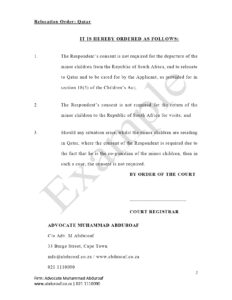
Suppose the other parent also has parental responsibilities and rights over the minor child, and he or she does not want to consent to the relocation of the minor child to Brazil, then in such a case, the Court needs to be approached. Here I refer you back to section 18(5) of the Children’s Act referred to above where it states: (5) Unless a competent court orders otherwise, the Consent of all the persons that have guardianship of a child is necessary in respect of matters set out in subsection (3)(c). Therefore, after your Court Application has been launched an both sides have been heard, the Court would make the necessary Order. If you are successful in your application for the relocation of your minor children to Brazil, then the Court will make an Order similar to that which is shown below. [caption id="attachment_10798" align="alignnone" width="694"]
Relocation consent for minor child to Brazil – Advocate Muhammad Abduroaf[/caption] [caption id="attachment_10799" align="alignnone" width="690"]
Relocation consent for minor child to Brazil – Advocate Muhammad Abduroaf[/caption]
Posted on by Telelaw
family trust, register a trust, Cape Town
Posted on by Telelaw