30 May 2020 – Latest Regulations on the movement of minor children during the lockdown – The introduction of the Magistrate’s Permit

The Minister of Cooperative Governance and Traditional Affairs, Dr Nkosazana Dlamini Zuma, published new regulations regarding the Lockdown on 29 April 2020. As from 1 May 2020, South Africa’s lockdown would be on Level 4, one level down from when it started. The new regulations bring challenging changes regarding the movement of children between parents. For example, the provision of applying for a Magistrate’s permit. Therefore, some of the new regulations are welcomed by us, and others not. The regulations are further below. Click here to read an article regarding the previous regulations on the movement of children. Summary of the recent regulations that will come in effect tomorrow 1 May 2020:

Local movement of children during the lockdown

Movement of Children may only take place in the same metropolitan area or district municipality if the co-holders of parental responsibilities and rights or a caregiver is: (a) in possession of a Court Order; or (b) a parental responsibilities and rights agreement or parenting plan, registered with the family advocate; or (c) a permit issued by a magistrate which corresponds with Form 3 of Annexure A if the latter documentation is not available; and (d) The household to which the child has to move must be free of COVID-19. Before a magistrate may issue a permit, he or she must be provided with a birth certificate or certified copy of a birth certificate of the child or children to prove a legitimate relationship between the co-holders of parental responsibilities and rights. Furthermore, written reasons as to why the movement of the child is necessary must be provided. In our view, the permit application is a step back. This we say as previously there was no need for the application for a permit. The courts would be inundated with such applications. Producing a birth certificate as previously required should have continued.

Inter-Provincial movement of children during the National lockdown

The regulations now allow for a once-off movement of children between provinces during the lockdown. It states: “Any child who was not at the residence of their primary caregiver before the lockdown period and who could not travel between provinces, metropolitan and district areas during the lockdown will be permitted, on a once-off basis, to return to the residence of their primary caregiver if the co-holders of parental responsibilities and rights or a caregiver is in possession of a permit issued by a magistrate which corresponds with Form 3 of annexure A.” Before a magistrate issues a permit, he or she must be provided with: (a) a court order; or (b) a parental responsibilities and rights agreement or parenting plan registered with the family advocate; or (c) a birth certificate or certified copy of a birth certificate of the child or children to prove a legitimate relationship between the co-holders of parental responsibilities and rights, and (d) written reasons why the movement of the child is necessary. Furthermore, the household to which the child has to move must be free of COVID-19. Click here to read an article regarding the previous regulations on the movement of children. Below are the relevant regulations and the relevant form the Magistrate must provide. Movement of children
  1. (1) The movement of children between co-holders of parental responsibilities and rights or a caregiver, as defined in section 1(1) of the Children’s Act, 2005 (Act No. 38 of 2005), in the same metropolitan area or district municipality is allowed subject to the following if the co-holders of parental responsibilities and rights or a caregiver is in possession of—
(a) a court order; or (b) a parental responsibilities and rights agreement or parenting plan, registered with the family advocate (c) a permit issued by a magistrate where which corresponds with Form 3 of Annexure A if the documentation in paragraphs (a) and (b) is not available. (2) The movement of children between co-holders of parental responsibilities and rights or a caregiver, as defined in section 1(1) of the Children’s Act, 2005 (Act No. 38 of 2005), between different metropolitan areas, district municipalities or provinces is allowed if the co-holders of parental responsibilities and rights or a caregiver is in possession of a permit, issued by a magistrate which corresponds with Form 3 of Annexure A. (3) Any child who was not at the residence of their primary caregiver before the lockdown period and who could not travel between provinces, metropolitan and district areas during the lockdown will be permitted, on a once-off basis, to return to the residence of their primary caregiver if the co-holders of parental responsibilities and rights or a caregiver is in possession of a permit issued by a magistrate which corresponds with Form 3 of annexure A. (4) The household to which the child has to move, must be free of COVID-19. (5) (a) Before a magistrate issues a permit referred to in regulation 17(1)(c), he or she must be provided with— (i) birth certificate or certified copy of a birth certificate of the child or children to prove a legitimate relationship between the co-holders of parental responsibilities and rights; and (ii) written reasons why the movement of the child is necessary.   (b) Before a magistrate issues a permit referred to in 17(2) or (3), he or she must be provided with— (i) A court order (ii) a parental responsibilities and rights agreement or parenting plan registered with the family advocate or (iii) a birth certificate or certified copy of a birth certificate of the child or children to prove a legitimate relationship between the co-holders of parental responsibilities and rights; and (iv) written reasons why the movement of the child is necessary.
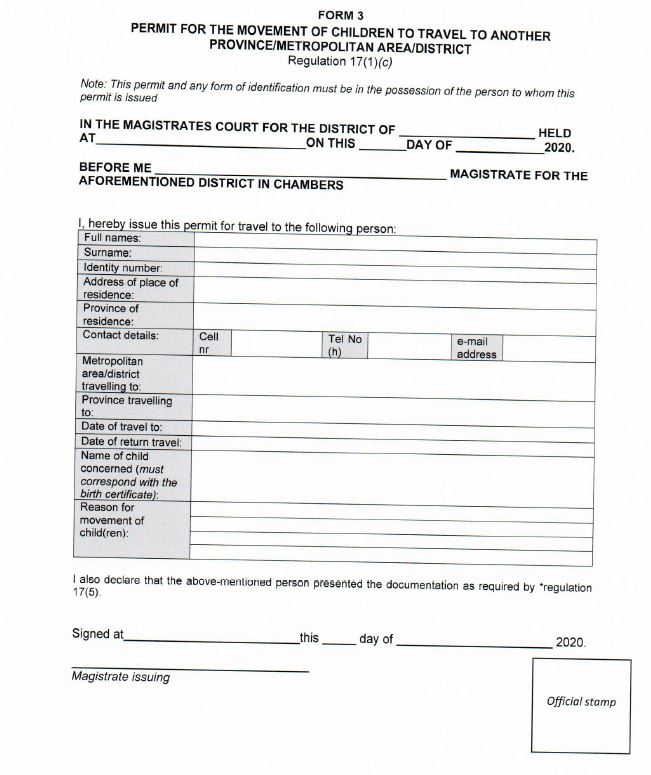
[caption id="attachment_9098" align="alignleft" width="651"]Permit issued by a Magistrate for the movement of children during the lockdown Permit issued by a Magistrate for the movement of children during the lockdown[/caption]                                           We are certain that you found the above article useful and interesting. Please consider sharing it on the share buttons below. They include Facebook, Twitter, LinkedIn, WhatsApp, Gmail and more. Someone may find it useful as well. Should you require business advice or services, feel free to click on these links: Business SA | Private Legal | Envirolaws Click here to read an article regarding the previous regulations on the movement of children.  

30 May 2020 – Latest Regulations on the movement of minor children during the lockdown – The introduction of the Magistrate’s Permit

The Minister of Cooperative Governance and Traditional Affairs, Dr Nkosazana Dlamini Zuma, published new regulations regarding the Lockdown on 29 April 2020. As from 1 May 2020, South Africa’s lockdown would be on Level 4, one level down from when it started.

The new regulations bring challenging changes regarding the movement of children between parents. For example, the provision of applying for a Magistrate’s permit. Therefore, some of the new regulations are welcomed by us, and others not. The regulations are further below.

Click here to read an article regarding the previous regulations on the movement of children.

Summary of the recent regulations that will come in effect tomorrow 1 May 2020:

Local movement of children during the lockdown

Movement of Children may only take place in the same metropolitan area or district municipality if the co-holders of parental responsibilities and rights or a caregiver is:

(a) in possession of a Court Order; or

(b) a parental responsibilities and rights agreement or parenting plan, registered with the family advocate; or

(c) a permit issued by a magistrate which corresponds with Form 3 of Annexure A if the latter documentation is not available; and

(d) The household to which the child has to move must be free of COVID-19.

Before a magistrate may issue a permit, he or she must be provided with a birth certificate or certified copy of a birth certificate of the child or children to prove a legitimate relationship between the co-holders of parental responsibilities and rights. Furthermore, written reasons as to why the movement of the child is necessary must be provided.

In our view, the permit application is a step back. This we say as previously there was no need for the application for a permit. The courts would be inundated with such applications. Producing a birth certificate as previously required should have continued.

Inter-Provincial movement of children during the National lockdown

The regulations now allow for a once-off movement of children between provinces during the lockdown. It states:

“Any child who was not at the residence of their primary caregiver before the lockdown period and who could not travel between provinces, metropolitan and district areas during the lockdown will be permitted, on a once-off basis, to return to the residence of their primary caregiver if the co-holders of parental responsibilities and rights or a caregiver is in possession of a permit issued by a magistrate which corresponds with Form 3 of annexure A.”

Before a magistrate issues a permit, he or she must be provided with:

(a) a court order; or

(b) a parental responsibilities and rights agreement or parenting plan registered with the family advocate; or

(c) a birth certificate or certified copy of a birth certificate of the child or children to prove a legitimate relationship between the co-holders of parental responsibilities and rights, and

(d) written reasons why the movement of the child is necessary.

Furthermore, the household to which the child has to move must be free of COVID-19.

Click here to read an article regarding the previous regulations on the movement of children.

Below are the relevant regulations and the relevant form the Magistrate must provide.

Movement of children

  1. (1) The movement of children between co-holders of parental responsibilities and rights or a caregiver, as defined in section 1(1) of the Children’s Act, 2005 (Act No. 38 of 2005), in the same metropolitan area or district municipality is allowed subject to the following if the co-holders of parental responsibilities and rights or a caregiver is in possession of—

(a) a court order; or

(b) a parental responsibilities and rights agreement or parenting plan, registered with the family advocate

(c) a permit issued by a magistrate where which corresponds with Form 3 of Annexure A if the documentation in paragraphs (a) and (b) is not available.

(2) The movement of children between co-holders of parental responsibilities and rights or a caregiver, as defined in section 1(1) of the Children’s Act, 2005 (Act No. 38 of 2005), between different metropolitan areas, district municipalities or provinces is allowed if the co-holders of parental responsibilities and rights or a caregiver is in possession of a permit, issued by a magistrate which corresponds with Form 3 of Annexure A.

(3) Any child who was not at the residence of their primary caregiver before the lockdown period and who could not travel between provinces, metropolitan and district areas during the lockdown will be permitted, on a once-off basis, to return to the residence of their primary caregiver if the co-holders of parental responsibilities and rights or a caregiver is in possession of a permit issued by a magistrate which corresponds with Form 3 of annexure A.

(4) The household to which the child has to move, must be free of COVID-19.

(5) (a) Before a magistrate issues a permit referred to in regulation 17(1)(c), he or she must be provided with—

(i) birth certificate or certified copy of a birth certificate of the child or children to prove a legitimate relationship between the co-holders of parental responsibilities and rights; and (ii) written reasons why the movement of the child is necessary.


(b) Before a magistrate issues a permit referred to in 17(2) or (3), he or she must be provided with—

(i) A court order

(ii) a parental responsibilities and rights agreement or parenting plan registered with the family advocate or

(iii) a birth certificate or certified copy of a birth certificate of the child or children to prove a legitimate relationship between the co-holders of parental responsibilities and rights; and

(iv) written reasons why the movement of the child is necessary.

Permit issued by a Magistrate for the movement of children during the lockdown


We are certain that you found the above article useful and interesting. Please consider sharing it on the share buttons below. They include Facebook, Twitter, LinkedIn, WhatsApp, Gmail and more. Someone may find it useful as well.

Should you require business advice or services, feel free to click on these links:

Business SA | Private Legal | Envirolaws

Click here to read an article regarding the previous regulations on the movement of children.


Related Post

Do you own Divorce (DIY) No lawyers needed!

advice-child-maintenance-child-custody-divorce

If you want to get divorced from your spouse, I strongly advise that your approach a legal practitioner, or an attorney to attend to it on your behalf. This I would implore even more under the following circumstances:
  • There will be a dispute over care and visitation rights over the child/children
  • One of the parties will be applying for forfeiture of patrimonial benefits from a marriage in community of property;
  • The joint estate is huge or complicated; or
  • The other party will be making use of legal representation.
If, however, you would like to know the general procedures on how to go about a divorce, they are listed summarily below. There are many rules that regulate divorce processes and the summary below does exclude certain of them. These include exceptions, strikeouts, compelling compliance, service addresses etc. Other matters incidental to divorce proceedings, e.g. interim arrangements, pending the divorce regarding maintenance for you or your children and care and contact regarding children are not dealt with. Therefore, please consult a legal practitioner or the divorce court throughout your divorce process should you decide to do the divorce yourself.

Summons and Particulars of Claim

A summons needs to be drafted which will be issued by the divorce court to commence the divorce process. It should have on it the details of the court you will be issuing divorce, details of the parties, e.g. names, occupation, and address etc. Every High Court in the area where you live has the authority to attend to a divorce. There are however specialized divorce courts that may attend to a divorce as well. You should then draft particulars of claim, outlining relevant matters concerning the marriage, children, reasons for wanting a divorce and what do you want the court to grant you in a divorce order. These particulars of claim you attach to the summons. Here is an example of a summons and particulars of claim for a divorce for a couple married in community of property with no children getting a divorce in the High Court in Cape Town.

Summons

IN THE HIGH COURT OF South Africa CASE NO.: (Western Cape High Court, Cape Town) In the matter between: John Smith (Plaintiff) And Jane Smith (Defendant) To the Sheriff or his/her Deputy INFORM Jane Smith (hereinafter referred to as the defendant an adult female, self-employed as a singer currently residing at 12 Club Road, Waterfront, Western Cape and whose full and further particulars are unknown, That: John Smith (hereafter referred to as the plaintiff), an adult male self-employed painter residing at Garden Road, Cape Town, Western Cape, Hereby institutes an action against her in which action the Plaintiff claims the relief and on the grounds set out in the particulars annexed hereto marked A. INFORM the Defendant further that if she disputes the claim and wishes to defend the action she shall (a) within 10 (TEN) days after the service upon her of this Summons, file with the Registrar of this Court at Kieron Street, Cape Town a notice of her intention to defend, and serve a copy thereof on the Plaintiff, on which notice shall be given an address (not being a post office or poste restante) referred to in Rule 19(3) for the service upon the Defendant of all notices and documents in the action; and (b) thereafter, and within 21 (TWENTY-ONE) court days after the filing and serving such notice of intention to defend as aforesaid, file with the Registrar and serve upon the Plaintiff a Plea, Exception, Notice to strike out, with or without a counterclaim. INFORM the Defendant further that if she fails to file and serve notice as aforesaid, judgment as claimed may be given against her without further notice to her, or if having filed and served such notice, she fails to plead, except, make application to strike out or counterclaim, judgment may be given against her. INFORM the Defendant also that if she does not intend to defend the action, she will inform the Registrar in writing to enable the Registrar to, on request in writing from Plaintiff, immediately set the matter down for hearing. AND IMMEDIATELY THEREAFTER serve on the Defendant a copy of this Summons and return same with whatsoever you have done thereupon. DATED AT CAPE TOWN ON THIS ____ THE DAY OF _________2018.   ……………………………………………………………… REGISTRAR OF THE HIGH COURT   ……………………………………………………………… Plaintiff in Person __________________________  

Particulars of Claim “A”

  (A) Parties Plaintiff is John Smith, an adult male Bus Driver, residing at no. 5 Truck Apartments, Cape Town, Western Cape. The defendant is Jane Smith (born Smit) an adult female, employed as a hairdresser, residing at Hectic House, 2 Main Road, Strand, Western Cape.  

(B) Marriage

Plaintiff and Defendant (hereafter referred to together as “the Parties”) married each other on 10 August 2003 at Pretoria, in community of property and the marriage still subsists. Kindly find attached hereto a copy of the marriage certificate marked “MC”. The Parties are domiciled within the area of jurisdiction of this honourable court. There are no children born out of the marriage.  

(C) Irretrievable breakdown

The marriage between the Parties has irretrievably broken down and there are no reasonable prospects of the restoration of a normal marital relationship between them in that: Defendant left the common home approximately 2 years ago; There is no love and affection, understanding and communication between the parties; The Parties are incompatible and continue arguing; and Plaintiff has a gambling problem.  

(D) Prayer

WHEREFORE Plaintiff prays for Judgement against Defendant in the following terms:   A decree of divorce; Each party retain the property in his or her possession as his or her sole property; Cost if this action is opposed; and Further and/ or alternative relief.   DATED AT CAPE TOWN ON THIS THE ______ DAY OF______ 2018.   _____________________________ Per: John Smith (Plaintiff in Person)   Service Address     Once you have your summons and particulars of claim in order, make three (3) copies of your set of documents and have it issued at court.

Issuing & Service of Summons

Once you are at the court, go to the clerk of the court and have your documents issued. The clerk will sign the summons and provide a case number and write it on the summons. You should then take the original and a copy (both must be signed and stamped by the clerk of the court) and take it to the sheriff which serves documents where your spouse works of lives. You can ask the clerk of the court for that details. The extra—copy of the summons & particulars of claim you keep for your file and records.

Notice of intention to defend

Once the sheriff has served the documents, your spouse has a defined period to inform your whether he or she will be defending the divorce. This information is outlined in the summons as shown above.

Plea to particulars of claim

Once you received notice of your spouse’s intention to defend the divorce, about a months later, your spouse or their attorney will serve and file a plea. The plea will outline which parts of your particulars of claim your spouse agrees (or disagree) with which would give a direction of what to prove in court.

Counter Claim

Your spouse might want to file a counterclaim. In the same way, which you outlined your case as to what you want from the court and the reasons therefore in your particulars of claim, your spouse can file on your as well a counterclaim.   A counterclaim might still be filed if your spouse agrees to a divorce, by maybe wants care of the children, but in your particulars of claim, you asked for care. You should then within 10 (ten) days plead to the counterclaim the same manner in which your spouse pleaded to your particulars of claim.

Obtaining a Trial date

Once you received the plea, without a counterclaim, or have pleaded to your spouse’s counterclaim, you should then approach the clerk of the court for a trial date. This you or your spouse may do.

Discovery

While you waiting for a trial date, and way before the trial, you may ask or may be asked to provide, under oath, a schedule of books and documents in your possession and under your control relating to the divorce. This could be policy documents, deeds etc, and which you or your spouse might want to make use of at trial. Once you received this schedule you may inspect and request copies of the documents.

Divorce day / Trial

If your spouse does not defend the divorce within the time period, go back to court and ask for an unopposed divorce date and attend to your divorce on that date. If, however, your divorce is defended, a trial will ensure. During the trial, each party will prove his or her case. Witnesses will be called and at the end, the Magistrate or Judge will deliver the verdict. Best of luck, and please, don’t take my word, contact a legal practitioner should you decide to get divorced.  

Sharing is Caring

advice-child-maintenance-child-custody-divorce

This and other articles and posts found on this website are written by Adv. Muhammad Abduroaf to assist people with various family law related issues they may have. If you find any of our articles, free resources and posts interesting, or possibly useful to others, please like and share it on Social Media by clicking on the icons below. For more interesting articles and information on Family Law, view our articles and Q&A page. If you have a family law related legal issue and you want someone to answer or reply to it, feel free to post it on our Family Law Blog. Therefore, kindly like and share. Should you require any other legal services and advice, not related to family law, visit Private Legal.

Do you require a video legal advice consultation?

Click here and schedule one today!