My Child was born out of wedlock: Her mother will not consent to her surname change and for me to be registered as her biological father. What can I do?
It often happens that a child is registered at the Department of Home Affairs with the mother’s surname, and later the father wants the child to have his surname. The opposite is also true. This is when the child has the father’s surname, and the mother wants her to have her surname. This often happens in cases of children born out of wedlock, or in cases where the parents are divorced. So, what can a parent do to change the child’s surname? Read on to find out the answers below. Then there is the other scenario where the details of the father are not provided when registering the child with the Department of Home Affairs. One reason for this could be that the mother is not certain who the father is, or just does not want him to be associated with the child. Either way, that section of the child’s birth registration is left blank. Now, what can such a father, or child do under such a situation? We approached Advocate Muhammad Abduroaf, a Family Law Expert for some advice on this issue. Read on if you want to know more. [caption id="attachment_2957" align="alignleft" width="200"]

Consult with us, click here.[/caption]
What is a surname?
A surname connects you to your family, ancestors and heritage. On a rare occasion, your last name can be an omen that you carry with you for the rest of your life. Each parent would prefer to have their offspring have their family name to connect their child to them. But sometimes, getting it right can be a challenge, especially if the child’s parents are not married and do not share the same surname.
You may find the following articles interesting:- How do I get full custody over my child?
- Parental Child Abuse in Custody Cases
- Relocate with a minor child. Parent Refusing Consent for a Passport
- Father being refused contact with his child! What are his rights as a Father?
- Father’s Parental Responsibilities and Rights to his Child
- Urgent Access to your Children without a Lawyer
- Parenting Plans and the Law
- What happens in a custody dispute where one parent is mentally ill?
- How to win your child custody and access court case – Tips and Tricks
Most people get married, and the wife usually changes her surname to that of her husband, or have what they call a “double-barrel” surname. If that is the case, then their offspring would have their last name. Should the child walk down the street past a neighbour, and a neighbour asks the child her surname, through that they would be able to assume where the child lives, and who her parents are etc. Depending on the neighbourhood, the child’s great-grandparents would also be able to be identified. For some, having the same surname as your parents can be less important, but mostly not.
What does the law say about changing a minor child’s surname?
A child must have the surname of one of his or her parents. If the child was born out of wedlock, the child will have the surname of the mother, unless the father consent to the use of his surname. According to the Births and Deaths Registration Act 51 of 1992 a “child born out of wedlock” “
does not include a child whose parents were married to each other at the time of his or her conception or at any time thereafter before the completion of his or her birth”. We are going to look at two issues in this legal article. The first is that of the amendment of the birth registration of children born out of wedlock. In other words, correcting the records to reflect the biological father, as the father. It is possible for the change of a surname of a child born within marriage; however, this article will not be dealing with that. The other issue we shall look at is how can a surname change be done. This would be of use to fathers who never married the mother.
Where are the father’s details found?
It may come to the surprise of the father to find out that he is not registered as the father of his child at the Department of Home Affairs. When he finds this out, the first thing he may do is speak to a lawyer or do some research. Either route will take him to the relevant legislation, in this case, the Births and Deaths Registration Act 51 of 1992. The Act is a long and crafty piece of legislation. We shall however only deal with the relevant sections for this legal piece.
Section 11 of the Births and Deaths Registration Act 51 of 1992
Section 11 of the Births and Deaths Registration Act 51 of 1992 deals with the amendment of birth registration of a child born out of wedlock. An extract of the Act is as follows:
- Amendment of birth registration of child born out of wedlock
(1) Any parent of a child born out of wedlock whose parents married each other after the registration of his or her birth, may, if such child is a minor, or such child himself or herself may, if he or she is of age, apply in the prescribed manner to the Director-General to amend the registration of his or her birth as if his or her parents were married to each other at the time of his or her birth, and thereupon the Director-General shall, if satisfied that the applicant is competent to make the application, that the alleged parents of the child are in fact his or her parents and that they legally married each other, amend the registration of birth in the prescribed manner as if such child’s parents were legally married to each other at the time of his or her birth. (2) If the parents of a child born out of wedlock marry each other before notice of his or her birth is given, notice of such birth shall be given and the birth registered as if the parents were married to each other at the time of his or her birth. (3) … (4) A person who wishes to acknowledge himself to be the father of a child born out of wedlock, may, in the prescribed manner, with the consent of the mother of the child, apply to the Director-General, who shall amend the registration of the birth of such child by recording such acknowledgement and by entering the prescribed particulars of such person in the registration of the birth of such child. (4A) An amendment of the particulars of a person who has acknowledged himself as a father of a child as contemplated in subsection (4) and section 10(1)(b) of the Act shall be supported by the prescribed conclusive proof of that person being the father of the child. (5) Where the mother of a child has not given her consent to the amendment of the registration of the birth of her child in terms of subsection (4), the father of such a child shall apply to the High Court of competent jurisdiction for a declaratory order which confirms his or her paternity of the child and dispenses with the requirement of consent of the mother contemplated in subsection (4). (6) When the court considers the application contemplated in subsection (5) the provisions of section 26(b) of the Children’s Act shall apply. In short, the sections say … The above sections are self-explanatory. They deal with the situation where a change is made in relation to the marital status of the parent and for the inclusion of the father in the records. What is important to note is that the records can be changed after the parent married each other, and by the child when he or she turns 18. Furthermore, even if the mother refuses to give consent, the father can apply to the Court to dispense with the mother’s consent. Section 26(b) of the Children’s Act deals with persons who apply to Court to confirm paternity. As can be seen from the above, the law allows for a change in the birth registration regarding the marital status of a child’s parents in relation to the specific child, as well as the identity of the child’s father. According to the regulations of the Births and Deaths Registration Act 51 of 1992, both parents must complete Form BI-1682 and submit it to any domestic Home Affairs office under normal circumstances. Otherwise, a Court order is required.
Alteration or Change to a minor child’s surname
Now we move onto the aspect of the alteration of the surname of the minor child. Unlike the amendment of the records to reflect the marital status of the parents, or identity of the father of the minor child in the record, where we are dealing with factual issues; changing a surname, can have greater issues. In other words, a mother would not have much of a foot to stand on in refusing a father the right to have the records reflect him as a father. However, when it comes to a parent refusing a surname change, things are not that simple. This is where a child’s best interests have to be looked at. At the outset, one can assume that litigation could become inevitable. The relevant section to look at is section 25 of the Births and Deaths Registration Act 51 of 1992. An extract of the Act is as follows:
- Alteration of surname of minor
(1) When – (a) the birth of any minor born out of wedlock has been registered and the mother of that minor marries any person other than the natural father of the minor; (b) the father of any minor is deceased or his or her parents’ marriage has been dissolved and his or her mother remarries or his or her mother as a widow or divorcee resumes a surname which she bore at any prior time and the father, where the marriage has been dissolved, consents thereto in writing, unless a competent court grants exemption from such consent; (c) the birth of any minor born out of wedlock has been registered under the surname of his or her natural father and the natural father consents thereto in writing, unless a competent court grants exemption from such consent; or (d) a minor is in the care of a guardian, his or her mother or his or her guardian, as the case may be, may apply to the Director-General for the alteration of his or her surname to the surname of his or her mother, or the surname which his or her mother has resumed, or the surname of his or her guardian, as the case may be, and the Director-General may alter the registration of birth of that minor accordingly in the prescribed manner: Provided that the man who married the mother of a minor mentioned in paragraph (a) or (b), shall grant written consent for the alteration. (1A) Notwithstanding subsection (1)(b) and (c), the natural father’s written consent is not required where the mother has sole guardianship of the child concerned. (2) Any parent of a minor whose birth has been included under a specific surname in the population register, may on the strength of a reason not mentioned in subsection (1), apply in the prescribed manner to the Director-General for the alteration of the surname of the minor under which his or her birth was registered, and the Director-General may, on submission of a good and sufficient reason given for the contemplated alteration of the surname, alter the said original surname accordingly in the prescribed manner. (3) For the purposes of this section “guardian” includes any person who has in law or in fact the custody or control of a minor. Section 25 is quite self-explanatory. For the purpose of this article, section 25(2) is of relevance. What is important to also note is that if a parent does not consent to the surname change application, the Court can give such consent to such an application or dispense with the refusing parent’s consent. Under all circumstances, the child’s best interests would be looked at when considering such a court application. Below are some examples of good reasons, and not so good reasons for such an Application:
Good reasons for the surname change of a minor child
One good reason would be that the minor child always used the surname of the father, but has not been registered with his surname. There are always problems that occurs due to the parent having a different surname than the child. The father is caring for the child and/or the child primarily lives with him.
Unsound reasons for a surname change of a minor child
On the basis that the child should have the fathers surname in principle. He was never involved in the child’s life but now wants a surname change. The sole reason for the change is that he is paying child support. The child visits him during the holidays.
Final words to parents of children born out of wedlock
If a child was born out of wedlock, it is recommended that the father’s details be included in the registration. If the parties are intending to live together as life partners, and not get married, they need to discuss the aspect of whose surname the child will have. This will have a huge impact on the child’s life in the future. If they cannot come to an agreement on the surname, it would be best to take the issue on mediation. We wish all parents the best in the parenting of their child. Remember, a child cannot choose his or her surname at birth, let alone his or her parents. But you as parents have the choice to make the right decisions for the sake of the future happiness of your child.
Have a family Law appointment with us
We have an
online appointments system which enables you to save valuable time and cut straight to the chase. There is, therefore, no need for you to visit our offices (unless it is best for you to do so, or is your most preferred option).
You may set up telephonic or video consultations should you wish to do so. You can, therefore, stay in the office or on the couch in the comfort of your own home when dealing with us. We are therefore physical, online, set-up and ready to meet with you. Make your
appointment online for a consultation today. If you find any of our articles, free resources and posts interesting, or possibly useful to others, please like and share it on Social Media by clicking on the icons below. Should you require any other legal services and advice, not related to family law, visit
Private Legal. Or click here for the details of
Cape Town Advocate,
Muhammad Abduroaf or this
advocate link to learn more. [caption id="attachment_5070" align="alignleft" width="300"]

Advocate Muhammad Abduroaf[/caption] Visit our
child custody and maintenance site for additional information.
Post a family law question on:
- Ante-nuptial Contracts
- Changing your Matrimonial Property Regime
- Child Maintenance / Support
- Child Custody / Visitation / Access
- Divorce
- Domestic Violence
- Parenting Plans
If you have a question on any of the topics mentioned in the links above, go ahead and click on it, and post your question.
Free Family Law Resources
If you require any of the following free resources, feel free to order them.
- Free Basic Will Tool Kit
- Free Shariah Will Template
- Free Divorce Starter Tool Kit
- Free Child Maintenance Calculator
- Free DIY Urgent Child Contact Toolkit
- Urgent Holiday Contact Toolkit
If you are in search of family law articles, view some of them below.
Child Maintenance
- How to Apply for Child Maintenance at Court – Step by Step Guide and Advice
- Child Maintenance Question. How much should I pay or contribute as a parent?
- Child Support or maintenance claims. Does an unemployed father pay?
- Non-compliance with Maintenance Orders — Civil and Criminal Remedies
- Tricks and tips on how to win your child maintenance case
Child Custody
- The Law Regarding Children – The Children’s Act 38 of 2005
- Child born out of wedlock: Mother will not consent to her surname change and to be registered as her biological father. What can I do?
- How do I get full custody over my child?
- Parental Child Abuse in Custody Cases
- Relocate with minor child. Parent Refusing Consent for a Passport
- Father being refused contact to his child! What are his rights as a Father?
- Father’s Parental Responsibilities and Rights to his Child
- Urgent Access to your Children without a Lawyer
- Parenting Plans and the Law
- What happens in a custody dispute where one parent is mentally ill?
- How to win your child custody and access court case – Tips and Tricks
Divorce & Property
- How to Change your Matrimonial Property Regime
- Do your own Unopposed Divorce. No lawyers needed and its Free.
- Parental Rights of Divorced Muslim parents after a Talaq or Faskh
- Free Online Divorce Assistance Form – DIY Cape Town South Africa comprising of:
Domestic Violence
- I’m in a physically and emotionally abusive relationship. Help from Abuse.
- How to make a Domestic Violence Application
Frequently asked questions
To find out a little more about our legal expertise, feel free to click on some of legal resources:


 Relocation consent Court Order for minor child to Denmark – Advocate Muhammad Abduroaf[/caption]
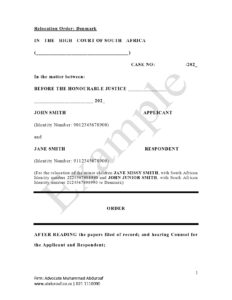 Relocation consent Court Order for minor child to Denmark – Advocate Muhammad Abduroaf[/caption] [caption id="attachment_10826" align="alignnone" width="675"]