Most family law matters come with heightened emotions and stress. It, however, does not always have to be that way. Staying focused and rational is important to get the best results.

Many legal practitioners will tell you, the one aspect of family law, that differentiates it from other branches of law, is the emotions that it brings to their clients. It would often happen that a client breaks down, or sheds a tear in your office. This is understandable, as family law issues have a lot of history behind it. Even simple family law legal matters, for example, the terms of an antenuptial contract, can stir emotion. The lawyer under such cases has to act as a mediator, pacifier and legal advisor at the same time.

Types of family law matters that cause heightened emotions and anxiety

Before we delve into this topic, let us first bring things into perspective. These are some of the family law matters we are referring to:
  • Divorces (Contested or Undefended);
  • Domestic Violence matters;
  • Child maintenance disputes; and
  • Child custody disputes.
The actual list is more extensive. You may even want to consider including last wills and testaments and winding up of deceased estates. As can be seen from the types of matters mentioned, there are always children involved or personal relationships. Some of these relationships have lasted for decades. We often see people who were married for more than 30 years, getting divorced. And in other cases, the relationship, albeit personal, could have been for a very short while, but still, elicit a lot of emotions. For example, a domestic violence family legal matter.

The personal nature of family matters makes it harder to deal with

One of the challenges for a legal practitioner is to try to convince the client that he or she should trust the law, and not focus too much on the other party. For example, in a divorce matter, where a spouse has been abused or constantly been bullied during the relationship. The abused spouse would very often agree to sign away everything just to get divorced speedily. This is not only unfair but could lead to many issues in the future. This situation must be avoided at all costs.

Intimidation in abusive relationships

Then we have the challenge in a domestic violence matter. A party who has been abused would agree on withdrawing an application for a protection order, even though it is dangerous to do so. Or there is the situation where a party would agree that a protection order is issued against them due to being intimidated either by the other party or by his or her lawyer. This they do not do because of having committed domestic violence, but just to get the matter over and done with. The consequence of that is the applying party would have an interdict and a warrant of arrest against you which may be abused.

Intimidation in child maintenance or alimony cases

We cannot count the number of times we have been told that the reason why a parent does not want to approach the maintenance court, is due to being told by the other parent that he or she will get much less than what they are currently receiving. This is emotional and psychological abuse and not in the child’s best interest. One reason for believing the abuser is due to the relationship the parties had. The abuser was controlling and abusive during the relationship, and the victim has been brainwashed into believing everything the abuser said.

What people must try to understand in family legal matters?

Although it is understandable for someone to be anxious when dealing with family law related matters, it is important to note that issues need to be dealt with properly. If your spouse was abusive during your relationship, that does not mean it has to continue after your relationship ended. There are laws in place to protect people from abuse and violence. For example, the Domestic Violence Act. If you make use of the law, you would have a better chance of getting the legal results you want. Go to the police if necessary.

Final words to people who are intimidated by, or is afraid of the other party

Although it is easier said than done, we implore people not to allow themselves to be bullied when it comes to family law matters. This includes being intimidated by the other party, or his or her lawyer. If you have rights; enforce them. Believe in yourself and your cause and others will learn to respect it. Many cases are won by unrepresented litigants who were up against a team of lawyers. Moreover, no one has the right to belittle you or deny you of your rights. Take a stand and fight for what is right. We are certain that you found the above article useful and interesting. Please consider sharing it on the share buttons below. They include Facebook, Twitter, LinkedIn, WhatsApp, Gmail and more. Someone may find it useful as well. Should you require business advice or services, feel free to click on these links: Business SA | Private Legal | Envirolaws  

Most family law matters come with heightened emotions and stress. It, however, does not always have to be that way. Staying focused and rational is important to get the best results.

Many legal practitioners will tell you, the one aspect of family law, that differentiates it from other branches of law, is the emotions that it brings to their clients. It would often happen that a client breaks down, or sheds a tear in your office. This is understandable, as family law issues have a lot of history behind it. Even simple family law legal matters, for example, the terms of an antenuptial contract, can stir emotion. The lawyer under such cases has to act as a mediator, pacifier and legal advisor at the same time.

Types of family law matters that cause heightened emotions and anxiety

Before we delve into this topic, let us first bring things into perspective. These are some of the family law matters we are referring to:

  • Divorces (Contested or Undefended);
  • Domestic Violence matters;
  • Child maintenance disputes; and
  • Child custody disputes.

The actual list is more extensive. You may even want to consider including last wills and testaments and winding up of deceased estates. As can be seen from the types of matters mentioned, there are always children involved or personal relationships. Some of these relationships have lasted for decades. We often see people who were married for more than 30 years, getting divorced. And in other cases, the relationship, albeit personal, could have been for a very short while, but still, elicit a lot of emotions. For example, a domestic violence family legal matter.

The personal nature of family matters makes it harder to deal with

One of the challenges for a legal practitioner is to try to convince the client that he or she should trust the law, and not focus too much on the other party. For example, in a divorce matter, where a spouse has been abused or constantly been bullied during the relationship. The abused spouse would very often agree to sign away everything just to get divorced speedily. This is not only unfair but could lead to many issues in the future. This situation must be avoided at all costs.

Intimidation in abusive relationships

Then we have the challenge in a domestic violence matter. A party who has been abused would agree on withdrawing an application for a protection order, even though it is dangerous to do so. Or there is the situation where a party would agree that a protection order is issued against them due to being intimidated either by the other party or by his or her lawyer. This they do not do because of having committed domestic violence, but just to get the matter over and done with. The consequence of that is the applying party would have an interdict and a warrant of arrest against you which may be abused.

Intimidation in child maintenance or alimony cases

We cannot count the number of times we have been told that the reason why a parent does not want to approach the maintenance court, is due to being told by the other parent that he or she will get much less than what they are currently receiving. This is emotional and psychological abuse and not in the child’s best interest. One reason for believing the abuser is due to the relationship the parties had. The abuser was controlling and abusive during the relationship, and the victim has been brainwashed into believing everything the abuser said.

What people must try to understand in family legal matters?

Although it is understandable for someone to be anxious when dealing with family law related matters, it is important to note that issues need to be dealt with properly. If your spouse was abusive during your relationship, that does not mean it has to continue after your relationship ended. There are laws in place to protect people from abuse and violence. For example, the Domestic Violence Act. If you make use of the law, you would have a better chance of getting the legal results you want. Go to the police if necessary.

Final words to people who are intimidated by, or is afraid of the other party

Although it is easier said than done, we implore people not to allow themselves to be bullied when it comes to family law matters. This includes being intimidated by the other party, or his or her lawyer. If you have rights; enforce them. Believe in yourself and your cause and others will learn to respect it. Many cases are won by unrepresented litigants who were up against a team of lawyers. Moreover, no one has the right to belittle you or deny you of your rights. Take a stand and fight for what is right.

We are certain that you found the above article useful and interesting. Please consider sharing it on the share buttons below. They include Facebook, Twitter, LinkedIn, WhatsApp, Gmail and more. Someone may find it useful as well.

Should you require business advice or services, feel free to click on these links:

Business SA | Private Legal | Envirolaws
 

Related Post

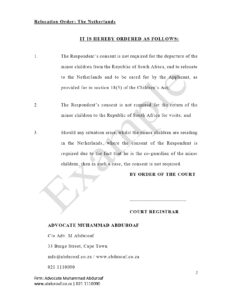
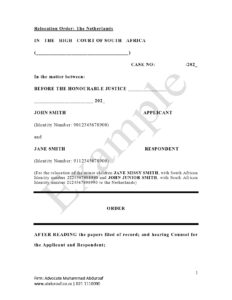
[caption id="attachment_10806" align="alignnone" width="707"]Relocation consent for minor child to Netherlands - Advocate Muhammad Abduroaf Relocation consent for minor child to the Netherlands – Advocate Muhammad Abduroaf[/caption]
I want to relocate from South Africa to the Netherlands with my minor child. The other parent does not want my child to relocate to the Netherlands. What can I do?

The Netherlands is a popular destination to emigrate to. People emigrate from South Africa for many reasons. It ranges from better employment opportunities, family relations, or for a better standard of living. Whatever the reason a parent wants to relocate to the Netherlands, if a minor child will be joining that parent and also relocating to the Netherlands, then the parent remaining in South Africa’s consent would usually be required. Let us unpack the legal issues a parent may encounter when wanting to emigrate to the Netherlands. Before we do so, let us list the various cities and towns in the Netherlands to which you may want to relocate:

Drenthe (province), Meppel, Flevoland (province), Lelystad, Friesland (province), Leeuwarden, Sneek, Gelderland (province), Nijmegen, Renkum, Rheden, Tiel, Zutphen, Groningen (province), Groningen, Limburg (province), Kerkrade, Maastricht, Roermond, Sittard, Tegelen, Venlo, Noord-Brabant (province), Oss, Roosendaal, ’s-Hertogenbosch, Tilburg, Noord-Holland (province), the Netherlands, Den Helder, Marken, Velsen, Volendam, Zaanstad, Overijssel (province), Kampen, Zwolle, Utrecht (province), Soest, Utrecht, Zeist, Zeeland (province), Middelburg, Vlissingen, Zuid-Holland (province), The Hague, Scheveningen, Katwijk, Leiden, Lisse, Rijswijk, Rotterdam, Schiedam, Vlaardingen, Zoetermeer, Caribbean Netherlands (special municipalities), Bonaire (special municipality), Saba (special municipality), Sint Eustatius (special municipality), Aruba (unitary state), Oranjestad, San Nicolas, Curaçao (unitary state), Willemstad, Sint Maarten (unitary state)

(https://www.britannica.com/topic/list-of-cities-and-towns-in-the-Netherlands-2055398)

Why do I require the other parent’s Consent to relocate to the Netherlands?

According to South African law, if you are a co-holder of parental responsibilities and rights over your minor child, you must consent to your child leaving South Africa. In this case, relocating to the Netherlands. Here we refer to section 18 of the Children’s Act 38 of 2005. The entire provision is as follows:

18 Parental responsibilities and rights

 (1) A person may have either full or specific parental responsibilities and rights in respect of a child.

 (2) The parental responsibilities and rights that a person may have in respect of a child, include the responsibility and the right-

 (a) to care for the child;

 (b) to maintain contact with the child;

 (c) to act as guardian of the child; and

 (d) to contribute to the maintenance of the child.

 (3) Subject to subsections (4) and (5), a parent or other person who acts as guardian of a child must-

 (a) administer and safeguard the child’s property and property interests;

 (b) assist or represent the child in administrative, contractual and other legal matters; or

 (c) give or refuse any consent required by law in respect of the child, including-

 (i) consent to the child’s marriage;

 (ii) consent to the child’s adoption;

 (iii) consent to the child’s departure or removal from the Republic;

 (iv) consent to the child’s application for a passport; and

 (v) consent to the alienation or encumbrance of any immovable property of the child.

 (4) Whenever more than one person has guardianship of a child, each one of them is competent, subject to subsection (5), any other law or any order of a competent court to the contrary, to exercise independently and without the Consent of the other any right or responsibility arising from such guardianship.

(5) Unless a competent court orders otherwise, the Consent of all the persons that have guardianship of a child is necessary in respect of matters set out in subsection (3)(c).

Now let us explain what Parental Responsibilities and Rights are.

What are parental Responsibilities and Rights of a parent in relation to a child?

As can be seen from section 18(2) of the Children’s Act, when we refer to Parental Responsibilities and Rights, we refer to the following:

(a) to care for the child;

 (b) to maintain contact with the child;

 (c) to act as guardian of the child; and

 (d) to contribute to the maintenance of the child.

Therefore, if a parent has parental responsibilities and rights over a minor child, and accordingly, rights of guardianship, their Consent is required when it comes to issues of guardianship. As seen from section 18(3)(c) of the Children’s Act above, both parents’ Consent is required should a minor child depart from the Republic of South Africa. In this case, to emigrate to the Netherlands. Even if the minor child only wants to go for a short holiday to the Netherlands, both guardians’ Consent would be required.

When would the other parent be seen as a guardian in the case of a relocation matter to the Netherlands?

It must be noted that not all parents are legal guardians over their minor children. We should therefore distinguish between married or divorced parents and parents who were never married. As you would see below, usually married, or divorced parents’ Consent would be required for a minor child to relocate or emigrate to the Netherlands. However, that does not automatically apply to parents who were never married. This could be because the child could have been born from a brief encounter and never met his or her father. It would not make sense that a parent who never met his or her 15-year-old child, should give Consent for relocation to the Netherlands.

Mother’s Consent for relocation of the minor child to the Netherlands

Section 19 of the Children’s Act deals with the Parental responsibilities and rights of mothers. It states the following:

19 Parental responsibilities and rights of mothers

 (1) The biological mother of a child, whether married or unmarried, has full parental responsibilities and rights in respect of the child.

 (2) If-

 (a) the biological mother of a child is an unmarried child who does not have guardianship in respect of the child; and

 (b) the biological father of the child does not have guardianship in respect of the child, the guardian of the child’s biological mother is also the guardian of the child.

 (3) This section does not apply in respect of a child who is the subject of a surrogacy agreement.

As seen from section 19(1) of the Children’s Act, in most cases involving the relocation of a minor child to the Netherlands, the mother’s Consent is required as she has full parental responsibilities and rights over the minor child.

Married father’s Consent for the relocation of the minor child to the Netherlands

Section 20 of the Children’s Act deals with Parental responsibilities and rights of married fathers. It states the following:

20 Parental responsibilities and rights of married fathers

The biological father of a child has full parental responsibilities and rights in respect of the child-

(a) if he is married to the child’s mother; or

(b) if he was married to the child’s mother at (i) the time of the child’s conception; (ii) the time of the child’s birth; or (iii) any time between the child’s conception and birth.

As can be seen from sections 20 (a) and (b) of the Children’s Act, if the father and the mother were married, or are married, then his Consent is required for the minor child to relocate to the Netherlands. Of course, an exception to this would be should a court of law order otherwise. This would be the case should the parents be divorced and the divorce court ordered that only the mother may act as guardian. Next, we deal with the issue of an unmarried father’s Consent to relocate a minor child to the Netherlands.

Consent of unmarried fathers for the relocation of their minor children to the Netherlands.

Section 21 of the Children’s Act deals with parental responsibilities and rights of unmarried fathers. The section states the following:

21 Parental responsibilities and rights of unmarried fathers

 (1) The biological father of a child who does not have parental responsibilities and rights in respect of the child in terms of section 20, acquires full parental responsibilities and rights in respect of the child-

 (a) if at the time of the child’s birth he is living with the mother in a permanent life-partnership; or

 (b) if he, regardless of whether he has lived or is living with the mother-

 (i) consents to be identified or successfully applies in terms of section 26 to be identified as the child’s father or pays damages in terms of customary law;

 (ii) contributes or has attempted in good faith to contribute to the child’s upbringing for a reasonable period; and

 (iii) contributes or has attempted in good faith to contribute towards expenses in connection with the maintenance of the child for a reasonable period.

 (2) This section does not affect the duty of a father to contribute towards the maintenance of the child.

 (3) (a) If there is a dispute between the biological father referred to in subsection (1) and the biological mother of a child with regard to the fulfilment by that father of the conditions set out in subsection (1) (a) or (b), the matter must be referred for mediation to a family advocate, social worker, social service professional or other suitably qualified person.

 (b) Any party to the mediation may have the outcome  of the mediation reviewed by a

court.

 (4) This section applies regardless of whether the child was born before or after the commencement of this Act.

As can be seen from the latter sections, a father of a child born out of wedlock does not automatically have parental responsibilities and rights over his minor child. He may however acquire those parental responsibilities and rights over his minor child if he is materially involved in the child’s life. That would be where the father and the mother were in a permanent life partnership when the child was born or he is meaningfully involved in the child’s life, as outlined above. We shall not go into much detail regarding that. However, in most cases, if the father had regular contact with the child and paid child support, he would have acquired parental responsibilities and rights over the minor child.

What do you do if the other parent does not want to consent to the minor child relocating to the Netherlands?

Suppose the other parent also has parental responsibilities and rights over the minor child, and he or she does not want to consent to the relocation of the minor child to the Netherlands, then in such a case, the Court needs to be approached. Here I refer you back to section 18(5) of the Children’s Act referred to above where it states:

(5) Unless a competent court orders otherwise, the Consent of all the persons that have guardianship of a child is necessary in respect of matters set out in subsection (3)(c).

Therefore, after your Court Application has been launched an both sides have been heard, the Court would make the necessary Order. If you are successful in your application for the relocation of your minor children to the Netherlands, then the Court will make an Order similar to that which is shown below. [caption id="attachment_10805" align="alignnone" width="715"]Relocation consent for minor child to Netherlands - Advocate Muhammad Abduroaf Relocation consent Order for minor child to the Netherlands – Advocate Muhammad Abduroaf[/caption] [caption id="attachment_10806" align="alignnone" width="694"]Relocation consent for minor child to Netherlands - Advocate Muhammad Abduroaf Relocation consent Order for minor child to the Netherlands – Advocate Muhammad Abduroaf[/caption]  

Do you require a video legal advice consultation?

Click here and schedule one today!