[caption id="attachment_10806" align="alignnone" width="707"]Relocation consent for minor child to Netherlands - Advocate Muhammad Abduroaf Relocation consent for minor child to the Netherlands – Advocate Muhammad Abduroaf[/caption]

I want to relocate from South Africa to the Netherlands with my minor child. The other parent does not want my child to relocate to the Netherlands. What can I do?

The Netherlands is a popular destination to emigrate to. People emigrate from South Africa for many reasons. It ranges from better employment opportunities, family relations, or for a better standard of living. Whatever the reason a parent wants to relocate to the Netherlands, if a minor child will be joining that parent and also relocating to the Netherlands, then the parent remaining in South Africa’s consent would usually be required. Let us unpack the legal issues a parent may encounter when wanting to emigrate to the Netherlands. Before we do so, let us list the various cities and towns in the Netherlands to which you may want to relocate:

Drenthe (province), Meppel, Flevoland (province), Lelystad, Friesland (province), Leeuwarden, Sneek, Gelderland (province), Nijmegen, Renkum, Rheden, Tiel, Zutphen, Groningen (province), Groningen, Limburg (province), Kerkrade, Maastricht, Roermond, Sittard, Tegelen, Venlo, Noord-Brabant (province), Oss, Roosendaal, ’s-Hertogenbosch, Tilburg, Noord-Holland (province), the Netherlands, Den Helder, Marken, Velsen, Volendam, Zaanstad, Overijssel (province), Kampen, Zwolle, Utrecht (province), Soest, Utrecht, Zeist, Zeeland (province), Middelburg, Vlissingen, Zuid-Holland (province), The Hague, Scheveningen, Katwijk, Leiden, Lisse, Rijswijk, Rotterdam, Schiedam, Vlaardingen, Zoetermeer, Caribbean Netherlands (special municipalities), Bonaire (special municipality), Saba (special municipality), Sint Eustatius (special municipality), Aruba (unitary state), Oranjestad, San Nicolas, Curaçao (unitary state), Willemstad, Sint Maarten (unitary state)

(https://www.britannica.com/topic/list-of-cities-and-towns-in-the-Netherlands-2055398)

Why do I require the other parent’s Consent to relocate to the Netherlands?

According to South African law, if you are a co-holder of parental responsibilities and rights over your minor child, you must consent to your child leaving South Africa. In this case, relocating to the Netherlands. Here we refer to section 18 of the Children’s Act 38 of 2005. The entire provision is as follows:

18 Parental responsibilities and rights

 (1) A person may have either full or specific parental responsibilities and rights in respect of a child.

 (2) The parental responsibilities and rights that a person may have in respect of a child, include the responsibility and the right-

 (a) to care for the child;

 (b) to maintain contact with the child;

 (c) to act as guardian of the child; and

 (d) to contribute to the maintenance of the child.

 (3) Subject to subsections (4) and (5), a parent or other person who acts as guardian of a child must-

 (a) administer and safeguard the child’s property and property interests;

 (b) assist or represent the child in administrative, contractual and other legal matters; or

 (c) give or refuse any consent required by law in respect of the child, including-

 (i) consent to the child’s marriage;

 (ii) consent to the child’s adoption;

 (iii) consent to the child’s departure or removal from the Republic;

 (iv) consent to the child’s application for a passport; and

 (v) consent to the alienation or encumbrance of any immovable property of the child.

 (4) Whenever more than one person has guardianship of a child, each one of them is competent, subject to subsection (5), any other law or any order of a competent court to the contrary, to exercise independently and without the Consent of the other any right or responsibility arising from such guardianship.

(5) Unless a competent court orders otherwise, the Consent of all the persons that have guardianship of a child is necessary in respect of matters set out in subsection (3)(c).

Now let us explain what Parental Responsibilities and Rights are.

What are parental Responsibilities and Rights of a parent in relation to a child?

As can be seen from section 18(2) of the Children’s Act, when we refer to Parental Responsibilities and Rights, we refer to the following:

(a) to care for the child;

 (b) to maintain contact with the child;

 (c) to act as guardian of the child; and

 (d) to contribute to the maintenance of the child.

Therefore, if a parent has parental responsibilities and rights over a minor child, and accordingly, rights of guardianship, their Consent is required when it comes to issues of guardianship. As seen from section 18(3)(c) of the Children’s Act above, both parents’ Consent is required should a minor child depart from the Republic of South Africa. In this case, to emigrate to the Netherlands. Even if the minor child only wants to go for a short holiday to the Netherlands, both guardians’ Consent would be required.

When would the other parent be seen as a guardian in the case of a relocation matter to the Netherlands?

It must be noted that not all parents are legal guardians over their minor children. We should therefore distinguish between married or divorced parents and parents who were never married. As you would see below, usually married, or divorced parents’ Consent would be required for a minor child to relocate or emigrate to the Netherlands. However, that does not automatically apply to parents who were never married. This could be because the child could have been born from a brief encounter and never met his or her father. It would not make sense that a parent who never met his or her 15-year-old child, should give Consent for relocation to the Netherlands.

Mother’s Consent for relocation of the minor child to the Netherlands

Section 19 of the Children’s Act deals with the Parental responsibilities and rights of mothers. It states the following:

19 Parental responsibilities and rights of mothers

 (1) The biological mother of a child, whether married or unmarried, has full parental responsibilities and rights in respect of the child.

 (2) If-

 (a) the biological mother of a child is an unmarried child who does not have guardianship in respect of the child; and

 (b) the biological father of the child does not have guardianship in respect of the child, the guardian of the child’s biological mother is also the guardian of the child.

 (3) This section does not apply in respect of a child who is the subject of a surrogacy agreement.

As seen from section 19(1) of the Children’s Act, in most cases involving the relocation of a minor child to the Netherlands, the mother’s Consent is required as she has full parental responsibilities and rights over the minor child.

Married father’s Consent for the relocation of the minor child to the Netherlands

Section 20 of the Children’s Act deals with Parental responsibilities and rights of married fathers. It states the following:

20 Parental responsibilities and rights of married fathers

The biological father of a child has full parental responsibilities and rights in respect of the child-

(a) if he is married to the child’s mother; or

(b) if he was married to the child’s mother at (i) the time of the child’s conception; (ii) the time of the child’s birth; or (iii) any time between the child’s conception and birth.

As can be seen from sections 20 (a) and (b) of the Children’s Act, if the father and the mother were married, or are married, then his Consent is required for the minor child to relocate to the Netherlands. Of course, an exception to this would be should a court of law order otherwise. This would be the case should the parents be divorced and the divorce court ordered that only the mother may act as guardian. Next, we deal with the issue of an unmarried father’s Consent to relocate a minor child to the Netherlands.

Consent of unmarried fathers for the relocation of their minor children to the Netherlands.

Section 21 of the Children’s Act deals with parental responsibilities and rights of unmarried fathers. The section states the following:

21 Parental responsibilities and rights of unmarried fathers

 (1) The biological father of a child who does not have parental responsibilities and rights in respect of the child in terms of section 20, acquires full parental responsibilities and rights in respect of the child-

 (a) if at the time of the child’s birth he is living with the mother in a permanent life-partnership; or

 (b) if he, regardless of whether he has lived or is living with the mother-

 (i) consents to be identified or successfully applies in terms of section 26 to be identified as the child’s father or pays damages in terms of customary law;

 (ii) contributes or has attempted in good faith to contribute to the child’s upbringing for a reasonable period; and

 (iii) contributes or has attempted in good faith to contribute towards expenses in connection with the maintenance of the child for a reasonable period.

 (2) This section does not affect the duty of a father to contribute towards the maintenance of the child.

 (3) (a) If there is a dispute between the biological father referred to in subsection (1) and the biological mother of a child with regard to the fulfilment by that father of the conditions set out in subsection (1) (a) or (b), the matter must be referred for mediation to a family advocate, social worker, social service professional or other suitably qualified person.

 (b) Any party to the mediation may have the outcome  of the mediation reviewed by a

court.

 (4) This section applies regardless of whether the child was born before or after the commencement of this Act.

As can be seen from the latter sections, a father of a child born out of wedlock does not automatically have parental responsibilities and rights over his minor child. He may however acquire those parental responsibilities and rights over his minor child if he is materially involved in the child’s life. That would be where the father and the mother were in a permanent life partnership when the child was born or he is meaningfully involved in the child’s life, as outlined above. We shall not go into much detail regarding that. However, in most cases, if the father had regular contact with the child and paid child support, he would have acquired parental responsibilities and rights over the minor child.

What do you do if the other parent does not want to consent to the minor child relocating to the Netherlands?

Suppose the other parent also has parental responsibilities and rights over the minor child, and he or she does not want to consent to the relocation of the minor child to the Netherlands, then in such a case, the Court needs to be approached. Here I refer you back to section 18(5) of the Children’s Act referred to above where it states:

(5) Unless a competent court orders otherwise, the Consent of all the persons that have guardianship of a child is necessary in respect of matters set out in subsection (3)(c).

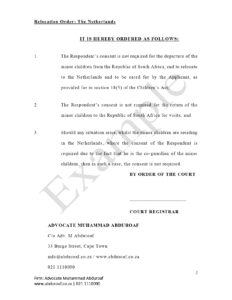
Therefore, after your Court Application has been launched an both sides have been heard, the Court would make the necessary Order. If you are successful in your application for the relocation of your minor children to the Netherlands, then the Court will make an Order similar to that which is shown below. [caption id="attachment_10805" align="alignnone" width="715"]Relocation consent for minor child to Netherlands - Advocate Muhammad Abduroaf Relocation consent Order for minor child to the Netherlands – Advocate Muhammad Abduroaf[/caption] [caption id="attachment_10806" align="alignnone" width="694"]Relocation consent for minor child to Netherlands - Advocate Muhammad Abduroaf Relocation consent Order for minor child to the Netherlands – Advocate Muhammad Abduroaf[/caption]  
Relocation consent for minor child to Netherlands - Advocate Muhammad Abduroaf
Relocation consent for minor child to the Netherlands – Advocate Muhammad Abduroaf

I want to relocate from South Africa to the Netherlands with my minor child. The other parent does not want my child to relocate to the Netherlands. What can I do?

The Netherlands is a popular destination to emigrate to. People emigrate from South Africa for many reasons. It ranges from better employment opportunities, family relations, or for a better standard of living. Whatever the reason a parent wants to relocate to the Netherlands, if a minor child will be joining that parent and also relocating to the Netherlands, then the parent remaining in South Africa’s consent would usually be required. Let us unpack the legal issues a parent may encounter when wanting to emigrate to the Netherlands. Before we do so, let us list the various cities and towns in the Netherlands to which you may want to relocate:

Drenthe (province), Meppel, Flevoland (province), Lelystad, Friesland (province), Leeuwarden, Sneek, Gelderland (province), Nijmegen, Renkum, Rheden, Tiel, Zutphen, Groningen (province), Groningen, Limburg (province), Kerkrade, Maastricht, Roermond, Sittard, Tegelen, Venlo, Noord-Brabant (province), Oss, Roosendaal, ’s-Hertogenbosch, Tilburg, Noord-Holland (province), the Netherlands, Den Helder, Marken, Velsen, Volendam, Zaanstad, Overijssel (province), Kampen, Zwolle, Utrecht (province), Soest, Utrecht, Zeist, Zeeland (province), Middelburg, Vlissingen, Zuid-Holland (province), The Hague, Scheveningen, Katwijk, Leiden, Lisse, Rijswijk, Rotterdam, Schiedam, Vlaardingen, Zoetermeer, Caribbean Netherlands (special municipalities), Bonaire (special municipality), Saba (special municipality), Sint Eustatius (special municipality), Aruba (unitary state), Oranjestad, San Nicolas, Curaçao (unitary state), Willemstad, Sint Maarten (unitary state)

(https://www.britannica.com/topic/list-of-cities-and-towns-in-the-Netherlands-2055398)

Why do I require the other parent’s Consent to relocate to the Netherlands?

According to South African law, if you are a co-holder of parental responsibilities and rights over your minor child, you must consent to your child leaving South Africa. In this case, relocating to the Netherlands.

Here we refer to section 18 of the Children’s Act 38 of 2005. The entire provision is as follows:

18 Parental responsibilities and rights

 (1) A person may have either full or specific parental responsibilities and rights in respect of a child.

 (2) The parental responsibilities and rights that a person may have in respect of a child, include the responsibility and the right-

 (a) to care for the child;

 (b) to maintain contact with the child;

 (c) to act as guardian of the child; and

 (d) to contribute to the maintenance of the child.

 (3) Subject to subsections (4) and (5), a parent or other person who acts as guardian of a child must-

 (a) administer and safeguard the child’s property and property interests;

 (b) assist or represent the child in administrative, contractual and other legal matters; or

 (c) give or refuse any consent required by law in respect of the child, including-

 (i) consent to the child’s marriage;

 (ii) consent to the child’s adoption;

 (iii) consent to the child’s departure or removal from the Republic;

 (iv) consent to the child’s application for a passport; and

 (v) consent to the alienation or encumbrance of any immovable property of the child.

 (4) Whenever more than one person has guardianship of a child, each one of them is competent, subject to subsection (5), any other law or any order of a competent court to the contrary, to exercise independently and without the Consent of the other any right or responsibility arising from such guardianship.

(5) Unless a competent court orders otherwise, the Consent of all the persons that have guardianship of a child is necessary in respect of matters set out in subsection (3)(c).

Now let us explain what Parental Responsibilities and Rights are.

What are parental Responsibilities and Rights of a parent in relation to a child?

As can be seen from section 18(2) of the Children’s Act, when we refer to Parental Responsibilities and Rights, we refer to the following:

(a) to care for the child;

 (b) to maintain contact with the child;

 (c) to act as guardian of the child; and

 (d) to contribute to the maintenance of the child.

Therefore, if a parent has parental responsibilities and rights over a minor child, and accordingly, rights of guardianship, their Consent is required when it comes to issues of guardianship. As seen from section 18(3)(c) of the Children’s Act above, both parents’ Consent is required should a minor child depart from the Republic of South Africa. In this case, to emigrate to the Netherlands. Even if the minor child only wants to go for a short holiday to the Netherlands, both guardians’ Consent would be required.

When would the other parent be seen as a guardian in the case of a relocation matter to the Netherlands?

It must be noted that not all parents are legal guardians over their minor children. We should therefore distinguish between married or divorced parents and parents who were never married. As you would see below, usually married, or divorced parents’ Consent would be required for a minor child to relocate or emigrate to the Netherlands. However, that does not automatically apply to parents who were never married. This could be because the child could have been born from a brief encounter and never met his or her father. It would not make sense that a parent who never met his or her 15-year-old child, should give Consent for relocation to the Netherlands.

Mother’s Consent for relocation of the minor child to the Netherlands

Section 19 of the Children’s Act deals with the Parental responsibilities and rights of mothers. It states the following:

19 Parental responsibilities and rights of mothers

 (1) The biological mother of a child, whether married or unmarried, has full parental responsibilities and rights in respect of the child.

 (2) If-

 (a) the biological mother of a child is an unmarried child who does not have guardianship in respect of the child; and

 (b) the biological father of the child does not have guardianship in respect of the child, the guardian of the child’s biological mother is also the guardian of the child.

 (3) This section does not apply in respect of a child who is the subject of a surrogacy agreement.

As seen from section 19(1) of the Children’s Act, in most cases involving the relocation of a minor child to the Netherlands, the mother’s Consent is required as she has full parental responsibilities and rights over the minor child.

Married father’s Consent for the relocation of the minor child to the Netherlands

Section 20 of the Children’s Act deals with Parental responsibilities and rights of married fathers. It states the following:

20 Parental responsibilities and rights of married fathers

The biological father of a child has full parental responsibilities and rights in respect of the child-

(a) if he is married to the child’s mother; or

(b) if he was married to the child’s mother at (i) the time of the child’s conception; (ii) the time of the child’s birth; or (iii) any time between the child’s conception and birth.

As can be seen from sections 20 (a) and (b) of the Children’s Act, if the father and the mother were married, or are married, then his Consent is required for the minor child to relocate to the Netherlands. Of course, an exception to this would be should a court of law order otherwise. This would be the case should the parents be divorced and the divorce court ordered that only the mother may act as guardian. Next, we deal with the issue of an unmarried father’s Consent to relocate a minor child to the Netherlands.

Consent of unmarried fathers for the relocation of their minor children to the Netherlands.

Section 21 of the Children’s Act deals with parental responsibilities and rights of unmarried fathers. The section states the following:

21 Parental responsibilities and rights of unmarried fathers

 (1) The biological father of a child who does not have parental responsibilities and rights in respect of the child in terms of section 20, acquires full parental responsibilities and rights in respect of the child-

 (a) if at the time of the child’s birth he is living with the mother in a permanent life-partnership; or

 (b) if he, regardless of whether he has lived or is living with the mother-

 (i) consents to be identified or successfully applies in terms of section 26 to be identified as the child’s father or pays damages in terms of customary law;

 (ii) contributes or has attempted in good faith to contribute to the child’s upbringing for a reasonable period; and

 (iii) contributes or has attempted in good faith to contribute towards expenses in connection with the maintenance of the child for a reasonable period.

 (2) This section does not affect the duty of a father to contribute towards the maintenance of the child.

 (3) (a) If there is a dispute between the biological father referred to in subsection (1) and the biological mother of a child with regard to the fulfilment by that father of the conditions set out in subsection (1) (a) or (b), the matter must be referred for mediation to a family advocate, social worker, social service professional or other suitably qualified person.

 (b) Any party to the mediation may have the outcome  of the mediation reviewed by a

court.

 (4) This section applies regardless of whether the child was born before or after the commencement of this Act.

As can be seen from the latter sections, a father of a child born out of wedlock does not automatically have parental responsibilities and rights over his minor child. He may however acquire those parental responsibilities and rights over his minor child if he is materially involved in the child’s life. That would be where the father and the mother were in a permanent life partnership when the child was born or he is meaningfully involved in the child’s life, as outlined above. We shall not go into much detail regarding that. However, in most cases, if the father had regular contact with the child and paid child support, he would have acquired parental responsibilities and rights over the minor child.

What do you do if the other parent does not want to consent to the minor child relocating to the Netherlands?

Suppose the other parent also has parental responsibilities and rights over the minor child, and he or she does not want to consent to the relocation of the minor child to the Netherlands, then in such a case, the Court needs to be approached. Here I refer you back to section 18(5) of the Children’s Act referred to above where it states:

(5) Unless a competent court orders otherwise, the Consent of all the persons that have guardianship of a child is necessary in respect of matters set out in subsection (3)(c).

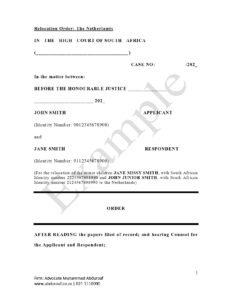
Therefore, after your Court Application has been launched an both sides have been heard, the Court would make the necessary Order. If you are successful in your application for the relocation of your minor children to the Netherlands, then the Court will make an Order similar to that which is shown below.

Relocation consent for minor child to Netherlands - Advocate Muhammad Abduroaf
Relocation consent Order for minor child to the Netherlands – Advocate Muhammad Abduroaf
Relocation consent for minor child to Netherlands - Advocate Muhammad Abduroaf
Relocation consent Order for minor child to the Netherlands – Advocate Muhammad Abduroaf


Related Post

Relocation with my minor child to Vietnam, Ha Long (Consent and Refusal) – Advocate Muhammad Abduroaf

The world is becoming a much smaller place, and technology plays a huge role. People are moving across the world for employment, love and happiness, something that was not the norm a few decades ago. There is no reason why you should remain in South Africa if you can find a better life for yourself and your family overseas. Moving overseas may provide you with the quality of life you want or the possibility of experiencing things you always wanted. The same applies to your child or children relocating with you.

Relocation of your minor child to Ha Long, Vietnam

If you are single and do not have any minor children, then moving around the world would not be too complicated. All you need to do is ensure that you have the necessary travel documentation and travel ticket (and spending money), and off you go. However, if you want to travel with your minor children (for example, ages five or six) or relocate to another country, things may not be that simple. Firstly, if there is another parent, and he or she has parental responsibilities and rights, then his or her consent is required. For example, let us say you live in Butterworth or Bloemfontein, South Africa, and you want to relocate to Ha Long, Vietnam, you would require the other parent’s consent to leave South Africa with your minor child. This can cause challenges, especially if the staying parent (in South Africa) does not agree to the relocation.

What about Passport Consent to travel or relocate to Ha Long, Vietnam?

The same applies when it comes to your minor child applying for a South African passport to relocate to Vietnam, or any country. Both parents who have parental responsibilities and rights of guardianship will have to consent to the minor child’s passport application as well. In this regard, both parents have to be at the Department of Home Affairs (or the relevant bank that also assists with passport application) when making the Application with the minor child. This can be challenging if you have a disinterested parent who does not want to cooperate with the passport application. As you will see later, legal action would need to be taken.

What are the steps to follow when I want to relocate to Ha Long, Vietnam with my minor child? There is there another parent.

To simplify the process for relocation, the first step would be to receive the other parent’s consent in principle for the relocation and that he or she will co-operate in this regard. Once that has been resolved, the parent relocating would need to make the appointment for the minor child’s passport application as well as the application for the relevant VISA. Each country has different requirements; however, seeing that it is a relocation, you need to apply for the correct VISA. For that, you need the Passport. Once the visa and travel arrangements have been finalised, the parent remaining behind will sign a parental consent letter for the international travel. That letter can be found on the Department of Home Affairs website. Basically, the parent remaining behind would state that he or she gives consent for the minor child to leave the Republic of South Africa and travel and/or relocate to Ha Long, Vietnam.

What can I do if the other parent does not want to consent to the minor child’s relocation to Ha Long, Vietnam?

If the parent remaining in South Africa does not want to consent to the minor child’s passport application and/or his or her relocation to Ha Long, Vietnam, then you would need to approach the Court. The Court, as upper guardian of the minor child, may order that the parent’s consent for the passport application and relocation be dispensed with. What this entails is submitting Court documents explaining why you want to relocate to Ha Long, Vietnam. The other parent would also have an opportunity to give reasons why he or she objects. At the end of the process, the Court would determine what is in the minor child’s best interests. If it is in the minor child’s best interests to relocate to Ha Long, Vietnam, the Court would make it possible despite the issue of consent or refusal.

What is the first step I should take if the other parent does not want to consent to the minor child’s passport application and/or relocation to Ha Long, Vietnam?

If the other parent does not want to consent to the passport application and/or the relocation of the minor child to Ha Long, Vietnam – in that case, we suggest you approach an attorney or advocate (trust account) to assist you with the legal process. He or she would then contact the other parent explaining the reasons for the relocation and request the necessary consent. If the parent remaining in South Africa does still not agree to the passport application and/or to the relocation to Ha Long, Vietnam, then the attorney or advocate will proceed to take the matter to court. The legal route can be expensive. However, it is necessary to make the relocation of the minor child possible. You may also attend to the legal process yourself.

Getting legal assistance or help with your relocation application to Ha Long, Vietnam

If you require legal assistance or representation with relocating to Ha Long, Vietnam due to the other parent not cooperating or providing consent, then feel free to contact us for assistance. The Firm Advocate, Muhammad Abduroaf, deals with these types of matters.

Divorce – Questions and Answers on the Process and Procedure

advice-child-maintenance-child-custody-divorceDivorces signify the end of marriages. However, it can also be seen as a beginning of a new life. Once a couple has tried everything to save their marriage, to no avail, a divorce is an inevitable consequence. With divorces, comes the law. Only a court can legally divorce you. And because of this, people have many questions on the divorce procedure and process. This post is intended to assist parties whose marriage had irretrievably broken down by answering frequently asked questions on divorces. Due to the nature of legal matters, it is best to make use of an attorney or get the advice of a legal professional when dealing with a divorce. However, we intend giving you a general overview of the divorce process below with the assistance of Adv. Muhammad Abduroaf.

Family Law Questions and Answers

Should you not find what you are looking for, feel free to post your questions on our blog, by clicking on the following links:

Divorces – Questions and Answers

Child Custody – Questions and Answers

Child Maintenance – Question and Answers

Domestic Violence – Questions and Answers

You are welcome to call us on 021 424 3487 / 0870735800

For other legal and business services, feel free to visit:

Business SA or Private Legal.

Divorce – Things to Consider

There are a few things to consider when proceeding with a divorce. Depending on the issues involved, it would determine how quick or how complicated your divorce could be. They are as follows:

Minor Children in divorces

As a consequence of marriage, are children. If your children are 18 years or older at the time of the divorce, they would not be a factor, as they are adults. However, if they are younger than 18 years old, their interests are affected in the divorce process. The Court won’t divorce you unless it is satisfied that their best interests are taken care of. When a divorce settlement is reached, the settlement should be taken to the Office of the Family Advocate. The Family Advocate would then study the document, and, if they are satisfied with it, enforce it. If they are not happy with it or have any issues, they will usually provide it in a cover letter. Factors to consider are the following:
  • Child Maintenance
  • Primary Residence
  • Parental Responsibilities and Rights of Care and Contact
  • Guardianship
  • Facilitation or Dispute Resolution
The Court is however not bound by the views of the Family Advocate. The Court would consider it, however, if the Court feels that the settlement agreement or recommendations of the Family Advocate is not in the child’s best interests, it would then make the appropriate order. In our view, if the parents came to an agreement, and they believe it is workable, it would most of the time be in the children’s best interests for the agreement to be made an Order of Court. Purchase our Unopposed Divorce Package, click here.

Matrimonial Property Regime

The Matrimonial Property Regime the Parties are married in is an important aspect to consider when getting divorced. This we unpack next.

In Community of Property

The default Matrimonial Property Regime is that of “In Community of Property”. What this basically means is that there is one joint estate. In other words, there are no longer two separate estates. By way of example, if the husband takes out a loan, the wife is also responsible to repay it. This is so as the Joint Estate incurred the debt. The husband could not have incurred the debt solely as he does not have a separate estate.

Out of Community of Property

It has become the trend for people to get married “Out of Community of Property”. What this means is that there are two separate estates. It is as if you are not married. The wife can enter into loans and agreements without the consent of her husband, and his estate would not be affected by that. There are however two variables to being married Out of Community of Property. That is married Out of Community of Property with the inclusion of the accrual regime, and the other without.

Accrual Regime Included in Your Marriage

If the accrual regime is not specifically excluded in the Ante-nuptial Contract, then it is by default included. What this means, is that during the marriage, there are two separate estates. You can do what you please without the consent or consideration of the other party’s estate. However, at divorce, or death of one of the parties, you must share in half the difference of the accruals of each estate. So, for example, if the accrual regime applies, and at divorce, the husband’s estate is worth R 10 000 – 00 and the wife’s estate is worth R 5 000 – 00; then he should pay her R 2500 – 00 in cash. The same would apply at death. Both parties would, therefore, leave the marriage with the sum of R 7 500 – 00. This regime would be beneficial where the wife or husband stays at home, looking after the household and children. The other spouse would be working on building an empire.

Accrual Regime Expressly Excluded in your marriage

Let’s say the parties got married Out of Community of Property. However, in their Ante-nuptial contract, they specifically excluded the accrual regime. In that case, there would be two separate estates during the marriage. And at divorce or death, there would still be two separate estates and neither spouse would have to pay the other spouse any amount. If both spouses are working during the marriage, building their own empires, then this regime would be a better option.

Pension Funds in Divorces

Pension funds would apply to marriages in Community of Property, and where the accrual regime applies, to marriages out of Community of Property. When the parties divorce, in the case of a marriage in Community of Property, a spouse has a claim to half the Pension Fund of the other spouse. If they are married Out of Community of Property with the accrual regime, then the value of the pension fund is taken into consideration when determining the accrual. Therefore, if both the pension funds are the same in value, and both parties have the same amount of assets; there would be no accrual. This would be so if all else is equal. Next, we move to the divorce process and procedure, written by Adv. Muhammad Abduroaf. Pictures are provided for some assistance.

The Divorce Process

Some advice from Adv. Muhammad Abduroaf

First, some Legal Advice

If you want to get divorced from your spouse, I strongly advise that your approach a legal practitioner, or an attorney to attend to it on your behalf. This I would implore even more under the following circumstances:
  • There will be a dispute over care and visitation rights over the child/children;
  • One of the parties shall be applying for forfeiture of patrimonial benefits from a marriage in community of property;
  • The joint estate is huge or complicated; or
  • The other party shall be making use of legal representation.

General Divorce Process and Procedure

If, however, you would like to know the general procedures on how to go about in obtaining a divorce decree; they are listed summarily below. There are many rules that regulate divorce processes and the summary below does exclude some of them. These include exceptions, strikeouts, compelling compliance, service addresses etc. Other matters incidental to divorce proceedings, e.g. interim arrangements, pending the divorce regarding maintenance for you or your children and care and contact regarding children are not dealt with. Therefore, please consult a legal practitioner or the divorce court throughout your divorce process should you decide to do the divorce yourself. Purchase our Unopposed Divorce Package, click here.

Summons and Particulars of Claim

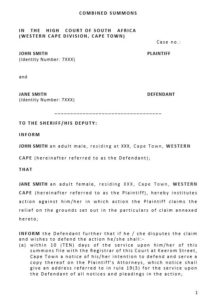
A summons needs to be drafted which should be issued by the divorce court to commence the divorce process. It should have on it the details of the court you will be issuing the divorce from, details of the parties, e.g. names, occupation and address etc. Every High Court in the area where you live has the authority to attend to a divorce. You should then draft a particulars of claim outlining relevant matters concerning the marriage, children, reasons for wanting a divorce and what do you want the court to grant you in a divorce order. These particulars of claim you attach to the summons. [caption id="attachment_6734" align="alignleft" width="800"]Divorce Process Summons - Divorce Lawyer Example of a Divorce Summons[/caption] https://www.ourlawyer.co.za/wp-content/uploads/Divorce-Summons-Divorce-Lawyer-Process-217×300.jpg
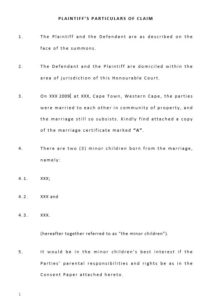
Divorce Particulars of Claim

Once you have your summons and particulars of claim in order, you have to have the summons issued. To do this, make three (3) copies of your set of documents (Summons and Particulars of Claim) and have it issued at court. [caption id="attachment_6731" align="alignleft" width="800"]Divorce Process - Divorce Atorney Example of A Particulars of Claim in a Divorce Action[/caption]
Issuing and Service of Divorce Summons and Particulars of Claim

advice-child-maintenance-child-custody-divorceOnce you are at the court, go to the clerk/registrar of the court and have your documents issued. The clerk/registrar will sign the summons and provide a case number by writing it on the summons. You should then take the original and a copy (both must be signed and stamped by the clerk/registrar of the court) and take it to the sheriff which serves documents where your spouse work, of lives. You can ask the clerk/registrar of the court for that details. The extra—copy of the summons and particulars of claim you keep for your file and records.

Notice of intention to defend

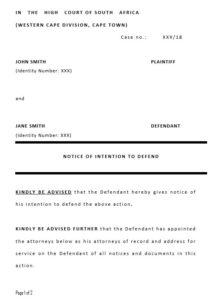
Once the sheriff served the documents, your spouse has two weeks to inform you of whether he or she shall be defending the divorce. This information is outlined in the summons. If your spouse decided not to defend the divorce action, then after a period of two weeks has elapsed, you may set the matter down as an undefended divorce. If your spouse intends to defend the divorce, he or she would then have to file the notice of intention to defend. In this notice, you would advise the Court and the Plaintiff that you are defending the divorce, and also, provide a service address. The Service Address is the address at which the Plaintiff would send notices in the court case to you. Below, kindly find an example of a Notice of Intention to Defend. [caption id="attachment_6743" align="alignleft" width="800"]Divorce Lawyer Cape Town Notice of Intention to Defend[/caption]
Divorce Plea to particulars of claim

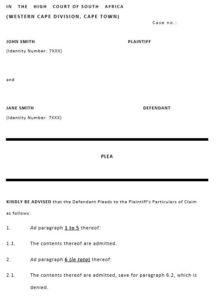
Once you received notice of your spouse’s intention to defend the divorce, about a month later, your spouse or his or attorney should serve and file a plea. The plea should outline which parts of your particulars of claim your spouse agrees (or disagree) with which would give a direction of what to prove at court. Purchase our Unopposed Divorce Package, click here. [caption id="attachment_6740" align="alignleft" width="800"]Plea - Divorce Process - Lawyer Plea in a Divorce Action[/caption]  

[caption id="attachment_6739" align="alignleft" width="903"] Plea in a Divorce Action[/caption]

Divorce Counterclaim or Claim in Reconvention

Your spouse might want to file a counterclaim or claim in reconvention. In the same way which you outlined your case as to what you want from the court and the reasons therefore in your particulars of claim; your spouse can file on you a counterclaim. A counterclaim might still be filed if your spouse agrees to a divorce, but maybe wants primary care of the children, but in your particulars of claim, you asked for primary care. You should then within 10 (ten) days plead to the counterclaim in the same manner which your spouse pleaded to your particulars of claim [caption id="attachment_6738" align="alignleft" width="789"]Divorce Counter Claim - Divorce Process Divorce Counter Claim[/caption]  

advice-child-maintenance-child-custody-divorceDiscovery

When you present evidence at Court, you want to be fully prepared. Therefore, all documents your spouse will be making use of at Court should be presented to you beforehand. And you should do the same. This is where discovery comes into play. You may ask or may be asked to provide under oath a schedule of books and documents in your possession and under your control relating to the divorce. This could be policy documents, deeds etc, and which you or your spouse might want to make use of at trial. Once you received the schedules you may inspect and request copies of the documents. [caption id="attachment_6727" align="alignleft" width="800"]Divorce Lawyer - Process Request for Discover Notice[/caption]  

[caption id="attachment_6726" align="alignleft" width="800"]Divorce Lawyer - Process Discovery Notice[/caption]

Discovery Affidavit

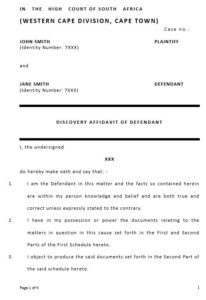
After receiving a notice requesting a spouse to discover, an affidavit should be provided. The wording of the Affidavit can be seen in the pictures below. [caption id="attachment_6723" align="alignleft" width="800"]Divorce Law - Process Example of a Discovery Affidavit[/caption]

[caption id="attachment_6725" align="alignleft" width="800"]Divorce Process - Lawyer Discovery Affidavit[/caption]
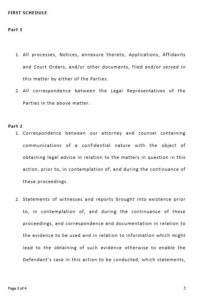
[caption id="attachment_6724" align="alignleft" width="800"]Divorce Lawyer Discovery Affidavit[/caption]

Obtaining a Trial date for the Divorce

Once you received the plea, with or without a counterclaim, or have pleaded to your spouse’s counterclaim, and discovery is done, one should then approach the clerk/registrar of the court for a trial date. This you or your spouse may do. This process is a bit complicated, so it’s best to do it with the guidance of a lawyer or the clerk/registrar of the court. Purchase our Unopposed Divorce Package, click here.

Pr-Trial Procedure

Before a date gets allocated to you for the divorce, the Court would want to ensure that your matter is trial ready. What this basically means, is that all that needs to be done, has been attended to and the trial will run. Many months are spent waiting for a court date, and it would be unfair to the court if a judge and other litigants are appointed to a matter, and the matter does not proceed. A judge will meet with the parties in chambers, and once the matter is trial ready, he or she will endorse the file in that regard.

Divorce day / Trial / Unopposed hearing date

If your spouse does not defend the divorce within the time period, go back to court and ask for an unopposed divorce date and attend to your divorce on that date. If, however, your divorce is defended, a trial should ensure. During the trial, each party should prove his or her case. Witnesses should be called and at the end, the Magistrate or Judge shall deliver the verdict. Best of luck, and please, don’t take my word, contact a legal practitioner should you decide to get divorced. Advocate Muhammad Abduroaf advice-child-maintenance-child-custody-divorce [caption id="attachment_6758" align="alignleft" width="300"]Divorce Lawyer and Process Divorce Lawyer and Process[/caption]

Finding the right lawyer (Attorney or Advocate) to fight for you in your contractual dispute in Polokwane. Read further below about a “Bulldog Lawyer”)

Contract law is the bedrock of business and day-to-day transactions, providing a framework for parties to define their rights, obligations, and expectations. However, disputes can arise when one or more parties feel that the terms of the contract have been violated. This can apply to an employment contract, lease agreement, marriage contract, or one where you lent someone money. Even buying groceries at your local grocery is a contractual transaction. You pay, and he provides you with the goods. The list is endless.

All is good until someone violates the terms of the contract. This is where you may want to use an attorney or advocate in Polokwane. Read further below about what is referred to as a “bulldog lawyer”. If the other side is playing hardball or has a bulldog lawyer, then having a tough lawyer who takes no-nonsense is something that you must consider. Please note that the law on contractual disputes would be the same whether you live in Polokwane or any other city in South Africa.

Let us get into the theory. Navigating the complexities of contract law disputes requires a clear understanding of the legal principles and practical strategies for resolution.

Critical Elements of Contract Law are as follows:

Formation of Contract:

Before delving into disputes, it’s essential to understand how contracts are formed. A valid contract typically requires an offer, acceptance, consideration, legal capacity, and legality of purpose. Disputes may arise if any of these elements are in question. If you are entering into a high value contact, it may be best to consult with an advocate or attorney beforehand.

Types of Contracts:

Contracts can take various forms, such as express, implied, unilateral, and bilateral. Understanding the nature of the contract is crucial in determining the rights and obligations of the parties involved.

Common Contract Disputes:

Breach of Contract:

The most prevalent type of contract dispute arises from a breach. This occurs when one party fails to fulfil its obligations outlined in the contract. It could involve non-payment, incomplete performance, or failure to deliver goods or services.

Misrepresentation:

If one party makes false statements that induce another to enter a contract, it may lead to a dispute. Misrepresentation can be innocent, negligent, or fraudulent, each carrying different legal consequences.

Duress and Undue Influence:

Contracts entered under duress or undue influence may be deemed voidable. If one party was coerced or pressured into an agreement, it could lead to a dispute over the contract’s validity.

What follows are resolution strategies when it comes to contract disputes.

Negotiation:

Often, disputes can be resolved through negotiation. Parties can discuss the issues, explore compromises, and reach a mutually acceptable resolution without legal action. You should use a tough lawyer to represent you if the other side is unreasonable.

Mediation:

Mediation involves a neutral third-party facilitating discussions between the parties to help them resolve. It is a voluntary and confidential process that can be less adversarial than litigation.

Arbitration:

Arbitration is a more formal process where an arbitrator or a panel makes a binding decision after hearing both sides. It provides a faster and more private resolution compared to traditional court proceedings.

Litigation:

If all else fails, parties may resort to litigation. This involves taking the dispute to court, presenting evidence, and having a judge decide. Litigation can be time-consuming and costly, but it provides a definitive resolution.

Conclusion:

Contract law disputes are an inherent risk in business transactions, but understanding the principles and available resolution strategies can mitigate potential damage. Whether through negotiation, mediation, arbitration, or litigation, the goal is to find a fair and just resolution that upholds the integrity of the contractual relationship. As businesses continue to engage in complex transactions, a comprehensive understanding of contract law and dispute resolution mechanisms is essential for navigating the legal landscape successfully. When meeting with an advocate or attorney to assist you in your contractual dispute, discuss the above issues or factors with him or her to find out if they know what they are talking about.

What is a bulldog lawyer?

A “bulldog lawyer” is a colloquial term used to describe a lawyer (attorney or advocate) known for their aggressive and tenacious approach to legal representation. The term draws an analogy between the lawyer’s characteristics and those of a bulldog, known for its solid and determined demeanour. Bulldog lawyers are often associated with being assertive, persistent, and unwavering in pursuing their client’s interests.

Key characteristics of a bulldog lawyer may include:

Aggressiveness: Bulldog lawyers are known for their assertive and forceful advocacy on behalf of their clients. They are unafraid to challenge opponents and vigorously pursue their client’s objectives.

Tenacity:

Bulldog lawyers are persistent and determined in their legal pursuits. They may be willing to go to great lengths to achieve their client’s goals and are known for not easily giving up in the face of challenges.

Fearlessness:

Bulldog lawyers are often unafraid to take on tough cases or confront powerful adversaries. They may be known for their willingness to face complex legal battles head-on.

Advocacy Skills: Bulldog lawyers possess strong advocacy skills, including effective communication, negotiation, and litigation abilities. They can passionately argue their client’s case in court or during negotiations.

Strategic Thinking:

While aggressive, bulldog lawyers are also strategic in their approach. They carefully plan their legal strategies and tactics to achieve the best possible outcome for their clients.

It’s important to note that “bulldog lawyer” can have positive and negative connotations. On the positive side, it highlights an attorney’s dedication and commitment to their clients. On the negative side, it may suggest an overly aggressive or abrasive style that may not be suitable for all legal matters or personalities.


Do you require a video legal advice consultation?

Click here and schedule one today!