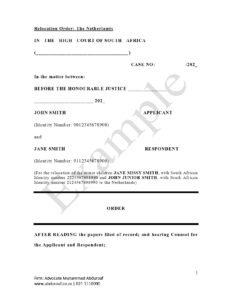
38 Relocation with my minor child to Thailand, Pattaya (Consent and Refusal) – Advocate Muhammad Abduroaf The world is becoming a much smaller place, and technology plays a huge role. People are moving across the world for employment, love and happiness, something that was not the norm a few decades ago. There is no reason why you should remain in South Africa if you can find a better life for yourself and your family overseas. Moving overseas may provide you with the quality of life you want or the possibility of experiencing things you always wanted. The same applies to your child or children relocating with you. Relocation of your minor child to Pattaya, Thailand If you are single and do not have any minor children, then moving around the world would not be too complicated. All you need to do is ensure that you have the necessary travel documentation and travel ticket (and spending money), and off you go. However, if you want to travel with your minor children (for example, ages seven or eight) or relocate to another country, things may not be that simple. Firstly, if there is another parent, and he or she has parental responsibilities and rights, then his or her consent is required. For example, let us say you live in Johannesburg or Ulundi, South Africa, and you want to relocate to Pattaya, Thailand, you would require the other parent’s consent to leave South Africa with your minor child. This can cause challenges, especially if the staying parent (in South Africa) does not agree to the relocation. What about Passport Consent to travel or relocate to Pattaya, Thailand? The same applies when it comes to your minor child applying for a South African passport to relocate to Thailand, or any country. Both parents who have parental responsibilities and rights of guardianship will have to consent to the minor child’s passport application as well. In this regard, both parents have to be at the Department of Home Affairs (or the relevant bank that also assists with passport application) when making the Application with the minor child. This can be challenging if you have a disinterested parent who does not want to cooperate with the passport application. As you will see later, legal action would need to be taken. What are the steps to follow when I want to relocate to Pattaya, Thailand with my minor child? There is there another parent. To simplify the process for relocation, the first step would be to receive the other parent’s consent in principle for the relocation and that he or she will co-operate in this regard. Once that has been resolved, the parent relocating would need to make the appointment for the minor child’s passport application as well as the application for the relevant VISA. Each country has different requirements; however, seeing that it is a relocation, you need to apply for the correct VISA. For that, you need the Passport. Once the visa and travel arrangements have been finalised, the parent remaining behind will sign a parental consent letter for the international travel. That letter can be found on the Department of Home Affairs website. Basically, the parent remaining behind would state that he or she gives consent for the minor child to leave the Republic of South Africa and travel and/or relocate to Pattaya, Thailand. What can I do if the other parent does not want to consent to the minor child’s relocation to Pattaya, Thailand? If the parent remaining in South Africa does not want to consent to the minor child’s passport application and/or his or her relocation to Pattaya, Thailand, then you would need to approach the Court. The Court, as upper guardian of the minor child, may order that the parent’s consent for the passport application and relocation be dispensed with. What this entails is submitting Court documents explaining why you want to relocate to Pattaya, Thailand. The other parent would also have an opportunity to give reasons why he or she objects. At the end of the process, the Court would determine what is in the minor child’s best interests. If it is in the minor child’s best interests to relocate to Pattaya, Thailand, the Court would make it possible despite the issue of consent or refusal. What is the first step I should take if the other parent does not want to consent to the minor child’s passport application and/or relocation to Pattaya, Thailand? If the other parent does not want to consent to the passport application and/or the relocation of the minor child to Pattaya, Thailand – in that case, we suggest you approach an attorney or advocate (trust account) to assist you with the legal process. He or she would then contact the other parent explaining the reasons for the relocation and request the necessary consent. If the parent remaining in South Africa does still not agree to the passport application and/or to the relocation to Pattaya, Thailand, then the attorney or advocate will proceed to take the matter to court. The legal route can be expensive. However, it is necessary to make the relocation of the minor child possible. You may also attend to the legal process yourself. Getting legal assistance or help with your relocation application to Pattaya, Thailand If you require legal assistance or representation with relocating to Pattaya, Thailand due to the other parent not cooperating or providing consent, then feel free to contact us for assistance. The Firm Advocate, Muhammad Abduroaf, deals with these types of matters.
38 Relocation with my minor child to Thailand, Pattaya (Consent and Refusal) – Advocate Muhammad Abduroaf
The world is becoming a much smaller place, and technology plays a huge role. People are moving across the world for employment, love and happiness, something that was not the norm a few decades ago. There is no reason why you should remain in South Africa if you can find a better life for yourself and your family overseas. Moving overseas may provide you with the quality of life you want or the possibility of experiencing things you always wanted. The same applies to your child or children relocating with you.
Relocation of your minor child to Pattaya, Thailand
If you are single and do not have any minor children, then moving around the world would not be too complicated. All you need to do is ensure that you have the necessary travel documentation and travel ticket (and spending money), and off you go. However, if you want to travel with your minor children (for example, ages seven or eight) or relocate to another country, things may not be that simple. Firstly, if there is another parent, and he or she has parental responsibilities and rights, then his or her consent is required. For example, let us say you live in Johannesburg or Ulundi, South Africa, and you want to relocate to Pattaya, Thailand, you would require the other parent’s consent to leave South Africa with your minor child. This can cause challenges, especially if the staying parent (in South Africa) does not agree to the relocation.
What about Passport Consent to travel or relocate to Pattaya, Thailand?
The same applies when it comes to your minor child applying for a South African passport to relocate to Thailand, or any country. Both parents who have parental responsibilities and rights of guardianship will have to consent to the minor child’s passport application as well. In this regard, both parents have to be at the Department of Home Affairs (or the relevant bank that also assists with passport application) when making the Application with the minor child. This can be challenging if you have a disinterested parent who does not want to cooperate with the passport application. As you will see later, legal action would need to be taken.
What are the steps to follow when I want to relocate to Pattaya, Thailand with my minor child? There is there another parent.
To simplify the process for relocation, the first step would be to receive the other parent’s consent in principle for the relocation and that he or she will co-operate in this regard. Once that has been resolved, the parent relocating would need to make the appointment for the minor child’s passport application as well as the application for the relevant VISA. Each country has different requirements; however, seeing that it is a relocation, you need to apply for the correct VISA. For that, you need the Passport.
Once the visa and travel arrangements have been finalised, the parent remaining behind will sign a parental consent letter for the international travel. That letter can be found on the Department of Home Affairs website. Basically, the parent remaining behind would state that he or she gives consent for the minor child to leave the Republic of South Africa and travel and/or relocate to Pattaya, Thailand.
What can I do if the other parent does not want to consent to the minor child’s relocation to Pattaya, Thailand?
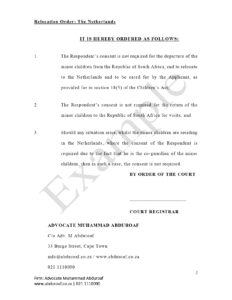
If the parent remaining in South Africa does not want to consent to the minor child’s passport application and/or his or her relocation to Pattaya, Thailand, then you would need to approach the Court. The Court, as upper guardian of the minor child, may order that the parent’s consent for the passport application and relocation be dispensed with. What this entails is submitting Court documents explaining why you want to relocate to Pattaya, Thailand. The other parent would also have an opportunity to give reasons why he or she objects.
At the end of the process, the Court would determine what is in the minor child’s best interests. If it is in the minor child’s best interests to relocate to Pattaya, Thailand, the Court would make it possible despite the issue of consent or refusal.
What is the first step I should take if the other parent does not want to consent to the minor child’s passport application and/or relocation to Pattaya, Thailand?
If the other parent does not want to consent to the passport application and/or the relocation of the minor child to Pattaya, Thailand – in that case, we suggest you approach an attorney or advocate (trust account) to assist you with the legal process. He or she would then contact the other parent explaining the reasons for the relocation and request the necessary consent. If the parent remaining in South Africa does still not agree to the passport application and/or to the relocation to Pattaya, Thailand, then the attorney or advocate will proceed to take the matter to court. The legal route can be expensive. However, it is necessary to make the relocation of the minor child possible. You may also attend to the legal process yourself.
Getting legal assistance or help with your relocation application to Pattaya, Thailand
If you require legal assistance or representation with relocating to Pattaya, Thailand due to the other parent not cooperating or providing consent, then feel free to contact us for assistance. The Firm Advocate, Muhammad Abduroaf, deals with these types of matters.

Related Post

Divorces – Is it possible to increase my chances of getting a fair outcome? Here are some Tips and Tricks to assist you.

Divorce cases can be straightforward or riddled with issues. Not only legal issues but also emotional issues, especially when there are children involved. What about the proprietary aspects of your marriage? Well, that is the easy bit. If parties are married in
community of property, there should not be much to argue about. The law is the law. Each party should get what the law says they are entitled to – in this case, an equal division of the joint estate. Click here to find out how to attend to your own unopposed divorce.

Divorces should be straightforward and simple, but this is not always the case.

In our view, the simplest divorce would be when the couple married with an ante-nuptial contract. They excluded community of property and the accrual regime. Furthermore, there are no minor children born from the marriage. In such a case, all that is required is a decree of divorce. However, if there are minor children involved, then the parties may be at loggerheads as to who should have custody, or how visitation should be exercised. Then there is the issue of child maintenance, which can be a tedious and complicated matter to resolve.

Focus less on emotions, but what is best in the long run

In this article, advice is provided on how to get the best out of your divorce. This is done by focusing on what is necessary, fair, and what you are entitled to. Many people focus too much on emotions and irrelevant issues. This is where the wisdom of experts comes into play. What follows are some of the tips and tricks provided by Advocate Muhammad Abduroaf, a family law expert with more than a decade and a half of experience on family law, divorce, child custody and child maintenance matters. Read on to find out some tips and tricks of the trade. Valuable advice is given on what to do through the divorce court process.

A divorce scenario – Father cares for the children

Let say a couple was married for 10 years – they married in community of property. In other words, they share everything. There are 2 (two) children born from the marriage. They live in a home that is bonded but purchased by the wife before the marriage. The bond is only registered in her name and gets deducted from her personal banking account. The father, however, does not work but attends to the household, which includes cleaning, taking the kids to school, making food etc. When the children are ill, the father would be the one who stays up caring for them. School projects and homework is also attended by the father. The father does some web designing work for an income, but his income is minimal compared to that of his wife. Should this couple divorce, the best for them would be to enter into a parenting plan outlining their contact and care rights after the divorce.

Divorces and properly law – Who gets what?

Now in a case of divorce, the wife would find it unfair that the husband should have half the value of the home. This is so as she is the one who purchased it before the marriage and paid up all the monthly instalments. Our advice to the mother would be not to waste her time on this issue. The parties were married in community of property, forming one joint estate. If she came into the marriage with the property, then it forms part of the joint estate. The same advice goes to the husband. All that he needs to do is stick to what the law says he is entitled to. The judge would agree with him.

Child Custody and the Law – Know your parental rights

Then there is the issue of child custody. The mother believes that she is entitled to be the primary caregiver because she gave birth to the children. She also believes that all mothers should have custody over minor children no matter what the circumstances are. Apparently, someone told her that. However, the reality of the matter is that the father, in this case, cared for the minor children for most of their lives. It would further be in their best interests if he continues to do so. He knows their routine, needs, and how to care for them better than the mother. And besides that, the mother is a career woman, who works long, hard hours. She does not have the time, patience or skills to care for the minor children, as efficiently as the father has. The same principles may apply in matters of relocation.

Child Maintenance Tips and Tricks

Now, what advice do we have for parents where there is a dispute regarding the amount of Child Maintenance to Claim? Have a look at this article on Tricks and tips on how to win your child maintenance case. Similar principles can be applied to child maintenance issues in a divorce court, whether in the High Court, or Regional Court. With regard to the scenario above, the father would be the one claiming child maintenance from the mother. Unless he is successful in claiming personal maintenance (or alimony) from the mother, he would have to get a job, or earn more in his web designing business and support himself and contribute towards the expenses of the minor children.

The financial impact of Divorce on the household

The sad reality of divorce for most people is that their standard of living drops post-divorce. This is so as there are now two households that need to be maintained. When the couple lived together, there was only one bond or rental amount to pay, one municipal bill, and the entire family used the family car. Now it has doubled, placing a strain on the resources the parents have. Therefore, one needs to be practical as to what amount of maintenance one claims under these situations. The belt needs to be tightened when it comes to non-essentials. However, the parents must try their utmost to ensure that the minor children’s standard of education does not drop.

Child Custody Tips and Tricks

This aspect is one of the trickiest aspects regarding a divorce matter. Have a look at this article on How to win your child custody and access court case – Tips and Tricks. Here as well, similar principles can be applied to child custody issues in a divorce court. With regard to the scenario above, it would make sense that the father is awarded custody over the minor children and the mother reasonable contact. Her contact rights should accommodate her busy work schedule. That may either be every second weekend, every second day after school or once a month. It all depends on the facts of the case.

Busy Parents when it comes to Access

No parent should be punished for their work schedule. If the mother in the future gets more time off work, then provision should be made for that. In the same manner, should the father be gainfully employed in the future, then the mother would also need to come to the party and make more time for the children.

Fights over Child Custody

If the parties are in a battle regarding who should get custody of the minor children, then focus should be centred as to what is in the minor children’s best interests. The focus should be as to who can care better for the children in substance, and not in theory. Many parents say they can care better or will care better than the other parent, but have nothing to back up such bold allegations. No one is perfect, but if you demonstrated that you cared well for your child in the past, it may be best to leave things the way they are.

Badmouthing the other parent – Not a good idea

The focus should not be on badmouthing or finding faults in the other parent. You will annoy the court and your lawyer. Nonetheless, it won’t assist you in any way. If you truly care for your children, place personal issues aside, and put your children first. Even if the reason for the divorce is domestic violence, a level head should still be maintained.

Final words on how to win your divorce case

The advice in this article is not intended to trick the courts into finding in your favour. In our view, winning is getting what you are entitled to. To state it differently, losing would be not getting what is fair. So even if you paid for everything in the joint estate, and leave with half, that is still winning. Many people ask for the impossible in the divorce summons and do not receive it. This is either due to bad legal advice, or a case based on unsound judgment. Losing would be leaving with less than half if there was no legal basis for it. But if you feel that you want to give your spouse more than half, then do so.

Have a family Law appointment with us

We have an online appointments system which enables you to save valuable time and cut straight to the chase. There is, therefore, no need for you to visit our offices (unless it is best for you to do so, or is your most preferred option). You may set up telephonic or video consultations should you wish to do so. You can, therefore, stay in the office or on the couch in the comfort of your own home when dealing with us. We are therefore physical, online, set-up and ready to meet with you. Make your appointment online for a consultation today. We are certain that you found the above article useful and interesting. Please consider sharing it on the share buttons below. They include Facebook, Twitter, LinkedIn, WhatsApp, Gmail and more. Someone may find it useful as well. Should you require business advice or services, feel free to click on these links: Business SA | Private Legal | Envirolaws    

I am an unmarried mother. I want to take my child with me on a holiday overseas, but the biological father of my child does not want to give consent and co-operate. What are my, and our child’s rights for a passport and to visit the United Kingdom?

South Africa is one of the most beautiful countries in the world. We have mountains, seas, forests, lakes, and dams. It is the ideal holiday destination, and a countless number of people flock to our shores every year. But now and again, South Africans want to leave our borders and go on holiday to another country. For this, one usually only requires an air ticket, passport, and a visa. And of course, some money. Now the process of traveling overseas would be simple if you are an adult going on your own, or with another adult.

What if a single parent wants to travel overseas with a minor child?

But what if you want to travel overseas with your minor child? When we say minor child, we refer to a child under the age of 18 years old. Under normal circumstances, both parents would co-operate in applying for a visa and a passport for the minor child. But what if this is not the case? What if one parent does not want to consent to the minor child going overseas with the other parent? Let us explore the issues and laws involved.

The parenting scenario – unmarried parents and the child

Let’s say a couple had a child together and they are now separated. They were never married. The father was actively involved in the child’s life since the child’s birth. He paid child maintenance regularly and visited the child often. However, when the child was three (3) years old, he had challenges in obtaining regular contact with the minor child.

Father approaches the Children’s Court

The father then approaches the children’s court and he was awarded reasonable contact. This entailed him having the minor child every second weekend and a half of the school holidays. Telephone and special days’ contact were also incorporated in the Court Order.

The mother approaches the maintenance court

The mother then took the father to the maintenance court, as according to her, the amount he was currently paying was not enough. The matter was then resolved and it was ordered that the father pays for all the minor child’s school fees and medical costs. He also had to make a cash contribution which increased each year by 10%.

Father approaches the domestic violence court

The mother was not happy with the child maintenance amount that was ordered by the Court. The father remarried and his wife was expecting a child. He then approached the maintenance court for a reduction in child maintenance. At the time, the mother also inherited a large sum of money. Arguments arose regarding maintenance, and the mother approached the Domestic Violence court for a Protection Order. The parties, however, managed to resolve the issue. The maintenance order was ultimately reduced and the mother never proceeded with the Domestic Violence Court matter.

Things go well after the parties were tired of litigating against each other

The parties were now tired of litigating against each other. Contact and maintenance payments went well for years. Whenever the mother required consent for something where a co-guardian had to consent for, the father would provide it. For example, the application and enrolment for the minor child into a primary school. The relationship between the parent and the father went well for many years as well.

The Mother wishes to take the minor child with her to the United Kingdom

The child is now 10 years old, and the mother wants to take him with her on a holiday to the United Kingdom to visit the child’s maternal grandparents. This would take place during the mother’s half of the school holidays as per the Children’s Court Order. The last time either the mother or the child saw the maternal grandparent was 5 years ago. This was when the grandparents visited South Africa.

The father refuses to give his consent for the minor child to travel

The mother can afford to pay for both the minor child and her air ticket to the United Kingdom. Accommodation is also not an issue as they will be staying at the maternal grandparents. There are two problems. The child does not have a passport and the father does not want to consent to the minor child going with the mother on holiday overseas. His reason for refusing is because he believes the child is too young to travel overseas. Now let us unpack the parental rights of unmarried parents. Is he allowed to do that?

Parental rights and responsibilities of unmarried parents?

Before we can advise on the scenario above, we first need to unpack the law. The first issue is, that of what are parental responsibilities and rights of parents? Thereafter, we must outline what the parental responsibilities and rights of unmarried mothers and fathers are. As can be seen from the scenario above, the two issues are those of an application for a passport, and for the child to go overseas. Section 18 of the Children’s Act deal with Parental responsibilities and rights. It states the following: 18 Parental responsibilities and rights (1) A person may have either full or specific parental responsibilities and rights in respect of a child. (2) The parental responsibilities and rights that a person may have in respect of a child, include the responsibility and the right- (a) to care for the child; (b) to maintain contact with the child; (c) to act as guardian of the child; and (d) to contribute to the maintenance of the child. (3) Subject to subsections (4) and (5), a parent or other person who acts as guardian of a child must- (a) administer and safeguard the child’s property and property interests; (b) assist or represent the child in administrative, contractual and other legal matters; or (c) give or refuse any consent required by law in respect of the child, including- (i) consent to the child’s marriage; (ii) consent to the child’s adoption; (iii) consent to the child’s departure or removal from the Republic; (iv) consent to the child’s application for a passport; and (v) consent to the alienation or encumbrance of any immovable property of the child. (4) Whenever more than one person has guardianship of a child, each one of them is competent, subject to subsection (5), any other law or any order of a competent court to the contrary, to exercise independently and without the consent of the other any right or responsibility arising from such guardianship. (5) Unless a competent court orders otherwise, the consent of all the persons that have guardianship of a child is necessary in respect of matters set out in subsection (3) (c).  From the above, it is clear, if a parent has parental responsibilities and rights, he or she must consent for the application for a passport, and the minor child to travel overseas.

What are the Parental responsibilities and rights of unmarried mothers?

Now let us unpack the law regarding parental responsibilities and rights of unmarried mothers as per our scenario above. This is where section 19 of the Children’s Act comes into play. It states:

19 Parental responsibilities and rights of mothers

(1) The biological mother of a child, whether married or unmarried, has full parental responsibilities and rights in respect of the child. (2) If- (a) the biological mother of a child is an unmarried child who does not have guardianship in respect of the child; and (b) the biological father of the child does not have guardianship in respect of the child, the guardian of the child’s biological mother is also the guardian of the child. (3) This section does not apply in respect of a child who is the subject of a surrogacy agreement. It is clear from the above, that irrespective of whether a child’s mother gave birth in wedlock, or out, she has full parental responsibilities and rights over the minor child. Does the biological father have the same rights?

What are the Parental responsibilities and rights of unmarried fathers?

This is the question of law the father in our scenario wants to know. What are his parental responsibilities and rights as he was not married to the mother? This is where section 20 of the Children’s Act comes into operation. It states the following:

21 Parental responsibilities and rights of unmarried fathers

(1) The biological father of a child who does not have parental responsibilities and rights in respect of the child in terms of section 20, acquires full parental responsibilities and rights in respect of the child- (a) if at the time of the child’s birth he is living with the mother in a permanent life-partnership; or (b) if he, regardless of whether he has lived or is living with the mother-
  • consents to be identified or successfully applies in terms of section 26 to be identified as the child’s father or pays damages in terms of customary law;
  • (ii) contributes or has attempted in good faith to contribute to the child’s upbringing for a reasonable period; and
  • (iii) contributes or has attempted in good faith to contribute towards expenses in connection with the maintenance of the child for a reasonable period.
(2) This section does not affect the duty of a father to contribute towards the maintenance of the child. (3) (a) If there is a dispute between the biological father referred to in subsection (1) and the biological mother of a child with regard to the fulfilment by that father of the conditions set out in subsection (1) (a) or (b), the matter must be referred for mediation to a family advocate, social worker, social service professional or other suitably qualified person. (b) Any party to the mediation may have the outcome of the mediation reviewed by a court. (4) This section applies regardless of whether the child was born before or after the commencement of this Act. Looking at our scenario and the law above, it is clear that this father has full parental responsibilities and rights in respect of the minor child. This is so as he actively took part in the child’s life since his birth. He also paid maintenance since his son’s birth.

What are the rights of the father in this scenario?

From the facts and law outlined above, it is clear that the mother requires the father’s consent to apply for the minor child’s passport and for him to travel with her overseas. The father, therefore, has the right to refuse consent. However, what can the mother do if she believes it is in the child’s best interest to travel with her overseas? This we deal with next.

What can the mother do if the father refuses to give consent?

Section 18(5) of the Children’s Act quoted above states: Unless a competent court orders otherwise, the consent of all the persons that have guardianship of a child is necessary in respect of matters set out in subsection (3) (c). This means that the Court may be approached for the necessary consent. If the court feels that it would be in the minor child’s best interest to obtain a passport and to travel overseas, the court would so order it. Read this article written by us dealing with the latter court application. We are certain that you found the above article useful and interesting. Please consider sharing it on the share buttons below. They include Facebook, Twitter, LinkedIn, WhatsApp, Gmail and more. Someone may find it useful as well. Should you require business advice or services, feel free to click on these links: Business SA | Private Legal | Envirolaws          

Do you require a video legal advice consultation?

Click here and schedule one today!