Updated: 16 April 2020

New regulations have been issued on 16 April 2020. Click on the link below: The material change is that you do not have to have a court order or a parental responsibilities and rights agreement or parenting plan, registered with the family advocate. Possession of a birth certificate or certified copy of a birth certificate is now also allowed.

Update: 07 April 2020

NEW LOCKDOWN REGULATIONS REGARDING THE MOVEMENT OF CHILDREN – CERTAIN PARENTS MAY MOVE CHILDREN DURING THE NATIONAL LOCKDOWN PERIOD (7 April 2020)

Latest Directives by the Minister of Social Development regarding the movement of children during the National Lockdown (30 March 2020)

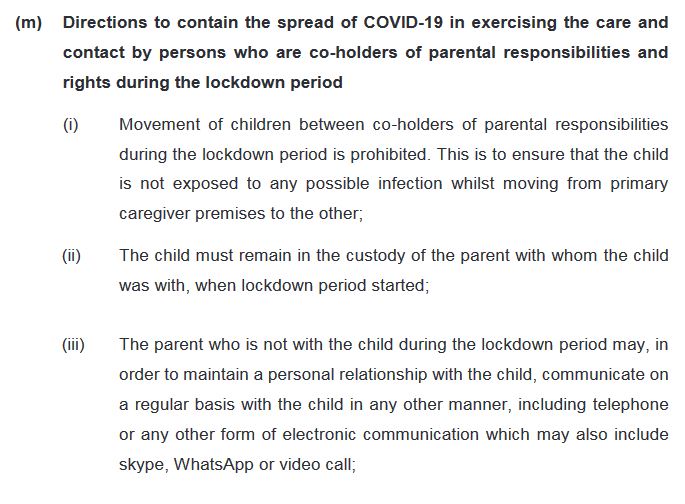
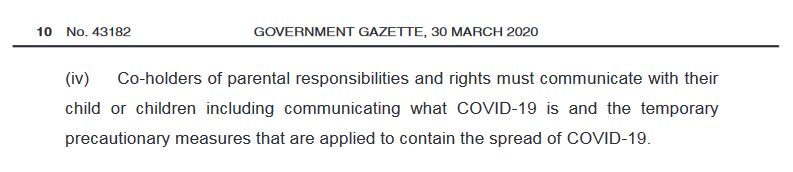
On 30 March 2020, the Minister of Social Development, Ms Lindiwe D Zulu, issued directives in order to prevent and combat the spread of the COVID-19. The directives in relation to parental contact are as follows: (m)Directions to contain the spread of COVID-19 in exercising the care and contact by persons who are co-holders of parental responsibilities and rights during the lockdown period (i) Movement of children between co-holders of parental responsibilities during the lockdown period is prohibited. This is to ensure that the child is not exposed to any possible infection whilst moving from primary caregiver premises to the other; (ii) The child must remain in the custody of the parent with whom the child was with, when lockdown period started; (iii) The parent who is not with the child during the lockdown period may, in order to maintain a personal relationship with the child, communicate on a regular basis with the child in any other manner, including telephone or any other form of electronic communication which may also include skype, WhatsApp or video call; (iv)Co-holders of parental responsibilities and rights must communicate with their child or children including communicating what COVID-19 is and the temporary precautionary measures that are applied to contain the spread of COVID-19. Click here to download the directives from the Government site. Below are images are the directives. (i) Movement of children between co-holders of parental responsibilities during the lockdown period is prohibited. This is to ensure that the child is not exposed to any possible infection whilst moving from primary caregiver premises to the other;   (i) Movement of children between co-holders of parental responsibilities during the lockdown period is prohibited. This is to ensure that the child is not exposed to any possible infection whilst moving from primary caregiver premises to the other;

Update: 07 April 2020

NEW LOCKDOWN REGULATIONS REGARDING THE MOVEMENT OF CHILDREN – CERTAIN PARENTS MAY MOVE CHILDREN DURING THE NATIONAL LOCKDOWN PERIOD (7 April 2020)

Updated: 16 April 2020

New regulations have been issued on 16 April 2020. Click on the link below:

The material change is that you do not have to have a court order or a parental responsibilities and rights agreement or parenting plan, registered with the family advocate. Possession of a birth certificate or certified copy of a birth certificate is now also allowed.

Update: 07 April 2020

NEW LOCKDOWN REGULATIONS REGARDING THE MOVEMENT OF CHILDREN – CERTAIN PARENTS MAY MOVE CHILDREN DURING THE NATIONAL LOCKDOWN PERIOD (7 April 2020)

Latest Directives by the Minister of Social Development regarding the movement of children during the National Lockdown (30 March 2020)

On 30 March 2020, the Minister of Social Development, Ms Lindiwe D Zulu, issued directives in order to prevent and combat the spread of the COVID-19.

The directives in relation to parental contact are as follows:

(m)Directions to contain the spread of COVID-19 in exercising the care and contact by persons who are co-holders of parental responsibilities and rights during the lockdown period

(i) Movement of children between co-holders of parental responsibilities during the lockdown period is prohibited. This is to ensure that the child is not exposed to any possible infection whilst moving from primary caregiver premises to the other;

(ii) The child must remain in the custody of the parent with whom the child was with, when lockdown period started; (iii) The parent who is not with the child during the lockdown period may, in order to maintain a personal relationship with the child, communicate on a regular basis with the child in any other manner, including telephone or any other form of electronic communication which may also include skype, WhatsApp or video call;

(iv)Co-holders of parental responsibilities and rights must communicate with their child or children including communicating what COVID-19 is and the temporary precautionary measures that are applied to contain the spread of COVID-19.

Click here to download the directives from the Government site.

Below are images are the directives.

(i) Movement of children between co-holders of parental responsibilities during the lockdown period is prohibited. This is to ensure that the child is not exposed to any possible infection whilst moving from primary caregiver premises to the other;


(i) Movement of children between co-holders of parental responsibilities during the lockdown period is prohibited. This is to ensure that the child is not exposed to any possible infection whilst moving from primary caregiver premises to the other;

Update: 07 April 2020

NEW LOCKDOWN REGULATIONS REGARDING THE MOVEMENT OF CHILDREN – CERTAIN PARENTS MAY MOVE CHILDREN DURING THE NATIONAL LOCKDOWN PERIOD (7 April 2020)

Related Post

Top tips and tricks from a Senior Family Law Advocate on claiming maintenance for a five-year-old child in Emalahleni.

Child Maintenance is the right of the child, and not that of the parent. It is also not a privilege granted to parents who must pay it. It is their duty to pay child maintenance and support their children. Once the child is self-supporting (being able to care for him or herself), the obligation falls away. This can happen when the child is 18, 20, or even 30. It all depends on the circumstances of the case.

Claiming child maintenance for your child in Emalahleni

Whether you claim child maintenance in Emalahleni, or any other city in South Africa, the procedures would be the same. There are however two (2) courts that can deal with child maintenance matters. That is a divorce court, in a divorce matter, and a Child Maintenance Court. For this article, we will focus on claiming maintenance in a Maintenance Court matter in Emalahleni.

The maintenance scenario – Emalahleni South Africa

In this article, we will deal with the following fictitious scenario, in a child maintenance matter:

  1. The Child is seven years old and attends school in Emalahleni
  2. The child is cared for by the mother who works in Emalahleni
  3. The mother works and earns a Salary of R 10 000
  4. The father sees the child every second weekend. He also lives and works in Emalahleni
  5. The child’s monthly expenses are R 6000 – 00 which includes food, clothing, accommodation, education, travel etc.
  6. The father earns a reasonable salary and can afford the R 20 000 – 00 per month
  7. The mother claims R 4 000 – 00 maintenance as the father earns double her salary

What is the first step the mother must take in claiming child maintenance?

The first thing the mother must do is work out exactly what the child costs by item. She breaks down the minor child’s living expenses, starting from rent or accommodation to groceries to school fees etc. Once she has done that, she would need to determine what exactly does the minor child cost per month, seeing that she will be asking the father to contribute towards that. As best as possible, she needs to collect proof of expenses. This can be in the form of receipts.

How does she start the legal process?

The mother now needs to approach the maintenance court in the area where she lives or works to lodge a complaint for child maintenance. If she lives or works in Emalahleni, it would be the maintenance court in Emalahleni. She will complete a Form A wherein she will provide all the expenses for her and the minor child. She would also have to stipulate her income. Once she completed the form and submitted it to the maintenance court, she must then follow the next step.

What do you do while waiting for the maintenance court date?

While you wait to be informed of the court date by the Maintenance Court of Emalahleni, and up until the actual first court date, you need to ensure that you keep a record of all income and expenses for you and the child. This is very important as the court allocates maintenance based on recent income and expenses.

What happens at the first court appearance at the Emalahleni Maintenance Court?

Once you have been notified of the maintenance court date by the Emalahleni Maintenance Court, you need to ensure that you attend it. On that day, both you and the father of the child would appear before a maintenance officer. The maintenance officer would go through both your income and expenses as well as that of the father. If all the relevant information is not before the maintenance court, then the matter may be postponed in order for the parties to submit it.

The maintenance officer will try to settle the matter and have the parents come to an agreement regarding the amount of child maintenance to be paid. If they cannot come to an agreement regarding the child maintenance to be paid, the matter would have to proceed to a formal hearing or trial before a Magistrate.

How does the Maintenance Court hearing or trial work in Emalahleni?

Essentially, the maintenance court is called upon to make a fair ruling regarding what is a fair amount of child support that needs to be paid. For that to happen, the parents would have to give evidence in that regard. The mother would present to the court what the child costs, what she contributes and what she requires the other parent to pay. The Father would have a right to question the mother and to present evidence as to why he cannot afford the amount requested or why he feels it is an unfair amount. The mother can they also question him.

At the end of the day, the Emalahleni Maintenance Court would be able to properly determine what is a fair and adequate amount of child maintenance to pay after being presented will all relevant information. The Emalahleni Maintenance Court should play an active role in determining what is a fair amount of child maintenance the father should pay.

The above child maintenance application principles should apply to the following provinces and cities:

Eastern Cape:

Alice, Butterworth, East London, Graaff-Reinet, Grahamstown, King William’s Town, Mthatha

Port Elizabeth, Queenstown, Uitenhage, Zwelitsha

Free State:

Bethlehem. Bloemfontein, Jagersfontein, Kroonstad, Odendaalsrus, Parys, Phuthaditjhaba, Sasolburg, Virginia, Welkom

Gauteng:

Benoni, Boksburg, Brakpan, Carletonville, Germiston, Johannesburg, Krugersdorp, Pretoria, Randburg, Randfontein, Roodepoort, Soweto, Springs, Vanderbijlpark, Vereeniging

KwaZulu-Natal:

Durban, Empangeni, Ladysmith, Newcastle, Pietermaritzburg, Pinetown, Ulundi, Umlazi

Limpopo:

Giyani, Lebowakgomo, Musina, Phalaborwa, Polokwane, Seshego, Sibasa, Thabazimbi

Mpumalanga:

Emalahleni, Nelspruit, Secunda, North West, Klerksdorp, Mahikeng, Mmabatho, Potchefstroom, Rustenburg, Northern Cape, Kimberley, Kuruman, Port Nolloth

Western Cape:

Bellville, Emalahleni, Constantia, George, Hopefield, Oudtshoorn, Paarl, Simon’s Town, Stellenbosch, Swellendam, Worcester


Could you provide me with an explanation of how a quick divorce works and what steps are involved in the process?

If your marriage is irreparably broken, divorce may be the most practical solution. However, if there is still a chance of reconciliation, divorce may not be the optimal choice for you and your family. You may want to consider trying marriage counseling, having open communication, or seeking guidance from a religious authority to try to save your marriage. If all attempts fail, seeking advice from a legal professional can help you finalize your divorce.

How does a quick divorce work?

A quick divorce can be finalized in a few weeks when both spouses agree on the divorce and proceed on an uncontested basis. Meeting with an attorney and advocate to draft necessary papers initiates the divorce process. The steps to follow are simpled:
  1. Meet with the advocate or attorney,
  2. draft the settlement agreement,
  3. issue the divorce summons, serve the summons on the defendant,
  4. set the divorce down for hearing,
  5. and get divorced at court.

Searching for a good divorce lawyer

When searching for a good lawyer, it is important to do your research and consider a few key factors. Start by asking friends or family members for recommendations, as personal referrals can often be the most reliable source of information. You can also search for lawyers online and read reviews from past clients. Look for a lawyer who specializes in divorce cases and has experience in your specific situation. Make sure to schedule a consultation to discuss their fees, experience, and approach to your case. It is important to feel comfortable with your lawyer and confident in their abilities to represent you effectively. We recommend
Advocate Muhammad Abduroaf. He is a Trust Account Advocate, and practices throughout South Africa. You can visit his website at www.abduroaf.co.za or make an appointment using the link www.ourlawyer.co.za. Specifically request to consult with him.

How to deal with minor children in a divorce

If you have children and are going through a divorce, it is important to prioritize their well-being. Consider finding a lawyer who specializes in family law and has experience with child custody cases. Look for someone who will prioritize the needs and best interests of your children. It may also be helpful to seek out a therapist or counselor for your children to help them navigate the emotional impact of the divorce. Remember to communicate openly and honestly with your children throughout the process and prioritize their feelings and needs. Here we again recommend Advocate Muhammad Abduroaf.

Affording a divorce lawyer in South Africa

When it comes to affording a divorce, it’s important to start by creating a budget and understanding all the expenses associated with the process. This may include legal fees, court costs, and potential fees for child custody evaluations or mediation. Consider looking into low-cost or pro bono legal services if necessary, and explore options for alternative dispute resolution such as collaborative divorce or mediation. It may also be helpful to seek financial counseling to ensure you are making informed decisions about your finances during this time. Remember to prioritize your own well-being and seek support from loved ones as needed.

How to deal with the emotional aspect of a divorce?

If you’re struggling to cope with the emotional toll of a divorce, seeking counseling can provide helpful support. It’s essential to prioritize your mental health and get help from loved ones or professionals if needed. Additionally, financial counseling can assist you in making informed decisions about your finances during this time. It’s crucial to take care of yourself and seek assistance if required.    

Do you require a video legal advice consultation?

Click here and schedule one today!