Updated: 16 April 2020

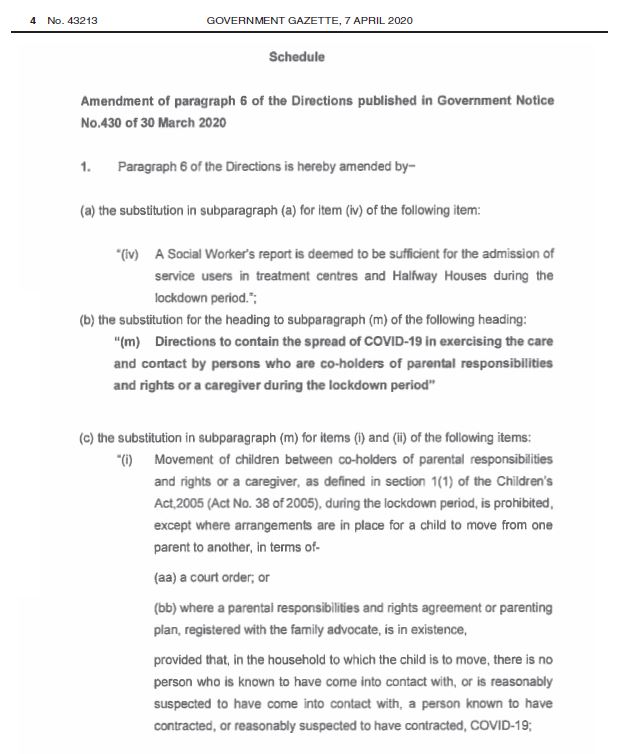
New regulations have been issued on 16 April 2020. Click on the link below: The material change is that you do not have to have a court order or a parental responsibilities and rights agreement or parenting plan, registered with the family advocate. Possession of a birth certificate or certified copy of a birth certificate is now also allowed.

If you have a court order, or a parental responsibilities and rights agreement or parenting plan registered with the office of the Family Advocate, you can move children during the lockdown period, if certain conditions are met.

Today, the Minister of Social Development, Ms Lindiwe Zulu, MP, made changes to the regulations regarding the movement of children during the lockdown period. It is now possible for certain children to be moved between parents during the lockdown period.

The regulations apply to the following parents only:

  1. There are arrangements in place for the children to move for one parent to another in terms of a court order; or
  2. A parental responsibilities and rights agreement or parenting plan registered with the office of the Family Advocate; and
  3. In the household to which the child is to move, there is no person who is known to have come into contact with, or is reasonably suspected to have come into contact with, a person known to have contracted, or reasonably suspected to have contracted, COVID-19;
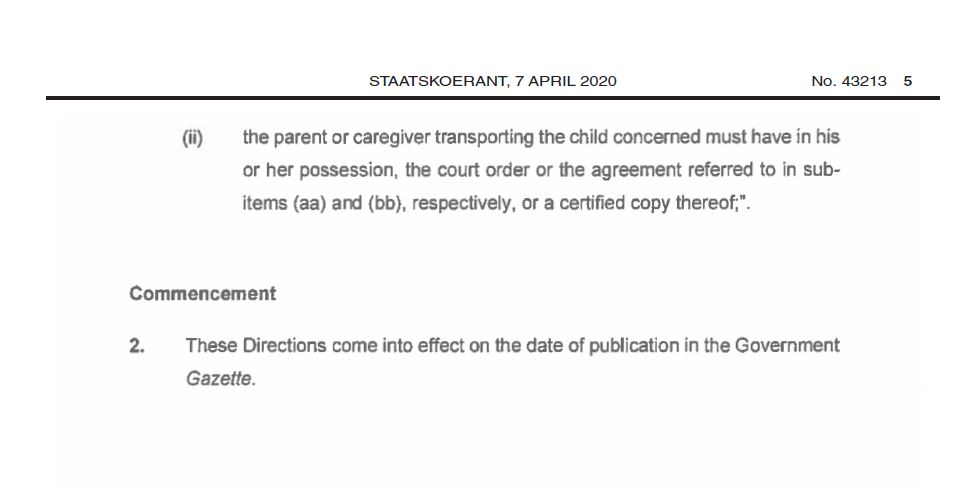
  4. The parent or caregiver transporting the child concerned must have in his or her possession, the court order or the latter agreement, or a certified copy thereof.
Below are the relevant regulations: Lockdown Regulations Movement of Children allowed with Court Order Lockdown Regulations Movement of Children allowed with Court Order  

Updated: 16 April 2020

New regulations have been issued on 16 April 2020. Click on the link below:

The material change is that you do not have to have a court order or a parental responsibilities and rights agreement or parenting plan, registered with the family advocate. Possession of a birth certificate or certified copy of a birth certificate is now also allowed.

If you have a court order, or a parental responsibilities and rights agreement or parenting plan registered with the office of the Family Advocate, you can move children during the lockdown period, if certain conditions are met.

Today, the Minister of Social Development, Ms Lindiwe Zulu, MP, made changes to the regulations regarding the movement of children during the lockdown period. It is now possible for certain children to be moved between parents during the lockdown period.

The regulations apply to the following parents only:

  1. There are arrangements in place for the children to move for one parent to another in terms of a court order; or
  2. A parental responsibilities and rights agreement or parenting plan registered with the office of the Family Advocate; and
  3. In the household to which the child is to move, there is no person who is known to have come into contact with, or is reasonably suspected to have come into contact with, a person known to have contracted, or reasonably suspected to have contracted, COVID-19;
  4. The parent or caregiver transporting the child concerned must have in his or her possession, the court order or the latter agreement, or a certified copy thereof.

Below are the relevant regulations:

Lockdown Regulations Movement of Children allowed with Court Order

Lockdown Regulations Movement of Children allowed with Court Order


Related Post

41 Relocation with my minor child to Turkey, Istanbul (Consent and Refusal) – Advocate Muhammad Abduroaf The world is becoming a much smaller place, and technology plays a huge role. People are moving across the world for employment, love and happiness, something that was not the norm a few decades ago. There is no reason why you should remain in South Africa if you can find a better life for yourself and your family overseas. Moving overseas may provide you with the quality of life you want or the possibility of experiencing things you always wanted. The same applies to your child or children relocating with you. Relocation of your minor child to Istanbul, Turkey If you are single and do not have any minor children, then moving around the world would not be too complicated. All you need to do is ensure that you have the necessary travel documentation and travel ticket (and spending money), and off you go. However, if you want to travel with your minor children (for example, ages nine or ten) or relocate to another country, things may not be that simple. Firstly, if there is another parent, and he or she has parental responsibilities and rights, then his or her consent is required. For example, let us say you live in Port Elizabeth or Sasolburg, South Africa, and you want to relocate to Istanbul, Turkey, you would require the other parent’s consent to leave South Africa with your minor child. This can cause challenges, especially if the staying parent (in South Africa) does not agree to the relocation. What about Passport Consent to travel or relocate to Istanbul, Turkey? The same applies when it comes to your minor child applying for a South African passport to relocate to Turkey, or any country. Both parents who have parental responsibilities and rights of guardianship will have to consent to the minor child’s passport application as well. In this regard, both parents have to be at the Department of Home Affairs (or the relevant bank that also assists with passport application) when making the Application with the minor child. This can be challenging if you have a disinterested parent who does not want to cooperate with the passport application. As you will see later, legal action would need to be taken. What are the steps to follow when I want to relocate to Istanbul, Turkey with my minor child? There is there another parent. To simplify the process for relocation, the first step would be to receive the other parent’s consent in principle for the relocation and that he or she will co-operate in this regard. Once that has been resolved, the parent relocating would need to make the appointment for the minor child’s passport application as well as the application for the relevant VISA. Each country has different requirements; however, seeing that it is a relocation, you need to apply for the correct VISA. For that, you need the Passport. Once the visa and travel arrangements have been finalised, the parent remaining behind will sign a parental consent letter for the international travel. That letter can be found on the Department of Home Affairs website. Basically, the parent remaining behind would state that he or she gives consent for the minor child to leave the Republic of South Africa and travel and/or relocate to Istanbul, Turkey. What can I do if the other parent does not want to consent to the minor child’s relocation to Istanbul, Turkey? If the parent remaining in South Africa does not want to consent to the minor child’s passport application and/or his or her relocation to Istanbul, Turkey, then you would need to approach the Court. The Court, as upper guardian of the minor child, may order that the parent’s consent for the passport application and relocation be dispensed with. What this entails is submitting Court documents explaining why you want to relocate to Istanbul, Turkey. The other parent would also have an opportunity to give reasons why he or she objects. At the end of the process, the Court would determine what is in the minor child’s best interests. If it is in the minor child’s best interests to relocate to Istanbul, Turkey, the Court would make it possible despite the issue of consent or refusal. What is the first step I should take if the other parent does not want to consent to the minor child’s passport application and/or relocation to Istanbul, Turkey? If the other parent does not want to consent to the passport application and/or the relocation of the minor child to Istanbul, Turkey – in that case, we suggest you approach an attorney or advocate (trust account) to assist you with the legal process. He or she would then contact the other parent explaining the reasons for the relocation and request the necessary consent. If the parent remaining in South Africa does still not agree to the passport application and/or to the relocation to Istanbul, Turkey, then the attorney or advocate will proceed to take the matter to court. The legal route can be expensive. However, it is necessary to make the relocation of the minor child possible. You may also attend to the legal process yourself. Getting legal assistance or help with your relocation application to Istanbul, Turkey If you require legal assistance or representation with relocating to Istanbul, Turkey due to the other parent not cooperating or providing consent, then feel free to contact us for assistance. The Firm Advocate, Muhammad Abduroaf, deals with these types of matters.

Adoption Law in South Africa

The
Child Care Act forms the foundation of the Adoption Law and is very much adhered when following through with the adoption process. The ultimate objectives of the Children’s Act is to:
  • Protect the social and emotional well-being of a child.
  • To implement structures within a community that can care and protect the child.
  • To ensure that no child goes through starvation, abuse, exploitation and so forth.
  • To ensure that the public (adults) are not taking advantage/exploiting or inflicting physical harm onto a child.
[caption id="attachment_4511" align="alignleft" width="300"] Call our law offices on: 0211110090
Email us at: [email protected][/caption] For free, expert legal advice on the Children’s Act, read our legal piece on The Law Regarding Children – The Children’s Act 38 of 2005. Feel free to call our law offices on 021 424 3487 for an online appointment for a professional legal consultation today.

Baby adoption process

We often don’t know where to start when it comes to child adoption. These are brief, yet relevant steps you could be looking at when entering into the adoption process:
  1. Establish a mutual ground between you and your spouse: this means making sure that both parties are actively involved in the adoption process and that both parties would like to process with the process.
  2. Social worker or adoption agency: A social worker mandatory to the process even though you may personally know the biological mother of the child. When it comes to a social worker and agency, you need to ensure that you can trust both the agency and social worker. These two factors will play an essential role in the outcome of the adoption process.
  3. Screening process: this can be the most dreadful step.
[caption id="attachment_4512" align="alignleft" width="300"] Call our law offices on: 0211110090
Email us at: [email protected][/caption] You will need:
  • Interview with your social worker
  • Police clearance
  • Medical report
  • Psychological assessment
  • Summary of finances
  • Clearance from National Child Protection Register
  • Clearance from the National Register of Sexual Offenders
  • Assessing of your marriage
  • References
  • Group sessions
  • Social worker will have to visit your home to check for a stable, safe home for the child
  • An overall family assessment
  1. Wait for your child while the social worker determines an ideal candidate that suits the circumstances of the matter.
  2. You will get to meet your child and you will have an idea of your child’s history and have a choice if you would like to proceed.
  3. Complete the legal work: this is where a good, family legal expert comes in to help you through the process of the Children’s Court and other legalities.
Inter-country Definition The term “inter-country” adoption is pretty much self-explanatory and refers to adoption taking place out of the country. For more information on inter-country adoption or overall adoption, click on the following links below: [caption id="attachment_4513" align="alignleft" width="300"] Call our law offices on: 0211110090
Email us at: [email protected][/caption] Are you residing out of Cape Town? No problem. Make use of our national number on 087 701 1124 or simply call our offices on 021 424 3487 for an online appointment for a professional legal consultation.  

Do you require a video legal advice consultation?

Click here and schedule one today!