Divorce – Questions and Answers on the Process and Procedure

advice-child-maintenance-child-custody-divorceDivorces signify the end of marriages. However, it can also be seen as a beginning of a new life. Once a couple has tried everything to save their marriage, to no avail, a divorce is an inevitable consequence. With divorces, comes the law. Only a court can legally divorce you. And because of this, people have many questions on the divorce procedure and process. This post is intended to assist parties whose marriage had irretrievably broken down by answering frequently asked questions on divorces. Due to the nature of legal matters, it is best to make use of an attorney or get the advice of a legal professional when dealing with a divorce. However, we intend giving you a general overview of the divorce process below with the assistance of Adv. Muhammad Abduroaf.

Family Law Questions and Answers

Should you not find what you are looking for, feel free to post your questions on our blog, by clicking on the following links:

Divorces – Questions and Answers

Child Custody – Questions and Answers

Child Maintenance – Question and Answers

Domestic Violence – Questions and Answers

You are welcome to call us on 021 424 3487 / 0870735800

For other legal and business services, feel free to visit:

Business SA or Private Legal.

Divorce – Things to Consider

There are a few things to consider when proceeding with a divorce. Depending on the issues involved, it would determine how quick or how complicated your divorce could be. They are as follows:

Minor Children in divorces

As a consequence of marriage, are children. If your children are 18 years or older at the time of the divorce, they would not be a factor, as they are adults. However, if they are younger than 18 years old, their interests are affected in the divorce process. The Court won’t divorce you unless it is satisfied that their best interests are taken care of. When a divorce settlement is reached, the settlement should be taken to the Office of the Family Advocate. The Family Advocate would then study the document, and, if they are satisfied with it, enforce it. If they are not happy with it or have any issues, they will usually provide it in a cover letter. Factors to consider are the following:
  • Child Maintenance
  • Primary Residence
  • Parental Responsibilities and Rights of Care and Contact
  • Guardianship
  • Facilitation or Dispute Resolution
The Court is however not bound by the views of the Family Advocate. The Court would consider it, however, if the Court feels that the settlement agreement or recommendations of the Family Advocate is not in the child’s best interests, it would then make the appropriate order. In our view, if the parents came to an agreement, and they believe it is workable, it would most of the time be in the children’s best interests for the agreement to be made an Order of Court. Purchase our Unopposed Divorce Package, click here.

Matrimonial Property Regime

The Matrimonial Property Regime the Parties are married in is an important aspect to consider when getting divorced. This we unpack next.

In Community of Property

The default Matrimonial Property Regime is that of “In Community of Property”. What this basically means is that there is one joint estate. In other words, there are no longer two separate estates. By way of example, if the husband takes out a loan, the wife is also responsible to repay it. This is so as the Joint Estate incurred the debt. The husband could not have incurred the debt solely as he does not have a separate estate.

Out of Community of Property

It has become the trend for people to get married “Out of Community of Property”. What this means is that there are two separate estates. It is as if you are not married. The wife can enter into loans and agreements without the consent of her husband, and his estate would not be affected by that. There are however two variables to being married Out of Community of Property. That is married Out of Community of Property with the inclusion of the accrual regime, and the other without.

Accrual Regime Included in Your Marriage

If the accrual regime is not specifically excluded in the Ante-nuptial Contract, then it is by default included. What this means, is that during the marriage, there are two separate estates. You can do what you please without the consent or consideration of the other party’s estate. However, at divorce, or death of one of the parties, you must share in half the difference of the accruals of each estate. So, for example, if the accrual regime applies, and at divorce, the husband’s estate is worth R 10 000 – 00 and the wife’s estate is worth R 5 000 – 00; then he should pay her R 2500 – 00 in cash. The same would apply at death. Both parties would, therefore, leave the marriage with the sum of R 7 500 – 00. This regime would be beneficial where the wife or husband stays at home, looking after the household and children. The other spouse would be working on building an empire.

Accrual Regime Expressly Excluded in your marriage

Let’s say the parties got married Out of Community of Property. However, in their Ante-nuptial contract, they specifically excluded the accrual regime. In that case, there would be two separate estates during the marriage. And at divorce or death, there would still be two separate estates and neither spouse would have to pay the other spouse any amount. If both spouses are working during the marriage, building their own empires, then this regime would be a better option.

Pension Funds in Divorces

Pension funds would apply to marriages in Community of Property, and where the accrual regime applies, to marriages out of Community of Property. When the parties divorce, in the case of a marriage in Community of Property, a spouse has a claim to half the Pension Fund of the other spouse. If they are married Out of Community of Property with the accrual regime, then the value of the pension fund is taken into consideration when determining the accrual. Therefore, if both the pension funds are the same in value, and both parties have the same amount of assets; there would be no accrual. This would be so if all else is equal. Next, we move to the divorce process and procedure, written by Adv. Muhammad Abduroaf. Pictures are provided for some assistance.

The Divorce Process

Some advice from Adv. Muhammad Abduroaf

First, some Legal Advice

If you want to get divorced from your spouse, I strongly advise that your approach a legal practitioner, or an attorney to attend to it on your behalf. This I would implore even more under the following circumstances:
  • There will be a dispute over care and visitation rights over the child/children;
  • One of the parties shall be applying for forfeiture of patrimonial benefits from a marriage in community of property;
  • The joint estate is huge or complicated; or
  • The other party shall be making use of legal representation.

General Divorce Process and Procedure

If, however, you would like to know the general procedures on how to go about in obtaining a divorce decree; they are listed summarily below. There are many rules that regulate divorce processes and the summary below does exclude some of them. These include exceptions, strikeouts, compelling compliance, service addresses etc. Other matters incidental to divorce proceedings, e.g. interim arrangements, pending the divorce regarding maintenance for you or your children and care and contact regarding children are not dealt with. Therefore, please consult a legal practitioner or the divorce court throughout your divorce process should you decide to do the divorce yourself. Purchase our Unopposed Divorce Package, click here.

Summons and Particulars of Claim

A summons needs to be drafted which should be issued by the divorce court to commence the divorce process. It should have on it the details of the court you will be issuing the divorce from, details of the parties, e.g. names, occupation and address etc. Every High Court in the area where you live has the authority to attend to a divorce. You should then draft a particulars of claim outlining relevant matters concerning the marriage, children, reasons for wanting a divorce and what do you want the court to grant you in a divorce order. These particulars of claim you attach to the summons. [caption id="attachment_6734" align="alignleft" width="800"]Divorce Process Summons - Divorce Lawyer Example of a Divorce Summons[/caption] https://www.ourlawyer.co.za/wp-content/uploads/Divorce-Summons-Divorce-Lawyer-Process-217×300.jpg

Divorce Particulars of Claim

Once you have your summons and particulars of claim in order, you have to have the summons issued. To do this, make three (3) copies of your set of documents (Summons and Particulars of Claim) and have it issued at court. [caption id="attachment_6731" align="alignleft" width="800"]Divorce Process - Divorce Atorney Example of A Particulars of Claim in a Divorce Action[/caption]

Issuing and Service of Divorce Summons and Particulars of Claim

advice-child-maintenance-child-custody-divorceOnce you are at the court, go to the clerk/registrar of the court and have your documents issued. The clerk/registrar will sign the summons and provide a case number by writing it on the summons. You should then take the original and a copy (both must be signed and stamped by the clerk/registrar of the court) and take it to the sheriff which serves documents where your spouse work, of lives. You can ask the clerk/registrar of the court for that details. The extra—copy of the summons and particulars of claim you keep for your file and records.

Notice of intention to defend

Once the sheriff served the documents, your spouse has two weeks to inform you of whether he or she shall be defending the divorce. This information is outlined in the summons. If your spouse decided not to defend the divorce action, then after a period of two weeks has elapsed, you may set the matter down as an undefended divorce. If your spouse intends to defend the divorce, he or she would then have to file the notice of intention to defend. In this notice, you would advise the Court and the Plaintiff that you are defending the divorce, and also, provide a service address. The Service Address is the address at which the Plaintiff would send notices in the court case to you. Below, kindly find an example of a Notice of Intention to Defend. [caption id="attachment_6743" align="alignleft" width="800"]Divorce Lawyer Cape Town Notice of Intention to Defend[/caption]

Divorce Plea to particulars of claim

Once you received notice of your spouse’s intention to defend the divorce, about a month later, your spouse or his or attorney should serve and file a plea. The plea should outline which parts of your particulars of claim your spouse agrees (or disagree) with which would give a direction of what to prove at court. Purchase our Unopposed Divorce Package, click here. [caption id="attachment_6740" align="alignleft" width="800"]Plea - Divorce Process - Lawyer Plea in a Divorce Action[/caption]  

[caption id="attachment_6739" align="alignleft" width="903"] Plea in a Divorce Action[/caption]

Divorce Counterclaim or Claim in Reconvention

Your spouse might want to file a counterclaim or claim in reconvention. In the same way which you outlined your case as to what you want from the court and the reasons therefore in your particulars of claim; your spouse can file on you a counterclaim. A counterclaim might still be filed if your spouse agrees to a divorce, but maybe wants primary care of the children, but in your particulars of claim, you asked for primary care. You should then within 10 (ten) days plead to the counterclaim in the same manner which your spouse pleaded to your particulars of claim [caption id="attachment_6738" align="alignleft" width="789"]Divorce Counter Claim - Divorce Process Divorce Counter Claim[/caption]  

advice-child-maintenance-child-custody-divorceDiscovery

When you present evidence at Court, you want to be fully prepared. Therefore, all documents your spouse will be making use of at Court should be presented to you beforehand. And you should do the same. This is where discovery comes into play. You may ask or may be asked to provide under oath a schedule of books and documents in your possession and under your control relating to the divorce. This could be policy documents, deeds etc, and which you or your spouse might want to make use of at trial. Once you received the schedules you may inspect and request copies of the documents. [caption id="attachment_6727" align="alignleft" width="800"]Divorce Lawyer - Process Request for Discover Notice[/caption]  

[caption id="attachment_6726" align="alignleft" width="800"]Divorce Lawyer - Process Discovery Notice[/caption]

Discovery Affidavit

After receiving a notice requesting a spouse to discover, an affidavit should be provided. The wording of the Affidavit can be seen in the pictures below. [caption id="attachment_6723" align="alignleft" width="800"]Divorce Law - Process Example of a Discovery Affidavit[/caption]

[caption id="attachment_6725" align="alignleft" width="800"]Divorce Process - Lawyer Discovery Affidavit[/caption]

[caption id="attachment_6724" align="alignleft" width="800"]Divorce Lawyer Discovery Affidavit[/caption]

Obtaining a Trial date for the Divorce

Once you received the plea, with or without a counterclaim, or have pleaded to your spouse’s counterclaim, and discovery is done, one should then approach the clerk/registrar of the court for a trial date. This you or your spouse may do. This process is a bit complicated, so it’s best to do it with the guidance of a lawyer or the clerk/registrar of the court. Purchase our Unopposed Divorce Package, click here.

Pr-Trial Procedure

Before a date gets allocated to you for the divorce, the Court would want to ensure that your matter is trial ready. What this basically means, is that all that needs to be done, has been attended to and the trial will run. Many months are spent waiting for a court date, and it would be unfair to the court if a judge and other litigants are appointed to a matter, and the matter does not proceed. A judge will meet with the parties in chambers, and once the matter is trial ready, he or she will endorse the file in that regard.

Divorce day / Trial / Unopposed hearing date

If your spouse does not defend the divorce within the time period, go back to court and ask for an unopposed divorce date and attend to your divorce on that date. If, however, your divorce is defended, a trial should ensure. During the trial, each party should prove his or her case. Witnesses should be called and at the end, the Magistrate or Judge shall deliver the verdict. Best of luck, and please, don’t take my word, contact a legal practitioner should you decide to get divorced. Advocate Muhammad Abduroaf advice-child-maintenance-child-custody-divorce [caption id="attachment_6758" align="alignleft" width="300"]Divorce Lawyer and Process Divorce Lawyer and Process[/caption]

Divorce – Questions and Answers on the Process and Procedure

advice-child-maintenance-child-custody-divorceDivorces signify the end of marriages. However, it can also be seen as a beginning of a new life. Once a couple has tried everything to save their marriage, to no avail, a divorce is an inevitable consequence. With divorces, comes the law. Only a court can legally divorce you. And because of this, people have many questions on the divorce procedure and process. This post is intended to assist parties whose marriage had irretrievably broken down by answering frequently asked questions on divorces. Due to the nature of legal matters, it is best to make use of an attorney or get the advice of a legal professional when dealing with a divorce. However, we intend giving you a general overview of the divorce process below with the assistance of Adv. Muhammad Abduroaf.

Family Law Questions and Answers

Should you not find what you are looking for, feel free to post your questions on our blog, by clicking on the following links:

Divorces – Questions and Answers

Child Custody – Questions and Answers

Child Maintenance – Question and Answers

Domestic Violence – Questions and Answers

You are welcome to call us on 021 424 3487 / 0870735800

For other legal and business services, feel free to visit:

Business SA or Private Legal.

Divorce – Things to Consider

There are a few things to consider when proceeding with a divorce. Depending on the issues involved, it would determine how quick or how complicated your divorce could be. They are as follows:

Minor Children in divorces

As a consequence of marriage, are children. If your children are 18 years or older at the time of the divorce, they would not be a factor, as they are adults. However, if they are younger than 18 years old, their interests are affected in the divorce process. The Court won’t divorce you unless it is satisfied that their best interests are taken care of. When a divorce settlement is reached, the settlement should be taken to the Office of the Family Advocate. The Family Advocate would then study the document, and, if they are satisfied with it, enforce it. If they are not happy with it or have any issues, they will usually provide it in a cover letter. Factors to consider are the following:

  • Child Maintenance
  • Primary Residence
  • Parental Responsibilities and Rights of Care and Contact
  • Guardianship
  • Facilitation or Dispute Resolution

The Court is however not bound by the views of the Family Advocate. The Court would consider it, however, if the Court feels that the settlement agreement or recommendations of the Family Advocate is not in the child’s best interests, it would then make the appropriate order. In our view, if the parents came to an agreement, and they believe it is workable, it would most of the time be in the children’s best interests for the agreement to be made an Order of Court.

Purchase our Unopposed Divorce Package, click here.

Matrimonial Property Regime

The Matrimonial Property Regime the Parties are married in is an important aspect to consider when getting divorced. This we unpack next.

In Community of Property

The default Matrimonial Property Regime is that of “In Community of Property”. What this basically means is that there is one joint estate. In other words, there are no longer two separate estates. By way of example, if the husband takes out a loan, the wife is also responsible to repay it. This is so as the Joint Estate incurred the debt. The husband could not have incurred the debt solely as he does not have a separate estate.

Out of Community of Property

It has become the trend for people to get married “Out of Community of Property”. What this means is that there are two separate estates. It is as if you are not married. The wife can enter into loans and agreements without the consent of her husband, and his estate would not be affected by that. There are however two variables to being married Out of Community of Property. That is married Out of Community of Property with the inclusion of the accrual regime, and the other without.

Accrual Regime Included in Your Marriage

If the accrual regime is not specifically excluded in the Ante-nuptial Contract, then it is by default included. What this means, is that during the marriage, there are two separate estates. You can do what you please without the consent or consideration of the other party’s estate. However, at divorce, or death of one of the parties, you must share in half the difference of the accruals of each estate. So, for example, if the accrual regime applies, and at divorce, the husband’s estate is worth R 10 000 – 00 and the wife’s estate is worth R 5 000 – 00; then he should pay her R 2500 – 00 in cash. The same would apply at death. Both parties would, therefore, leave the marriage with the sum of R 7 500 – 00. This regime would be beneficial where the wife or husband stays at home, looking after the household and children. The other spouse would be working on building an empire.

Accrual Regime Expressly Excluded in your marriage

Let’s say the parties got married Out of Community of Property. However, in their Ante-nuptial contract, they specifically excluded the accrual regime. In that case, there would be two separate estates during the marriage. And at divorce or death, there would still be two separate estates and neither spouse would have to pay the other spouse any amount. If both spouses are working during the marriage, building their own empires, then this regime would be a better option.

Pension Funds in Divorces

Pension funds would apply to marriages in Community of Property, and where the accrual regime applies, to marriages out of Community of Property. When the parties divorce, in the case of a marriage in Community of Property, a spouse has a claim to half the Pension Fund of the other spouse. If they are married Out of Community of Property with the accrual regime, then the value of the pension fund is taken into consideration when determining the accrual. Therefore, if both the pension funds are the same in value, and both parties have the same amount of assets; there would be no accrual. This would be so if all else is equal.

Next, we move to the divorce process and procedure, written by Adv. Muhammad Abduroaf. Pictures are provided for some assistance.

The Divorce Process

Some advice from Adv. Muhammad Abduroaf

First, some Legal Advice

If you want to get divorced from your spouse, I strongly advise that your approach a legal practitioner, or an attorney to attend to it on your behalf. This I would implore even more under the following circumstances:

  • There will be a dispute over care and visitation rights over the child/children;
  • One of the parties shall be applying for forfeiture of patrimonial benefits from a marriage in community of property;
  • The joint estate is huge or complicated; or
  • The other party shall be making use of legal representation.

General Divorce Process and Procedure

If, however, you would like to know the general procedures on how to go about in obtaining a divorce decree; they are listed summarily below. There are many rules that regulate divorce processes and the summary below does exclude some of them. These include exceptions, strikeouts, compelling compliance, service addresses etc. Other matters incidental to divorce proceedings, e.g. interim arrangements, pending the divorce regarding maintenance for you or your children and care and contact regarding children are not dealt with. Therefore, please consult a legal practitioner or the divorce court throughout your divorce process should you decide to do the divorce yourself.

Purchase our Unopposed Divorce Package, click here.

Summons and Particulars of Claim

A summons needs to be drafted which should be issued by the divorce court to commence the divorce process. It should have on it the details of the court you will be issuing the divorce from, details of the parties, e.g. names, occupation and address etc. Every High Court in the area where you live has the authority to attend to a divorce. You should then draft a particulars of claim outlining relevant matters concerning the marriage, children, reasons for wanting a divorce and what do you want the court to grant you in a divorce order. These particulars of claim you attach to the summons.
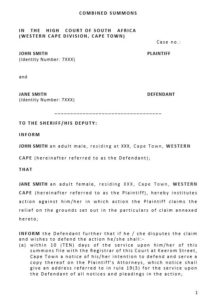
Divorce Process Summons - Divorce Lawyer
Example of a Divorce Summons

https://www.ourlawyer.co.za/wp-content/uploads/Divorce-Summons-Divorce-Lawyer-Process-217×300.jpg

Divorce Particulars of Claim

Once you have your summons and particulars of claim in order, you have to have the summons issued. To do this, make three (3) copies of your set of documents (Summons and Particulars of Claim) and have it issued at court.
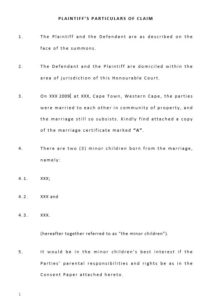
Divorce Process - Divorce Atorney
Example of A Particulars of Claim in a Divorce Action

Issuing and Service of Divorce Summons and Particulars of Claim

advice-child-maintenance-child-custody-divorceOnce you are at the court, go to the clerk/registrar of the court and have your documents issued. The clerk/registrar will sign the summons and provide a case number by writing it on the summons.
You should then take the original and a copy (both must be signed and stamped by the clerk/registrar of the court) and take it to the sheriff which serves documents where your spouse work, of lives. You can ask the clerk/registrar of the court for that details.
The extra—copy of the summons and particulars of claim you keep for your file and records.

Notice of intention to defend

Once the sheriff served the documents, your spouse has two weeks to inform you of whether he or she shall be defending the divorce. This information is outlined in the summons. If your spouse decided not to defend the divorce action, then after a period of two weeks has elapsed, you may set the matter down as an undefended divorce. If your spouse intends to defend the divorce, he or she would then have to file the notice of intention to defend. In this notice, you would advise the Court and the Plaintiff that you are defending the divorce, and also, provide a service address. The Service Address is the address at which the Plaintiff would send notices in the court case to you. Below, kindly find an example of a Notice of Intention to Defend.
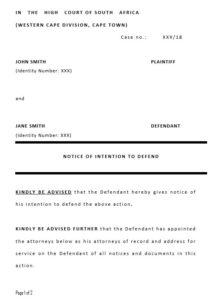
Divorce Lawyer Cape Town
Notice of Intention to Defend

Divorce Plea to particulars of claim

Once you received notice of your spouse’s intention to defend the divorce, about a month later, your spouse or his or attorney should serve and file a plea. The plea should outline which parts of your particulars of claim your spouse agrees (or disagree) with which would give a direction of what to prove at court.

Purchase our Unopposed Divorce Package, click here.
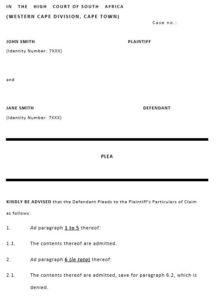
Plea - Divorce Process - Lawyer
Plea in a Divorce Action


Plea in a Divorce Action

Divorce Counterclaim or Claim in Reconvention

Your spouse might want to file a counterclaim or claim in reconvention. In the same way which you outlined your case as to what you want from the court and the reasons therefore in your particulars of claim; your spouse can file on you a counterclaim. A counterclaim might still be filed if your spouse agrees to a divorce, but maybe wants primary care of the children, but in your particulars of claim, you asked for primary care. You should then within 10 (ten) days plead to the counterclaim in the same manner which your spouse pleaded to your particulars of claim

Divorce Counter Claim - Divorce Process
Divorce Counter Claim


advice-child-maintenance-child-custody-divorceDiscovery

When you present evidence at Court, you want to be fully prepared. Therefore, all documents your spouse will be making use of at Court should be presented to you beforehand. And you should do the same. This is where discovery comes into play. You may ask or may be asked to provide under oath a schedule of books and documents in your possession and under your control relating to the divorce. This could be policy documents, deeds etc, and which you or your spouse might want to make use of at trial. Once you received the schedules you may inspect and request copies of the documents.

Divorce Lawyer - Process
Request for Discover Notice


Divorce Lawyer - Process
Discovery Notice

Discovery Affidavit

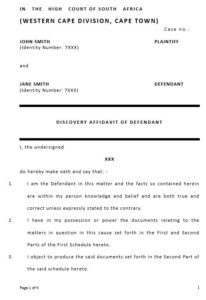
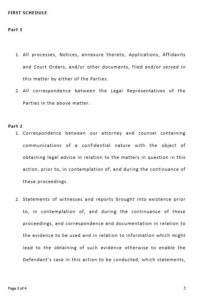
After receiving a notice requesting a spouse to discover, an affidavit should be provided.

The wording of the Affidavit can be seen in the pictures below.

Divorce Law - Process
Example of a Discovery Affidavit

Divorce Process - Lawyer
Discovery Affidavit

Divorce Lawyer
Discovery Affidavit

Obtaining a Trial date for the Divorce

Once you received the plea, with or without a counterclaim, or have pleaded to your spouse’s counterclaim, and discovery is done, one should then approach the clerk/registrar of the court for a trial date. This you or your spouse may do. This process is a bit complicated, so it’s best to do it with the guidance of a lawyer or the clerk/registrar of the court.

Purchase our Unopposed Divorce Package, click here.

Pr-Trial Procedure

Before a date gets allocated to you for the divorce, the Court would want to ensure that your matter is trial ready. What this basically means, is that all that needs to be done, has been attended to and the trial will run. Many months are spent waiting for a court date, and it would be unfair to the court if a judge and other litigants are appointed to a matter, and the matter does not proceed. A judge will meet with the parties in chambers, and once the matter is trial ready, he or she will endorse the file in that regard.

Divorce day / Trial / Unopposed hearing date

If your spouse does not defend the divorce within the time period, go back to court and ask for an unopposed divorce date and attend to your divorce on that date. If, however, your divorce is defended, a trial should ensure. During the trial, each party should prove his or her case. Witnesses should be called and at the end, the Magistrate or Judge shall deliver the verdict.
Best of luck, and please, don’t take my word, contact a legal practitioner should you decide to get divorced.

Advocate Muhammad Abduroaf

advice-child-maintenance-child-custody-divorce

Divorce Lawyer and Process

Related Post

Family Law Service – Advocate Muhammad Abduroaf – Finding the best lawyer for you.

Appeals and Reviews Advocate Muhammad Abduroaf South Africa Best Choosing the right law firm (Attorney or Advocate) can be a daunting task in the intricate landscape of legal matters. Whether you’re facing a complex litigation case, navigating corporate law, or seeking legal assistance for personal issues, the decision of which law firm to engage is crucial. At the firm Advocate Muhammad Abduroaf, we understand the significance of this decision, and we aim to demonstrate why choosing our firm can make all the difference.

Expertise and Specialisation

One of the primary reasons for choosing our law firm is our expertise and specialisation in diverse legal areas. As you can see from this website, Advocate Muhammad Abduroaf practices in various fields of law. This breadth of expertise ensures that no matter the nature of your legal issue, you will have access to knowledgeable and experienced professionals who can provide tailored solutions.

Personalised Approach

We recognise that every client and every case is unique. That’s why we prioritise a personalised approach to legal representation. From the moment you engage our services, we take the time to understand your specific needs, concerns, and objectives. This allows us to develop strategies and solutions customised to your circumstances, ensuring the best possible outcome for your case.

Commitment to Excellence

At Advocate Muhammad Abduroaf, excellence is not just a goal – it’s our standard. We are committed to providing our clients with the highest quality legal services, characterized by thorough research, meticulous attention to detail, and strategic thinking. Our track record of success speaks for itself, with numerous satisfied clients who have benefited from our dedication to excellence.

Responsive and Accessible

Legal matters can be stressful and overwhelming, so we prioritise responsiveness and accessibility. Our team is readily available to address your questions, concerns, and needs throughout your case. Whether you prefer to communicate via phone, WhatsApp, email, or in-person meetings, we are here to provide you with the support and guidance you need when you need it.

Cost-Effective Solutions

Legal representation shouldn’t break the bank. That’s why we are committed to providing cost-effective solutions that deliver value for our clients. We offer transparent billing practices and strive to minimise unnecessary expenses wherever possible, ensuring you receive top-notch legal services without the hefty price tag.

Ethical and Professional Conduct

Integrity and ethics are at the core of everything we do. Our team adheres to the highest standards of professional conduct, ensuring your case is handled with the utmost integrity, honesty, and discretion. You can trust that your legal matters will be handled with care and respect, and your confidentiality will always be protected. In conclusion, choosing the right law firm can significantly impact the outcome of your legal matters. At Advocate Muhammad Abduroaf, we offer expertise, specialisation, personalised service, commitment to excellence, responsiveness, cost-effective solutions, and ethical conduct. These qualities set us apart and make us the ideal choice for clients seeking top-notch legal representation. Contact us today to learn how we can assist you with your legal needs. If you require an Advocate Law Firm to assist you in your legal matter, feel free to contact us using the following details:
    • Tel.: 021 111 0090
    • Email.: [email protected]

The Firm: Advocate Muhammad Abduroaf

Trust Account Advocate. Advocate Muhammad Abduroaf is a registered firm with the Legal Practice Council of South Africa. It holds offices in Cape Town. However represents clients all over South Africa. If required, he would travel out to your province to attend to you matter. Advocate Muhammad Abduroaf is a Trust Account practice, which means it may take instructions directly from members of the public. This is compared to referral advocates who may not take instructions directly from members of the public. Advocate Muhammad Abduroaf’s practice allows clients to deposit money into their Trust Account. To do so, it needs to hold a valid fidelity fund certificate, which it does. Advocate Muhammad Abduroaf may appear on its client’s behalf in all courts in the Republic of South Africa. These include the Constitutional Court, the Supreme Court of Appeal, all High Court and magistrates courts in all provinces in South Africa. The services you may instruct the firm of Advocate Muhammad Abduroaf to represent you in are as follows:

High Court matters

  • Civil claim surrounding money;
  • Interdicts;
  • Divorces (Opposed and unopposed);
  • Child Custody and guardianship disputes;
  • Relocation of minor children;
  • Various criminal matters;
  • Minor children surname changes;
  • Appeals and Reviews; and
  • Other matters.

Magistrates Court matters

  • Civil claim surrounding money;
  • Various criminal matters;
  • Interdicts;
  • Maintenance Court matters;
  • Divorces Court matters (Opposed and unopposed)’
  • Children’s Court matter; and
  • Other matters.

Constitutional Court

  • Appeals

Supreme Court of Appeal

  • Appeals and Reviews

Consult with, or Instruct Advocate Muhammad Abduroaf

If you would like to have a legal advice consultation with Advocate Muhammad Abduroaf, feel free to use the Our Lawyer online appointment form by clicking 
here. Should you already have consulted with Advocate Muhammad Abduroaf and wish to mandate and instruct the firm, kindly proceed with completing the mandate form using this mandate link. We service clients throughout South Africa. These include: Cape Town Rustenburg Kimberley East London Nelspruit Polokwane Pietermaritzburg Bloemfontein Port Elizabeth Pretoria Durban Johannesburg

Advocate Muhammad Abduroaf – Advocate of the High Court of South Africa

Advocate Muhammad Abduroaf is an advocate of the High Court of South Africa. He has the right of appearance in any Court in South Africa. Other than representing clients in Court in legal matters, he also advises them. Read further to find out more about this exceptional legal eagle. [caption id="attachment_7082" align="alignleft" width="188"]Advocate of the High Court of South Africa Legal Cape Town Advocate Muhammad Abduroaf[/caption]

Early success

Having completed his Masters in Law Degree (LL.M) in 2003, advocate Abduroaf was the same year admitted as an advocate of the High Court of South Africa. In the same year, he further successfully represented his client in the Western Cape High Court, where history was made. This was the case of Petersen v Maintenance Officer Simon’s Town Maintenance Court and Others 2004 2 SA 56 (C) 38. Because of this important case, it is now possible to claim maintenance from paternal grandparents of children born out of wedlock. This was not possible for over 80 years. If it was not for his tenacity and belief in law, his client wouldn’t receive the much-needed child support.

Advocate Abduroaf keeping the momentum

A year later, the young advocate Abduroaf, again made legal history. This was in the case of Soller v Maintenance Magistrate, Wynberg and Others 2006 2 SA 66 (C) 2006 446. In this case, the Western Cape High Court confirmed the extensive powers of the Maintenance Court, which includes interdicting pension funds. A mother struggling to obtain maintenance has an additional option because of this case. Because of the latter two cases, family law has developed constitutionally to the benefit of many.

Advocate Abduroaf’s practices for over 20 (years) years

For over 20 (twenty) years, advocate Abduroaf represented his clients in countless legal matters. These ranged from businesses, commercial, family, to criminal matters. Don’t forget about employment and delictual matters. Advocate Abduroaf fearlessly represented his clients and keeps that work ethic up until this day. You would further find a range of legal articles on the internet written by the advocate. Go ahead and do a simple search.

Attorney Referrals and Direct briefing

Advocate Abduroaf is a Trust Account Advocate. Therefore, he can take on work from attorneys or directly from members of the public. If you want to instruct him, feel free to do so.

Contact Advocate Muhammad Abduroaf

If you wish to contact Advocate Muhammad Abduroaf, feel free to call 0211110090. Follow this link to read more about the
advocate.

Articles

View some of the articles written by Advocate Muhammad Abduroaf by clicking on the links:

Child Maintenance

  1. How to Apply for Child Maintenance at Court – Step by Step Guide and Advice
  2. Child Maintenance Question. How much should I pay or contribute as a parent?
  3. Child Support or maintenance claims. Does an unemployed father pay?
  4. Non-compliance with Maintenance Orders — Civil and Criminal Remedies
  5. Tricks and tips on how to win your child maintenance case

Child Custody

  1. The Law Regarding Children – The Children’s Act 38 of 2005
  2. Child born out of wedlock: Mother will not consent to her surname change and to be registered as her biological father. What can I do?
  3. How do I get full custody over my child?
  4. Parental Child Abuse in Custody Cases
  5. Relocate with minor child. Parent Refusing Consent for a Passport
  6. Father being refused contact to his child! What are his rights as a Father?
  7. Father’s Parental Responsibilities and Rights to his Child
  8. Urgent Access to your Children without a Lawyer
  9. Parenting Plans and the Law
  10. What happens in a custody dispute where one parent is mentally ill?
  11. How to win your child custody and access court case – Tips and Tricks
  12. Rights of care, contact and guardianship of grandparents to their grandchildren – What does the law say?

Divorce & Property

  1. How to Change your Matrimonial Property Regime
  2. Do your own Unopposed Divorce. No lawyers needed and its Free.
  3. Parental Rights of Divorced Muslim parents after a Talaq or Faskh
  4. Free Online Divorce Assistance Form – DIY Cape Town South Africa comprising of:

Domestic Violence

  1. I’m in a physically and emotionally abusive relationship. Help from Abuse.
  2. How to make a Domestic Violence Application
 

Do you require a video legal advice consultation?

Click here and schedule one today!