Top tips from a Senior Family Law Advocate on how to deal with your Child Custody matter in the Springs Children’s Court


Family law legal matters can be very stressful. This is so whether you live in Springs or any other city in South Africa. Especially so if you have no idea how the legal processes work. It is one thing to know that you are entitled to child support, but it is a totally different matter to know the law and procedure on how to claim child support. Luckily in child maintenance matters, the maintenance court is there to assist you in completing the application form. However, many times that is not enough. Especially so if the other parent has a lawyer and knows how to present the case for his or her client.

This article, however, deals with some top tips in care and contact or custody matters in the Children’s Court in Springs. It would explain the processes involved and advise on how to be best prepared for your matter. This advice is applicable whether you live in Springs or any other city in South Africa.

What to do before visiting the Springs Children’s Court

Before you approach the Children’s Court in Springs, first try to resolve the issues with the other parent. Therefore, if you want more contact with your child and the other parent is refusing, try to resolve the matter first with that parent. If that does not work, try mediation. The mediator can be anyone, from a trusted mutual friend, priest, or other religious leaders, or a professional like an attorney, psychologist, or the office of the Family Advocate. Springs has many professionals that can assist you in this regard. If resolving the matter by yourselves is not possible, or mediation fails, then we suggest you approach the Springs Children’s Court for assistance.

TIP: Focus on getting someone neutral to assist in mediating your matter. Organisations like FAMSA and FAMAC can be of assistance. Google them.

Approaching the Springs Children’s Court

The Springs Children’s Court should be approached if it is the closest Children’s Court to you. You need to verify with the Springs Children’s Court that you fall under their area of jurisdiction. If not, they would direct you to which Children’s Court is applicable to you.

Once you arrive at the Springs Children’s Court, they will provide you with a form headed “Bringing Matter to Court in Terms of Section 53 Children’s Act, 2005 (Act no. 38 of 2005) Regulation Relating to Children’s Court and International Child Abduction, 2008 [Regulation 6]. This form is also called Form 2.

In this form, you will provide all your particulars and that of the child or children and the other parent. The sections in the form are as follows:

  • PART A: PARTICULARS OF CHILD(REN)
  • PART B: PARTICULARS OF *CHILD WHO IS AFFECTED BY OR INVOLVED IN THE MATTER/PERSON *ACTING IN THE INTEREST OF THE CHILD/*ON BEHALF OF THE CHILD WHO CANNOT ACT IN HIS/HER OWN NAME/ *MEMBER OF A GROUP OF CLASS OF CHILDREN/*IN THE PUBLIC INTEREST (SECTION 53(2)
  • PART C: PARTICULARS OF PERSONS HAVING AN INTEREST IN THE MATTER
  • PART D: PARTICULARS OF MATTER

In part D, the following is stated which you need to provide in the form:

  • Nature of matter brought to Court: (Please give full details of the matter e.g., registration/amendment of parenting plans, removal of child to safe care, children in need of care and protection, placement in youth care centers, adoption etc.
  • Documents: Are there any documents relating to the matter? (If so please attach)

Once you have completed the form and attached the relevant documents to it, you must take it to a commissioner of Oaths to have it commissioned. It does not have to be in Springs.

TIP: Draft a separate affidavit explaining your case. Outline some background information and reasons why the Court should give you what you request. Attach it to Form 2.

Processing your Application at the Springs Children’s Court

Once you complete the Form A and submit it to the Clerk of the Springs Children’s Court, they will process it and allocate it a case number or reference number. The Clerk of the Court would then allocate a date to the matter and advise the parties accordingly when the court date is. Please note that some courts follow a different process for processing the application and informing the parties of the court date. Please enquire from the Court when making the application what process they follow.

TIP: Obtain the contact details of the Court for you to contact them to obtain the Court date or other information. Ask for their contact number and email address.

Appearing in the Springs Children’s Court

When notified of the Court date, both you and the other parent should attend. If you are making use of a lawyer (Advocate or Attorney), inform them timeously of the date. Depending on the Court, you may first see the Clerk or go directly to the Magistrate. The Children’s Court would do its best to try to resolve the matter. If the parents cannot come to an agreement, the Children’s Court may postpone the matter for either of the following:

  • Get a social worker involved in the matter;
  • Appoint a legal representative for the minor child;
  • Implement interim care and contact arrangements;
  • Having the parties attempt to agree on a parenting plan;
  •  

In serious matters, the Court may remove the minor child from both parents and place the child in foster care. The powers of the Children’s Court are extensive. It will, however, focus on what is in the child’s best interests.

TIP: Be as vocal as possible. Do not expect the Court to be understanding of your case or be on your side. It is your duty to explain your case and provide the Court with all the relevant information they require for them to make a fair decision.

Finalising the matter in the Springs Children’s Court

Once the Springs Children’s Court has enough information to make a final decision, it will do so. Depending on the facts of the matter, that could either be making a Parenting Plan, an Order of the Court or a final care and contact Order. The Court may even make further interim orders, where the parties are to return to Court after a few months, or a year later.

TIP: Do not agree to something just because the social worker, a lawyer, or the Court suggest it. You need to be happy with what is decided.

The above Springs Children’s Court Application tips should apply to the following provinces and cities:

Eastern Cape:

Alice, Butterworth, East London, Graaff-Reinet, Grahamstown, King William’s Town, Mthatha

Port Elizabeth, Queenstown, Uitenhage, Zwelitsha

Free State:

Bethlehem. Bloemfontein, Jagersfontein, Kroonstad, Odendaalsrus, Parys, Phuthaditjhaba, Sasolburg, Virginia, Welkom

Gauteng:

Benoni, Boksburg, Brakpan, Carletonville, Germiston, Johannesburg, Krugersdorp, Pretoria, Randburg, Randfontein, Roodepoort, Soweto, Springs, Vanderbijlpark, Vereeniging

KwaZulu-Natal:

Durban, Empangeni, Ladysmith, Newcastle, Pietermaritzburg, Pinetown, Ulundi, Umlazi

Limpopo:

Giyani, Lebowakgomo, Musina, Phalaborwa, Polokwane, Seshego, Sibasa, Thabazimbi

Mpumalanga:

Emalahleni, Nelspruit, Secunda, North West, Klerksdorp, Mahikeng, Mmabatho, Potchefstroom, Rustenburg, Northern Cape, Kimberley, Kuruman, Port Nolloth

Western Cape:

Bellville, Springs, Constantia, George, Hopefield, Oudtshoorn, Paarl, Simon’s Town, Stellenbosch, Swellendam, Worcester
Top tips from a Senior Family Law Advocate on how to deal with your Child Custody matter in the Springs Children’s Court


Family law legal matters can be very stressful. This is so whether you live in Springs or any other city in South Africa. Especially so if you have no idea how the legal processes work. It is one thing to know that you are entitled to child support, but it is a totally different matter to know the law and procedure on how to claim child support. Luckily in child maintenance matters, the maintenance court is there to assist you in completing the application form. However, many times that is not enough. Especially so if the other parent has a lawyer and knows how to present the case for his or her client.

This article, however, deals with some top tips in care and contact or custody matters in the Children’s Court in Springs. It would explain the processes involved and advise on how to be best prepared for your matter. This advice is applicable whether you live in Springs or any other city in South Africa.

What to do before visiting the Springs Children’s Court

Before you approach the Children’s Court in Springs, first try to resolve the issues with the other parent. Therefore, if you want more contact with your child and the other parent is refusing, try to resolve the matter first with that parent. If that does not work, try mediation. The mediator can be anyone, from a trusted mutual friend, priest, or other religious leaders, or a professional like an attorney, psychologist, or the office of the Family Advocate. Springs has many professionals that can assist you in this regard. If resolving the matter by yourselves is not possible, or mediation fails, then we suggest you approach the Springs Children’s Court for assistance.

TIP: Focus on getting someone neutral to assist in mediating your matter. Organisations like FAMSA and FAMAC can be of assistance. Google them.

Approaching the Springs Children’s Court

The Springs Children’s Court should be approached if it is the closest Children’s Court to you. You need to verify with the Springs Children’s Court that you fall under their area of jurisdiction. If not, they would direct you to which Children’s Court is applicable to you.

Once you arrive at the Springs Children’s Court, they will provide you with a form headed “Bringing Matter to Court in Terms of Section 53 Children’s Act, 2005 (Act no. 38 of 2005) Regulation Relating to Children’s Court and International Child Abduction, 2008 [Regulation 6]. This form is also called Form 2.

In this form, you will provide all your particulars and that of the child or children and the other parent. The sections in the form are as follows:

  • PART A: PARTICULARS OF CHILD(REN)
  • PART B: PARTICULARS OF *CHILD WHO IS AFFECTED BY OR INVOLVED IN THE MATTER/PERSON *ACTING IN THE INTEREST OF THE CHILD/*ON BEHALF OF THE CHILD WHO CANNOT ACT IN HIS/HER OWN NAME/ *MEMBER OF A GROUP OF CLASS OF CHILDREN/*IN THE PUBLIC INTEREST (SECTION 53(2)
  • PART C: PARTICULARS OF PERSONS HAVING AN INTEREST IN THE MATTER
  • PART D: PARTICULARS OF MATTER

In part D, the following is stated which you need to provide in the form:

  • Nature of matter brought to Court: (Please give full details of the matter e.g., registration/amendment of parenting plans, removal of child to safe care, children in need of care and protection, placement in youth care centers, adoption etc.
  • Documents: Are there any documents relating to the matter? (If so please attach)

Once you have completed the form and attached the relevant documents to it, you must take it to a commissioner of Oaths to have it commissioned. It does not have to be in Springs.

TIP: Draft a separate affidavit explaining your case. Outline some background information and reasons why the Court should give you what you request. Attach it to Form 2.

Processing your Application at the Springs Children’s Court

Once you complete the Form A and submit it to the Clerk of the Springs Children’s Court, they will process it and allocate it a case number or reference number. The Clerk of the Court would then allocate a date to the matter and advise the parties accordingly when the court date is. Please note that some courts follow a different process for processing the application and informing the parties of the court date. Please enquire from the Court when making the application what process they follow.

TIP: Obtain the contact details of the Court for you to contact them to obtain the Court date or other information. Ask for their contact number and email address.

Appearing in the Springs Children’s Court

When notified of the Court date, both you and the other parent should attend. If you are making use of a lawyer (Advocate or Attorney), inform them timeously of the date. Depending on the Court, you may first see the Clerk or go directly to the Magistrate. The Children’s Court would do its best to try to resolve the matter. If the parents cannot come to an agreement, the Children’s Court may postpone the matter for either of the following:

  • Get a social worker involved in the matter;
  • Appoint a legal representative for the minor child;
  • Implement interim care and contact arrangements;
  • Having the parties attempt to agree on a parenting plan;
  •  

In serious matters, the Court may remove the minor child from both parents and place the child in foster care. The powers of the Children’s Court are extensive. It will, however, focus on what is in the child’s best interests.

TIP: Be as vocal as possible. Do not expect the Court to be understanding of your case or be on your side. It is your duty to explain your case and provide the Court with all the relevant information they require for them to make a fair decision.

Finalising the matter in the Springs Children’s Court

Once the Springs Children’s Court has enough information to make a final decision, it will do so. Depending on the facts of the matter, that could either be making a Parenting Plan, an Order of the Court or a final care and contact Order. The Court may even make further interim orders, where the parties are to return to Court after a few months, or a year later.

TIP: Do not agree to something just because the social worker, a lawyer, or the Court suggest it. You need to be happy with what is decided.

The above Springs Children’s Court Application tips should apply to the following provinces and cities:

Eastern Cape:

Alice, Butterworth, East London, Graaff-Reinet, Grahamstown, King William’s Town, Mthatha

Port Elizabeth, Queenstown, Uitenhage, Zwelitsha

Free State:

Bethlehem. Bloemfontein, Jagersfontein, Kroonstad, Odendaalsrus, Parys, Phuthaditjhaba, Sasolburg, Virginia, Welkom

Gauteng:

Benoni, Boksburg, Brakpan, Carletonville, Germiston, Johannesburg, Krugersdorp, Pretoria, Randburg, Randfontein, Roodepoort, Soweto, Springs, Vanderbijlpark, Vereeniging

KwaZulu-Natal:

Durban, Empangeni, Ladysmith, Newcastle, Pietermaritzburg, Pinetown, Ulundi, Umlazi

Limpopo:

Giyani, Lebowakgomo, Musina, Phalaborwa, Polokwane, Seshego, Sibasa, Thabazimbi

Mpumalanga:

Emalahleni, Nelspruit, Secunda, North West, Klerksdorp, Mahikeng, Mmabatho, Potchefstroom, Rustenburg, Northern Cape, Kimberley, Kuruman, Port Nolloth

Western Cape:

Bellville, Springs, Constantia, George, Hopefield, Oudtshoorn, Paarl, Simon’s Town, Stellenbosch, Swellendam, Worcester

Related Post

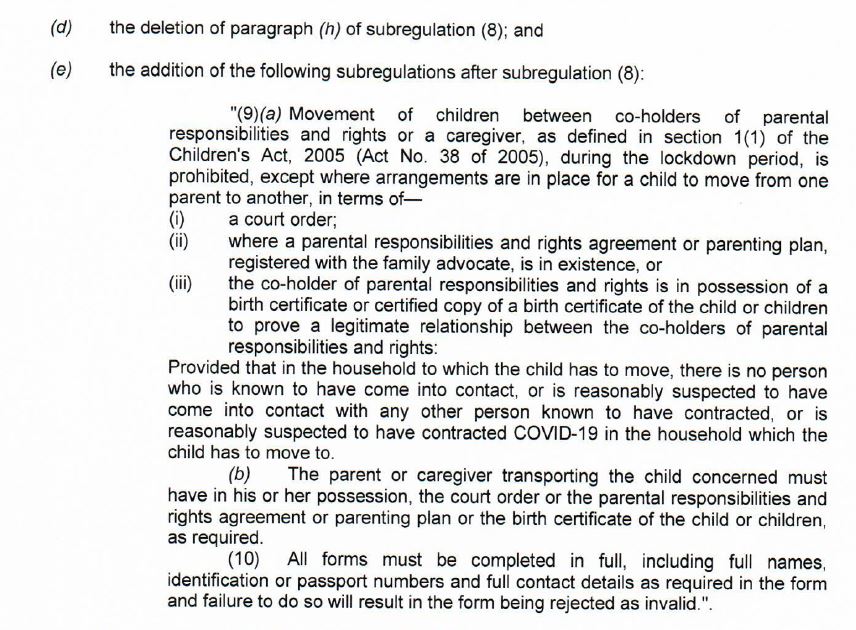
Latest regulations regarding the movement of children between co-holders of parental responsibilities and rights or a caregiver. Essentially, all children can move, with specific requirements to be in place – 16 April 2020

On 16 April 2020, the Minister of Cooperative Governance and Traditional Affairs Dr Nkosazana Dlamini Zuma made changes to the regulations regarding the movement of children during the lockdown.

The material change is that you do not have to have a court order or a parental responsibilities and rights agreement or parenting plan, registered with the family advocate. Possession of a birth certificate or certified copy of a birth certificate is now also allowed.

In summary, the new regulations published today applies as follows:
  1. The movement of children should be between co-holders of parental responsibilities and rights or a caregiver;
  2. The following must be in existence:
    • A court order;
    • a parental responsibilities and rights agreement or parenting plan, registered with the family advocate, or
  3. the co-holder of parental responsibilities and rights is in possession of a birth certificate or certified copy of a birth certificate of the child or children. This is required to prove a legitimate relationship between the co-holders of parental responsibilities and rights;
  4. In the household to which the child is to move, there is no person who is known to have come into contact with, or is reasonably suspected to have come into contact with, a person known to have contracted, or reasonably suspected to have contracted, COVID-19;
  5. The parent or caregiver transporting the child concerned must have in his or her possession, the court order or the parental responsibilities and rights agreement or a parenting plan or the birth certificate of the child or children, as required.
  6. All forms must be completed in full, including full names, identification or passport numbers and full contact details as required in the form and failure to do so will result in the form being rejected as invalid.
 

The relevant regulations are copied below:

  [caption id="attachment_9046" align="alignleft" width="856"]regulations-movement-children-16-April-lockdown regulations-movement-children-16-April-lockdown[/caption]  

Dear Advocate Abduroaf. My child custody case is very complicated. How do I find the best child custody lawyer, attorney or advocate for my case in Port Elizabeth?

A great child custody lawyer (attorney or advocate) is a legal practitioner who specializes in family law and has expertise in handling cases related to child custody and visitation rights. Family law matters can be very emotionally challenging for both parents. The same applies to the child concerned. Whether you live in Cape Town or in Port Elizabeth, the law applicable would be the same throughout South Africa.

Here are some qualities and characteristics that can define a great child custody lawyer, or the best one for your case:

Experience and Expertise:

  • Specialization in family law, particularly child custody cases.
  • Proven track record of successfully handling similar cases.

Knowledge of Family Law:

  • In-depth understanding of family law.
  • Awareness of recent legal developments and changes in family law.

Communication Skills:

  • Effective communication skills to clearly articulate your case in court.
  • Ability to negotiate and mediate to reach favourable settlements.

Compassion and Empathy:

  • Understanding and empathy towards the emotional challenges involved in child custody disputes.
  • Ability to provide emotional support to clients during a difficult time.

Strategic Thinking:

  • Ability to devise a strategic legal approach tailored to the unique aspects of your case.
  • Forethought and anticipation of potential challenges.

Availability and Responsiveness:

  • Prompt responses to client inquiries and concerns.
  • Availability for meetings, court appearances, and consultations.

Client Reviews and References:

  • Positive reviews from previous clients.
  • Recommendations from colleagues or other legal professionals.

Ethical Conduct:

  • Adherence to professional and ethical standards.
  • Transparent and fair billing practices.

Courtroom Experience:

  • Comfort and confidence in a courtroom setting.
  • Skillful presentation of arguments and evidence.

Resourcefulness:

  • Resourcefulness in finding legal precedents and utilizing available resources to strengthen the case.

Problem-Solving Skills:

  • Creative problem-solving skills to navigate complex family dynamics and legal issues.

Custody and Visitation Knowledge:

  • In-depth knowledge of various custody arrangements and visitation schedules.
  • Ability to advocate for the best interests of the child.

What should you consider when meeting with a family law attorney or advocate?

When looking for a great child custody lawyer, it’s essential to schedule consultations, discuss your case, and assess whether the lawyer, attorney, or advocate possesses the qualities and skills that align with your needs and goals. Additionally, consider seeking recommendations from trusted friends, family members, or other legal professionals. Finding the best child custody lawyer involves thorough research, careful consideration of your specific needs, and evaluation of the lawyer’s qualifications. Here are some steps you can take to find the right child custody lawyer for your situation:

Define Your Goals and Needs:

  • Clearly identify your goals and priorities in the child custody case.
  • Determine the specific services you need from a lawyer, such as legal representation, mediation, or collaborative law.

Research Local Family Law Attorneys:

  • Use online legal directories and referral services to identify family law attorneys or Trust Account Advocate in your area.
  • Seek recommendations from friends, family, or colleagues who have gone through similar situations.

Check Credentials and Specialization:

  • Look for lawyers who specialize in family law and, more specifically, child custody cases.
  • Check their credentials, education, and any certifications related to family law.

Read Reviews and Testimonials:

  • Read online reviews on legal review websites, social media, or the lawyer’s own website.
  • Consider testimonials from previous clients to gauge the lawyer’s reputation and success rate.

Consult with Multiple Lawyers:

  • Schedule consultations with several child custody lawyers to discuss your case.
  • Prepare a list of questions to ask during the consultation, covering topics such as experience, approach to cases, and expected outcomes.

Evaluate Communication Skills:

  • Assess the lawyer’s communication style and whether you feel comfortable discussing your case with them.
  • Ensure that the lawyer listens actively and provides clear explanations of legal processes.

Consider Experience:

  • Inquire about the lawyer’s experience in handling child custody cases similar to yours.
  • Ask about their success rate and outcomes in past cases.

Review Legal Fees:

  • Discuss the lawyer’s fee structure during the consultation.
  • Clarify billing practices, retainer fees, and any additional costs associated with your case.

Check Disciplinary Records:

  • Verify the lawyer’s standing with the Legal Practice Council of South Africa.
  • Check for any disciplinary actions or complaints against the lawyer.

Seek Second Opinions:

  • If you have initial concerns or uncertainties, consider seeking a second opinion from another attorney or advocate.
  • Compare advice and recommendations from multiple sources.

Trust Your Instincts:

  • Pay attention to your instincts and gut feelings about the lawyer.
  • Choose a lawyer you feel comfortable working with and who understands your unique situation.

Negotiation and Mediation Skills:

Assess the lawyer’s ability to negotiate and mediate, especially if you prefer an amicable resolution.
  • Remember that finding the best child custody lawyer is a personalized process, and the right fit for one person may not be the best for another. Take the time to thoroughly research and evaluate potential lawyers to make an informed decision based on your specific needs and circumstances.
We service clients in all cities: Cape Town Rustenburg Kimberley East London Nelspruit Polokwane Pietermaritzburg Bloemfontein Port Elizabeth Pretoria Durban Johannesburg

Worldwide Law & Legal Directory

Dear Private Legal – PTYLtd.,

We trust this message finds you well, and are writing to you regarding your existing directory listing:

Private Legal – PTYLtd.

At LawFirms1, we are continually striving to provide you with valuable tools to enhance your online presence and competitiveness. Today, we are excited to introduce a powerful new feature that can significantly impact your digital strategy – Competitor Social Media Monitoring.

What is Competitor Social Media Monitoring?

Competitor Social Media Monitoring is a cutting-edge tool that allows you to track and analyse the social media activities of your competitors directly from your Inbox. With this feature, you can gain real-time insights into your competitors’ social media strategies, content performance, engagement metrics, and much more.

A few examples of the ones you can monitor:

African Legal Information Institute
SD Law South Africa
SchoemanLaw Inc
Erasmus Ranchod & Associates
Straughan Inc.
Marlon Shevelew and Associates Inc – Attorneys, Notaries and Conveyancers
Abrahams and Gross Attorneys
Our Lawyer (Legal Services | Referrals | Attorney | Advocate)
Adriaans Attorneys
Maurice Phillips | Wisenberg

Benefits of Competitor Social Media Monitoring:

Strategic Insights: Understand what types of content and strategies are resonating with your competitors’ audiences, helping you fine-tune your own social media approach.

Stay Ahead: Get a competitive edge by staying informed about your rivals’ latest promotions, campaigns, and announcements. This knowledge can help you respond proactively and adapt your strategies accordingly.

Identify Trends: Discover emerging industry trends and best practices by analyzing what’s working for your competitors. Use this information to align your content with current market demands.

Benchmark Performance: Compare your social media metrics against those of your competitors. Identify areas where you excel and areas where you can improve to outperform the competition.

Enhanced Engagement: Engage with your competitors’ audiences strategically by participating in relevant conversations and discussions, expanding your reach, and potentially attracting new customers.

How to get started:

Getting started with Competitor Social Media Monitoring is easy. First click here to log in to your LawFirms1 account. From there, add your competitors’ listings pages and start tracking their activities.

We believe that this feature can be a game-changer for your business, providing you with the data-driven insights needed to refine your social media strategy and maintain a competitive edge in your industry.

Don’t miss out on this opportunity to gain a deeper understanding of your competition and enhance your online presence. Sign up for Competitor Social Media Monitoring today and take your digital strategy to the next level.


Thank you for being a valued member of LawFirms1. We look forward to seeing the positive impact this feature can have on your business.

Best regards,

The LawFirms1 Team

LawFirms1 2024
Our mailing address is:
[email protected]

Unsubscribe

Do you require a video legal advice consultation?

Click here and schedule one today!